Last of the Monster Kids

Last of the Monster Kids
"LAST OF THE MONSTER KIDS" - Available Now on the Amazon Kindle Marketplace!
Showing posts with label the howling. Show all posts

Monday, April 29, 2019

RECENT WATCHES: The Howling: Reborn (2011)


“Howling III” featured a self-aware joke. The female lead got a job acting in a werewolf movie called “Shapeshifters Part 8,” Phillipe Mora correctly guessing that more “Howling' sequels would follow his. After “New Moon Rising” baffled all who saw it, and the direct-to-video horror market starting to favor cheaper kinds of monsters, “The Howling” series appeared to be truly over for sixteen years. That's when some producers realized they had to fulfill the prophecy and create an eighth entry in the long-sleeping werewolf series. “The Howling: Reborn” would tear its way onto DVD shelves in 2011. After over a decade of hibernation, did the “Howling” franchise show any appreciable improvement?

“Reborn” claims to be adapted from Gray Brandner's second “Howling” novel but, in the proud tradition of this series, has nothing to do with any of the previous “Howling” movies. This film focuses in on Will Kidman, a teenager about to graduate high school, whose mother mysteriously disappeared after he was born. Will is bullied at school, has few friends, and is ignored by the girl he likes. Yet fate tosses him and Eliana together anyway. While at a party, he's pursued by a hairy beast. His dad is seduced by a strange woman. Weird shirtless dudes start to hassle Will at school. It turns out he's being chased by werewolves, including his absent mom, on account of being a lycanthrope himself. Will and Eliana are trapped in the school after hours and must fight against the creatures to survive.

The “Howling” series was not revived in the early 2010s because someone thought the world was nostalgic for all those shitty sequels. No, it's very clear what trend “Howling: Reborn” was hoping to capitalize on. It's a film focused on high schoolers, specifically a disaffected teen who suddenly discovers he's special. His romance with Eliana occupies a lot of the film, including a ridiculous scene where she offers to take his virginity in the middle of being chased by monsters. As if the connection couldn't be more obvious, his evil mom's werewolf minions are hunky dudes who never wear shirts. “Howling: Reborn” was clearly hoping to ride the coattails of “Twilight,” with a little “Harry Potter” thrown in too. (Will even wears similarly nerdy glasses.) Because the audience for Y.A. fiction and cheap eighties werewolf movies clearly has a lot of overlap.

In its own way, “Reborn” is just as cheap and ugly as the worst of the eighties “Howling” sequels. The film attempts to replicate the visual palette of “Twilight' as well. So all the scenario has a washed-out and gray color to it. There's a number of very unimpressive slow motion shots, usually to emphasize the underwhelming power of the werewolf. Most embarrassingly, an incredibly obvious dummy is even tossed down a staircase in one scene. The film's emulation of “Twilight” and its disciples extends to the soundtrack, which is full of groan-worthy covers of established pop/rock hits. An dreary, acoustic version of “Don't Fear the Reaper” is especially ear-splitting.

So it almost goes without saying that, on a scripting level, “Howling: Reborn” is really fucking stupid. Will, listlessly brought to life by Landon Liboiron, chimes in throughout the film with a deeply unnecessary and obnoxiously obvious narration. During any lull in the story, Will's senseless interior monologue will usually pipe in. The script leaps through the convoluted hoops to justify setting the entire second half of the film in the high school, doubtlessly a budgetary decision. Will's mom emerging as the film's villain is so grotesquely overwrought, that it starts to feel uncomfortably personal. The only clever thing about the script does is update the original “Howling's” ending, by having an on-camera werewolf transformation becoming a viral video. And even that functions more like a lame sequel hook than anything else.

As disconnected with the rest of “The Howling” series as it is, “Reborn” does maintain the sequel tradition of not having nearly enough werewolf action. The wolves largely stay in their hunky-shirtless-guy forms until about the last half-hour. At that point, they transform into brown ape-like creatures that paw at their intended victims. Will, his mom, and a few other characters turn into uninspired werewolf designs near the end. At least, I think the designs are uninspired. In the werewolf fight that follows, the camera never fucking stops moving, making it impossible to get a good look at the beasties. One can only assume that this obnoxious stylistic quirk was an intentional choice to cover up some subpar effects.

Congratulations are in order. “Howling: Reborn” manages to suck more than any previous “Howling” sequels. Oh, sure, it's more competently made than “New Moon Rising.” It technically delivers more werewolf action than “The Original Nightmare” or “The Rebirth.” The story is less incoherent than “Your Sister is a Werewolf” or “The Marsupials.” Yet none of that matters when the movie is such a tedious slog to get through. At least those sequels, shitty as they unquestionably are, were actually attempting to be horror movies. “Reborn” wants to be a trendy teen flick. It's a cheap knock-off of then-popular fads executed with zero heart.

“Reborn” did not spawn the further sequels it clearly was hoping for. But don't think for a minute the misbegotten “Howling” series is truly dead, because now some damned soul is trying to get a remake off the ground. If that ever enters production, it'll have to work to be as mercenary and soulless as “The Howling: Reborn.” [3/10]

Thursday, April 25, 2019

RECENT WATCHES: The Howling: New Moon Rising (1994)


From any sort of narrative perspective, most of the “Howling” films are unrelated to each other. Aside from a token attempt to link “Your Sister is a Werewolf” to the original, only the presence of werewolves connected the rest of the films. Behind the scenes, however, there’s a little more conjunctive fibers. Phillippe Nora directed two and three, after all. Producers Steven A. Lane and Robert Pringle were involved with nearly the entire series. And then there's Clive Turner. Turner produced, co-wrote, and acted in “Howlings” four and five, even doing some uncredited directorial work on “The Original Nightmare.” Turner's enthusiasm for “The Howling” was such that he would be the primary creative force behind the seventh entry in the series, “The Howling: New Moon Rising.” The resulting film is easily among the oddest sequels in a semi-well known horror franchise I've ever seen.

A dead body is found outside the small town of Pioneerville, California. A detective is dispatched to investigate, soon teaming up with a Catholic priest who is convinced a demonic werewolf is behind the slayings. Though the detective is skeptical at first, the priest's thorough research soon convinces him. Meanwhile, a mysterious Australian man named Ted arrives in Pioneerville. He befriends the townsfolk, romancing a local woman and spending time at the country-and-western bar. However, some people begin to suspect that Ted and the mysterious werewolf murders in the night may be linked.

Once upon a time, another low budget werewolf feature was described as “a movie that takes it time and hangs around in bars.” This sentence rather literally describes “New Moon Rising.” Well over seventy percent of the seventh “Howling” movie is devoted to the locals of Pioneerville – playing themselves – sitting in a honky-tonk bar. They drink and clean up tables. They listen and play a lot of country and western music, sometimes while line dancing. They trade in-jokes and personal anecdotes that must be hilarious if you knew these people personally. In fact, “New Moon Rising's” status as a werewolf movie seems incidental to its actual goal. Clive Turner fell in love with the residents of Pioneerville. He wanted to share them with the rest of the world, producing a whole film around this purpose. This essentially makes “New Moon Rising” an elaborate home movie.

Despite clearly not being that interested in making a werewolf movie, Turner was also determined to make “New Moon Rising” the caper on a trilogy. The film weaves “The Original Nightmare,” “The Rebirth,” and this film – the three “Howling” sequels Turner was involved with, incidentally – into one story. It does not do this elegantly. The story of the detective and the priest is largely disconnected from the rest of the movie, at first. Long scenes are devoted to the priest dumping exposition on the cop. Quickly, this devolves into extensive stock footage from the fourth and fifth film, as these unrelated stories are awkwardly woven together into one story. Turner at least went to the effort to get Romy Windsor, the protagonist of part four, back for a brief part. (That the superior “Howling VI” is left out of the movie's lore makes “New Moon Rising” seem even more like an ugly vanity project for Turner.)

“The Howling VII” very rarely attempts to be a real movie. For most of its run time, it exists as an extremely shaggy combination of a franchise clip show and footage of Clive Turner and his friends hanging out. There are no actual werewolf attacks in the film. Instead, we get recycled footage from previous movies and red-tinted point-of-view shots. In its last third, “New Moon Rising” remembers that movies are suppose to have actual plots. At this point, there are even more awkward plot points sorted out through exposition. The werewolf's identity is bluntly revealed. (Apparently werewolves can change their appearance.) This leads to our on-screen transformation... Which is accomplished by having the actor's face crudely morph into a werewolf head that wouldn't pass mustard as a Halloween mask. The film then ends abruptly, with yet more singing and dancing.

In other words, “The Howling: New Moon Rising” is one of the damnest films I've ever seen. It does not follow the rules movies are suppose to, clearly being the work of amateurs. If you go in expecting a werewolf movie that follows the traditional trajectory of cinematic art, you'll probably agree with those that say “Howling VII” is among the worst werewolf movies ever made. If you go in expecting a piece of outsider art, a baffling homage to a small town and the people who live there, you'll get a lot more out of it. Turner somehow tricked New Line Home Video into distributing this on video, meaning they could slap “From the Creators of “A Nightmare on Elm Street”” on the box, but it remains unreleased on DVD. Granted, this is still a pretty bad movie no matter how you slice it. Yet it's a fascinating bad movie, one that makes you wonder how the hell it got made. [4/10] 

Monday, April 22, 2019

RECENT WATCHES: Howling VI: The Freaks (1991)


The “Howling” series would continue to haunt video stores into the nineties. Despite the serious lack of werewolf action in the last two entries in this werewolf series, video store patrons were clearly not deterred. With the sixth installment, “Howling VI: The Freaks,” a woman would step behind the camera. Hope Perello would direct this latest installment, which would prove more ambitious than the previous “Howling” sequels. This decision to put a little more time and money in paid off to some degree. While I’ve heard nothing but negative things about the other “Howling” sequels, people have occasionally said nice things about “The Freaks.”

Just like most of the “Howling” sequels, “The Freaks” has no connection to any of the previous entries in the series. (Though it supposedly draws some story elements from Gary Brandner’s third “Howling” novel.) Instead, the film follows Ian Richards, a drifter who wanders into the midwestern town of Canton Bluff. Ian soon befriends local pastor Dewey and begins a romance with his daughter, Elizabeth. But Ian is in town for a purpose. He’s pursuing a traveling carnival run by the mysterious R. B. Harker. Richards is a werewolf and Harker is a vampire, running a freak show full of other monsters. The two have a personal matter to settle but not before Ian escapes being displayed among the freaks and proves himself to Dewey and Elizabeth.

The last two “Howling” movies really gave the viewer werewolf blue balls, leaving the hairy beasts off-screen as long as possible. Seemingly to make up for this lack of creature carnage, “Howling VI” is a proper monster mash. Ian transforms into a werewolf on-screen, in a fairly effective sequence. His wolf form, though it resembles Lon Chaney Jr. more than Rob Bottin’s elaborate creatures in the original “Howling,” is pretty cool and on-screen frequently. Harker isn’t just a fangs-and-evening-wear vampire. He turns into a bat-faced beastie later in the film. As is the way, werewolf and vampire fight. And it’s actually pretty well done, the action scenes featuring some solid stunts. The way Harker is defeated, a likely homage to both “Horror of Dracula” and “The Evil Dead,” is an especially neat note to end things on.

“The Freaks” doesn’t stop there. Setting this fangs vs. fur narrative in a carnival sideshow allows for other oddities to appear. Deep Roy appears as a card shark with an extra, deformed arm sprouting from his chest. There’s a scaly-faced alligator boy, one of the more virtuous freaks. On the less deformed end, we also have a mime who also works as the chicken gutting geek and, among the film’s least PC choices, an evil hermaphrodite. It’s not just the carnival setting that adds color to this story. The film is seemingly set in the fifties, creating a folksy and rather likable atmosphere for its small town. Little scenes devoted to the local election and church are surprisingly cute.

The previous “Howling” sequels have not exactly set a high standard for acting in the latter half of this series. Among its other surprises, “The Freaks” actually has a decent cast. Brendan Hughes previously played a werewolf in “An American Werewolf in London” and has a few other horror credits of note. He’s fairly likable as Ian, a conflicted guy trying to do his best. Bruce Payne plays Harker. There’s a reason Payne frequently appears as villains in low budget flicks. It’s extremely fun to watch him ham it up as oversized villain, which he certainly gets to do here. Antonio Fargas, Huggy Bear himself, plays the aforementioned geek. Michelle Matheson, of “Mr. Belvedere” fame, appears as Liz and is cute and charming. None of the performances are mind blowing but the characters are likable. You don’t mind following this bunch for ninety minutes.

It’s entirely possible the lackluster quality of every previous “Howling” sequel has lowered my standards. “The Freaks” may be a simply serviceable creature feature, entertaining but nothing special. Coming after the uneventful fourth and fifth “Howling” movies, it’s a real breath of fresh air. While it can’t quite match the campy insanity of “Your Sister is a Werewolf,” “Howling VI” is a fun monster mash with decent effects, effective pacing, and a likable cast of characters. This, almost by default, makes it among the best “Howling” sequels. Maybe I’ll rewatch it some day outside the context of the other films and see if I like it as much then. [7/10]

Friday, April 19, 2019

RECENT WATCHES: Howling V: The Rebirth (1989)


From a modern perspective, you can't help but wonder who the hell thought it was a good idea to keep churning out sequels to “The Howling.” Yet, one must remember, they wouldn't have kept making these things if people weren't watching/renting them. “Howling IV” must have seen some success because writer/producer/actor Clive Turner returned to work on a fifth installment. Instead of a genre veteran like John Hough behind the camera, “Howling V: The Rebirth” was made by one of the two directors of “Space Mutiny.” Granted, he was the second choice, after the original director, cinematographer, and lead actor were fired during the first week. This seems like an awful lot of trouble to go through to make a Budapest-lensed, direct-to-video werewolf movie but that's show business, I guess.

Despite the fourth entry rebooting the franchise, “The Rebirth” is yet another stand-alone sequel. This one begins in 1498 in a Hungarian castle. There, a cursed bloodline commits suicide or are killed... Save for one baby, which survives. The castle is sealed off for five hundred years. That is when a group of eight totally unrelated people are invited to this isolated location by the mysterious Count Istvan. Some of the strangers attempt to woo each other, while others wander off and discover hidden passageways in the castle. Soon enough, people begin to vanish. After much wandering around a dark castle, the Count reveals that everyone invited here is part of the cursed bloodline. And one of them is a werewolf.

One of the few things “Howling IV” had going for it was an occasionally moody shot of fog spookily billowing through the woods. “The Rebirth,” from time-to-time, mines a similarly old fashion vein of gothic horror atmosphere. The opening credits, which plays over a cradle eerily rocking back-and-forth, set a decent mood. The castle location is pretty cool. The many, many scenes of people wandering the underground tunnels features some fog, some blue lights, iron gates, and stony walls. There's also something to be said for the way the sequel embraces old school tropes, like secret passageways behind walls or cursed bloodlines. It's not a lot – it's not much at all – but it does give the fifth film the tiniest smidgen of an advantage over the fourth.

However, “The Rebirth” still has the same problem as “The Original Nightmare.” It's way too stingy with the werewolf action. We never actually get a decent look at the monster this time, which only appears in dark rooms, blurry flashes, or shadowy close-ups. All the werewolf attacks occur largely off-screen, the action frequently fading to black as soon as a fuzzy claw appears. The film ends without a proper werewolf sequence. Gorehounds will definitely be disappointed. Save for a random axing and crossbow firing, slightly bloodied bodies are only discovered after-the-fact. (If it weren't for some brief nudity, this one easily could've gotten a PG-13 too.) Before too long, the story degrades to long and tedious scenes of the cast members exploring the castle, talking tersely among themselves.

Conceptually, there's definitely some fun to be had with doing an Agatha Christie style mystery but with a werewolf. That's obviously what the filmmakers were going for, as the secret identity of the werewolf is what motivates most of the plot. However, this is not enough to occupy even a ninety minute movie. So, like some half-assed slasher flick, we get many underwhelming scenes of the characters drinking, discussing hobbies, recounting the castle's legend, and attempting to have sex with each other. Sometimes, characters even wander off to take baths or naps despite a murderer being in their midst. None of the cast members are distinct or memorable, being defined solely by their occupations. There's an award-winning actress, a former actress, a would-be actress, a photographer, a tennis player, a historian, and even more people that don't even get that much identification.

By the way, any viewer will figure out who the werewolf is long before the film ends. It's forecast from fairly early on. Ultimately, “The Rebirth” is another lame “Howling” sequel, with few thrills, almost zero cool special effects, and absolutely no connection to the original. Still, it does seem this one has a handful of defenders. I can appreciate its gothic setting and might've warmed up to it as a kid through repeat watchings. Yet the underwhelming gore, dragging story, shallow characters, and largely off-screen werewolf would've annoyed me even then. [4/10]

Thursday, April 18, 2019

RECENT WATCHES: Howling IV: The Original Nightmare (1987)


The original “The Howling,” by most accounts, did fairly well in theaters. The first two sequels did receive theatrical releases but do not seem to have been that popular at the box office. However, the films probably did a lot better on video. We know this because five more sequels to Joe Dante's original werewolf classic would be released, foregoing theaters and being released straight-to-video. “Howling IV: The Original Nightmare” even seemed to have some actual talent behind the camera. Director John Hough previously made a number of good or at least interesting horror films. “The Legend of Hell House” is well regarded while “Twins of Evil,” “The Watchers in the Woods,” “The Incubus” and even “American Gothic” have their moments. (Outside the horror genre, Hough would also direct “Dirty Mary, Crazy Larry,” another movie I really like.) Yet there's probably a reason why “Howling IV” is not usually mentioned in the same brief as these films.

You also suspect that the overseers of the “Howling” franchise were starting to run out of ideas. Instead of sequelizing the original or telling a new story, “The Original Nightmare” purports to be a more faithful adaptation of Gary Brandner's original novel. This means it is practically a remake of the first film, retreading a lot of the same ground. In this variation, author Marie Adams is being haunted by images of a ghostly nun. Her husband, Richard, is instructed to take Marie on vacation. They end up in a cabin in the woods outside the rural village of Drago. Yet Marie can't rest here either, as she hears strange howls in the night and her husband grows more distant. Her new friend Janince agrees with Marie that something weird is going on. It's not long before things start to get hairy.

I haven't read Brandner's original novel but, just going by the Wikipedia synopsis, this film does seem to hew closer to the book than Dante's adaptation. Once again, we are given proof that fidelity to the source material does not immediately make a good film. “The Original Nightmare” is one of those tiresome horror films where the protagonist knows something is amiss immediately but nobody does anything about it. Everyone around Marie ignores her concerns, even as things start to get more serious. When her hallucinations continue, and even after a regular wolf seems to break into the cabin, Richard refuses to take her home. Instead of rising tension and making us question the protagonist's sanity, we just think the husband is an asshole. It is possible to make good horror movies around this premise but “Howling IV: The Original Nightmare” is not on the level of, say, “Rosemary's Baby.”

As a horror film, “The Original Nightmare” is slow-going. Not much happens for most of the film, the characters milling around town or the cabin. When there's an actual attempt to scare the audience, the results are underwhelming. Random appearances of a spooky nun, furniture overturning, or minor characters being chased through the woods by a point-of-view monster don't impress much. What's especially frustrating about this is that “The Original Nightmare” occasionally shows flashes of competence. There's some decent foggy atmosphere in the woods. A sudden werewolf attack is mildly shocking. A transformation scene, where the human flesh melts off and reforms into wolf-skin, is pretty damn cool. The monster mayhem and special effects in the last ten minutes are all satisfying. This suggest director Hough hadn't lost his talent but the budget forced the film to save this stuff for the end.

As decent as these bright spots are, it's still hard to forgive “Howling IV' for its crimes. Aside from its slow pace and dull story, the film also features some fairly ropy acting. Romy Windsor is never convincing as Marie, her fear coming off more like sleepiness. Michael T. Weiss, who would go on to greater success as a voice actor, is stiff and flat as the borderline abusive Richard. Lamya Derval, essentially playing the same role Elizabeth Brooks did in the original, glares with smoky eyes but does no actual acting. The film, like many straight-to-video productions of the time, was shot in South Africa. Several of the actors have trouble disguising their accents and a few appear to have been dubbed over.

While going back to the original novel might seem like an idea with merit, all “The Original Nightmare” mostly does is make you wish you were watching the first "Howling" again. Say what you will about the second and third entries in the series but at least they had flashes of insane brilliance. Really the only thing this one has in its favor is some pretty cool werewolf make-up and effects. You can probably find a compilation of the various special effects shots from the film on Youtube. I recommend you watch that and skip watching this usually dull sequel in its entirety. Believe me, you're not missing much. [4/10] 

Wednesday, April 17, 2019

RECENT WATCHES: Howling III (1987)


According to Philippe Mora, “Howling II” was taken away from him during post-production and re-edited by producers. That would certainly explain some things about “Your Sister is a Werewolf.” Mora hoped to make up for the first sequel's mistakes. So he personally purchased the rights to the name from original author Gary Brandner and raised the money on his own for a third installment. “Howling III” – which sometimes has the subtitle, “The Marsupials,” before or after its name – would be even more disconnected from the original film and Brandner's novel than part two. Much to the disappointment of my childhood friends and I, the film also isn't about a horde of killer were-kangaroos.

Here's what “Howling III” is about. Harry Beckmeyer is an Australian anthropologist who discovers seventy year old footage of Aboriginals seemingly torturing a female werewolf to death. This theory is confirmed when Beckmeyer discovers Jerboa. Raised in a community of were-thylacine, Jerboa fled her family due to her abusive stepfather. She soon met up with Donny, a casting agent for a low budget horror film. The two fell in love and had sex, Jerboa becoming pregnant. Soon, a baby were-thylacine wiggles its way into her pouch. After the Australian government becomes aware of the creatures, they decide to exterminate them. Jerboa, Donny, Harry and the Russian ballet dancer/werewolf he's fallen in love with flee into the outback with a few of the other were-marsupials.

You can't deny that Philippe Mora wasn't ambitious. Within its opening minutes, “Howling III” states that werewolf reports are funneling out of Russia. Both the Soviet and American governments are covering up. The film then goes on to introduce a community of were-marsupials living in the Australian outback, focusing on a young female that flees into human civilization. The movie then goes even further, explaining that these were-thylacines are spiritual beings brought into existence by the extinction of regular thylacines. These creatures have their own rules, their culture steeped in Aboriginal mysticism, their transformations triggered by flashing lights. In its second half, the sequel is built around these few surviving were-creatures fighting the government armies sent to exterminate them. This is enough ideas for about four different films but “Howling III” awkwardly shoves them all into one.

Shortly after “Howling III,” Mora would direct the exceedingly bizarre “Communion.” The director's approach to this material is similarly off-center. There are some genuinely kind of cool ideas in “Howling III.” Like the sight of a ballerina transforming into a werewolf before a confused crowd. Or a mildly effective scene devoted to a werewolf fighting a group of mercenaries. Yet the film also takes a comedic approach to its horror story sometimes, like during a farcical costume party or the random appearance of Dame Edna. Yet other times, the film throws images at the viewer that aren't scary so much as they are surreal. You see a gaggle of nuns with stretchy werewolf faces, a female werewolf with several rows of teets, or a were-fetus wiggling into Jerboa's pouch. Mora frequently throws in some seasick-inducing first person POVs or careening dolly shots. Added all together, it creates a very off-putting viewing experience.

Two things truly spell “Howling III”s” downfall. First off, the film's special effects are atrocious. Jerboa and Donny's first date has him taking her to a werewolf movie, where we see an exaggerated and cartoonish transformation scene that seems to parody the first “Howling” and Mora's own “The Beast Within.” Yet all the other werewolf transformations in the sequel are of a similar quality. An especially laughable sequence involves a giant werewolf head, that looks like its made with paper mache, being exploded with a bazooka. Secondly, the movie's pacing is slow and only grows slower as it goes on. Combined with some pretty choppy acting – almost all the performances in the film are sleepy or blank – and the “Howling III” strikes one as a cheap and unsteady production.

“The Marsupials” does deserves points for being a truly unique take on the werewolf legend. There have been no other were-thylacine movies made before or after this one. That sheer novelty factor has won the movie a small fanbase over the years, bolstered by frequent television airings. (This being the only PG-13 “Howling” movie, it can easily be shown on TV with little editing.) Ultimately though, the standalone sequel's high weirdness factor and ambitious ideas can only take it so far. It's probably a better written movie than “Your Sister is a Werewolf” but it's clear which of Mora's whacked-out werewolf sequels is more entertaining. [5/10]

Thursday, April 11, 2019

Director Report Card: Joe Dante (1981)


3. The Howling

In the early eighties, a convergence of events would lead to a short-lived but highly influential wave of werewolf movies. The blockbuster success of late seventies classics like “Halloween,” “Alien,” and “Dawn of the Dead' made the genre bigger than ever before, among both the indie producers and big studios. At the same time, advances in practical special effects made it possible to create wilder on-screen images. So, naturally, people would return to that classic archetype of the werewolf. It wasn't intentional that “The Howling” came out the same year as “An American Werewolf in London” or “Wolfen,” as an adaptation of Gary Brandner’s splatterpunk novel had been kicking around Hollywood for a few years. While initial drafts where more faithful to the novel, as soon as Joe Dante and John Sayles came on-board, they completely rewrote the story. The resulting film would be a financial and critical success, raising Dante's profile considerably.

The film follows Karen White, news reporter. After a serial killer starts obsessing over her, she’s sent on a sting mission to find the man. The events that follow leave a dead body, the killer identified as Eddie Quist, and a traumatized Karen. While recovering and suffering from nightmares, her shrink sends her to the Colony, an experimental resort in the California countryside. Soon, it becomes clear that the residents of the Colony aren’t exactly what they appear to be. Karen’s husband is soon attracted to an alluring woman there, her nightmares continue, and she hears strange noises outside her room at night. As her newsroom friends continue to investigate the mystery of Eddie Quist, they uncover the answer of the Colony’s mystery. Could it be… Werewolves?

Perhaps to avoid competing with 1981's other werewolf movies, much of “The Howling's” marketing concealed the exact nature of its supernatural threat. You can see this tendency in the film as well. For a large portion of its first act, “The Howling” plays more like a crime thriller than a traditional horror movie. That opening scene of Karen meeting with Eddie in the porno shop is a super gritty short film, clarifying its threat as one with very human desires. Even after arriving at the Colony, it takes “The Howling” a while to reveal its werewolves, clear shots of which we don't get until the last act. This crime film atmosphere is maintained through a subplot of Karen's friends, Chris and Terri, investigating what happened exactly with Eddie Quist. This approach identifies “The Howling” as a more grounded approach to the werewolf genre.

Further elevating “The Howling” is how much this is Karen's story. Though her encounter with Eddie Quist is brief, it has deep ramifications upon her. She is almost completely unable to relax afterwards. She is constantly haunted by nightmares, even her dreams being taken over by thoughts of Quist. This behavior alienates the people closer to her. Her co-workers dismiss her fears and her husband grows increasingly intolerant. Even when she's seemingly calm, Karen can quickly be thrown into a panic attack by the smallest reminder of what happened. This is a surprisingly accurate portrayal of post-traumatic stress syndrome. A werewolf movie is not exactly the first place you'd expect to see such a thing.

Contributing to making Karen's mental state so believable is a brilliant performance from Dee Wallace. From the earliest scene, Wallace projects a lovable wholesomeness, seeming genuinely uncomfortable in the porno shop setting. You want to see her protected and happy. Wallace does a fantastic job of portraying Karen's fractured mental state. She can be all smiles one minute before degrading to shrieked cries of terror the next. Wallace shows incredible control as a performer, saying a lot with her body language, hinting at Karen's discomfort even whens she appears content. The performance establishes Wallace as, not merely a scream queen, but as an excellent actress who can bring an incredible depth to a role.

The film's surprisingly nuanced take on PTSD co-exists alongside the subtext you expect from the werewolf genre. See, in addition to being traumatized, Karen is also somewhat sexually repressed. She's often shown alongside flames, visually suggesting her low burning desires. The porn shop in the opening makes her viscerally uncomfortable. Her trauma prevents her from getting intimate with her husband. The werewolves, meanwhile, are linked with an uncontrolled and wild sexuality. While Eddie transforms behind Karen, he forces her to watch a violent, rape-themed stag reel. Later, her husband is entranced by Eddie's beautiful and scantily-clad sister. Eventually, they consummate their love under the moon... And begin to transform into wolves at the same time. Eventually, Karen has to confront these feelings she fears so much directly, turning into a werewolf at the end.

As heady as “The Howling” can get, this is still a monster movie that goes for the throat. Dante makes great use of enclosed spaces to ramp up intensity. The intimacy of that opening scare, Karen shoved into a tiny porno booth with an attacker, makes that scene even more unsettling. Later, Terri is attacked in a cramped cabin by an unseen wolf. The creature tears off the boards of the wall to get to her, a frenzied attack that only grows more intense as it goes on. Later, a very small doctor's office is an ideal setting for a more clearly seen werewolf attack, a moment that starts with a brilliant jump scare and builds towards a more uneasy type of thrills. Yet Dante also makes great use of the isolated, countryside setting. The woods, full of mysterious noises, makes an ideal setting for such sequences of terror.

Adding to the movie's successful horror sequences is its gorgeous visual design. This is, by far, the best looking film of Dante's career up to this point. There's an almost Argento-esque use of color at times. The early scenes set in the sleaziest corners of Los Angeles, the cramped alleys and porn shops filtered through searing reds and unearthly purples. Those colors reappear, usually whenever Karen is revisiting her trauma. Cool blues and warm oranges, seen during the werewolf transformation in the last act, recall the varying shades of fire that reoccur throughout the story. Yet Dante wanders at the natural, if deeply isolated, beauty of the Pacific Northwest. There are some amazing shots here of fog billowing over deeply wooded hills. To that, the director adds a number of Dutch angles, a fantastic reverse dolly shot, and stylized close-ups that similarly leave the audience uneasy and unsettled.

As scary as “The Howling” is, one can still spot Dante's trademark humor. John Sayles’ script is packed with in-jokes. “The Wolfman” appears on TV. Most of the characters are named after werewolf movie directors. Ginsberg’s “Howl” and a Thomas Wolfe book can be glimpsed in the background. Roger Corman and Forrest Ackerman get cutesy cameos. Dante’s impish sense of humor sneaks into the margins of the film. The killer’s trademark is a Smiley Face sticker, an upbeat symbol contrasting against the grim circumstances. A coroner nonchalantly lays a fast food burger next to excised organs. The newscaster, with the typical overblown newscaster voice, actually speaks with a hick accent. A side character assures someone is okay. The film then cuts to that character being fatally wounded by a werewolf. The conclusion features viewers reacting in various ways to a werewolf transforming on-screen, before a character speaks directly to the audience. It's funny stuff, complimenting but never distracting from the movie's horrific content.

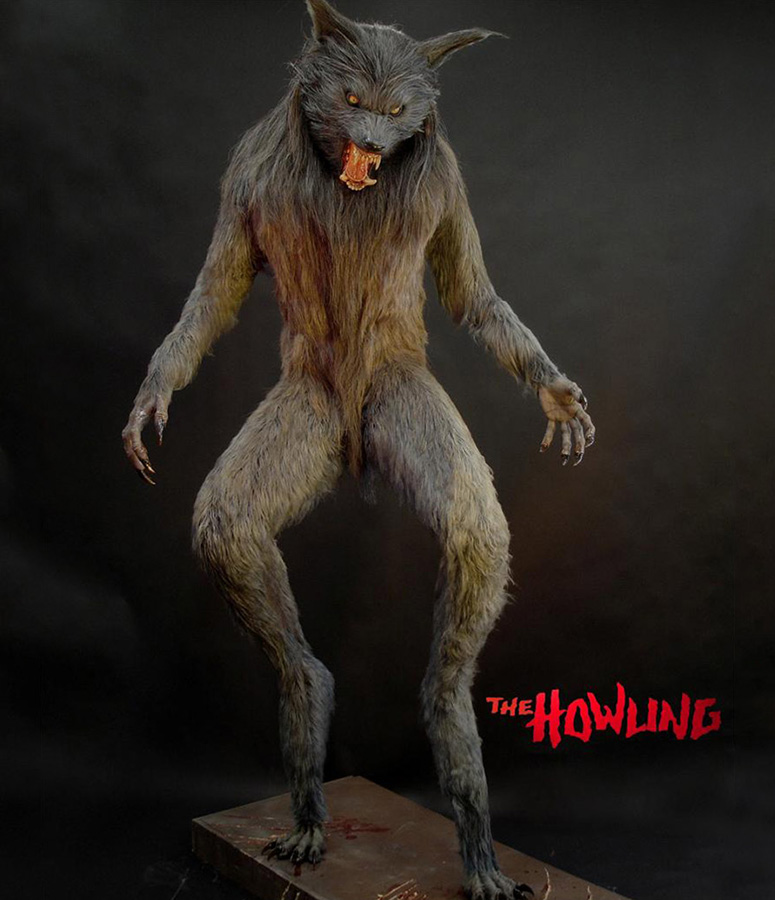
Not only is “The Howling” linked to “An American Werewolf in London” by both being werewolf movies from 1981, both films feature then-cutting edge special effects during the transformation sequences. The werewolf design is classical but effective, bipedal wolves with long, pointed ears. Notably, when a wolf has its arms chopped off, the claw bubbles and morphs into a human arm. The big effects set piece is when Eddie Quist changes into a wolf in front of Karen’s eyes. Rob Bottin, just a year away from creating the greatest monster effects ever in “The Thing,” certainly does great work here. Under-the-skin bladders are used extensively, making a tiny person expand and morph in a shockingly believable way. However, Dante gets a little carried away, spending too much time focusing on the transformation scene. You can’t blame the guy for being impressed but it does slow things down just when the film should be getting most intense. Still, the make-up effects are excellent.

While Wallace is the center of the film's attention, it features an accomplished supporting cast. Dante fills small roles with some of his favorite character actors. Kevin McCarthy appears as a stern network executive. John Carradine and Slim Pickens appear as members of the Colony, each expanding what could've been nothing parts into memorable performances. Dick Miller, naturally, appears as an especially snarky variation of Walter Paisley, an occult book owner this time. Belinda Balaski makes a decent heroine in her scenes, the audience enjoying watching her investigate this mystery and fight back against her attackers. Robert Picardo brings the right level of sleaze to Eddie Quist, being memorably greasy as the werewolf serial killer. Elisabeth Brooks, whose career was sadly short-lived, is incredibly alluring as Quist's sexy sister.

Returning from “Piranha,” Pino Donaggio gifts the film with a gorgeous score. Donaggio's main title doesn't go for shrieking thrills. Instead, it's build around a graceful string section, a mourning harmonica, and solitary guitar sounds. This creates music that goes perfectly with Karen's isolated mental state and the forested setting. Other scenes are accompanied by eerie vocal noises and scattered synth, further creating an uneasy mood. During the more intense moment, Donaggio loads up on heavy percussion and blaring horns, classic monster movie music that suits what happens on screen very well. It captures just about every emotion you'd want and shows what an underrated, multi-talented composer Donaggio is.

“The Howling” runs a compact ninety minutes, compelling the viewer totally during its brief run time and hitting hard. Deeply satisfying and completely effective as a horror movie, it sits comfortably near the top of most people's favorite werewolf movies. The movie would impress Steven Spielberg so much, he'd pick Joe Dante up to direct “Gremlins.” The movie's box office performance meanwhile, grossing 17 million dollars against a one and a half million dollar budget, would spawn a bafflingly long-running series of sequels, most of questionable quality. Regardless of what came after, “The Howling” is still a damn good horror movie. [Grade: A-]