Last of the Monster Kids

Last of the Monster Kids
"LAST OF THE MONSTER KIDS" - Available Now on the Amazon Kindle Marketplace!
Showing posts with label future report cards. Show all posts

Tuesday, September 24, 2013

Halloween 2013: September 24


Carrie (1976)

The influence of “Carrie” can’t be overstated. The film transformed Stephen King from a minor bestseller to an international success. Brian De Palma, known before for absurdest satires, was changed into the predominant thriller filmmaker of his age. It launched the careers of Nancy Allen, Amy Irving, William Katt, John Travoltra and, most importantly, Sissy Spacek. The movie’s box office success and critical praise was acknowledged with two Academy Award nominations, unheard for a horror film. Finally, the film introduced the final jump scare into the horror movie cliché library, something most every major shock film of the next two decades would rip off.

“Carrie” is a simple story, befitting a film adapted from a slender, 250-page novel. Meek, poor and telekinetic Carrie White suffers abuse at school from classmates and at home from her religious fanatic mother. Sue Snell, Tommy Ross, and Miss Collins attempt to help poor Carrie, to save her. Vindictive Chris Hargensen and her doofus boyfriend plan petty revenge for mostly imagined wrongs. The plot is engineered to build towards the climatic prom sequence, each storyline coming together. The whole story takes place over no more then a few days. The structure is precise, elegant, and functional.

It's also a coming of age story. The film begins and ends with blood in bath water, representing different losses of innocence. The emergence of Carrie’s powers is tied directly with her first menstrual cycle. Her character arc is ultimately framed as a struggle against her mother’s authority. Her psychic abilities give her the strength to fight back, to strike out on her own. Dowdy and plain at first, Carrie goes through a “Beautiful All Along” transformation, charming Tommy at prom, suggesting that, had this not been a Stephen King story, she could have gotten away from her mother, had a normal life. King’s original book was a epistolary novel, showing the events from the outside looking in. The film refocuses on Carrie, showing her world, her side of the story.

For a fact, whenever the movie shifts away from Carrie, it suffers. De Palma’s past as a cult filmmaker occasionally pokes through. A long sequence of the girls in gym detention is odd, with upbeat music and comical angles, adding little to the story. How about the scene of Tommy and friends trying on tuxes, which features bizarre fast motion and also adds nothing? Carrie’s Mother isn’t the most complex character in the film. She’s little more then a raving, religious lunatic cliché. Only near the end, when explaining Carrie’s conception, does the character seem to be more. Piper Laurie plays the part as operatic theater, driving her intensity to absurdest heights, most evident during her orgasmic death scene, writhing in religious agony. Chris is similarly cartoonist, a sadistic, evil queen bitch. It’s no fault of Nancy Allen, who plays the part to its fullest, simply an example of thin writing. (I blame Stephen King for this, not screenwriter Lawrence D. Cohen. King’s villains are usually two dimensional.) William Katt, several years away from his light comedy hero roles, is nearly flat as Tommy. Katt tries, occasionally showing some depth under those golden locks, but frequently comes off as a brainless jock.

Spacek owns the film and, when the focus is on her, “Carrie” shines. Her big blue eyes and freckled face conveys such a strong vulnerability, a deep sadness. You feel for the character, want to protect her. As the prom night goes on, as you see her smile and come into her own, a deep melancholy comes over the film that almost brings me to tears every time. Because you know her happiness is going to be short-lived. Despite occasional misinterpretations, “Carrie” isn’t a revenge story. Carrie’s psychic wrath at the prom isn’t righteous nor is the audience meant to enjoy it. Instead, it’s high tragedy. You’re watching her fragile world shatter apart and the terrible fall-out from it. “Carrie” is ultimately an incredibly sad film. You forget that between showings, only remembering De Palma’s stylistic flourishes or the intense effect scenes.

De Palma’s highly stylish direction occasionally verges on melodramatic. The multiple quick-cut close-ups on Carrie’s glaring face or Margret chopping a carrot drawls too much attention. The infamous De Palma split-screen nicely show the effect of Carrie’s powers but are an exercise in style, not story. The last supper between Carrie and her mother, though beautifully shot in deep shadows, puts too fine a point on it when lightening strikes after Margret’s dialogue. Ultimately though, De Palma’s direction works for the film. His repeated use of double focus, different items in the foreground and the background, provide depth to the frame, supporting the themes of the film. The turn-table shot of Carrie and Tommy at the prom probably goes on too long but beautifully illustrates both her heavenly feeling while subtly suggesting that things are about to go out of control. No sequence is better constructed then the lead-up to the prom massacre. Another one of De Palma’s trademarks, a long, single shot, revolving around the room, setting each puzzle piece in place brilliantly. The flames erupting behind Carrie are mythic, blazing demonic wings sprouting behind her.

Pino Donaggio’s score is also hugely important to the film’s success. The score is beautiful, dreamy and romantic when it needs to be. Carrie and her mother each have a leitmotif, a mournful oboe for Carrie and pounding, psychotic piano steps for Mom. During the prom, Donaggio’s score fluctuates from silent to foreboding, slowly building tension. While the actual massacre is happening, the score is almost non-existent, treating the violence starkly, honestly. Unlike De Palma’s direction, the score is always honest, building and supporting the story’s emotions… Except for the shrieking, Hermann-esque “Psycho” strings that play whenever Carrie employs her powers. This was no doubt De Palma’s idea, the Hitchcock humping bastard.

Though infamous, I almost feel like that final jump scare is unnecessary. It’s an exploitation movie move in a film that is anything but. However, that final image, of Sue’s mother cradling her on the bed, the room womb-like, a warm parental relationship, the kind Carrie never had, recalls the story’s whole point. “Carrie” is a devastatingly sad, powerful horror picture, showing that the genre can explore emotions far deeper then fear or revulsion. [9/10]


Flesh and Fantasy (1943)

Another Universal release, this isn’t quite horror but comes surprisingly close. It fits comfortably under the “dark fantasy” label. An anthology, the framing device revolves around a man suffering from troubling dreams. His friend tries to take his mind off the issue by regaling him with stories of the supernatural, all of which explores fate and the influence magic has over people’s lives.

The first story is the weakest. It opens with the striking image of winged demons stepping over a dead man. Louisiana and Marti Gras are revealed as the setting, the demons only people in costumes. The direction shifts to a young woman who considers herself so ugly that no one could ever love her. (Betty Field under bumpy make-up.) After stumbling into a mask shop, the mysterious owner gives her a mask which will gift her with beauty for a few hours. While it has a strong start, this one quickly develops into sap. There isn’t any ironic twist. This is an obvious story of inner beauty. The voice-over gets heavy handed at times and the ending is too on the nose. Either way, Field gives a good performance and is quite lovely.

The second tale is the best, featuring a strong performance from Edward G. Robison. At a party, a fortune teller accurately predicts the future of everyone present. After reading Robison’s palm, the medium predicts that he will commit murder. At first dismissing this as nonsense, Robison is quickly taunted by an inner voice, convincing him to kill. This segment has moody direction and Robison’s inner voice, usually shown as his own reflection, leads to some nice moments. My favorite is when his shadow begins to speak. The story builds to an effective ending with some nicely atmospheric black and white shadows. There’s dark humor here and the murderous protagonist is what pushes the film into horror. I quite liked it.

The third segment is the lightest on fantasy and the most blatantly romantic. A tight-rope walker, whose gimmick involves getting drunk before walking the wire, keeps having a dream that he’ll fall to his death. The dream also features a woman he’s never met before. While on a boat ride across the ocean, he meets her. The two naturally fall in love. However, it quickly becomes apparent that she is hiding a secret. Charles Boyer and Barbara Stanwyck have decent chemistry together. Though maybe the least interesting story on paper, it proves compelling in execution.

The film has a history. Originally, a fourth segment about a murderer hiding out with a family and falling in love with their blind daughter opened the film. Each story was supposed to flow into the next, as the second and third do. However, the first sequence was built into a stand alone film called “Destiny” and the comedic framing device added. “Flesh and Fantasy” probably won’t interest most horror fans beyond Universal completest like myself. It makes decent Halloween viewing either way because of its shadowy mood. [7/10]


Tales from the Crypt: 
Dig That Cat… He’s Real Gone

Early Crypt Keeper continues to be darker. He opens this episode with a brief monologue about the nature of death. I know this is a horror show but gee, that’s dark. With the slower, raspier delivery, even the shitty one-liners come off as a lot meaner.

“Dig That Cat… He’s Real Gone” is another early episode anchored by its lead actor. Joey Pantoliano has made a career out of playing sleazy jerks. Ulric the Undying proves an especially sleazy jerk, a homeless bum granted a cat’s nine lives by a mad scientist. That premise is absurd, of course, and the episode uses it mostly as a set-up for increasingly elaborate deaths for Ulric. As in most “Tales from the Crypt” scenario, the episode is also a moral story. Ulric murders the mad scientist, who is also his stage manager. Ulric’s showgirl girlfriend turns on him before he finally decides to screw over the carnival barker he works for. As is always the case, our villain protagonist is punished for his greedy ways with a nicely ironic ending.

Episode 3 is way goofier then the first. Richard Donner’s direction is comical and exaggerated, using dutch angles, overbaked quick cats, and even cartoonish scene transitions. (Did somebody say star wipe?) The characters are cartoonish too, from Robert Wuhl’s foul-mouthed carnival barker to Kathleen York’s squeaky voiced showgirl. Joey Pants holds it together though, making for another entertaining half-hour. [7/10]

(Oh, and if you wonder why I skipped the famous second episode, “And All Through the House…” Come on, man, it’s still September. Way too early for Christmas horror.)

Monday, February 13, 2012

Recent Watches: 2/12/12

George Clooney is an interesting A-List star actor. With his matinee idol looks and his incredible charm, he could have easily slummed into a series of lazy, cash-grabbing roles. (And occasionally does.) Instead, he’s mostly used his pull and talent to make smaller, quirkier films, occasionally winning awards along the way.

The latest thing he’s done is “The Descendents.” Based off a novel by Kaui Hart Hemmings, the film roots itself in the rich history of Hawaii. The first thing it does is remind viewers that Hawaii isn’t all beaches and vacation spots. There are cities, full of miserable people, in miserable nine-to-five jobs. From there, the story focuses on Matt King, a man with problems. His wife is in a coma and he just recently discovered that she was cheating on him at the time of her accident. He has a tumultuous relationship with both of his daughters, rebellious teenager Alex and quirky ten year old Scottie. On top of all of this, he finds himself the sole head of a family trustee group, stretching back to the very origins of the island as a part of the United States, deciding whither or not to sell a piece of untouched Hawaii land. All of this is sturdy ground to build a film on, dramatic, comedic, or otherwise.

It’s not new territory for director Alexander Payne. The film frequently plays like a less-funny version of Payne’s “About Schmit.” “Less-funny” is an important distinction, since “About Schmit” was a frequently hilarious but also deeply sad film all about regret and the fear that life is meaningless. Despite being advertised as a comedy, “The Descendents” is a bit of a drag. Clooney’s Matt King is a sad-sack, listless man, full of impotent rage, cracking under the weight of his responsibilities. His oldest daughter is a brat, swearing, drinking, challenging him constantly, and even dragging her clueless male friend along on family duties. Younger Scottie is undeniably weird. Honestly, the way little Amanda Miller plays it, you wouldn’t be surprised to find out that the girl grows up to be a serial killer.

All of this is established even before we find out that his comatose, dying wife was screwing around on them. At this point, a deeply suppressed, barely contained anger works its way into the film. The movie attempts to sum up all the grief, hurt, and betrayal such a scenario would create. While it does occasionally succeed, these heavy themes end up dragging the film down. Far too much of the film’s run time is composed of very sad people not being allowed to be very sad. “The Descendents” probably should have been about that emotional repression. Instead, it just lets that stuff slide off its back, not wanting to distract from the real story of a father getting back in touch with his estranged daughters, an idea no other screenwriter has ever had in the history of Hollywood, ever.

It’s really not until the end of the movie, when Clooney finally meets up with the man responsible for cuckolding him, that things pick up some. The man in question has a family himself, a very happy one, and a hugely successful business. (One that ties into the mostly tenuous land-deal subplot.) Here the movie finally addresses the messed-up storm of emotions its story has raised, answering some of it with a satisfying, mature ambiguity. There’s a hint of romance between Clooney and the man’s wife, played by an underutilized Judy Greer. Ultimately, it’s Greer who sets up the deeply needed, much appreciated catharsis that drives this middling film to its far-better conclusion.

None of the faults lie with the cast. Clooney is, as always, excellent, really showing off the wrinkles in his face and happily cracking up his movie-star facade. Shailene Woodley is especially good as the oldest daughter. Despite the character being unlikable, Woodley plays her as a real firecracker, someone who doesn’t spare the words or emotions that everyone else in the film contains. I’m surprised she didn’t receive an Oscar nomination. Robert Forster has a very funny supporting role as Clooney’s father-in-law. Like his granddaughter, he doesn’t suffers fools and let’s everybody known when he doesn’t like the cut of their jib. His interaction with clueless stoner Sid provides some of the film’s all-too-few laughs. You can’t even blame director Payne, who shoots the movie with an assured hand, letting the gorgeous Hawaiian landscape speak for itself. Similarly, the Hawaiian influenced score helpfully speaks to the emotional side of the movie, went it’s allowed.

Nope, it’s the script, written by Payne, Nat Faxon, and Jim “Lean, Mean, Dean-ing Machine” Rash. The movie stuffs Clooney’s mouth with an unnecessary, exposition-heavy voiceover, which brings to mind Harrison Ford’s laconic narration in the theatrical cut of “Blade Runner.” Luckily, that’s dropped before the movie is over. What isn’t dropped is the land trust subplot which, generally, adds nothing to the film, other then giving Beau Bridges a reason to show up. The additional story further drags down an already drag-y film. Moreover, it provides an easy, loaded precursor to the story’s inner-thoughts. You know that Clooney’s decision on what to do with the land will tie in neatly with whither or not he forgives his wife for her indiscretions. So, “The Descendents” is mediocre material propped up by an excellent class and pretty direction. Something that can be sadly said for far too much of the Oscar bait out there. (6/10)

Wednesday, April 27, 2011

Scream 4

You know what I thought halfway through “Scream 4?” “Who directed this?” None of the “Scream” films really feel like Wes Craven movies. Especially when compared to a movie swimming in his trademarks like “My Soul to Take,” it becomes apparent how much the “Scream” franchise is Kevin Williamson’s baby.

If nothing else, “Scream 4” is consistent. The franchise hasn’t changed much. Ten years have passed but 1996 is still with us.

I have two major complaints with “Scream 4.” First off, for the most meta and self-referial of horror series, the movie barely acknowledges the changes in the horror genre over the last decade. There’s lots of idle talk of “reboots” and “remakes.” “Torture porn” gets one brief, blunt dismissal. But, generally speaking, within the universe of “Scream,” it seems like the horror landscape hasn’t changed. These days, slasher films are generally made by and for hardcore fans of the genre. Movies like “Hatchet” and “Behind the Mask” pay homage to eighties slashers and are made by genre-obsessed filmmakers for a niche crowd.

Slashers aren’t mainstream anymore. But, as the opening minutes of the film make obvious, self-referal post-modern slashers apparently never went out of style within the movies universe. “Stab” sequels keep getting churned out. Yes, the killers in this film are hooked up to the internet and the “rules” are similarly updated, but if you’re expecting Ghostface to start mimicking and asking questions about the “Saw” franchise or the J-horror movement, you’ll be disappointed.

In the last reel, it’s made obvious that the most modern aspect of the movie is the killer’s motivation, which are directly tied to reality television and young people’s desire to be famous for doing nothing. While it’s amusing and interesting when it comes, I was expecting “Scream 4” to be a bit more in-the-know. The other disappointment steams from a certain character surviving the entire film, despite being played flatly by a bored, over-the-hill actress and being easily the least interesting of the series’ central trio.

The best aspect of “Scream 4” is, surprisingly, its cast of young newcomers. It’s easy to forget that likable characters were actually one of the strong suits of the original. While there might not be any here as memorable as Randy, the cast is still strong. Hayden Panettiere, an actress I’ve never been impressed with, is easily the most charming and witty of the young girls here. Rory Culken, the most talented of all the Culken brothers, adds another strong performance to his quickly growing list. Erik Knudsen’s character uploads every single thing he does to the internet and is clearly the writer’s most boldfaced attempt to create a “modern” teen. It actually works though and doesn’t come off like a desperate attempt to stay hip. Knudsen’s amusing performance might be solely responsible for this. Emma Roberts, ostensibly the star of the show, doesn’t really get to shin until the end of the movie, where a vicious spitfire emerges from her boring teen starlet shell.

Among the older set, Allison Brie and Marley Shelton both get meaty supporting parts and ham it up accordingly. Courtney Cox does okay as an over-the-hill Gale while David Arquette isn’t given too much to do. As for Sydney… Neve Campbell was never much of an actress. She’s just as wooden as ever here. Sydney, despite being the franchise’s default protagonist, is still boring as hell.

The gore is supposedly amp up but I’d say it’s on the same level of the first movie, which is more violent then people remember. There’s plenty of decent throat slashing and stabbing. There’s really nothing to compete with garage door kill from the first movie, up until a dagger gets buried up to the handle in someone’s forehead. That was cool.

The intensity level isn’t very high but the parking garage sequence, barn house set-piece, and assorted moments in the last twenty minutes are uniformly entertaining. The fun sense of “who-dun-it” injects this entry with a lot of audience interaction. It honestly kept me guessing, trying to figure out who among the cast was the killer. (I still figured it out before the reveal.)

The movie continues after the obligatory “the killer reveals their motivation” scene with an extended hospital sequence. It’s extraneous and drags the end down. Honestly, if the movie had just stopped before that scene it would have taken the series in a daring, exciting new direction.

“Scream 4” is, honestly, the best of the series since the original. It certainly doesn’t reinvent the wheel, or even try to. Kevin Williamson doesn’t have any new tricks up his sleeve. But the movie is a fun, decent way to waste ninety minutes. As a relative non-fan of the franchise, I thought it was pretty good. To someone who is a fan, I suspect they will love it. [Grade: B]

Sunday, March 13, 2011

Rango (2011)

Rango (2011)
Directed by Gore Verbinski

At this point, I was just about ready to jump Good Ship Gore Verbinski. In his attempt to balance a personal visual style with a commercial viability, he’s only managed alienate me. Most days I think of him as a slightly more talented Bret Ratner. Well, “Rango” has changed my mind, at least a little bit.

For what’s ostensibly a kid’s movie, it’s surprisingly smart. It’s a little on the, what you’d call, “meta” side. Within the opening minutes, our titular lizard is talking about acting and story-telling. Soon, a metaphor-speaking mentor is introduced. (In an amusingly surreal way.) Before you know it, this movie is cracking jokes about Joepsh Campbell and the Hero’s Journey. A mariachi band of owls function as a Greek chorus, telling us what's going to happen before it does, though this somehow doesn't spoil things. Before the main story proper even gets going, we get a visual shout-out to Hunter S. Thompson. In a kid’s movie! Crazy, right? It’s clear early on that “Rango” isn’t going to throw some celeb voices and fart jokes onto funny talking animals and call it a day.

By the time our hero wanders into the town of Dirt, the movie is well on its way to feeling like a real spaghetti western. The visual style here is impressive. While most CGI features these day focus on color and brightness, “Rango” is instead characterized by grit and detail. Though obviously cartoons, the animal characters are still designed to look as realistic as possible. Often, the character designs lean more towards amusingly ugly then cartoony cute. There’s a sense of lived-in reality to the setting.

The quirkiness extends pass the character designs. Rango is a captivating protagonist. Fancying himself a dramatic actor, his true personality seems rather meek. However, as soon as he gets into the flow of a story, he fashions a bravado, building a fantastic mythology around himself. It’s soon obvious that he’s really a coward but, as these things go, the townfolks buy his story. Through coincidence and luck, Rango is soon the hero of Dirt. It’s not the most original story. (The movie even lampshades that fact several times.) But Johnny Depp vivid vocals and the movie’s high comic energy sell it.

The rest of the cast is equally strong. Isla Fisher’s Miss Beans is clearly set-up as the love interest early on and, while that does happen, the character is a head-strong, independent woman… Uh, lizard. Her physical quirk seems to be an example of indie-movie wackiness trickling down to mainstream Hollywood, but Beans is far from a Manic Pixie Dream Lizard.

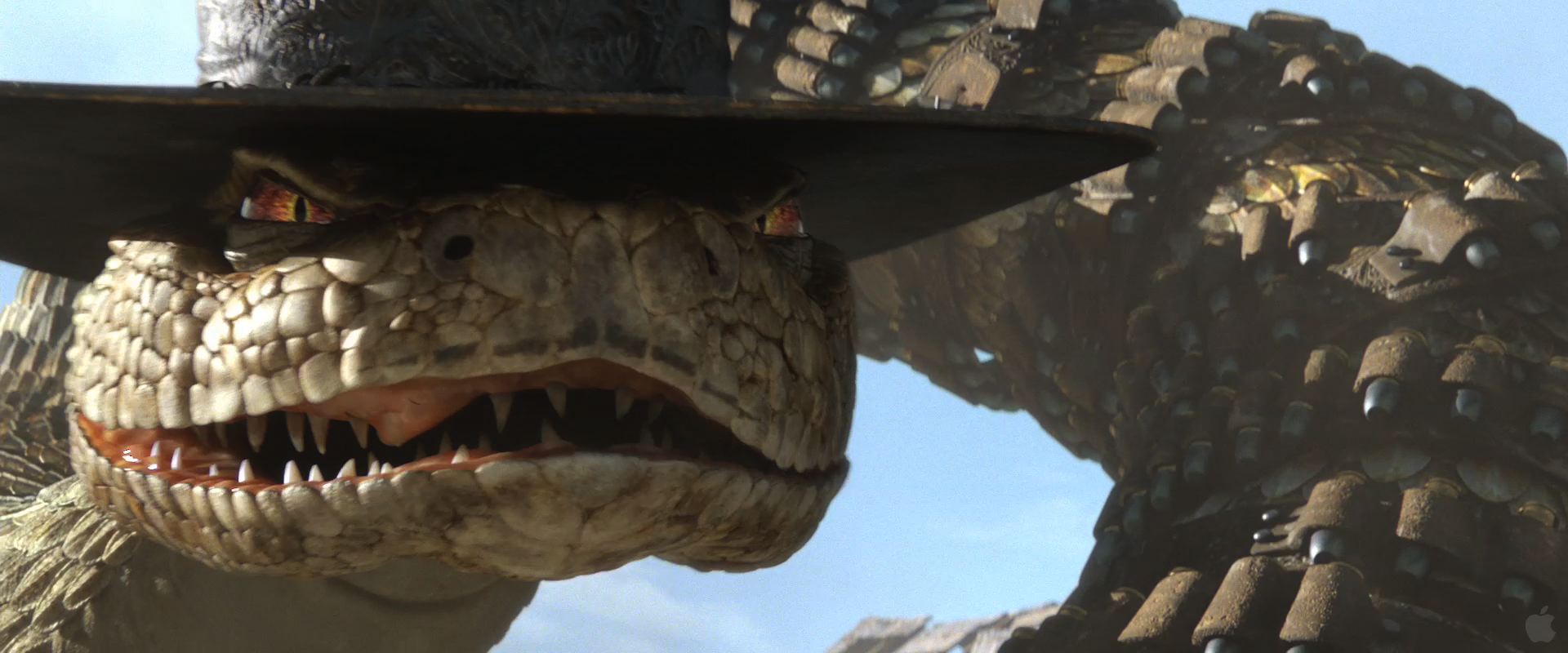
Abigail Brelins doesn’t have much to do as Priscilla, the mole/rat/schoolgirl thing, but the character is a good example of ugly-cute. Ned Beatty and Ray Winstone provide appropriate weight to their villainous roles. Later, Bill Nighy, his voice almost unrecognizable, shows up as Rattlesnake Jake, a villainous old gunslinger with a Gatling gun rattler. (He even has a pencil mustache!) Nighy oozes sinister dread and aggressive anger. It's the best performance of the film and one of the better performances of Nighy's recent career.

After a very funny opening act-and-a-half, the movie gets focused on regaining the lost water. A big chase scene, which then evolves into a bat-filled aerial battle, follows. It’s honestly a little disappointing. The movie drags a bit during these sections. Naturally, it isn’t long before a conspiracy against the town is uncovered. Our hero’s true identity is revealed, the populace’s trust is betrayed, and he’s run out of town. The movie’s self-reflective streak is forgotten as our hero (metaphorically) dies, journeys into a metaphorical cave, and encounters his mentor, Clint Eastwood. (Technically Timothy Olyphant doing a very good impersonation of Man-with-No-Name era Eastwood. But you don’t realize that until the credits.) You know what happens next. Its story-telling 101. Our hero journeys back into town and saves the day. The bad guys are vanquished. The legends of the west are eulogized. All is well.

Which isn’t to say that none of this isn’t incredibly satisfying. “Rango” knows the formula and follows it, but not without adding a lot of endearing quirkiness, strong characters, and a gorgeous visual aesthetic. Powered by Hans Zimmer’s amazing straight-out-of-Sergio-Leone score, it’s a kid’s flick that’s probably too smart, too dark, and too violent for most kids. But who even cares about that. Enjoy this treat for the surprise it is. Maybe Verbinski should stick to animation. [Grade: B+]