Last of the Monster Kids

Last of the Monster Kids
"LAST OF THE MONSTER KIDS" - Available Now on the Amazon Kindle Marketplace!
Showing posts with label ishiro honda. Show all posts

Sunday, October 6, 2019

Halloween 2019: October 4th


Lake Mungo (2008)

In the mid-two thousands, horror movies were experiencing a renewed popularity. The DVD market was also still on the move up at the time, though those with any foresight probably figured the decline was coming soon. These two factors would combine with the After Dark Horrorfest, an annual festival of independent horror films that would play as a set in theaters before being released on DVD. While a cool idea conceptually, most of the After Dark movies ranged from utterly forgettable to outright awful. It got to the point where I pretty much dismissed any film associated with the brand. However, occasionally gems would sneak in under the label. When I started hearing positive notices about “Lake Mungo,” one of After Dark's 2008 offerings, I was surprised. So surprised it took me until now to get around to it.

Presented as a television documentary, “Lake Mungo” follows the Palmer family of Victoria, Australia. One year ago, sixteen year old daughter Alice disappeared while out swimming with her family. Though mother June is hopeful, father Russell is soon brought in to identify a corpse that is clearly Alice. In the days and months since then, the Palmer family starts to experience strange events. Younger brother Matthew, an obsessive videographer, captured what appeared to be a blurry photograph of Alice at the lake... After she disappeared. Throughout the house, he captures what appears to be Alice's ghost on video tape. June brings in a psychic to investigate but, instead, the family uncovers the secrets Alice concealed both in life and death.

“Lake Mungo” is entirely committed to verisimilitude, feeling one-hundred percent like an actual documentary in its editing, pacing, and tone. The actors all look, act, and sound like real people. This pitch-perfect loyalty to realism makes “Lake Mungo” incredibly creepy at times. Though not a real found-footage movie, the film is fascinated by blurry video footage and photographs, including those from cell phones. A trick the film exploits successfully repeatedly is slow-zooms into the background of these photos, revealing a spooky, ghostly image that wasn't immediately apparent before. Every time, this technique is really creepy, the film confidently presenting the unnerving presence of a ghostly girl existing alongside normal people. This is a haunted house story for the modern age, placing its ghosts thoroughly in the mundane context of suburban homes and wholesome vacation spots.

Writer/director Joel Anderson – currently his only feature credit – wares his influences on his sleeve. “Lake Mungo” is the modern descendant of “Ghostwatch,” with its presentation of being a regular TV broadcast, its spectre lurking in the background of shots, and a story reveal mid-way through that evidence has been hoaxed. Moreover, “Twin Peaks” was pretty clearly an inspiration, the family's last name being “Palmer” being the most obvious nod. This is the story of a teenage girl with a double life. Alice, we soon learn, was regularly having threesomes with the married couple next door. She was keeping “secrets about having secrets,” as one character puts it. Like Lynch's landmark program, “Lake Mungo” is about the darkness beneath suburban perfection, unsightly images lurking in the background that can only be ignored for so long.

Yet more than even that, “Lake Mungo” is a frank depiction of grief. June is so haunted by her daughter's passing, that she refuses to initially acknowledge she's even dead. After her daughter's corpse is exhumed, she begins to sleepwalk, wandering into stranger's homes. Actress Rosie Trayner portrays her as clearly still shell-shocked by the trauma of loosing her child. Alice's ghost lingers in the house, not immediately seen but always present. Like grief itself, the ghost can never be banished but must be lived with. The film gets right at the guts of what the ghost genre means, acknowledging the ghost's status as a lingering reminder of our own mortality.

Instead of looking at “Lake Mungo” as just another member of the AfterDark Horrorfest family – check out that exploitative, bikini-clad poster art they designed for the film – one should consider the film as part of the wave of Australian horror that sprung up last decade. It's certainly a different breed of horror than “Wolf Creek” or “The Loved Ones” but is another proud example of the wonderful genre efforts that were coming out of that country at the time. While some referring to “Lake Mungo” as one of the scariest movies ever made might be overstating it slightly, it's a fabulously creepy and fantastically subtle cinematic haunting. This ghost story is likely to linger in my mind for quite a bit longer. [8/10]


Latitude Zero (1969)

Even though I didn't much care for it, “Atragon” was clearly very successful for Toho. I suspect the movie was popular in both Japan and America. I say this because, towards the end of the decade, Toho would create a spiritual sequel of sorts as an international co-production. Don Sharp – perhaps better known for directing films like “Kiss of the Vampire” or “Curse of the Fly” – would offer to co-produce another sci-fi submarine creature feature. The cast would be an international affair too, with Toho stars like Akihiko Hirata and Akira Takarada appearing alongside known American actors like Joseph Cotton and Caesar Romero. This didn't exactly work out for Toho, as Sharp dropped out just as production was about to start, forcing the studio to go ahead with half the intended budget. Perhaps this is why “Latitude Zero” is usually overshadowed by its more well-known sort-of, kind-of predecessor.

Oceanic geology Dr. Tashiro, marine biologist Jules Masson, and journalist Perry Lawton dive into the ocean in a bathysphere. When this goes wrong, they are unexpectedly rescue by a mysterious submarine: The Alpha, outfitted with advanced technology and captained by Craig McKenzie. The crew of the Alpha claims to be 200 years old. They hail from Latitude Zero, an underwater utopia where the inhabitants – all ship-wreck survivors – never age or gets sick. The only threat to this perfect kingdom is Dr. Malic, an evil scientist with his own high-tech submarine, the Black Shark, who has a habit of creating horrific human/animal hybrids.

While American science fiction of the late sixties and early seventies grew increasingly apocalyptic, Japanese sci-fi of the same era seems way more optimistic. “Latitude Zero” presents its utopia without any subversion or dark edge. The film runs with the idea that, if people live forever, they'll have no use for greed, hatred, or interpersonal strife. Dr. Malic's evil is presented as an aberration. It just so happens most of the residents of Latitude Zero are genius scientists, who pass the time making scientific advancements like an artificial sun or a bath that heals all sickness. This utopian image is awash in swingin' sixties camp, naturally. The immortals wear a lot of golden swimsuits and jump on trampolines. Yet the film's depiction of human nature is ultimately upbeat and positive, reflecting Ishiro Honda's belief in world peace. Then again, “Latitude Zero” is basically a children's movie so you'd probably expect its philosophies to be fairly wholesome.

When the film isn't explaining its utopian ideas, it's throwing all sorts of crazy, fun, goofy sci-fi shit at the viewer. The first act doubles down on submarine battles, the u-boats spiraling through the murky depths and blasting missiles at each other. (Though none of them look as cool as the Gotengo.) Once the heroes go on the offensive against Malic, they outfit themselves with high-tech weapons. This include jet packs and suits with laser blasters built into the fingertips. The special effects, the penultimate Toho credit of Eiji Tsuburaya, are charmingly lo-fi. The monsters are similarly amusing. Such as the seven-foot tall bat humanoids, with their high-pitched shrieks, and the squirm-inducing man-sized rats. The star kaiju of the film is a giant lion/condor hybrid with a human's mind. (Just called a griffon in the dub but its official Japanese name is, confusingly, Black Moth.) While not the most convincing of Toho's monsters, the griffon is better executed and more interesting than Manda was in “Atragon.”

The international cast gives “Latitude Zero” a distinctively different atmosphere than a lot of Toho flicks. Probably because few of the actors are dubbed in the English cut. Takarada and Hirata actually speak very clear English, allowing their clear charisma to be truly shown off. Sometimes this backfires though. Hikaru Kuroki, as the henchwoman whose brain ends up in the giant griffon, has a very thick accent and clearly isn't comfortable on-screen. (This is her sole screen credit.) It's not just the Japanese actors who sometimes struggle with this. Mysterious exploitation siren Linda Haynes, in her debut role, is surprisingly wooden as the comely doctor aboard the Alpha. As for the big stars, Joseph Cotton is amusingly fatherly as the super-heroic Captain Makenzie. Caesar Romero has a lot of fun as the cackling, practically mustache twirling Dr. Malic.

It's interesting to me that “Latitude Zero” feels like such a divided film. All the sci-fi and giant monster stuff feels entirely like a classic Toho kaiju flick. The scenes of people hanging around futuristic buildings, on the other, feel much dryer and far more American. I guess the two styles didn't quite mesh. (It didn't dissuade Toho from trying again. In the mid-seventies, they attempted to make a movie called “Nessie” with Hammer, an unrealized collaboration I would've loved to have seen.) Though very goofy and ultimately extremely minor in the grand tapestry of Toho's monster movies, “Latitude Zero” is definitely a fun watch. In the loosely connected super-submarine duo – the presence of high-tech subs is the only linking fiber – I'll take it over “Atragon” any day. [6/10]


Tales from the Cryptkeeper: Too Cool for School

If the first episode of “Tales from the Cryptkeeper's” third season was ripping off a vintage “The Twilight Zone” episode, its second is directly inspired by “Jurassic Park.” A pair of teenage girls decide the rules don't apply for them and skip school, on the day they'll be dissecting frogs in science class. Instead, they wander into the swamp and meet a friendly if stern zoologist. The next day, the girls haphazardly mix frog eggs with dinosaur DNA – which is quite literally just sitting in a fridge at the school. This creates a pack of mutated frog/dinosaur hybrids, who proceed to chase the girls through the school and back into the swamp. The scene where they hide in the school meat locker is clearly ripping off Spielberg's dino-classic.

Now that the Cryptkeeper is directly interacting with the stories, the writers have gotten lazier. For the second episode in a row, the Cryptkeeper is directly responsible for introducing the monster and causes it to disappear at the end, being positioned as an arbitrator of justice against the disobedient youths. In this episode, I really noticed the downgrade in animation quality. The girl's blank stares and wide-eyes are way creepier than the dino-frogs. The preachy moral couldn't be more hammered into the viewer's head. The weirdly literal presentation of this moral – kids, don't skip school or dinosaur-frogs will try and eat you – seems to negate the goal though. (For added educational value, the zoologist character talks a little about conservation.) About the only thing I like about this episode are the dino-frogs themselves. They look like raptors with hoppity frog legs, which is pretty cute. [4/10]


Forever Knight: Partners of the Month

“Partners of the Month” represents “Forever Knight” in an uncharacteristically light-hearted mod. Schanke and his often-referenced but rarely seen wife Myra are going through a rough stretch. The arguments get so bad that they actually separate. This is bad news for Nick, as Schanke haphazardly moves into his apartment. Knight has to hastily hide his vampiric nature. Schanke's relationship problems also start to affect his police work. This is most noticeable because their current case involves a workaholic, with a number of mistresses, who was mysteriously shot dead while his wife waited upstairs.

Seeing “Forever Knight” cut loose with a goofier episode is a nice change of pace. (Though the show's visual presentation remains ever gloomy and dark.) The scenes devoted to Schanke barging into Nick's apartment, or the two attempting to co-habitat, are pretty funny. A breakfast sequence shows off Geraint Wyn-Davies' rarely seen talent for deadpan facial reactions. They quickly begin to bicker like an old married couple, a good gag. Once Schank uncovers the true killer – the murder mystery this weak is truly superfluous – Nick acts behind the scene to give his parent some glory, a cute touch. The scene where Schank drowns his sorrow at Jenette's vampire club are amusing too. The flashback sequence are devoted to Nick and Jenette breaking up during the Renaissance, showing even vampires have bad break-ups apparently. [7/10]

Friday, October 4, 2019

Halloween 2019: October 3rd


Atragon (1963)

In 2014, I devoted a large chunk of my Halloween Horror-Fest Blog-a-Thon to review as many kaiju movies as I could get my hands on. During that marathon, I managed to watch all the sci-fi/monster movies Ishiro Honda would direct for Toho in the sixties and seventies... Except for one. For whatever reason, 1963's “Atragon” proved surprisingly hard to find. The DVD was out-of-print at the time, with asking prices well outside the range of reasonable. The film was certainly not streaming on any legitimate website and I couldn't even find it on any of the sketchy, pirated video sites I frequented at the time. Every Halloween season since then, I've looked for a copy of “Atragon,” always coming up empty-handed each time. Either Tokyo Shock re-issued its DVD recently or Amazon is now selling convincing bootlegs, because “Atragon” finally popped up for a decent price. Whatever the reason why, I have now seen every sci-fi/kaiju flick Honda made for Toho.

Mysterious events are happening all around Japan. A late night photography session is interrupted when a car drives into the sea. Strange men in unusual diving suits surface out of the ocean. Strange cab drivers with touches that can burn attempt to abduct people. Earthquakes shake cities. It soon becomes evident that the underwater civilization of Mu – once a technologically advanced continent that sunk below the ocean centuries ago and worship a dragon god called Manda – is threatening the surface world. They demand that a high-tech submarine called the Atragon, AKA the Gotengo, be surrender to them... Along with absolute control of the entire globe. The Atragon has been built by a rogue Japanese Naval officer, who refuses to relinquish it. A special team is assembled to convince him and stop Mu from destroying the surface world.

Though best remembered for the first appearance of kaiju Manda, the giant sea serpent is really incidental to “Atragon's” plot. “Atragon” doesn't just want to be a kaiju movie. The film is best described as a science fiction adventure, with its conflict between a scientifically advanced lost society and our slightly less advanced surface technology. Yet it's also a fantasy, as the Muans hang out in temples, wear robes, and worship a literal dragon. It has shades of a James Bond wannabe, with its brave heroes infiltrating villainous lairs and double agents being exposed. It's also a war movie of sorts, with long scenes devoted to a former World War II captain and his men preparing the bad-ass super submarine. None of these tones are combined in a satisfying form. Nor are these divergent plot points brought together into a coherent whole, leaving “Atragon's” story unwieldy and difficult to follow.

Long portions of “Atragon” is devoted to the conflict between Kusumi, a former admiral in the Japanese navy and now a believer in world peace, and Jinguji, the creator of the Atragon and a Japanese nationalist. Jinguji designed the Atragon to only be used by the Japanese navy. He's one of those legendary soldiers unaware that World War II ever ended. When he learns Japan surrendered, and disbanded its military, he's crestfallen. Initially belligerent and committed to his nationalistic goals, Jinguji is eventually convinced to allow the Atragon to help the entire world. This is interesting because it shows director Ishiro Honda, a fervent supporter of the United Nations, struggling against the strong militaristic elements in all these monster movies he's directed. “Atragon” tries to have its cake and eat it too, compromising its imperialistic past with its global future, showing why nationalism is bad but also allowing cool Japanese military guys to kick lots of ass.

It's really interesting but geopolitical debates is probably not what most people watching “Atragon” signed up for. The special effects are obviously the main attraction. Some of them are very impressive. The scaly diving suits the Muans wear are cool. A sequence devoted to earthquakes collapsing a city is fantastic. And, yes, the Gotengo/Atragon is a bad-ass flying submarine. Yet even these elements sometimes feel underwhelming. Manda is not an impressive kaiju, a mangy-looking puppet that awkwardly thrashes around before being quickly subdued by a freeze ray. The Gotengo doesn't actually do anything until the last third. It then completely steamrolls every adversary it comes up against, destroying the Mu forces in seemingly minutes. Which isn't very satisfying to watch from a narrative perspective. Despite their impressive weapons, the Muans are not smart villains. They make demands, chant and panic in their temples, and are then summarily crushed.

“Atragon” probably wasn't worth all the years I waited to see the movie. Its plot is convoluted, its pacing stop-and-go, and its central monster is underwhelming. Despite not being especially good, “Atragon” was pretty popular in Japan. The film's popularity was exactly why Manda was included in “Destroy All Monsters.” Toho would revisit the Gotengo several times, some version of the flying submarine appearing in “The War in Space,” “Godzilla: Final Wars,” and multiple video games. There was even a two-part anime spin-off called “Super Atragon” in the nineties. So maybe I'm the one who's wrong and this film is a beloved classic after all. [5/10]


Murders in the Rue Morgue (1971)

American International Pictures must've been pleased with “The Oblong Box” because, two years later, Gordon Hessler would return to direct the third film in this quasi-revival of the Poe Cycle. Though it's one of Poe's most famous stories, A.I.P had presumably not adapted “Murders in the Rue Morgue” yet because the 1932 Universal version was probably still in regular rotation on television. In large part due to that adaptation, Hessler had decided the story’s twist — an orangutan with a straight razor is the perp — was too well known. Thus, the new “Murders” would be a complete reinvention. Perhaps it strayed too far from the public’s conception. A.I.P.’s second wave of Poe films would end here.

Caesar Charron leads his Grand Guignol theater trope, currently adapting Poe’s “Murders in the Rue Morgue.” His current wife, Madeline, is the daughter of his previous wife. That woman was murdered by an another actor from the trope, Rene Marot, after she accidentally scarred his face with acid during a performance. Rene is thought dead, yet a masked madman with vengeance on his mind is pursuing Caesar and Madeline. While Caesar works with detectives to uncover the truth, Madeline is haunted by nightmares and hallucinations.

If that plot synopsis didn’t clue you in, Hessler’s “Murders in the Rue Morgue” has practically nothing to do with Poe’s story. The orangutan appears in the stage-play-within-the-movie, which itself is clearly more inspired by the 1932 film than the story, but that’s about it. Instead, the film haphazardly combines a number of elements from other unrelated sources. Poe’s fictional detective, Dupin, is replaced with his real life inspiration, Vidocq. The killer has an unhinged dwarf sidekick, clearly inspired by Henri de Toulouse-Lautrec and implied to be the descendant of Poe’s Hop-Frog. In addition to his deformity and his broken heart, Rene Marot was further driven insane by being buried alive, which is becoming a bad cliche of these movies. Mostly, Hessler rips off “Phantom of the Opera,” with his story of a theater company haunted by a deformed, masked madman fond of fedoras, capes, and the leading lady. Hessler even cast Herbert Lom, who previously played the Phantom for Hammer, as Marot.

“Murders in the Rue Morgue” has its share of death and a notably horny scene set in a brothel but is generally less explicit than “The Oblong Box.” (Which its plot also resembles to a degree.) The main source of its horror is its many dream sequences. Some of which are, admittedly, pretty interesting. The film makes no distinction between Madeline’s dreams and her waking life. This sometimes gifts the film a lyrical quality, such as the repeated flashbacks to the death of Madeline’s mother. Or a long scene where the dwarf leads Madeline through an otherwise empty mansion. Too often, it just makes the story hard to follow though, further maddening the narrative waters.

This “Murders” does have a decent cast. Jason Robards, in a part pretty clearly designed for Vincent Price (who was having a pay dispute with A.I.P. at the time), stars as Caesar. Robards doesn’t go for camp but instead attempts to gift the character with a hound dog sense of regret. Yet the film constantly leaves the viewer uncertain of Caesar’s motivation, making it hard to relate to the character. Lom is better here than in Hammer’s confused, sentimental “Phantom.” He’s certainly an intimidating figure. Christine Kaufmann is properly wide-eyed as Madeline, the kind of beautiful and vulnerable lady audiences can latch onto. Michael Dunn is also pretty creepy as the dwarf.

Ending with a big, incoherent twist, 1971’s “Murders in the Rue Morgue” is a frustrating experience. It’s Poe in-name-only, making you wonder why A.I.P. didn’t just call the movie something else entirely. That’s a serious problem all of the second half of the Poe Cycle had, the films using ol’ Edgar’s name for marketing purpose and nothing else. While it has one or two interesting moments and a decent cast, the plot is largely presented in a baffling way, making these “Murders” an overall perplexing motion picture. [5/10]


Tales from the Cryptkeeper: Sharon Sharalike

After its second season, “Tales from the Cryptkeeper” was canceled by ABC, probably due to low ratings. (Though Disney's acquisition of the network, and subsequent reshuffling of its Saturday morning line-up, might've played a role as well.) However, just like an undead ghoul, “Tales from the Cryptkeeper” pulled itself from the grave when least expected it. For reasons I can find no satisfying explanation for, “Tales from the Cryptkeeper” was resurrected in 1999 – two years after the original “Tales from the Crypt” ended – on CBS. Now presented as “New Tales from the Cryptkeeper,” the show would undergo many changes. A new animation company would take over, resulting in a totally different, more cartoonish visual style. The Cryptkeeper would now interact with the characters in the story. Most pressing, in order to comply with new laws regarding educational content on children's television, the already ham-fisted moral lessons of “Tales from the Cryptkeeper” would become even more exaggerated and obvious.

Take a look at the season three premiere, “Sharon Sharalike,” for a good example of this. The episode concerns a bratty teenager girl who refuses to share her toys with her little sister. In the mail one day, an old talking doll named Sharon Sharalike arrives. Despite not even liking the doll, the older sister claims Sharon for her own. This is much to the younger girl's chagrin. When mom demands Sharon be shared, the older sister hides her instead. That night, the doll springs to life to teach the bratty girl a lesson.

I'll give “Sharon Sharalike” some credit. It is actually attempting to be scary. The scenes of the girl being chased by doll are trying to be suspenseful, even including a heartbeat sound effect. Sharon's cutesy monotone, clearly inspired by Talky Tina, could be seen as creepy to younger kids. However, it's hard to built too much suspense because the teen protagonist is such a hateful little bitch and Sharon is so obviously not a physical threat. She never wants to hurt the girl, just teach her a lesson. Yes, the moral about sharing could not be more hammered into the viewer's head. The new character designs are rather jarring, with their broad, sharp angles. But at least the Vaultkeeper and the Old Witch aren't around anymore. [5/10]


Forever Knight: Baby Baby

“Baby Baby” has Nick's past coming back to haunt him once again. While investigating a mysterious death at a construction site, Nick runs into Serena. At the turn-of-the-century, he turned Selena into a vampire when she was only asking him to get her pregnant. He feels pretty bad about this misunderstanding still. Serena is apparently still longing for a baby, as she's currently romantically involved with the murder suspect. Legends, as told by LaCroix, persist that a vampire can get pregnant – their mortality returned but the suitor left dead – by special men as long as the conception happens high in the sky and under the full moon. Turns out this guy has a third chromosome, prompting Nick to try and stop another killing before it happens.

“Baby Baby” – that's what you'd call a bad title – has some issues. Serena is clearly coded as a lesbian, as she dresses like a man in the flashbacks and works as a welder in the present, which makes her desire to have a baby kind of odd. The circumstances surrounding her becoming a vampire certainly make Nick look like kind of an impulsive idiot though. However, the idea that vampires have legends of their own is an interesting idea. Nick and LaCroix being forced to worked together, however briefly, is a good source of dramatics. Denise Virieux is effectively intense as Serena. Her confrontations with Nick make for good television. I also like a minor scene where Natalie and Schanke talk about the time he wrote a poem for a childhood crush. [7/10]

Monday, October 20, 2014

Halloween 2014: October 18


Space Amoeba (1970)
Gezora, Ganime, Kameba: Kessen! Nankai no daikaijû / Yog, Monster from Space

“Space Amoeba” is the end of an era. The public’s enthusiasm for giant monster movies, experienced just a few years earlier, had started to wane. By the end of the sixties and the start of a new decade, kaiju movies were widely considered kid’s stuff. “Space Amoeba” would be the last film produced under the studio’s old star system. It would be the last giant monster movie the studio made with an A-budget. It was the first of the studio’s creature features made after the death of effects master Eiji Tsuburaya. It was even meant to be Ishiro Honda’s final science fiction film, though the studio would lure him back in 1975 to direct “Terror of MechaGodzilla.” Aside from the remaining Godzilla sequels, the film was the last monster movie Toho would produce in the Showa period. The movie seems especially old fashion now and; with its plot of adventurous journalists, superstitious islanders, alien invaders, and super-sized sea creatures; was likely considered a throw-back even in 1970.

The movie begins when an unmanned space probe is sent to study Jupiter. Along the way, the ship is possessed by an amorphous alien consciousness. Under the space amoeba’s control, the probe returns to Earth, crashing in the south sea. Meanwhile, a photojournalist is talked into photographing Seigai Island for a tourist company. Along with his girlfriend, a scientist, and a businessman of questionable scruples, he is challenged by the local tribe. They are fearful the old gods might be angered by modern man’s invasion. Their prophecy seemingly comes true when giant monsters, normal sea life grown to huge size, attack the island. The creatures have been possessed by the same space amoeba that came to Earth on the probe, the first step in its planned conquest of the planet.

“Space Amoeba” is fairly derivative of Toho’s other monster flicks. The island setting recalls “Godzilla Versus the Sea Monster” and “Son of Godzilla.” The adventurer reporter is a hero type used in many Godzilla movies, including the aforementioned “Son.” The island natives, dancing and chanting in hopes of fending off a local deity’s offense, goes all the way back to the original “Gojira” but was also seen in “Varan,” “Mothra,” and “King Kong vs. Godzilla.” Akira Ifukube’s score recycles musical cues heard in the latter most films. The islander’s song will definitely sound familiar to kaiju faithfuls. The subplot, of greedy businessmen looking to capitalize on some unspoiled land, recalls the earliest Godzilla flicks of the sixties. The cast is full of familiar faces. Akira Kubo, Atsuko Takahashi, Yukiko Kobayashi, Kenji Sahara, and Yoshio Tsuchiya all had major roles in past Godzilla movies. Looked at from this perspective, “Space Amoeba” makes it seem like the studio was starting to run out of ideas.

Yet “Space Amoeba” does offer some humble joys of it own. It’s a most unconventional of alien invasion flick. There are no flying saucers or alien leaders in funny outfits making villainous proclamation. Instead, Yog, as it was named in the American dub, is a far more insidious threat. It has no true form, only appearing as a glowing, blue mist. It slithers into organic beings, taking control of their bodies. In the shape of cuttlefish, crabs, or turtles, they grow into giants. For humans, they are controlled by ominous voices, telling humanity of its impending enslavement. The film reminds me a little bit of “The Thing.” The alien’s powers are potentially disastrous but, lucky for the human race, it fell in an isolated area. Granted, the freezing Arctic is more frightening then a tropical island…

The interesting sci-fi angle isn’t what got butts in seats. “Space Amoeba” is aware of this. The movie’s opening credits are taken up by footage of the three monsters fighting and attacking, dramatically scored and cut. The film throws three monsters at the viewer for the price of one. The goofiest, most intimidating and by far the most memorable is Gezora. A giant kisslip cuttlefish, the kaiju doesn’t act much like an invertebrate. Instead, Gezora crudely crawls around on his tentacles, walking across the island like a normal person would. The animal’s eyes were located where the suit actor’s – stalwart Toho monster man Hauro Nakajima – kneecaps would be. So Gezora’s eyes are constantly bulging out at odd angles. Despite his appearance being borderline comical, the movie still makes Gezora work. His appearance is preceded by a glowing light through the water. His tentacles reach out and grab victims, tossing them through the air. A sequence where he wrecks the native village, smashing grass huts and attacking spear-throwing natives, is one of the best in the movie. Disappointingly, the movie kills off its best monster half-way through. Gezora is burned to death by the heroes, retreating to the ocean and expiring.

The other monsters are less visually compelling and entertaining but aren’t without their charms. Ganime, a giant rubble crab, is probably the least impressive of the film. He shows up, cracks a few buildings, tumbles off a hill, and gets blown up. Without explanation, the giant crab appears again at the need. Kameba, meanwhile, is a huge mata mata turtle. Like the real animal, he can extend his neck out very far. Though the motion is somewhat mechanical, it is fun to see the turtle’s head shoot out at super-speed. After Yog is defeated by his weakness – supersonic sound, for those keeping track – the two kaiju go at each other, giving the movie it’s required giant monster fight. There’s some fun stuff here, the crab flipping the turtle over its back. The two monsters plummet into a volcano together, along with the Yog-controlled human, which makes for a fitting ending. It feels very classical.

“Space Amoeba” is not the disaster I’ve heard it is. It’s fairly minor, filled with familiar story beats. However, if you’re looking for campy monster action, it’s action-packed and lots of fun. As the last kaiju film of the sixties, kind of, it’s not the most impressive finale. Taken on its own, it’s a good time. [7/10]


Phantasm (1979)

“Phantasm” is the ultimate cult horror series. That’s a loaded statement. “Evil Dead” has had a wider reach. “Re-Animator” is more critically praised. Only “Phantasm,” however, has the winning combination of being most beloved by its fans, maintaining one man’s vision, and never loosing its low-budget, home-made weirdness. The sinister Tall Man, persistent silver orbs, and ice cream man action hero have never crossed-over much with the mainstream either, keeping “Phantasm” well within the realm of cultishly adored horror fandom.

“Phantasm” focuses on two brothers, twenty-something Jody and his little brother Mike, and their best friend Reggie, the local ice cream man. After the sudden death of a mutual friend, curious Mike begins to notice some strange things going on at the local mortuary. The graveyard is watched over by a tall, gray-haired man, silent and scowling. Bizarre hood figures creep around the bushes at night. A floating silver orb, armed with a blood-sucking drill and stabbing prongs, flies through the funeral home’s hallways. The boy has stumbled upon a terrifying secret from beyond, dragging his brother into it. Now, all three must face the wrath of the Tall Man.

There’s a lot going on inside “Phantasm” but it’s primarily an especially dark coming-of-age story. Mike is on the cusp of adulthood. His and Jody’s parents died in a car crash not that long ago and the boy is still recovering. Jody is eager to leave his small town, to see the rest of the world from the front seat of his supped-up Cuda. In one especially poignant scene, Mike runs behind his older brother, always trailing behind. Everyone Mike cares about has left him. And, soon enough, Jody will leave him too. There’s the issue of sex too. “Phantasm” begins with a young couple fucking in a cemetery, an ironic juxtaposition of eros and thanatos. After the sex is done, the man is stabbed to death by the woman. Later, Mike spies on Jody as he goes down on the same woman in the same graveyard, interrupting the two before they can finish. As befitting a boy in that age-group, sex is still a mysterious thing to Mike. He’s both intrigued and terrified. Sex represents maturity. And maturity, inevitably, leads to death.

Which raises the second, most pressing issue on “Phantasm’s” mind. Most every horror movie ever is secretly about a fear of death. “Phantasm” tackles that shit head-on. Don Coscarelli has been open about the movie being inspired by Western countries’ odd burial rituals. We give the bodies of our loved ones to strangers who take them into obscured rooms, doing who-knows-what to them. “Phantasm” plays on these anxieties directly. The Tall Man just doesn’t embalm dead bodies, he shrinks them down into hooded dwarves, slave-labor for his alien dimension. This is only the starting point for the film’s deeper discussion about death. The Tall Man is inescapable. Like Michael Myers in “Halloween,” he usually walks at a calm pace. He has no need to run. Death is going to catch up with all of us eventually. The final scene reveals that Jody has died. In the final seconds, the Tall Man appears again, dragging Mike to his death from behind a mirror. Death is unavoidable and unstoppable. And has there ever been a better symbol of the inevitably of our mortality then Angus Scrimm’s Tall Man? An imposing, towering old man, with a wisp of white hair on his head, a scowling, perpetually angry face and a booming voice. He’d rightfully become a horror icon.

Despite the heavy themes “Phantasm” tackles, the movie also has a youthful energy. Most horror movies would make a whole feature out of Mike trying to convince his brother that something strange is happening, In “Phantasm,” all Jody has to see is a twitching finger in a box full of mustard. From there on, “Phantasm” is a kooky, boy’s adventure flick. Mike sneaks into Morningside Cemetery, hides in a casket, and avoids being caught by the Tall Man. The brothers leap in Jody’s Cuda together, shooting down an evil, self-propelled car with a shotgun. When Jody locks his little brother in his bedroom, hoping to protect him, Mike straps a bullet to a hammer, cracking the door open with a tiny explosive. There’s lots of stuff like that in “Phantasm,” two guys getting into a crazy adventure and surviving just by the skin of their teeth, through pure ingenuity. That there’s no major female characters in the movie is relevant too. This isn’t “Halloween” or “Friday the 13th,” that follow a panicked, screaming girl. “Phantasm” is more macho then that, showing normal dudes getting in deep shit. Big guns, fast cars, male bonding, and scary monsters.

Yet when it’s scary, it’s frequently terrifying. Mike being pursued by the hooded dwarves is effectively creepy, playing on common fears of unseen things lurking outside. The first appearance of the sentinel orb has gone down in horror history as a classic moment. Because, of course, it’s awesome. The orb is such a novel creation that I’m surprised Coscarelli thought of it first. When the sphere slams into the random caretaker’s head, drilling his face, blood pouring out the opposite end, no one saw that coming in 1979. Two of the few female characters being abducted out of their cars on a foggy night are quite spooky. The final minutes of the film really pump up the suspense. Mike runs from the Tall Man, being doggedly pursued by the implacable man, the ominous theme music playing throughout. Images appear out of the night, attempting to frighten Mike into submission. The Lavender Lady stands behind some branches, wielding her knife. Tomb stones rise from the ground, foreshadowing everyone’s fate. And the Tall Man is never far behind. The loose plot runs on dream logic, creating the tone of a nightmare. This is most clear during two nightmare sequences. Mike awakes in his bed, in a graveyard, the Tall Man looming over him. Jody wakes up in the mortuary, the Tall Man slowly approaching down the hallway, his footsteps echoing. Eerie stuff.

The movie’s low budget creativity shines through constantly. Reggie Bannister is an ice cream man who winds up hulling a dead body in his truck. The gate to the Tall Man’s world is like a tuning fork, which Reggie picks up on. After calming the gate, the house disappears into a blur of color. The film is powered by Coscarelli’s limitless imagination, which usually works in its favor. I still don’t know about the weird, monster bug that grows out of the Tall Man’s fingers. It’s definitely the least convincing special effect in the film. The script was conceived in a short, burst of creativity which accounts for the film’s far-out ideas but also its sometimes slapdash plot progression. The perils of low budget film making are most obvious in the sometimes ropey acting. Bill Thornbury, especially, is frequently flat. Most everyone’s line-reading can be dull from time to time.

There are flaws but I’ve always been annoyed when people say “Phantasm” is campy or funny. Maybe it is at times but the film is so effective as a horror film and is such a pure blast of creativity. The film was destined to become a cult classic and lead a number of sequels. [9/10]


The Rocky Horror Picture Show (1975)

For a while there, I was making a yearly habit of seeing “The Rocky Horror Picture Show” at our local Apollo Theater around Halloween time. However, I found my interest in the show waning a bit in 2012 and began to wonder if this was a trip worth taking every October. JD and I skipped “Rocky” last year but this year, I decided to give it another shot. It helped that a whole crowd of friends was coming along with us, many of them doing this for their first time. As someone who has seen the movie many times, newcomers being humiliated on-screen and reacting to the stage show is more entertaining then the film.

The shadow cast provides a level of unpredictability that makes the midnight screenings worth attending. This year’s was a mixed bag. The Janet this year was fantastic, tossing her blonde wig off during the floor show. I think the Rocky was the same performer we saw back in 2012 and just as enthusiastic. The Frank, meanwhile, was overly hammy, doing a lot of distracting dance moves. JD said he was trying to “out-Curry Tim Curry” which is, of course, impossible. Many of the other shadow cast members clearly did not know their lines, glancing back at the screen repeatedly. Yet, overall, they did a decent job. The crowd was into it, with far more people dressing up then in previous years. A chorus of die-hard fans sat at the front of the theater, having clearly memorized all the call-back lines, including many I had never heard before. At one point, my row was covered with toilet paper, rice, and toast crumbs. My energy didn’t flag like in year’s past, my spirits staying high with lots of singing and dancing. It helped that my companions were clearly having a good time. I had a good contact high going by the time the movie let out.

Where do these crowds come from? It’s a common misconception among the general public that it is and that the crowds gather every October to mock the movie. People in the crowd do mock the movie, that’s for sure, but that’s not why they show up multiple times a year. Hardcore followers connect to something inside “Rocky Horror.” It’s been said that misfits and outsiders are attracted to the movie’s camp frankness. The film itself seems split on this issue. The wanton debauchery of Frank and the Transylvanians is celebrated. Yet it’s also punished, as most everyone except the squares end up dead by the end. Brad, Janet, and Dr. Scott are clearly left exhausted and diminished by their encounter, their innocent world shattered apart. This loss of innocence isn’t a good thing either. Despite being a landmark example of queer cinema, “Rocky Horror” doesn’t seem to have a very good opinion of actually accepting one’s sexuality.

And then there’s the issue of Dr. Frank-N-Furter, the film’s villain/primary protagonist. The crowd loves Frank and that devotion immediately made Tim Curry a cult superstar. Yet Frank is not a good person. He casually murders Eddie. He manipulates everyone around him, forcing others to his whim without considering them at all. He clearly doesn’t care about other people. After a whole movie of abusing, killing, and screwing with everyone around him, he sings a song about how misunderstood he is. He’s such a textbook narcissistic sociopath that the only person who can clearly please him is an artificial man made just to do that. Maybe this is something that bothers “Rocky Horror” detractors yet it’s not really too different from the way slasher fans idolize Freddy or Jason. Frank is charismatic and gets some of the movie’s best song. The image of an omni-sexual Tim Curry strutting in lingerie has become the film’s iconic image for a reason. Despite this, the movie comes down pretty hard on Frank. He’s misunderstood, maybe, but he’s a misunderstood asshole and gets the death scene he deserves. The film can’t quite nail the tragic story arc it’s aiming for, even with Curry giving it all.

That doesn’t answer the question of whether or not “Rocky Horror Picture Show” is a bad movie. The script is pretty shaky, especially the middle act where people are wandering around the mansion, having random encounters. Otherwise, there’s a lot to like about the film. The production design is impressive, the set inside Frank’s manor being beautifully realized. Many of the cast members are perfect. You can’t take your eyes off Tim Curry, who dominates the entire film. Richard O’Brian, Patricia Quinn, and Little Nell had all played their characters on stage and inhabit their roles here. Barry Boswick is the movie’s secret weapon, as the film’s humor wouldn’t work at without his dead-pan delivery. Susan Sarandon, too, is committed to the movie’s camp style. The same can be said of Charles Gray or Jonathan Adams. Even Peter Hinwood, whose performance is utterly flat, is actually perfect for the part of clueless, inhuman Rocky. The soundtrack is awesome too. “The Time Warp” and “Sweet Transvestite” are obviously classics but I think I prefer the nostalgic “Midnight Double Feature,” the subtle meloncholey of “There’s a Light,” or the surf-rock doo-wop of “Eddie’s Teddy.” To call “Rocky Horror” bad is to mistake its intentional aesthetic for incompetence. No film this calculated in its intentions was made without skill.

I came away from 2014’s “Rocky Horror Picture Show” experience with a renewed appreciation for the film. I know it’s not for everybody and I know a lot of people hate it. That’s fine. The movie can be off-putting to those not on its wavelength. A pop culture phenomenon like this doesn’t last for forty years without having some value. It’s the prime cult classic of the modern age and, when experienced while in the proper mood, can be a pretty good time. [8/10]


Saturday, October 18, 2014

Halloween 2014: October 17


King Kong Escapes (1967)

It’s a popular anecdote that, when “King Kong vs. Godzilla” came out, Kong was the more popular monster. I have no idea if that was still true by 1967 but I suspect it wasn’t. By that point, Godzilla was on his eighth film. This was only Kong’s fourth or so. The reason Toho waited five years to capitalize on that picture’s success probably has to do with legal issues. When a new solo Kong adventure rolled out, it wasn’t a sequel to “King Kong vs. Godzilla.” Instead, “King Kong Escapes” is a loose adaptation of the forgotten Rankin/Bass cartoon series that was airing around the same time.

Like nearly every Kong movie, the film begins with people arriving on an island. This time, it’s a group of U.N.-sanctioned explorers looking for oil. The soldiers don’t find oil on Mondo Island. Instead, they find Kong. Meanwhile, a mad scientist named Dr. Who has built a robotic Kong to dig up plutonium in the Arctic. When Mechani-Kong breaks down, Dr. Who’s dragon lady financier demands he track down the real thing to continue the digging. The three heroes are dragged along. It’s not long before Kong and his mechanical double are battling in the middle of Tokyo.

That “King Kong Escapes” was adapted from a cartoon is not surprising. The plot is incredibly childish. Turns out, flesh and blood gorillas are better at digging up plutonium then robotic ones. I question the logic of this conclusion. Dr. Who, at first, intends to capture Susan because Kong listens to her. Not long after that, he reveals a device that can hypnotize Kong. So why did he capture the woman and her comrades? Dr. Who’s exploits are financed by the mysterious Madame X, presumably so he’ll make nuclear weapons for her unnamed country. (I think she’s supposed to be from one of the Koreas. You know, the communist one.) Before the end, Madame X withdraws her support. Dr. Who continues to pursue Kong anyway even though he has no reason to. How goofy is the movie? A giant gorilla immediately recognizing his robot copy is the least absurd element.

Usually, the monster action redeems films of this sort. “King Kong Escapes” starts strong but eventually disappoints. Not long after walking onto the island, Susan is menaced by Gorosaurus. Awoken by an attractive blonde’s screams, Kong leaps into action. The fight with Gorosaurus is a blast, the dinosaur drop-kicking Kong through the jungle, the ape bounding around. Befitting the big ape, he splits the dinosaur’s jaw open. The action continues as Kong fights off a sea serpent, once again saving Susan. Kong immediately falling for the girl is one thing. The ape taking orders from her after only a minute strains believability, even for a movie like this.

Unfortunately, the kaiju wrasslin’ takes a back seat during the middle section. Kong is captured by Who, makes one failed mining attempt, and spends too much time locked up. The focus shifts to the villain and the heroes. Dr. Who is a straight-up supervillain, even wearing a cape. His underground lair and army of identically uniformed henchmen recalls a Bond villain. The whole movie has heavy Bond elements. Susan and Jiro are placed in a death trap, a quickly freezing room. Madame X attempts to seduce Carl with fancy clothes and fine wine. It doesn’t work, the hero instead turning the she-devil good. Since this is a kid’s flick, he doesn’t fuck goodness into her like Bond would. A simple kiss suffices. The movie openly invites the Bond connection since Mie Hama previously co-starred in “You Only Live Twice” just earlier that year.

As the title promises, King Kong eventually escapes Dr. Who’s clutches. Instead of delivering a rocking finale, the movie lurches into a weak last act. Kong swims to Tokyo, Mechani-Kong not far behind. Instead of crushing some JSDF tanks, Kong steps back, blinded by the bright lights. Bright lights turn out to be Kong’s weakness. Mechani-Kong continually blinds the beast with headlights, a lame Achilles' heel for sure. Fulfilling Kong movie expectations, the gorillas scale a tall structure - Tokyo Tower this time - a beautiful woman in hand. The main reason the finale disappoints is because Kong doesn’t dispatch his double. Instead, Madame X wrecks Dr. Who’s control room, Mechani-Kong plummeting from the tower to his doom.

In the final minutes, Who flees Japan, still determined to capture the big monkey. Upon catching up with Who, Kong, if you’ll excuse the pun, goes ape-shit. The great gorilla crushes the villain’s boat, tearing the propeller off, smashing the smoke stacks with it. After Kong has been an unabashed good guy throughout most of the run time, it’s surprising to see him cut loose in such a violent manner. It is also, not coincidentally, the most satisfying action in the film.

Eisei Amamoto hams it up as Dr. Who. In the American version, the only commercially available version, he’s dubbed by Paul Frees, using the exact same voice he used as the Burgermeister. Mie Hama has fun playing the villainous seductress. Unfortunately, Akira Takarada isn’t given much to do and leading man Rhodes Reason is a bore. Despite speaking English, Linda Miller was shrilly dubbed by Julie Bennett. You will get tired of hearing her shout “Kong!” Akira Ifukube contributes a beautiful score, its sweeping romantic themes at odds with the goofy shit happening on-screen. “King Kong Escapes” is a middling affair, one of Toho’s least endearing kaiju flicks. [5/10]


Sleepwalkers (1992)

Stephen King’s books are very successful. Movies based on Stephen King’s books have been, in general, successful. Movies Stephen King have had a direct hand in creating, meanwhile, have resulted in “Maximum Overdrive,” the crappy version of “The Shining” nobody cares about, and “Sleepwalkers.” “Sleepwalkers” has the sort of premise you’d expect from King’s cocaine years but was, amazingly, made in the early nineties, after he kicked the habit. It was also directed by Mick Garris, a man who has made many not-that-great movies out of Stephen King’s books and stories. I guess what I’m saying is, going into this one, I kept my expectations low.

“Sleepwalkers” begins with some made-up bullshit about sleepwalkers, cat-like monsters and precursors to vampires, that feed on the souls of virgins and are also, oddly, frightened of cats. The film follows what might be the last two sleepwalkers in existence. Charles and Mary Brady are an incestuous mother/son duo who are always on the run, fleeing from town to town after claiming another victim. After settling into a small Indiana town, Charles has his eye on Tanya, a virginal girl he goes to school with. When his mother’s appetite for souls grows stronger, Charlie has to pursue the girl more viciously.

The only thing “Sleepwalkers” really has going for it is its monsters. There aren’t many were-cats in fiction in general and even fewer on screen. Instead of pulling its titular creatures from some mythology somewhere, it makes up its own damn monsters. The Sleepwalkers are shape-shifter, able to assume human form. They have a number of powers beyond a human’s ability. In addition to the typical super strength, they can cast illusions, making themselves invisible or changing the appearances of things. However, there are faults in their powers. Mirrors show their true faces.  Despite being cat-people themselves, the only thing that can seemingly kill a sleepwalker are the claws of a cat. Apparently, a cat’s scratch causes their skin to burst into flames. Cats instinctively pick up on their monstrous qualities. Every home Charles and Mary travel too always has a fleet of pussycats waiting outside. In addition to all of this, the sleepwalkers are pretty cool looking monsters too. The effects are a bit rubbery, the faces’ inexpressive. However, the designs pick up on the eerie qualities of cats. The eyes are black and beady, the ears are back, and the skin is pale and filled with wrinkles.

“Sleepwalkers” is most valuable as a trashy horror movie. And, oh man, is it trashy. This is a film that opens with a cat leaping out from behind a closed door. The focus on the Brady’s incestuous relationship is strictly sensationalist, with close-ups on their flicking tongues and sweaty, entwined bodies. The gore in the movie is explosive and comes often. Glen Shaddix gets his hand torn off, blood splattering on the inside of a windshield. A ridiculous car chase follows, the fleeing Charles pursued by Dan Martin’s Andy. Andy is a black deputy who carries his cat everywhere, plays games with him while on the road, and makes up vulgar, nonsense songs. (That last one is a very King-esque touch.) The film seems obsessed with using non-traditional objects as stabbing weapons. A pencil is stabbed in an ear, heads are bashed with a camera and a flower vase, a man is impaled on fence rows and, most infamously, someone is killed with a corn cob. When Charles turns into a cat person in front of Tanya, he starts spouting cheesy one-liners. The best scene in the movie comes when Mary takes the fight to Tanya’s parents, decimating a fleet of cops, tearing Ron Perlman’s arm off. The violence is so excessive that I wonder if King didn’t write the movie as a parody of trashy eighties splatter flicks.

Most of the performances are keeping in this tone. Brian Krause is broad and ugly as Charles, really overdoing it in several key moments. Madchen Amick is a screaming damsel in distress, doing little to distinguish the part. Most of the cops are goofy too, like Jim Haynie, Ron Perlman, or the aforementioned Dan Martin. Glenn Shadix hams it up as the English professor who exists just to pad the body count and whose disappearance is never brought up. As he usually does, Mick Garris fills out the bit parts with cameos from other horror directors. This film’s lot includes John Landis, Joe Dante, Clive Barker, Tobe Hooper, and King himself in a very showy part. Sandwiched between all this ridiculousness is Alice Krige as Mary. Krige’s performance is one hundred percent sincere. She invests the part with a pure power and a steely beauty. She is determined and passionate yet also vulnerable, tearing up over her son’s fate. It’s the sort of part Krige usually plays, a villainous and sexual older woman, and she’s excellent each time. Her acting deserves a better movie.

The score is loud and abrasive but, before the end credits roll, Garris turns his camera towards an army of cats fleeing a burning yard while Enya’s haunting “Boadicea” plays on the soundtrack. If “Sleepwalkers” had a hundred more images like that, it would’ve been a classic. As it is, the movie can’t quite rise to the level of gory guilty pleasure. It’s a bit too minor and dumb even for that. Imagine what a young Peter Jackson or Sam Raimi could have done with corn murder and cat people. In the hands of Mick Garris, it’s goofy and forgettable. [5/10]


Tales from the Crypt: Split Personality

Sometimes, the perfect actor comes across the perfect material for him. Has any one person been better suited to the vulgarian charms of “Tales from the Crypt” then proud vulgarian Joe Pesci? And he got a good script too, from reliable monster kid scribe Fred Dekker. In “Split Personality,” Jack, a gambler and con artist with a fetish for the number two, comes across his version of heaven: A pair of single, hot twins with a massive fortune to split. Despite Pesci playing a typical Pesci character – a slimy, sleazy schemer – the girls take a liking to him. While in the bed of a Las Vegas hooker, Jack hits upon the perfect con. He’ll pretend to have a twin himself, cooking up a bullshit story about how the two are never in the country at the same time, and seduce and marry both girls. His millions are seemingly secure until the twins stumble upon the truth.

Like I said, Pesci is perfectly suited to this material. In the cartoon world of “Tales,” the actor can be as big, bold, brash, and foul-mouthed as he wants. He rips into it, playing the ultimate scumbag and sleazy double-dealer. I like the way Jack thinks on his feet, immediately pulling knowledge of architecture out of his ass when he realizes the twins are the daughters of a famous architect. Pesci being an actor of limited range, he doesn’t stretch himself much to play his “fake” twin. In any other show, the audience would never buy anyone could believe his con. It flies in the “Crypt” though. Jacquline and Kirsten Citron play the twins. Both are beautiful and always talk with a slinky, sex kitten purr. When the twins, inevitably, turn homicidal, that purr becomes creepy. “Split Personality’ is also notable as the sole directorial credit of mega-producer Joel Silver. Silver’s work is competent and non-intrusive. The episode makes good use of color and close-ups. The final image is classic “Crypt” and looks like it was pulled straight from the comic page. There have been better “Tales” but “Split Personality” might be one of the most satisfying. [8/10]


So Weird: Transplant

“So Weird” did a good thing in bringing back Mackenzie Gray as John Kane, last seen in “Strange Geometry.” The hard living Kane has recently undergone a full-blown heart transplant. The tour bus stops by his house in hopes of talking him into playing on Molly’s new album. He refuses and, quickly, Fiona notices that John’s personality has completely altered. He’s lost all interest in music and is acting erratic. Fi soon discovers that he’s developed a passionate interest in aliens and UFOs. A more shocking discovery comes when Fi finds that Kane is cobbling together a device to communicate with extraterrestrials, the same aliens that have some connection to his new heart.

Gray’s role in “Strange Geometry” was brief but he made an impression. The show cooked up a juicy part for the veteran television and voice actor in this one. Gray gets to play nervous, frantic, excited, frightened, and stressed out. It’s a fully formed performance and plays to the actor’s strengths. Gray’s performance is the key to “Transplant,” another “So Weird” episode that grounds its far-out by making the concepts personal to its characters. Kane hasn’t just developed an obsession with aliens, he’s lost the ability to make music. It’s like his entire personality has shifted. The episode is ultimately less about connecting with UFOs and more about learning to survive a huge change in your life. The ending cements this. It’s not a big flashy effects sequence. Instead, John finds the wife of the man who gave him his new heart, realizing the connection and coming to grips with it. It’s nice to see Jack and Fi working together, instead of against other, for once. “Transplant” is not mind-blowing but is devoted to a great guest performance and features the strong writing and acting that characterized “So Weird.” [7/10]

Monday, October 13, 2014

Halloween 2014: October 12


The War of the Gargantuas (1966)
Furankenshutain no kaijû: Sanda tai Gaira

“The War of the Gargantuas” is a widely loved monster movie. It has been cited as an influence on everyone from Guillermo del Toro to Brad Pitt. Where many of Toho’s other kaiju films have been filed as “just another Japanese monster movie,” this one struck a chord with a lot of people. The Japanese version is a loose sequel to “Frankenstein Conquers the World” while the American dub removed any references to the earlier film. Let’s see if we can figure out why this one is so beloved by so many people.

The opening scene features a giant octopus attacking a boat. The octopus is then pulled off by a huge, humanoid creature. A different man-like beast then attacks and eats the fleeing sailors. The media is driven into a frenzy as the same monster, a green-skinned beast named Gaira, attacks the city and eats several more people. A pair of scientists, who apparently helped raised the Frankenstein from the previous film, can’t believe that this violent new creature is connected to the docile Frankenstein. Turns out Gaira is the genetic off-spring of Sanda, a peaceful Frankenstein-like creature. The two monster brothers try to co-exist at first but soon the war of the gargantuas begin.

It wasn’t hard for the American distributors of “War of the Gargantuas” to remove any references to “Frankenstein Conquers the World.” The films are loosely connected at best. In “Frankenstein Conquers the World,” Dr. Bowen and Dr. Togami watched over a human-like Frankenstein Monster. The protagonists of this film are Dr. Stewert and his assistant Akemi. Bowen and Stewert are both played by American actors on loan to Toho, Nick Adams in the former and Russ Tamblyn in the latter. Both Togami and Akemi are played by Kumi Mizuno. However, the characters seemingly aren’t the same. Bowen and Togami were involved romantically. Stewert and Akemi’s relationship is more platonic. Furthermore, in a flashback, we see the doctors with a little Frankenstein. But this one is covered with brown hair, more ape-like then human. Though it’s not impossible to fan wank an explicit connection between the two, the only real uniting factor between he films is the use of the term Frankenstein. Even that is dropped by the end of the film, after the two monsters are named.

Part of the film’s reputation is owed to it being one of the more visceral kaiju films. Being human shaped, the Gargantua suits were less cumbersome then your usual kaiju get-ups. Thus the actors, Godzilla veteran Haruo Nakajima as Gaira and Yu Sekida as Sanda, are allowed a wider range of movement. Nakajima’s performance is practically acrobatic, Gaira leaping through the air, thrashing about in the water, and tossing tanks. Gaira is an especially memorable monster villain. He literally eats people, grabbing a woman out of a building, swallowing her whole, and spitting out the clothes. There’s something haunting about a shot where he’s seen under the waves, ghoulishly smiling, awaiting his prey. By making the monster explicitly cannibalistic, it makes Gaira a far more frightening threat. He also wreaks plenty of collateral damage, decimating a whole army of tanks, missile launchers, and helicopters. Sanda, meanwhile, more closely resembles the Frankenstein Monster seen last time. He’s gentle, observational, and shares a bound with a human female, rescuing her from falling to her death.

The relationship between the gargantua brothers provides the backbone for the movie. Despite Gaira being a vicious killer, Sanda still comes to his rescue when the military has the monster pinned down. He actually nurses the other monster back to health. Seeing the green gargantua relaxing against a rock would almost be comical if the movie wasn’t so earnest. Weirdly, it’s never explained why Sanda turns on his brother, battering him with a tree. Apparently, somehow, the good gargantua became aware of his brother’s homicidal tendency. The battle between the two in Tokyo is easily the high-light of the movie. The giants stumble into buildings and push each other around. The final duel, on the docks of Tokyo, has the two monsters performing high-flying battle slams and flips on another. As the battle wades into the sea, the gargantuas continue to thrash at each other. A volcano suddenly explodes out of the sea, claiming them both. As in “Frankenstein Conquers the World,” the Earth itself reclaims the monsters.

Gaira is partially nocturnal so most of his attack scenes take place in the dark, leading to some moody direction. The monsters contrast nicely against the purple skies. The last fight in Tokyo is filmed by huge spot-lights, adding to the spooky tone. Akira Ifukube’s music is effective and the composer would reuse some of its melodies for his later “Destroy All Monsters” score. The acting is not as captivating as that in “Frankenstein vs. Baragon.” Russ Tamblyn doesn’t have the rock star charisma of Nick Adams. Where Adams was slick and cool, Tamblyn is more detached and scientific. He doesn’t have anywhere the same chemistry with Mizuno, who doesn't have much chance to bring her vast skill to a less well defined part.

“War of the Gargantuas” has got some of the coolest monster fights in the Toho library and creatures with a really interesting dynamic. I don’t consider it a favorite and actually prefer “Frankenstein Conquers the World.” But there’s no denying that the movie is a fun one and a blast to watch. [7/10]


Ghoulies II (1988)

“Ghoulies” was a big video hit for Empire Pictures, mostly thanks to the advertising centered around a ghoulie peeking its head out of a toilet and the pithy tagline “They’ll get you in the end!” Despite that poster selling a lot of tapes, that scene is only briefly seen in the movie. The Ghoulies were just one of a number of monstrous things in the first film and hardly the focus. Never let it be said that Charles Band doesn’t know what his people want. “Ghoulies II” would be all about the little monsters, this time wrecking havoc in an old carnival. This, not coincidentally, made the series resemble “Gremlins” even more then it previously did.

The film dismisses the Satanic cult business of the first movie in its opening minutes. A priest, carrying a squirming brown bag, flees from a group of hooded cultists. The demonic creatures quickly disposed of the priest, with the help of a barrel of toxic waste. Fate has it that a truck, hulling the fun house for a traveling carnival, just happened to stop by the same location. Attracted to the monstrous faces painted on the side of the trailer, the ghoulies hitch a ride. Once at the carnival, they begin to cause trouble, make mischief, and take lives.

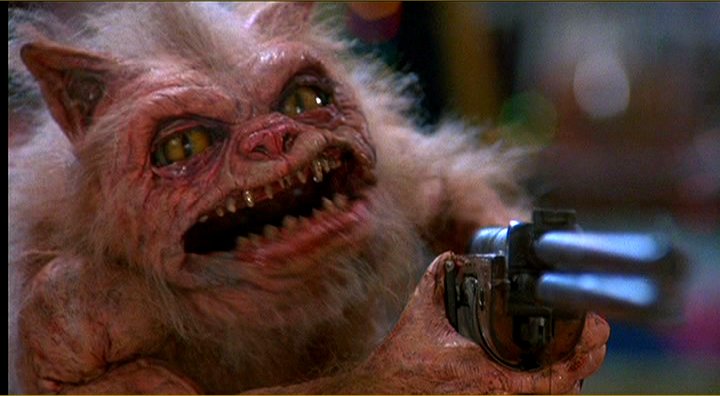
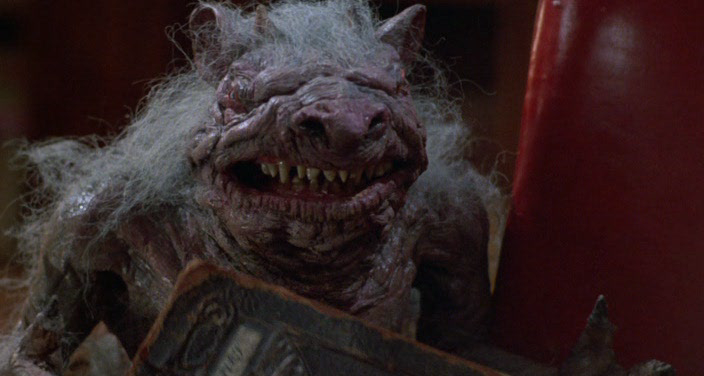
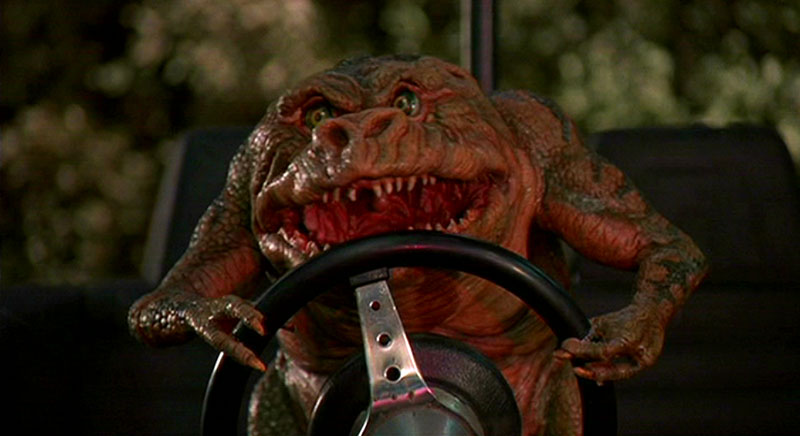
Since the Ghoulies are the stars this time around, a lot more attention is paid to them. The green, cat, and rat ghoulies all return, gaining more advanced designs, while the briefly glimpsed flying ghoulie graduates to featured player. A squat, pudgy lizard ghoulie joins the pack. The puppets are less slimy and more stream-lined, leading to better looking monsters. A few times, they’re even brought to life through stop-motion animation. They have a lot more personality, giggling, chattering, and sticking their heads in unexpected places. The monsters get in a lot more trouble. They gnaw on people, spray a kissing couple with green slime, slice a girl with a straight razor, and wrap a fellow up like a mummy. Fulfilling the promise of the original poster, this movie actually features a ghoulie biting someone’s ass as they sit down on the toilet. “Ghoulies II” is such a straight-up monster movies that it even ends with the heroes (accidentally) summoning a man-sized ghoulie that then eats all of the smaller ones.

The movie also makes good use of its carnival setting. The ghoulies remain in the fun house for most of the film. This leads to some entertaining moments, like innocent by-passers getting strapped into the fun house’s deadly devices. In the last act, the monster are let loose on a busy fairgrounds. They mess with the target game, fool around with the boxing glove game, run someone over with a bumper car, eat a clown dunked in a tank, and, my favorite, take apart a Ferris wheel just as it spins around, tossing the passengers to their death. The carnival setting, with its lovely dancing girls and decked-out freak show, adds a lot of color and fun to “Ghoulies II.”

If there’s any area where the sequel doesn’t live up to the original, it’s in the characters. The bafflingly weird characters of part one are traded out for much more normal horror heroes. Larry and his old, drunk Uncle Ned are trying to save the carnival from the mean businessman who seeks to buy it and fire everyone. Larry’s love interest, Nicole, gets a tedious, standard story arc of being afraid of heights which she, naturally, conquers before the end credits roll. The teenage victims are utterly generic, save for the one guy weirdly obsessed with his boom box. About the only character I like at all is Nigel, a classically trained actor who works in the silly carnival fun house to make end’s meet. Short actor Phil Fondacaro is given some stiff dialogue but he’s a likable presence and makes the character memorable.

Though it lacks the raw weirdness of the original, “Ghoulies II” is a far more focused and satisfying film. It delivers on the monster action the first only promised and gives the demonic beasties plenty of fun stuff to do. It’s fairly forgettable but, for non-discriminating horror nerds, is a good way to kill 89-minutes. [6/10]


Tales from the Crypt: The New Arrival

In “The New Arrival,” Dr. Goetz, a talk-radio child psychologist is faced with cancellations after his ratings start to sag. Enraged that he might loose his time slot to an obnoxious shock jock, he cooks up a scheme in hopes of gaining attention to the show. Along with his producer and the station manager, he visits the home of a regular caller with an abnormally difficult child. Arriving at the spooky mansion, the doctor begins to wonder if the mother is as deranged as the kid.

I’ve never much cared for “The New Arrival” and was surprised to see that it’s well regarded. It has two primary problems, in my eyes. The main character is an insufferable prick and I mean more-so then usual. We may watch “Tales” to see bad people get their comeuppance but usually there’s something sympathetic about them or, at the very least, they’re entertaining to watch. Dr. Goetz is smug, confrontational, short-tempered, and belittles everyone around him. His entire work philosophy is based around ignoring a child’s needs and being a selfish asshole. The plot also doesn’t make a lot of sense. Most of the episode points towards Felicity, the problem child at the plot’s center, being an imaginary creation of the demented old woman. Turns out, Felicity is actually an undead ghoul. How this happened isn’t expounded on and it makes for an especially nonsensical twist ending. Maybe people like “The New Arrival” for its cast. The episode is front-loaded with cult icons like David Warner, Zelda Rubinstein, Twiggy, and Robert Patrick. Or maybe it’s Peter Medak’s atmospheric direction. The mansion is certainly a spooky location and Medak shoots in it in an off-putting way. This is fitting since “The New Arrival” is one of the more off-putting tales. [5/10]


So Weird: Roswell

That “So Weird” would do an episode about the flying saucer that supposedly crashed in Roswell, New Mexico is not surprising. That it would come at the topic from an angle different then the usual conspiracy route, however, is quite refreshing. While riding through New Mexico, the Philips bus picks up what appears to be a mentally disabled adult man named Andrew. Andrew talks about hearing voices and carries a strange piece of metal around with him everywhere. After taking the man back to his sister, Fiona figures out that Andrew is the son of one of the military officers who handled the wreckage found in Roswell fifty years before.

“Roswell” just avoids being overly sappy. Too often, the media portrays people with mental disabilities as magical imps, attuned to a more honest world-view. Andrew is almost literally magical, as he has a connection to extraterrestrials. However, he is still portrayed as someone whose life is more complicated then charmed by his condition. The moment where he recalls what happened with the wreckage when he was a boy is the emotional climax of the episode and quite effective. These moments are shown in moody black-and-white. “So Weird” also takes the reports of the Roswell Incident at first value, which I guess shouldn’t surprise me. Even Molly is a believer. I wish the episode had made a little more time for Jack’s skepticism. The ending suggests that all this business with the aliens is building towards something, one of the many developing arcs destined to be cut short by season three. I like that “Roswell” goes to a more emotional place with its premise and, like “So Weird” usually does, pulls it off in an earnest, heart-felt fashion. [7/10]