Last of the Monster Kids

Last of the Monster Kids
"LAST OF THE MONSTER KIDS" - Available Now on the Amazon Kindle Marketplace!
Showing posts with label addams family. Show all posts

Sunday, September 6, 2026

Halloween 2026: October 6th

 
Scream 7 (2026)

Perhaps there will come a time when we can discuss "Scream 7" only within the context of being another sequel in a long-running franchise. Unfortunately, the circumstances around its production are impossible to ignore. How Michelle Barrera, the star of the last two entries, was fired after making pro-Palestine statements. How this led to an entire retooling of the next installment. How director Christopher Landon boarded the project and quickly left, amid harassment from fans. Whether it was even moral to go see the film was hotly debated in the months leading up to its release. With no other ideas on how to continue the story, I guess, series creator and now director Kevin Williamson went with the creatively bankrupt decision of focusing on Neve Campbell's Sidney. Simply put, "Scream 7" is a movie that shouldn't exist beyond the general reasons yet another slasher sequel probably shouldn't be made. None of this controversy stopped "Scream 7" from becoming the highest grossing title in the series' history. While all the bullshit had me skipping the film in theaters this past February, my dorky need to watch and review the entirety of a horror series has led me to finally judging "Scream 7" for myself. (And if you must know, I didn't pay to watch it, meaning the producers received no monetary gain from my viewing.) 

After years of being pursued by Halloween costume clad killers, the former Sidney Prescott has settled in Pine Grove, Indiana. She is now married to a cop named Mark and works at a local coffee shop. They have three kids, with teenage Tatum being the oldest. Despite having moved on, Sidney's history has led to tension between her and her daughter. This gets a lot worst when Sidney receives a video call seemingly from Stu Macher, one of the original Ghostfaces whose final fate has long been uncertain. Two of Tatum's friends are attacked and killed by a masked murderer at her school. After the town goes into lock down, a Ghostface sneaks into Sidney's home and attacks her and her family. Gale Weathers soon arrives in town, with "Scream VI" survivors Mindy and Chad in tow, to report on the breaking story. Sidney works with her old friend/rival to unravel this latest mystery and keep her daughter safe. Meanwhile, rebellious Tatum and her own friend group decide to take matters into their own hands. 

Aside from Ghostface's victims, another casualty of "Scream VI" was my interest in this series. It seems to me that, for quite some time now, "Scream" has been a series in search of a defining thesis. The original film is a deconstruction of the cliches of the eighties slasher movie. The second one does the same for the expectations around a slasher sequel, a phenomenon in its own right. Rather than evolve with the the times and take on whatever the current trend in horror was at any given moment, the later "Scream" movies have been content to simply eat their own tail. "Scream 3" was about nothing but "Scream's" own self-reflective nature. This was also true of "Scream 4," which gave some passing mentions to the found footage genre before inexplicably revealing itself to be about reality TV. While the fifth "Scream" found some relevance in discussing reboots and legacy sequels, while nodding at the "elevated" horror style, it wasn't about examining horror tropes and their relationship with the real world either. It was about "Star Wars" actually. The sixth film represented the series at its most self-indulgent yet. With the behind-the-scenes kerfuffle shifting seven's focus back to Sidney Prescott, there was almost zero chance of "Scream 7" on focusing anything other than the series' own backstory and unearned sense of self-importance. 

Well, I have some good news. "Scream 7" isn't another "Scream" movie about "Scream." Compared to sixth's masturbatory fixation on referencing past films, this one has fewer shout-outs. Unfortunately, "Scream 7" is also not a continuation of the original's premise of examining slasher stereotypes and the debatable effects fiction has on the real world. There's almost no mention of the "rules" or audience expectations, much less any mention of what is or isn't currently hot in the horror genre. All of which begs the question of what "Scream 7" is about. Well, I'm not sure it's about anything. However, that ever-present cultural boogeyman of "trauma" is mentioned. That Sidney's lingering scars from years of being targeted by serial killers might have had some effects on her own kids is brought up. This mostly manifests in limp arguments between our heroine and a typically temperamental teenager. Tatum resents living her life in the shadow of her mom's pain, which includes being named for the friend who had an unfortunate run-in with a garage door opener back in 1996. Generational trauma is certainly an idea worth discussing, especially as we millennials start to reach the same age our parents were when these movies first started getting made. However, I don't think the esteemed director of "Teaching Mrs. Tingle" has any interesting insight on this idea. The mother/daughter conflict in "Scream 7" mostly feels like petulant whining from Tatum. 

Instead, the only interesting idea inside the sequel revolves a lingering fear every parent has: That they can't protect their kids. Sidney has moved away from Woodsboro, stopped writing books about her life and disconnected from the true crime world. Neither that, nor marrying a cop or building a safe room in her house, does much to protect her daughter from the latest Ghostface. The only time the seventh film comes to life is when Sidney is desperately racing to the coffee shop, to save Tatum. Via an app in her phone, she can access the security cameras at the business. This is how she sees her daughter being stalked by a killer, while trying to talk her through it in a call. This recalls parents helplessly watching as news trickles in about a shooter at their kids' school, unable to do anything but watch or listen through phones and cameras. That's at least a reflection of our current world. "Scream 7" stubbornly resists developing this into coherent commentary. Instead, it merely exists alongside other indicators of modern anxiety, such as AI or the fear that your daughter's boyfriend might be a future mass shooter.  

"Scream 7" is uninterested in reinventing the wheel. The sequel seems to address, and hopefully bury, the incredibly dumb fan theory that Stu Macher somehow survived getting a big ass CRT TV dropped on his head thirty years ago. (While still bringing Matthew Lillard back for an easy pop from the fans.) That's in addition to a largely disconnected opening that sees the Macher house now having become a tacky tourist trap. Which could have been a commentary on the commodification of true crime or how all popular series are wrung out for every dollar until they are a pale imitation of themselves. Williamson doesn't do that either. The eventual reveal of who the Ghostfaces are this time, and the motivation for their murder spree, is somehow the least inspired element of the film, a thrown together twist that is delivered like a half-hearted sigh. 

This is the biggest problem with "Scream 7." At no point can it justify its own existence. I did not find myself caring about any of the new characters or cast members. Joel McHale is Sidney's husband and he shares some okay chemistry with Campbell. The script frustratingly leaves little room fie McHale's trademark sarcasm. Isabela May is mildly irritating but mostly uninteresting as Tatum, a mildly irritating but mostly uninteresting character. Most of her friends are of little note. The true crime fanatic next door or the boyfriend of debatable merit are nothing but obvious red herrings. Rising scream queen McKenna Grace shows some spark as Tatum's BFF but let's just say she exits the film early. The lack of energy behind the new cast would be somewhat forgivable if the script also wasn't so out of ideas of what to do with the old cast too. As has been the case since the third movie, Neve Campbell seems deeply bored with this character and her world. There's an attempt to build something between Sidney and Gale Weathers' relationship. Courtney Cox does what she can but you can't play off a brick wall much. When the film trots out a few more familiar faces, it feels like nothing more than a desperate attempt to spark another burst of dopamine from the dying, overstimulated synapses of an aging fan base by jingling familiar keys in front of our eyes. 

That a sense of franchise fatigue floats over all of "Scream 7" is disappointing. When taken as a simple slasher flick, it's at least got the required amount of gruel and grimness. Much like the sixth flick, there are some well engineered set pieces. The sequel is adapt at putting its characters in unfortunate situations. A young lady is suspended in a Peter Pan rig in a school auditorium while Ghostface lurks below. A cool shot sees the slow reveal of the killer's hiding place within Sidney's home. This proceeds a decently suspenseful sequence where the two final girls have to squeeze through a hollow wall while the attacker on the other side tries to pinpoint their location. That's a good demonstration of the laws of suspense, in showing the audience something the characters may or may not have figured out yet. A stalk-and-slash through the cramped kitchen of a bar, a plastic filled garage under repairs, a dangling from a chandelier, or the aforementioned coffee shop stand-off aren't bad either. You can tell Williamson studied Carpenter's "Halloween," as he emulates the trick of the villain's distinctive white mask slowly appearing in the shadows over someone's shoulders. From a gore hound's perspective, there's one or two amusing butcherings. A beer tap is used creatively. 

All of this implies that "Scream 7" might have been able to generate some suspense or more than a fleeting sense of same-old-same-old entertainment, if these sequences were attached to something other than a contractually obligated continuation. Instead, these scenes occur within a film with zero fresh or interesting ideas of how to stretch this story out for a seventh entry, anchored by a cast with little personality or desire to be there. The film made plenty of money, meaning an eighth installment is all but guaranteed. Such box office results suggest that the team behind "Scream" has no reason to give this series the drastic reinvention it obviously needs. I imagine Barrera will probably get invited back in time, that her storyline will continue in some form or fashion. However, if "Scream 7's" quality is anything to go by, I can't imagine a Sidney or Carpenter sisters-led future for "Scream" that has any actual guts or hot blood pumping through it. [5/10]


Lokis: A Manuscript of Professor Wittembach (1970)
Lokis. Rekopis profesora Wittembacha


The idea of a short story that goes on a bit too much to be called "short" or a novel that maybe lacks a few hundred words feel like concepts as old as literary classifications are. However, the term "novella" actually was invented in 1829. By a Frenchman, of course, sticklers for detail that they are. Prosper Mérimée coined the term and this guy's Wikipedia article is wild, man. Best known today for the story that inspired the opera "Carmen," Mérimée was a real Renaissance man in his day. An influential figure in the Romanticism movement, he was also an archivist, an archeologist, the Inspector-General of Historical Monuments, a folklorist, a translator, a prisoner, a senator, the official advisor to the Empress of Napoleon III, and a catty bitch who loved to start beef with his fellow authors and bureaucrats. He also wrote horror stories sometimes, among which was "Lokis. A Manuscript of Professor Wittembach." Set in Lithuania and inspired by its local legends, the novella was adapted to film in Poland in 1970, by director Janusz Majewski. Since its inclusion in the big folk horror box set a few years back, the film has gained a lot more attention. 

The titular Professor Wittembach is a pastor and writer. He travels to Lithuania to study local folk customs and translate the Bible into Samogitian, an obscure dialect of the region. He is invited to the estate of Count Szemiot, whose library includes many useful old texts. The Count is eccentric, with a history of madness in his family. The family physician, Dr. Froeber, informs Wittembach that the Count's mother went insane following a bear attack, believing her son to be the offspring of the same animal. The professor officiates the Count's marriage to a beautiful young maiden but bad omens persist over the castle. Might Szemiot actually be a were-bear or is he merely a victim of his own beliefs?

Most of the Polish horror and fantasy films I've seen so far have been on the artsier side of the spectrum, usually with a heavy political bent. This remains true with "Lokis." (The title, by the way, is a misspelling of the Lithuanian word for bear.) The film seems especially concerned with the separation between man and beast, which the pastor clarifies as a distinction between our higher, spiritual calling and our more bestial nature. Usually, when were-beast movies delve into this, it's about savagery and sex. "Lokis" touches on that a little bit. The count's backstory seems to link the bear with unleashed sexual frenzy and the story comes to its climax on his wedding night. However, Majewski and his team approach the subject from a sociopolitical angle. "Lokis" frequently contrasts the nobility, and its interest in academics, with the peasantry, who are a more superstitious lot. One of the first scenes is Wittembach and some elegant ladies watching, from a train, a street performance with a bear. This sets up a distance between the haves and have-nots. While the film ostensibly adopts the more "high-minded," scientific perspective of the upper crust, this is a world fairly unambiguously at the mercy of otherworldly forces. For all its pomp and circumstances, the ruling class is as governed as much by animal desires and the whims of the hidden world as those they preside over.

“Lokis” was made three years before “The Wicker Man” but bares some resemblance to that watershed moment in folk horror history. Both films concern a Christian authority figure, quite secure in his monotheistic viewpoint of the world, being continuously challenged by pagan beliefs and rituals. Matching the more intellectual tone of the film, “Lokis” has Wittembach's understanding of a world governed by a logical God at odds with the otherworldly events he witnesses. A carriage driver warns him of the devils that haunt the forest. Only to have a wheel pulled right off their vehicle, the supernatural forces seemingly proving their own presence. Later, the pastor and the count encounter a self-styled witch in the woods. She comes across as merely an eccentric old woman at first before walking across the moss covered surface of a river as if it's a solid object. “Lokis” slots in nicely with the political and spiritual upheaval of the early seventies, when traditional structures were falling apart and a different, more daemon-haunted world was presenting itself. 

All of that probably sounds pretty interesting. And it kind of is, if you're into European folklore. Unfortunately, Majewski's film is almost unbearably slow. “Lokis” is a motion picture composed almost entirely of men standing around in stately rooms and talking to each other. When the back story of the Count's mother possibly having been assaulted by an ursine is delivered, it plays out as a conversation over some paintings and books. The climatic moment of the film occurs entirely off-screen. All of this is delivered with a stilted, mannered approach. The movie can summon a certain dreamy energy in its best moments, such as the sequence with the witch. The score ramps up a few times, to get the heart pumping. However, nothing much actually seems to happen. “Lokis” is a horror movie in theory but everything sinister is implied, not shown. Don't go in expecting any were-bear chaos occurring on-screen, is what I'm saying. 

That glacial pacing does seem to divide viewers of “Lokis.” I've seen some enthusiastic reviews of it, from people fully sucked into its folkloric dreaminess and not too bothered by the slowness. However, others have been seriously let down by how the movie focuses on ideas and ambiance over anything else at all. It's a nice looking film, with strong cinematography and eye-catching visuals. The settings, of a forest with sheltering branches and the strange looking castle, do make for a suitably surreal location. Ultimately though, I found myself fighting sleep before the relatively short runtime wound up. Maybe you'll find it a bit more compelling but, despite some interesting sights and more interesting ideas, “Lokis” was sabotaged for me by a plodding pace. The film did intrigued me enough to add the original novel to my reading list, though that might also be because Propser Mérimée's life story caught my eye too. [5/10]


Wednesday: You Reap What You Woe

Netflix didn't cast recognizable actors like Catherine Zeta-Jones and Luis Guzman as Morticia and Gomez only to use them for a bit in the first episode. And so Wednesday's mom and dad come into focus in "You Reap What You Woe." The episode reveals that, while attending Nevermore as teens themselves, Gomez seemingly ran through a romantic rival for Morticia with a sword and dropped him off a ledge. While investigating the recent suicide of the seemingly happy town mortician, Sheriff Galpin uncovers evidence that Gomez did commit murder all those years ago. (How he escaped this conviction originally doesn't come up.) While Wednesday's parents are visiting the school, her father is arrested for the decades old crime. Now their daughter must pause her investigation of the current strangeness plaguing the school to clear her pop's name. Meanwhile, the other students at the academy have their own mama drama to attend to. 

The early flashback reveals that Gomez and Morticia attended Nevermore in the year 1991. Which would put them both in their forties in this show, assuming it's set in the modern day. While the original series did assign specific ages to the Addams, the thought of these two being Gen-Xers doesn't sit well with me. The idea of Gomez growing up during the Reagan administration feels wrong. However, I will say that Guzman and Zeta-Jones are well cast in the part. Guzman even looks a lot like Charles Addams' original illustration. He's certainly capable of bringing the weird gremlin energy of John Astin or the unapologetic eccentricity of Raul Julia to the part. The episode doesn't give him a chance to do that but at least the "Wednesday" show-runners felt no need to subvert the undying devotion and passion the parents have for each other. Zeta-Jones certainly has the demure sensuality and fey glint of the eyes necessary for Morticia. The show continues to play some tension between Wednesday and her mom, which still feels contrived to me. "You Reap What You Woe," in general, heaps on the sentimentality between parent and child. A scene where Gomez and Wednesday talk it out while he's behind glass comes awfully close to being too precious. She has a heart-to-heart with Pugsley too, once again showing how "Wednesday" seems incapable of balancing both the loyalty that defines the family and the sadomasochistic bond between these siblings. 

Despite the program's insistence on sticking intentionally atypical characters into a standard dramatic arc, the guest stars do enliven "Wednesday" a lot. Once again, I like this show the most when it resembles the old sitcom. Gags like Pugsley munching on potpourri with his dad or fishing with hand grenades, or mother and daughter swapping tips on disinterring a corpse, genuinely made me snicker. Almost like this gang was invented to deliver simple visual jokes and not be involved in an elaborate mystery! Speaking of which... "You Reap What You Woe" pushes the ongoing narrative aside for a bit. Eugene was left in a coma by the monster attack, a very annoying reeling back of the previous episode's cliffhanger. The details of what happened back in 1991, that Wednesday uncovers piece by piece, are very stupid. If the solution to your mystery involves mind control potions, you've written a bad mystery. Still, at least the fate of characters we actually care about are at stake here. If the Addams Family must be at the center of some grand intrigue, Gomez having possibly murdered another man for Morticia's affection feels a lot more in-character than whatever bullshit the season is building towards. It also helps a lot that this particular story line is resolved in one hour, instead of being dragged out intermittently for an entire season. 

Actually centering an episode of an Addams Family series on the Addams Family feels like an obvious conclusion. However, it's something "Wednesday" clearly is struggling with, if the subplots of this installment are anything to go by. Enid has a guilting, heavy-handed mother. She eventually gives her daughter pamphlets for "werewolf conversion" camps that will supposedly help Enid embrace her lycanthropic nature. Using a classic monster condition as a metaphor for being gay is an age-old practice. However, I think the allegory falls apart very quickly here. Enid is being told to embrace her inner nature, not deny it. Unlike queer teenagers sent off to abusive "prayer the gay away" camps by bigoted parents, she actually is a werewolf. She also likes boys, in a very traditionally girlish manner, making any attempted parallels seem wrong-headed. Enid's mom is worried about her daughter because she's a late bloomer, not because her lifestyle disagrees with them. It's a weird choice but at least Emma Myers is charming. An additional subplot about the siren girl's mother being in a cult or something is absolutely impossible to care about. More bullshit grist to occupy the runtime with on the way to the A-plot's conclusion, that I'm sure future episodes belabor unnecessarily upon. Who on the writer staff for this show had unresolved mama drama and why did they feel the need to insert it into multiple subplots? [5/10]


Thriller: A Wig for Miss Devore
 
Through no intentional move on my behalf, there's the second classic horror anthology episode I've watched this month to feature John Fiedler. In “A Wig for Miss Devore,” he plays the agent for the eponymous Sheila Devore. A once promising actress, Miss Devore is already washed-up and her looks faded by the age of 31. She is plotting a comeback though and finds a perfect vehicle in the story of Meg Peyton, a 18th century woman hanged at the gallows for witchcraft. Legend has it that Peyton wear a wig woven from the hairs of her victims, which granted her eternal youth and fame as long as she kept it on. Studio head Max Quinke has been keeping the residuals to Sheila's past hits to himself, information Herbert uses to blackmail him into funding the actress' comeback vehicle. Devore secures Meg Peyton's actual wig for the production, wearing it and being as strikingly beautiful again as she once was. Filming goes off without a hitch and the movie is a hit. The director marries Sheila. Yet the men around her seem to keep dying mysteriously. First Max and then her new husband, both of them found with horrible scratches over their faces. Now, what could possibly be the link there, I wonder? 

“A Wig for Miss Devore” is about the fourth episode of “Thriller” I've seen that resolves around a cursed object. Several of those were written by Robert Bloch, while this one is based on a story from fellow Weird Tales graduate August Derlith. I suppose this speaks to the way the pulp writers of the forties and fifties placed classical gothic horror tropes in modern contexts. “A Wig for Miss Devore” has quite a contemporary context, taking place in the world of Hollywood. The story of an aging and somewhat delusional actress recalls both “Sunset Boulevard” and “Whatever Happened to Baby Jane?” The script doesn't seem to have much insight into the wages of fame or how the shallow film industry treats women though. The episode plays Sheila as both somewhat victimized by the men around her, like the scheming Max and the manipulative husband, while also having her be a femme fatale. (While also implying that she's not that talented, seemingly only known for her looks.) I suppose the idea is that revenge hardens the heart of everyone, even those with justifiable grievances. Or perhaps the story is simply speaking to the cut throat, ruthless nature of the motion picture business. A woman has to resort to witchcraft and murder if she hopes to claw her way back to the top, in an industry that discards any actress for the crime of simply getting a little older.

Trying to dig up too much deeper meaning here is difficult though. Instead, it's a pretty simple fable, of someone with an insatiable vanity that eventually proves to be their own undoing. Patricia Barry does give a fine performance in the titular role, striking the viewer at first as an airhead type before revealing her more calculating, vicious side. The men around her prove to be properly spineless or deceiving. I wish so much of the story's ironic pay-off wasn't shoved into its last minute. I've not read Derluth's story but this feels like an encapsulation of a longer tale. In my experience, what “Thriller” really excelled at was fantastic final shocks and a willingness to be surprisingly grim for the time. “A Wig for Miss Devore” does have a gory final image and, by the standards of 1962, it was probably fairly shocking. It's also not as good as the shock endings we got in “The Cheaters” or “The Hungry Glass.” However, there is a memorable image here. Whenever Miss Devore removes her wig, until the final minutes, all we see are aged, ghastly hands groping through the shadowy air. That's pretty cool. I do wish more episodes of this series had Boris Karloff doing both an intro and an outra, Hitchcock and Sterling style, cause I do enjoy his baroque monologues. [7/10]


Saturday, September 5, 2026

Halloween 2026: October 5th

 
John Carpenter's “The Thing” ranks near the top of any list of obvious future classics that were initially dismissed by audiences and critics. This is the most basic piece of trivia about the movie. Nine years after the film's unsuccessful theatrical run, enough of a cult following had built up to make a continuation of some sort commercially viable. That's when “Darkman” screenwriter Chuck Pfarrer pitched Universal on a sequel. The studio passed on the treatment but it would re-emerge as a comic book from Dark Horse. (Re-titled “The Thing from Another World,” to distinguish itself from Marvel's ever-lovin', blue-eyed variety.) Three further comic book arcs sprung off from that one, proving that there was demand for more Things. This would kick off a series of attempts to sequelize Carpenter's remake but, in the metamorphic nature of the alien threat, always in mediums other than film. There was an almost well received video game in 2002. Three years after that, Frank Darabont attempted to produce a four hour long television mini-series for the Sci-Fi Channel. This would've depicted what happens when the Thing reaches a populated area. That didn't get made but, in 2007, you could walk through a Halloween Horror Nights maze based on the film.
 
All of this suggested a serious desire to replicate the 1982 film. During the horror reboot hungry new millennium, rumors of a remake of Carpenter's remake sprung from the ice. Quickly realizing that an imperfect clone would be unflatteringly compared to the progenitor, it was decided to follow the second most hacky trend of the time and do a prequel about the Norwegian camp instead. Dutchman Matthijs van Heijningen Jr. quickly boarded as director and a new “Thing” finally grew. Much like another horror reboot Universal made around the same time, the film was subjected to clueless executive meddling and reshoots. Fans and critics generally saw the prequel as an unconvincing copy of what came before. Though it did duplicate Carpenter's work in the sense that it also didn't make much money at the box office... Despite general audiences rejecting the premise twice now, there has been some hubbub recently about another stab at “The Thing.” It remains to be seen if anything will sprout from that but it did prompt me to revisit this prequel, to see if it was better than I recalled from a decade ago. 

And so we return to the frozen wasteland of Antarctica, slightly before the last time we visited it. A Norwegian research team from Thule Station are crossing the ice when their vehicle plunges through the surface. Within, they make two startling discoveries: An apparent otherworldly space craft and, a short distance away from it, the frozen remains of its very inhuman passenger. Kate Lloyd, an American paleontologist who specializes in excavating fossils from the ice, is called in to assist. The team successfully removes the hunk of glacier containing the life form and takes it back to the station. Team leader Dr. Halvorson is ecstatic to have made the paradigm shifting discovery that man is not alone in the universe. Kate and the others, including American helicopter pilot Sam, are less certain. That feeling grows when the thing in the ice breaks out, springing back to life after millions of years. Worst yet, the creature possesses the ability to assimilate and perfectly replicate living tissue. Now, much like an American team will discover in the near future, the residents of the station must contend with the shapeshifting Thing and their own paranoia about who could possibly be it. 

While the uncertainty of its ending has been endlessly discussed, Carpenter's "Thing" is greatly served by ambiguity all throughout. Who among the cast is the monster is rarely certain. The "what" around the creature is largely explained, "where" remains a vague answer of outer space, and the "why" is totally unrevealed. What happened at the Norwegian base is a purposely intriguing question, meant to draw the audience in further and foreshadow what will happen to the Americans soon, but the specific details were a mystery. All of these touches are what makes "The Thing" the intriguing, involving film it is. The prequel, meanwhile, seeks to answer as many questions as possible. Heijningen and his team went through the exploratory scene set at the abandoned base with a fine-tooth comb. They then built their film around showing us the exact steps that led to each little detail. Even minor ones like an axe embedded in a wall or an overturned shelf. It's a well-intentioned but flawed thesis, misunderstanding the purpose of a scene meant largely to entice and forebode as backstory that must be breathlessly detailed. This is the kind of fan boy brain better applied to wikia pages than narratives. 

This is not the main bone of contention people have to pick with 2011's "The Thing" though. No, the prequel was vexed by the exact annoying bullshit everyone feared from a modern day follow-up. Tom Woodruff Jr.'s Amalgamated Dynamics created practical creature effects for the project and they were used on-set. After test audiences complained that the results "looked like an eighties movie," CGI was hastily plastered over the rubber and latex. The effects team were so dismayed at the last minute changes that Woodruff ended up crowdfunding his own "Thing" inspired, all-practical (and totally forgettable) movie. Heijningen, meanwhile, has expressed regret over kowtowing to a clueless studio. Some internet users have petitioned for a release of the unaltered footage, if not a full director's cut of the prequel. This presents a tidy, fan-favorite narrative, of the promising young filmmaker having his vision ruined by air-headed execs. Of a disregard of hand-made artistry in favor of shiny, modern technology that will age far quicker and far worse. 

Now, I have no doubt that the practical creature make-up was easily superior to the rushed out CGI the final film utilizes. The digital effects are often poorly combined with the live actors. A face splitting in two or the final adversary both look especially unconvincing. However, Woodruff has clarified that his team's designs were maintained, the puppetry merely replaced with identical if less convincing CGI. None of the monstrous forms on-display here compare in any way to the work of a sleep-deprived, coked-up, young and hungry Rob Bottin. The original film featured asymmetrical creations, flesh that twisted and warped with a vicious nightmare logic. It combined the very familiar frailty of our human bodies with unexpected sights and sounds, to create a truly alien seeming entity. The prequel, meanwhile, always seems to center a face or jaws in its mutations. There are a lot of vagina dentata like maws or stabbing tentacles shooting forward like arrows. Bodies bend and flop around but are still recognizably human. The one clever gag the film has, an arm suddenly detaching, is quickly squandered by the film returning to gaping, toothy, screeching mouths. While the mediocre digital blanket job does the designs no favor, they repeatedly show a lack of imagination. Never once did the transformations make me wonder what the hell I was looking at, which is kind of an essential quality for this material. 

That lack of imagination is apparent in other elements of the film. While not technically a remake, 2011's “The Thing” essentially operates as one. Many of the iconic moments have similar sequences here. The beloved blood test is reprised, this time with fillings in teeth being used as the indicator that someone is still human. The aforementioned bit with the arm clearly recalls that time a head skittered across the floor. The prequel also concludes with a stand-off between the hero and the monster in its own lair, climaxing in a fiery explosion. Rather than expand on the first film, the script is content to merely repeat what worked before. Except Matthijs van Heijiningen Jr. isn't John Carpenter, with the rest of the crew clearly being similar downgrades. Instead of a score that emphasizes quiet unease, dramatic moments are punctuated with loud notes on the soundtrack. Instead of focusing on generating a feeling of isolation, the film goes for shit jumping out of the dark at you. 

2011's “The Thing” functions a lot like a modern legacy sequel, in the way it seems designed to simply remind viewers of a better movie with most of the changes being cosmetic. While Carpenter's “Thing” is famously devoid of female characters, this one has two. Mary Elizabeth Winstead stars as Kate. You'd think inserting a woman into an all-male space, especially in a story set in the early eighties, would present opportunities for commentary on gender dynamics or sexism or something. Kate is treated badly by Dr. Halvorson but not because she's a woman. It's because he's an asshole who is angered by anybody who challenges his plans. If a man had played this part, her function in the story would be entirely unchanged. Which is either the most progressive position you can take or renders the choice so arbitrary as to make you wonder why it was done at all. Having the French doctor also be a woman doesn't make this a male-exclusive environment anyway, so I guess it doesn't matter. 

Perhaps I'm nitpicking, complaining about what a film isn't and not about what it is. However, if a quasi-remake does little more than make changes simply to be different from the original, something has gone astray. A pun about how the authors of this "Thing" were not as good at copying as their titular menace is unavoidable. Personally, I think if you are going to make a belated follow-up to an iconic film, you're better served not blatantly emulating scenes and story beats from such a highly regarded work. Maybe the next remake should go back to the monster being a plant guy. What makes this "Thing" more unnecessary is that a far more clever remix of Carpenter's classic was released the year before. Peter Watts' short story "The Things" retells the 1982 events from the perspective of the alien, aghast that Earthlings are unable to shapeshift and unwilling to be assimilated. I don't know how you'd translate that story cinematically but it would make for a more interesting variation than this unimaginative prequel. [5/10]


You might not have heard of Raju Patel but he had a curious life and career. The son of an India born filmmaker, he was born and raised in Kenya. His dad, Sharad Patel, had some success with the biopic about Idi Amin where imprisoned journalist Denis Hills played himself. With business dealings in both England and America, Patel would have a pretty big hit with sex comedy “Bacholer Party” at only 24 years old. He would work on Disney movies, Hindi-language productions, and collaborated with random names like Mark Damon and Michael Jackson. He then checked out of life early, dying in his forties of colon cancer. Despite his eccentric career, Raju Patel would only direct one feature. That would be “In the Shadow of Kilimanjaro,” an international co-production that nonetheless still qualifies as one of the few horror movies made in Kenya. It's a trap-on-VHS cast-off that has a pretty good title, which is why I remember it. After all, if you're going to put a famous African mountain in a horror movie, probably a good idea to go with the one that has “Kill” in its name.

Within the shadow of the titular mountain peak are the key locations the film takes place in: The small village of Namanga, a school building for the local youths, a mining operation overseen by an Australian named Chris Tucker, and a hotel/bar that largely serves the miners. The area is caught in an on-going drought and it's causing the local wildlife to behave aggressively. American zoologist Jack Ringtree, while awaiting for his wife to arrive in the village, discovers a child orphaned after her mother is killed by unknown animals. This proceeds further violent attacks, the responsible party being a large troop of vicious baboons. Jack tries to alert the authorities and evacuate the area but his concerns are dismissed. It's not too long before the baboon attacks increase in frequency and intensity, soon trapping the locals within the hotel. 

Among the various dangerous wildlife of the African plains, the Chacma baboon probably ranks far below the more well-known body counts of lions, elephants, hippos, cape buffalo, wild dogs, hyenas, and so forth. Which is not to say that the baboon can't make for a properly intimidating visual. They have those massive fangs after all, the puffy face pads, the big red butts, the sinewy little bodies. While their primate intelligence has made them nuisances to people over the years, it's mostly the fact that they are exceptionally crazy looking when pissed off that makes the baboon a decent movie monster. “In the Shadow of Kilimanjaro” exploits this nicely. The baboon attack scenes, mostly done with real animals, get a lot of mileage out of the apparent ferocity of these monkeys. A swarming pack of angry baboons going right for your face is, indeed, a scary thought. “In the Shadow of Kilimanjaro” emphasizes this with some surprisingly gory special effects, of severed limbs and other body parts slumping to the ground as the beasties tear people apart. 

At the same time, the premise of “In the Shadow of Kilimanjaro” may strike some as, at the very least, unlikely. Baboons are not historically known to be man-eaters and, in some lights, can be kind of cute. The film tries to deflect this thought by claiming to be based on a true story. (An internet search on the topic mostly redirects back to this movie, meaning it couldn't have been too well known an event.) Despite that, “In the Shadow of Kilimanjaro” still generates outrageous chuckles more often than gasps. A rather robotic looking baboon puppet is used for a few scenes. I do applaud the actor playing an airplane pilot in one sequence, who keeps on flying while a very real mad ape is going at his head. Despite that intensity, it's still a deliriously silly sequence. Vicious as they can appear, I guess there is something inherently comical about monkeys sometimes. Still, in its last third, when the film becomes something of a siege picture about a stranded group of survivors hiding in a single location from the rampaging horde, it does generate some okay tension. The wind blowing on the plains at night, wild beast with glowing eyes emerging out of the darkness through a broken window, isn't a bad effect.  

By some improbable coincidence, this is the second jungle-set movie I've reviewed this year that features John Rhys-Davis sporting a preposterous accent. This time, the Welsh thespian adopts an Australian accent as the overseer of the mining operations. He's joined by Timothy Bottoms as Jack. If all animal attack movies are “Jaws” rip-offs of a sort, Rhys-Davis would probably slot into the Quint role. Bottoms is a combination of Sheriff Brody – the low-level authority whose reasonable warnings are ignored by those in command – and Hooper, an animal expert. Unfortunately, the film does not flesh its lead characters out any beyond that. The subplot of Jack and his wife's stormy relationship is nothing but filler. There appears to be an undercurrent in the script, criticizing white industrialists exploiting the natural resources of Kenya. This is most apparent in Don Blakely's role as the elderly, fairly racist hotel owner. This idea never germinates into anything substantial though. The film misses the chance to have its clueless town leader get munched by some crazed monkeys. I guess that correlates with the mayor making it out of “Jaws” unscathed. 

The underwhelming character work pairs with an abrupt and unsatisfying ending, though I suppose it's as logical a conclusion as you'd expect from a story about a drought. “In the Shadow of Kilimanjaro” never quite comes together. The script is too thinly sketched and unable to mine consistent thrills out of its fuzzy threats. Which isn't to say that there isn't some novelty to a baboons go bananas horror flick, especially one set on the actual African continent. (Which distinguishes this one from “Shakma,” whose trailer is slightly funnier, on the short list of baboon-sploitation flicks.) Raju Patel, or at least the team he hired, does show a semi-decent handling of the material, suggesting he probably could have made better movies than this one further down the line. I guess the experience of wrangling a pack of literal baboons did not endear the directional process to the guy. This is definitely a film I wanted to like more than I actually did, if only because of its novelty, but there's not quite enough here to make it stick. Though that airplane attack scene is hilarious. [6/10]


Wednesday: Woe What a Night

 
I feel like any time I review a modern streaming series, all I do is complain about how these shows are paced, plotted, and structured. The fourth episode of "Wednesday" is a case study example of how sloppy this style is. The show has stacked up a collection of plot threads that it can leap between whenever it wants, with no concern for tonal consistency, satisfying pacing, or overall coherence. This installment sees Wednesday digging deeper into her investigation of the wide-eyed monster in the woods, presenting her evidence to an annoyed and stunned Sheriff Galpin. She discovers that it takes body parts from each of its victims and seems to find its cave lair. She spots some scratches on Xavier's neck and uncovers his secret art studio, which includes paintings of the beast. Suspecting him of being connected to the killer, Wednesday instead ends up asking Xavier out to the upcoming school dance to cover for herself. 

This uncorks a mess of soap opera-like romantic entanglements. Enid goes to the dance with another guy, one of the bullies in town, to make Ajax jealous after he stood her up the other night. Xavier apparently genuinely likes Wednesday and, when he discovers that she only asked him out because of the mystery, he asks his siren ex-girlfriend to erase his memories of the Addams. But Wednesday still has a date to the dance cause Thing, of his own accord, asked normie townie boy Tyler to take her instead. That's not all of the melodrama at work here, as nerdy beekeeping boy Eugene is also harboring a crush on Enid. Oh my god, what the fuck. How is this an "Addams Family" show? Netflix really did take a premise designed to deliver goofy, morbid sight gags and turned it into a "Twilight" style supernatural romance for teenagers and fandom-brained Tumblr users. 

By 2022, however, the comic strip and sitcom that spawned her was long since overshadowed by the snarky goth girl archetype that Wednesday Addams became in the popular consciousness. "Wednesday" is a show more for people who saw the Barry Sonnefield films as a kid and caught a crush on Christina Ricci or fans of some YouTube cosplay account than anything else. I mean, the character imprinted on young me too, leading to an unfortunate life long fascination for women with dark hair, black clothes, cyanide wits, and undiagnosed BPD. Tim Burton deserves a lot of blame for the commodification of the goth subculture too, which makes his involvement with this show almost satirically on-the-nose. This episode really gets at how annoying this entire shtick has become in two moments. That is when a character tells Wednesday how he admires how free and unburdened she is by social expectations. Once again, it is hammered that Wednesday is a self-styled outcast, unpopular with her peers. A bit hard to buy that when she's at the center of two separate crushes in this episode alone and her family clearly has a long history with the school she's attending. Another scene has Wednesday criticizing the "objectification of women and the male gaze," a tweet misconstrued into dialogue. The episode then features the obviously movie star pretty Jenna Ortega doing a wacky girl dance at the goth prom to a Cramps song. It is a moment so tailor-made to appeal to people with a fetish for superficial strangeness that it's really as objectifying and othering for the young woman at its center as a strip tease would be. 

Of course, that scene became a viral sensation and is probably the main reason "Wednesday" became such a hit for Netflix. Like I said, I'm part of the problem. I liked that scene. It is one of the few moments "Woe What a Night" emerges from its own mess of subplots and rehashed cliches to show a spark of energy or wit. The "Carrie" homage that follows is predictable as can be but Ortega's enthusiasm and then disappointment with the stunt actually got a laugh out of me. So did how she stumbles through her attempt to ask the long-haired pretty boy to the dance. Or the genuinely cool shot of her and Enid in their dorm, split right down the middle between their two distinctive aesthetics. All of this suggests that if "Wednesday" was as much of a sitcom as the show that spawned it, merely about contrasting the protagonist's particular behavior against stratified adolescent social rituals, it would probably be consistently funny. Alas, such a humble pleasure is beyond the modern media landscape and I have four more episodes of this show, that I very stupidly promised to review, to wade through. [5/10]


The Twilight Zone: To Serve Man

As with past installments I've covered, I know the twist ending of "To Serve Man," the 24th episode of "The Twilight Zone's" third season, very well.  The rest of the episode is discussed less often. Alien beings known as the Kanamit arrived on Earth. They come in peace and, moreover, generosity. The beings speak to the United Nations from a book and offer endless treasures. While people are skeptical at first, the Kanamits lives up to their offers. They turn barren deserts into verdant fields. They offer impenetrable force fields to each nation, ending all international conflict overnight. They also willingly submit themselves to any tests the Earth governments ask for. Among these is an attempt by the American government to translate the significant book the aliens brought with them, whose title means "To Serve Man." Chambers, a cryptographer, and his assistant Patty work at the task. As pleasure cruises from Earth to the Kanamit home world begin, Chambers decides to join such a ride. As he boards the vessel, Patty arrives to inform him of the book's true purpose... 

The outlook of Rod Serling's work was usually pessimistic. Many of his stories reflect a belief that, while the individual person might be good, the human race is destined to destroy itself over petty grievances. "To Serve Man" is a bit unusual in that an outside force is the antagonist. Nine foot tall, dome-headed aliens arrive extending a glad hand only for it to hide more sinister intentions. It is tempting to read the moral as xenophobic or at least extremely cautious: Don't trust any offer that seems too good to be true. It reminds me of Hansel and Gretel, where endless generosity and a shelter in a storm are only a precursor to pure predation. All that kindness is to disarm you. All those sweets are just to fatten you up. While "To Serve Man" is ultimately cynical in its perspective, I do think Serling is criticizing mankind's preference for easy answers and gluttony more than anything else. Alien saviors arrive and resolve all our problems instantly. It makes us so happy that we can barely stop to consider their motivations. Moreover, the Kanamit promises endless pleasures too. Why, as a man boarding their ship excitedly shouts, they even have baseball on their home world. Maybe that fairy tale comparison is apt and the episode should be taken as a simple warning that good intentions are not always what they seem. Now, as then, tis simple truth, sweetest tongue has sharpest tooth. Literally, in this case. 

My initial reaction to "To Serve Man" is once again astonishment at how economical vintage television could be in its story telling. This is a far reaching story, about the entire planet's reaction to otherworldly visitors, and ends in outer space. Despite that, it runs a half-hour and mostly takes place in a few simple rooms. The action is mostly composed of people talking. Somehow, the stakes never feel artificial and the audience never feels cheapen. The U.N. setting establishes the global impact of these events and the seriousness with which each actor approaches the material makes the consequences feel fittingly important. I really like the montage in which leaders of various countries thank and welcome the alien visitors, speaking in their own languages with the translation appearing as a news ticker at the bottom of the screen. It shows that newsreels and stock footage – notable examples immediately recognizable as from "The Day the Earth Stood Still" and "Earth vs. The Flying Saucers" – can indeed be used to create a sense of scale and wide-reaching events. It's never the budget of a project but always the people utilizing it. 

"To Serve Man" doesn't have the intense expressionistic visuals of "Eye of the Beholder" nor the surreal nightmare logic of "It's A Good Life." Director Richard L. Bare – who would go on to direct "Wicked, Wicked" and 166 episodes of "Green Acres" – mostly keeps things simple. Though I do like the Kanamit being introduced first as a towering shadow on the wall before we see its face. Beloved tall guy Richard Kiel plays the lead alien. While the bulging cranium and white robes are typical of extraterrestrial depictions of the time, the Kanamit communicating strictly via telepathy means their faces are unmoving. Their eyes seem to project dull, animalistic instincts while their mouth droops open slightly, like a dog salivating over a ham bone. Maybe that's meant to be a hint to their motivations being hunger, not kindness. The ending is one of bitter irony, the title being revealed as a sick punchline, and the final moments being a grim conclusion that the wilier predator is always destined to eat the lesser one. Pretty good stuff. A tasty meal served quickly and effectively. [7/10]


Friday, September 4, 2026

Halloween 2026: September 4th

 
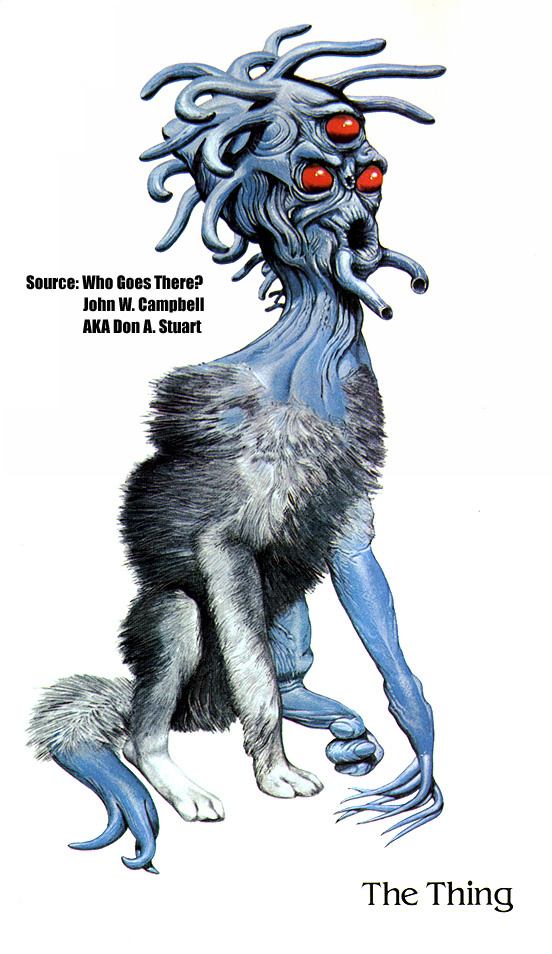
1938 would see the publication of "Who Goes There?" by John W. Campbell. It is a tale of an isolated Antarctic research team uncovering and unleashing a shapeshifting alien threat, that fully assimilates and then perfectly imitates any living being. Campbell seemingly invented a new type of monster, an ever-shifting and totally insidious invader that is so alien to human form and thought that it can only be called a thing. The literary thing first appears as a blue-haired, telepathic beastie with three glowing eyes before assuming a litany of other forms, via grotesque mutations of the flesh. Such a creature was beyond the special effects capabilities of the film world for many years. In 1951, Christopher Nyby and Howard Hawks would turn the amorphous thing into a seven foot tall vegetable-man in a medical jumpsuit with a Frankensteinian flat head, spikes sprouting from its knuckles, and a taste for human blood. A far looser, unofficial adaptation in 1971 made it into a psychic virus initially housed in the body of a red-eyed sasquatch. 

A few years after that, Universal began to develop a new cinematic take. Tobe Hooper's idea, set on a submarine with a non-shapeshifting thing, was discarded. Other notable names briefly linked to the project were Sam Peckinpah, Walter Hill, Michael Ritchie, John Landis, Deric Washburn, Nigel Kneale, and Richard Matheson. John Carpenter was approached early on but, as a big Howard Hawks admirer, was reluctant to commit. After reading the source material and teaming with writer Bill Lancaster, Carpenter's "Thing" would begin to take shape. By then it was the early eighties and creature effects in Hollywood were about to undergo a major renaissance. Monster makers like Baker, Winston, and Bottin were redefining what could be done with rubber, latex, inflating bladders, and robotic puppets. Bottin's achievements on "The Thing" stands as a major landmark of this time, Campbell's shapeless monster finally being realized as a cinematic nightmare.

Lancester's script would maintain the general outline of Campbell's story. Most of the adaptational changes made are of a strictly practical reason: 12 men stationed at Antarctic Outpost 31, rather than the novel's thirty. The Thing is no longer telepathic and its base form is never revealed. The biggest difference is that the research crew led by R.J. MacReady no longer discovers the alien life form. Instead, the near-by Norwegian camp uncovers the thing, their excavation of the flying saucer glimpsed as a proto-found footage movie on their monitor. While 1951's “Thing from Another World” played up on atomic era fears of strange threats coming from the sky as much as any fifties sci-fi movie, this change re-contextualizes the story in a global context. America never had nuclear tensions with Norway but the barrier of another language characterizes the early eighties setting. As Mac says, “Nobody trusts each other now and we are all very tired.” Anybody possibly being the Thing speaks to Cold War paranoia about the possibility of anyone being an enemy spy or government spook. This anxiety runs so deep that those taken over by the extraterrestrial threat aren't even aware of it. Imagine that: Your neighbor or sibling or yourself being an agent and not knowing it. 

Another element taken directly from the source is the understanding that, should the Thing escape the frozen continent, the consequences would be massive and immediate. This is the first film in Carpenter's informal Apocalypse Trilogy for good reason, the alien threat liable to consume all of humanity within months. As the film progresses, the characters increasingly face the possibility that none of them can survive this ordeal. For the betterment of mankind, to ensure that the Thing never escapes, they'll all have to perish. The much discussed and often referenced final scene isn't only a statement on the film's theme of distrust. In the context of the Cold War, MacReady and Childs agreeing to wait for a little while and see what happens – an admission that they'll both freeze to death before either concedes defeat – reads like a metaphorical Mutually Assured Destruction. It speaks to an international mood of apocalyptic paranoia, where it doesn't matter if you survive so long as the other guy doesn't win.

As pertinent to 1981 as the film's ideas were, “The Thing” endures because its themes are also timeless. The Berlin Wall fell a long time ago but the American Century of Global Anxiety is never ending, meaning an inability to distrust your fellow countrymen is as relevant as ever. Other signifiers root the film to the eighties decade. The way the guys are constantly drinking alcohol or smoking weed hearkens to a post-Vietnam era of national burnout. Blair is left alone in a cabin with just a flask of booze, a quiet agreement among the men that there's nothing left to believe in but the next high or bender. The year of “The Thing's” release also saw the first documented case of HIV, meaning it definitely wasn't on anyone's mind during production. Nevertheless, a sequence of protracted suspense around the purity of blood inevitably brings it to mind. Like that other great eighties remake of a fifties monster movie, Carpenter was speaking to a more generalized fear of bodily uncertainty that unknowingly spoke to the pandemic of the day. All of us are at the mercy of bodies and minds that will fail, will decay, and will turn on us. The explosive eruption of the Thing from its humanoid disguises are like out-of-control tumorous growths for a reason.

But let's go down the “Thing as AIDS metaphor” trail a little further. Because it gives me an excuse to talk about one of my favorite things: Homoerotic subtext in eighties hyper-masculine media! Like the second thing everybody notices about this movie is that there are no women in it. That trivia usually accompanies a mention of the sole female performer in the entire film, Adrienne Barbeau as the voice of MacReady's chess playing computer in his introductory scene. Which he then calls a "cheating bitch" and murders by pouring whiskey into its processors. So right away, this environment is hostile to any feminine essence. A repeated indicator of the Thing's presence is torn-up long johns, stained with bodily fluid. The discovery of which precedes further paranoia and infighting among the men. In the finale, the assimilated Blair murders Gary by shoving his fingers into his mouth and fusing with his face. Death via oral fisting. The blood test scene is a long build-up of men in a cramped room, groaning and ejecting more genetic material, that ends in an orgasmic frenzy of bodily expulsion. Including the Thing unfurling a tongue and pulling its reluctant victim towards its mouth. While the alien's motives are totally inscrutable, the repeated mention of assimilation suggests an abandonment of rugged individuality and an embracing of togetherness. The Thing just wants to bring these boys together but they are too closeted, even the kind of swishy roller skating Nauls, to allow it. It's certainly a reach to read "The Thing" as a story of a bunch of guys so afraid of being vulnerable, open, penetrable, that the last two men standing would rather freeze to death than cuddle. But I think something like these ideas are definitely buried in the twisted flesh, under the permafrost. 

Ultimately, I think that's what “The Thing” is truly getting at: A sense of isolation, from the rest of the world, from other people, from our own bodies. This is cooked into every element of the film. The opening effects shot, of the flying saucer careening towards Earth, takes place in the desolation of outer space. Not that the endless white of ice and snow on this planet is anymore hospitable. The soundtrack of pulsating, distant synth emphasizes this chilly, empty landscape. Carpenter's direction is tight and quiet. He often fades to black at the end of some scenes, furthering the impression that all of this is being watched by a dispassionate God. This is combined with those trademark Dean Cundy tracking shots, smoothly sailing through the hallways as people rush around in panics. The two techniques combine to accurately reflect what the characters must be feeling. A mixture of unending and freezing boredom that is broken up by sudden, raw panic. 

Notoriously, upon its original release, many critics were dismissive of “The Thing.” A common criticism was that the film was overly reliant upon its gory special effects, that these were somehow poor excuses for shock and scares. That truly undersells the power of the film's effects work. Rob Bottin was overworked, leading a bigger team than he had before, and apparently sleeping sporadically. When he would dream, it was often of creature designs, which he then incorporated into the film. This is evident, as the sheer visceral intensity of “The Thing's” effects pushes into the nightmarish immediately. It's sinew and flesh, bone and meat of unidentifiable origin but clearly pulsating and alive, twisted up in itself and coming right at the viewer. The film is edited so tightly that these sudden intrusions of hellish mutation function better than any well engineered jump scare could. The defibrillator scene is a great example, the circumstances shifting suddenly, violently from the sane and rational to the inexplicable. Even when the seams do show, a hand puppet here, a stiff movement there, it only adds to the surreal feeling of what is captured on-screen. 

In other words, if “The Thing” had nothing else going for it but Bottin and his team's make-up effects, it would still be a landmark motion picture of incredible power. Luckily, the film around it is also excellent. The cast, filled with many beloved character actors, some of whom where only beginning their career, manages to overcome what is the film's only real failing. We rarely get a sense of who any of these guys are, beyond stray characteristics here and there. I guess that's why you cast Keith David and Wilford Brimley, performers whose mere appearance and voice bring with it a world of experience. Ya know, I don't know if “The Thing” is the greatest horror movie ever made, as some have trumpeted. It's probably not even my favorite Carpenter film, as I find myself returning to the wacky looseness of “Big Trouble in Little China” or the meta-fictional brain teasing of “In the Mouth of Madness” more often. But there's no doubt that this movie truly is pretty damn great. [9/10]


Rooms for Tourists (2004)
Habitaciones para turistas


Argentina has had an active film industry since the Lumière brothers' days but it seems the nation's first horror movie wouldn't appear until 1934. In the decades after, the genre would make sporadic appearances among the country's cinematic output. A Poe adaptation here, a gothic monster movie there, the odd grisly thriller or mad scientist flick. If IMDb's listings are correct, a low-budget horror scene began to emerge in the early 2000s. More recently, directors like Demián Rugna and Cristian Ponce have made waves internationally, really drawing horror fans' attention to the country. But the first Argentine horror director I heard of was Adrián García Bogliano. His 2004 feature debut, "Rooms for Tourists," got a positive review in Fangoria and the title has stuck in my brain ever since. Time to finally catch up with this one, for my Horror Around the World stopover in the land of the gauchos and Aconcagua.

Five young women ride a train to the Argentine countryside. They are quiet and shy Theda, high-strung Elena, blonde party girl Ruth, film student Silvia, and the pierced and punky Lydia. The otherwise unconnected cadre all miss their bus ride and become stranded in a small village. The locals are standoffish. They observe an apparent exorcism performed within a church. A friendly man named Nestor offers them rooms for the night at his family home, where him and his brothers rent out their extra rooms to tourists since the death of their mother. Theda is having religious themed visions and all the girls seem stressed by something more than merely getting delayed. That night, a masked intruder murders one of the group with a meat cleaver. The killer comes for all of them next. This leads to a night of terror amid the strange home, the discovery of what links these strangers, and why they are being targeted. 

The first thing I noticed about "Rooms for Tourists" is its visuals. The film is shot by cinematographers David Bermeo and Veronica Padron in high-contrast black and white. The shadows are very deep and dark. They are broken up by piercing rays of light, grey-tinted clarity among the pitch black angles. Once the murderer begins stalking the girls through the isolated inn, the sole source of light is often a single lamp or a burning match. I can't find any information on whether "Rooms for Tourists" was shot on film or digital video. Either way, the movie has the kind of grit to its look that I very much associate with the indie horror scene of the early 2000s. The camerawork is often intimate, focused on faces and tight close-ups. This is, I suspect, not only for stylistic reasons but also to disguise the lack of resources the filmmakers were working with. There are occasional lapses in coherence or tact: An opening assault of shocking violence, an occasional burst of shaky cam, a rare heavy metal needle drop. However, "Rooms for Tourists" is mostly a very well tuned production. The camera movements are precise, the editing is tight, the shots are clear. (All the more impressive considering it was shot, "Eraserhead" style, over the course of four years and with a piecemeal crew.) 

The lo-fi but moody visuals are most apparent during Theda's hallucinations. She sees nun-like figures standing backlit in dark rooms, shots right out of a goth rock music video. Throughout, there is this sense of discomfort around organized religion in "Rooms for Tourists." When watching the sermon and apparent exorcism, the girls do so from the streets outside the church. They are not part of the congregation but excluded from it. The pastor stops by for dinner and the conversation he has is not outwardly aggressive but condescending. Faith seems to be a tool to push out undesirables, not to bring people together. This is especially hard for Theda, played with sincerity by Elena Sirrito, who seems like a quiet and unassuming young woman. The motivation for the murder spree and what brings the girls together is, cleverly, slowly revealed through dialogue here and there. When the understanding all comes together – that they have been targeted from the beginning for specific reasons by malicious actors – it ties in nicely with the theme of religion used not as a beacon but as a bludgeon. The final image is bleak and sudden, a chilling statement on how some in this world feel it is their duty to discard empathy and only punish those they deem evil. 

The social commentary and stylized visuals were a deliberate effort on Bogliano's behalf to elevate what would otherwise have been a standard first-time indie horror feature. By which I mean, "Rooms for Tourists" is a knowing innovation of genre traditions with stated references to the filmmaker's influences. Once a masked killer begins to chase the girls through an isolated location, this one's status as a slasher movie is crystalized. Vivid hallucinations in a boxy, shadowy room bring "Repulsion" to mind. The premise has shades of "Texas Chain Saw Massacre" and "Psycho," the latter of which is referenced in dialogue. Not to mention a scene where Sylvia starts talking about her favorite Argentine movies, specific shout-outs that are lost on this dumb-ass American. Unlike a lot of low-budget films of this type, "Rooms for Tourists" is not burdened by its kinship to past classics. This is a pretty creepy slasher. The killer wears a white stocking that removes all features from his face, an element rendered more nightmarish by the monochromatic visuals. The chase scenes are well done, the film capturing the increasing sense of hopelessness the girls feel as the night goes on. The gore is limited but well utilized, injuries occurring in close-up to maximize their distressing quality. 

It all works well for the first hour or so. There's a specificity to the locations and faces we meet, also going a long way to distinguish the story from its familiar element. Unfortunately, you also get the impression that the director was more accustomed to making shorts than features. The script starts to meander at the end of the second act. A few subplots, such as a reoccurring blind woman glimpsed in the distance, never amount to much. The ending is well done but also feels apart from the story's main action. Simply put, I'm not sure there's enough actual plot here to fill the runtime. The characters are well realized by their actors but remain frustratingly archetypal in many ways. We get glimpses at their wider histories – Lydia snorting a line, Ruth popping a pill – but the film does not flesh out these attributes much. I guess the idea was to keep the film focused in the present but devoting a little more to each woman's interior life or past would've been a good way to beef up the more meager sides of the film. 

Bogliano was actually born in Madrid and he's made films in Mexico and Spain since his debut. (Including a demonic kids story I couldn't quite get into and a werewolf flick with a strong cast I've been meaning to watch.) Despite that, I'm going to assume Argentine is the cultural identity he most connects with, considering the clear context that provides "Rooms for Tourists." This is a shocker that makes the most of its limited budget and resources, creating a few striking images and some nice tension along the way to a pointed cultural critique. [7/10]


Wednesday: Friend or Woe

 
The third episode of “Wednesday” delves more into the back story of its setting, the town of Jericho. She puts the torn out page seemingly depicting her in a painting from decades before into its source book, seeing the other half features Joseph Crackstone. That was the town's puritan founder. That dovetails with the school's Outreach Day, with Nevermore students working for a day at the pilgrim-themed tourist attraction. While searching for the genuine structures from the colonel days, she has a vision. It turns out that the sanitized version of Jericho's history covers up a legacy of indigenous bloodshed. Crackstone burned 'witches” and massacred the local native population. Which included Wednesday's identical ancestor, Goody Addams, whose mother was indigenous. Meanwhile, the bug-eyed monster continues to lurk in the woods. Potential love interest Xavier becomes aware there's a cover-up involving his roommate's disappearance, among yet more intrigue in and around the town and school.

There's a moment in “Friend or Woe” that genuinely caused an annoyed sound to escape my lips. When Xavier is talking about psychic visions – apparently his dad is a famous clairvoyant –  Wednesday glares at him and asks if he's “man-splaining” to her. This follows an earlier moment while, in perfect German, she explains to some tourist in a fudge shop the historical inaccuracy around the sweets and the chocolate industry's history of child slave labor. I would hope my years of writing have revealed my personal politics as insufferably left-wing. Which left me wondering why these moments made me clinch my jaw so hard. It's probably because this is the sort of corporate approved “woke” language that feels utterly inauthentic in any off-line discourse. Has anyone unironically used the word “mansplaining” since 2013? Furthermore, “Wednesday” was a multi-million dollar product produced by a billion dollar company. This episode includes blatant product placement for Taco Bell. (Disguised as a joke but that's what it is.) It is difficult to take any anti-exploitation message it may espouse very seriously at all. 

More than that, the series seems completely incapable of specifying what type of outcast Wednesday Addams is supposed to be. Is she a member of a family famously devoted to each other or an angsty teenager mad at her mom? The residents of Jericho are derisively referred to as “normies,” a slang term with a complicated history, by members of Nevermore. As much as the school is a supposed bastion for supernatural oddities, it maintains its own strict social hierarchies and cliques. This means Wednesday is an outsider both in regular society and at the school for outsiders. Later, she defends stereotypical dweeb Eugene from some bullying jocks, via her sweet martial arts moves. Afterwards, she clarifies to the boy that she defends him because he reminds her of Pugsley, her little brother... The same little brother that she has a history of torturing and attempting to murder. Later, she blows up a statue of Joseph Crackstone as a clear political statement. The Addams Family are always at-odds with the society around them but rarely through openly antagonistic means. They exist simply as their off-beat selves and that's enough to freak out the squares, who often enter into the Addams' spaces uninvited anyway. Trying to make Wednesday a darker, fairly leftist agitator like this seems at odds with that attitude. Revealing that the family has Native American roots, and where victims of Puritan persecution, is another idea motivated more by a conscious effort to make the program appear progressive than a genuine expression of a personal belief. 

And about that flashback. The word Joseph Crackstone uses to refer to the indigenous people he massacres is “outcasts.” That feels anachronistic at best but points towards this show's own uncertainty around that term. Tim Burton's movies have always been about societal outcasts striking back at conformist culture, rooted in the extremely privileged world of adolescent suburban alienation. That's what the scene of some white-bread guys picking on a glasses-wearing dweeb, and him vomiting directly in their face, is an expression of. This is the same Tim Burton who was making lisping Asians jokes in 2012. Moreover, conflating the plight of indigenous peoples to jocks pushing you around because you're a nerdy, gothy teenager feels miscalculated. Wednesday is a hyper-confident bad-ass, a freaky freak into murder and bondage, cooler than anyone else, an outsider at odds with the social structures around her, a young hero at the behest of superpowers she can't control, a typical teenager dealing with typical teenager feelings, and the apparent heir of some sort of ancient prophecy. Maybe pick an outsider lane and stick with it, guys. 

The town of Jericho is obviously inspired by Salem, Massachusetts. That's a city that functions as both a historical site teaching an important lesson about moral panic and a kitschy Halloween tourist attraction. Exploring those inconsistencies is a good template for a TV show. “Wednesday” isn't interested in that, not really, of course. However, the scenes of the title character snarking at her supervisor at the historical reenactment park, usually in a faux-16th century accent, are still one of the better moments here. Once again, Jenna Ortega is actually a fairly amusing Wednesday when cracking cheesy jokes. However, Ortega and the rest of the young cast's energy clearly flag anytime they have to deliver the utterly route exposition. This points towards how completely cookie-cutter and lifeless the actual plot of “Wednesday” is. I don't care about the backstory of Jericho or Nevermore Academy or the conflicts between the various forces at play. A scene where Enid and the guy she likes have to clean weird taxidermy animals at a shop are by far more entertaining. Suggesting once again that this show built around a sitcom character probably should have just been a sitcom, instead of a half-assed fusion of “Harry Potter,” “Stranger Things,” and a supernatural detective show. I liked the orchestral cover of “Nothing Else Matters” that plays over the obligatory end-of-the-episode montage. [5/10]


One Step Beyond: The Last Round
 
John Newland greets us from within a storage shop for unclaimed items following the bombing of Britain in World War II. He presents a ghost story within a ghost story: American boxer "Yank" Dawson is preparing for a bout along London's waterfront. His manager is concerned about his fighter's health while Dawson ignores these questions, only interested in winning one more fight so he can take the money and retire. That is when his opponent's promoter enters and mentions the story of Patty Teron, another aging American fighter who once grace these halls. It seems Patty died following a match, when a knock-out punch from the other guy dislodged a blood clot. The same boxer later claimed to see Patty's ghost before another match, seemingly warning of his own death. He ignored the omen and died on the mat that night. Since then, the spectre of Patty Teron has become a foreboding visitor warning of impending doom for anyone who sees him. Naturally, Yank encounters the ghost shortly afterwards. He sees him in the crowd during the match too. While this is dismissed as an attempt at psychological warfare by the other fighter's team, might something more mysterious be going on here? 

Once again, "One Step Beyond" is one of the more melodramatic and heavy handed of the classic genre anthology shows. "The Last Round" continuously points towards its own conclusion. Dawson is introduced as getting long in the tooth for a boxer. A tense exchange with the rival promoter reveals him as suffering a bad hit in a previous fight, following the repeated discussion of his ailing health. The appearance of Patty's ghost – who wears a sweater with his name stitched on the front in big letters, just in case you didn't understand who he was – is so heavily foreshadowed that any surprise or shock is gone. The twist that pushes this story into the realm of the supernatural is belabored during an exchange with a police officer. Newland's post-war introduction essentially spoils the episode's ending and what the ominous spirit's multiple appearances in this stadium foretells. I guess you could miss that this story takes place during a brief moment of All Clear during the Blitz but you would have to be really distracted not to figure out where this is going.

While "The Last Round's" ending is never much in doubt, there are still some interesting elements to be found.  Two of Charles Bronson's earliest television credits had him playing boxers, a role he was clearly still typecast in as the sixties started to roll around. While sans mustache and displaying a beefy physique, Bronson's sun-beaten facial features are still immediately recognizable. (Making it funny when his manager repeatedly calls him "boy." Chuck was about to turn forty at the time.) Something Charles Bronson was not well known for was his range. The steely gaze and monosyllabic delivery of the "Death Wish" films have not quite presented themselves. Bronson is clearly trying to be vulnerable and uncertain in this role and can't quite sell it. He's also given a fair bit of dialogue, shakily delivered in that famously clipped quasi-Lithuanian accent of his. Despite these shortcomings, Bronson always had magnetism. Simply as a hunk of chiseled meat, delivering punches in the ring, he is a compelling figure. He's surrounded by a collection of extremely British character actors, who do far better delivering the foreboding exposition. 

Most of "The Last Round" is fairly flat in its visuals composition, not atypical for this series. However, there are a couple cool looking shots within the boxing ring, the fists flying ahead and under the camera. I also do like Patty's second appearance, spotlighted in the back row of the crowd and smiling impishly. This episode probably needed more of that playful energy to truly work but, as an on-the-record fan of the future Paul Kersey, "The Last Round" is an interesting dispatch from the early years of his career. [6/10]