Last of the Monster Kids

Last of the Monster Kids
"LAST OF THE MONSTER KIDS" - Available Now on the Amazon Kindle Marketplace!
Showing posts with label chuck russell. Show all posts

Saturday, October 4, 2025

Halloween 2025: October 4th


Chuck Russell had a damn good run for a while. He got his start as a line producer on “The Hearse,” “Hell Night” and “Dreamscape” before making his directorial debut with what a lot of fans consider their favorite “A Nightmare on Elm Street” sequel. What followed was a beloved remake of a fifties classic, one of the movies that made Jim Carrey a superstar, probably the best of Arnold's late nineties flicks, and the first blockbuster starring the Rock. For reasons I've never found a satisfying explanation for, Russell took a fourteen year hiatus from feature film making. When he came back, it was with forgettable entries into the usually forgettable “geezer teaser” industry. While action movies had always been good to him, Russell had been plotting his proper return to the horror genre... With, of all things, a remake of “Witchboard.” The project was first announced back in 2017 and, through numerous starts and stops in production, Russell remained attached. He co-wrote the script too, so we can only assume he was genuinely passionate about remaking the eighties cult classic. After a long wait, the film finally came out last August. 

A botched robbery in a New Orleans museum ends with the thief dead in the woods with one stolen object: A 300 year old pendulum board, with which real witches used to contact otherworldly spirits. The board is found by Emily, while hunting for mushrooms in the forest. Her boyfriend, Christian, is preparing to open a fancy restaurants in the city's French district. At a party the night before the opening, Christian's ex Brooke puts in an appearance. She's into all that witchy shit and instantly recognizes the board for what it is, teaching Emily how to use it. Emily, a recovering addict, soon becomes hooked on talking to the board. She experiences bizarre visions of witchcraft and fiery executions. Meanwhile, bizarre deaths and the presence of feral cats begin to disrupt Christian's new business. He teams up with Brooke, to seek the advice of a local expert in the occult. Christian doesn't know it yet but his girlfriend is at the center of a revenge plot three centuries in the making to resurrect the witch Naga Soth.

As far as remakes go, this “Witchboard” is on the looser side. The scene where the spirits win the female protagonist over by helping her find a lost ring is about the only moment taken from the original. The decision to change your standard ouija board into a “pendulum board” – works on the same principal but with a witch's finger on a chain, instead of a planchette – shows the direction the film hopes to take the idea. Of the two words in the title, “witch” is emphasized over “board” in this telling. There are extensive flashbacks to medieval France, depicting the backstory of Naga Soth and the witch hunter obsessed with destroying her. The element of a cult devoted to fulfilling the witch's prophecy is included, bringing lots of decadent pagan ritual vibes to several scenes. The key presence of psychedelic mushrooms in one sequence cements what Russell and his gang where going for with this one. They wanted to get some modern day folk horror chocolate in Kevin Tenney's eighties possession/slasher movie peanut butter. It's an idea of debatable merit but, at the very least, setting the film in the New Orleans French District does give it a slightly more concrete connection to that old world setting. 

Considering the last horror movie Russell made twenty-five years ago and also bad, I had my doubts the director still had it in him for this one. This instinct was mostly correct but, every once in a while, 2024's “Witchboard” worked for me. The poltergeist-like activity of the original returns in a sequence where a little spilled gumbo and a sandwich slicer result in a surprisingly gory mishap. Another callback to the 1986 version involves Emily being abducted by spirits while in the shower. During this moment, and an earlier one where corpse-like hands reach out from her bed to grab her body, this “Witchboard” actually achieves that spook-a-blast feeling. Considering the obvious Raimi influence Tenney showed, incorporating that kind of chaotic, frenzied energy to scenes of supernatural menace isn't a bad idea. That scene with the poison mushroom has some serious flaws but, once the blood really starts to fly, I found myself enjoying it. The film needed more of that wacky, bloody sense of recklessness. 

Russell made extensive use of special effects in his eighties classics and nineties blockbusters. It is something of a trademark of his. That desire is still present in “Witchboard” but 2024's subpar digital effects do not have the charm of eighties rubber and latex. More than a few times, his “Witchboard” throws CGI spectres of screeching witches, demonic faces, or spring-loaded cats into the viewer's face. If the deployment of that last cliché sounds improbable, Russell actually builds several entire sequences around the evil kitties. One, in which a drug dealer falls from a rooftop onto a statue's up-lifted sword, is a good example of how the mediocre special effects drain some of the fun from the movie's ideas. The longer the film goes on, the more enamored it becomes of such digital trickery. Clouds of CGI green smoke, slow-mo dagger dives, or trippy distorted faces do not have the same appeal to them as Freddy's chest full of twitching souls or the bubbly tentacles of the government-engineered blob. 

Like far too many modern productions, what causes this “Witchboard” to droop the most is a script overburdened with backstory. As Christian and his friends are being introduced at that party, each one casually reveals their defining characteristic. Here's the jokey friend, the Caribbean one, the wiccan ex-girlfriend. The moment Emily is announced as a former junkie, you know that the witchboard is going to become her next addiction. Here's her former dealer, wandering randomly into the story to up the body count later on. No attempt is made to foster this connection with a deeper meaning. It's all mercenary plot construction, not an expression of a bigger idea. This is most evident in all the screen time focused on both the backstory of the witch and the man who cast her out of society. Adding some historical context to the idea of a “witch”board is nice and all, admitting that historical “witches” were usually persecuted women at the mercy of patriarchal systems. At the same time, the original didn't need fifteen minutes of flashbacks to make us understand that Malfeitor was a bad guy. It weights the movie down.

I went into the “Witchboard” remake with measured expectations, after the movie sat on a shelf for a bit and debuted to mixed reviews. I secretly hoped that Chuck Russell would make a strong come-back with this one. Alas, it is not the eighties anymore. Incorporating a more folkloric approach to the titular relic wasn't the worst idea. (Not to mention it helps distinguish the film from the officially licensed by Hasbro Ouija movies that have been made.) Occasionally, the remake comes close to making me crack a smile. Unfortunately, it is disappointingly short of spark, humor, and venom. The humble charms of the original are not much present in this largely overstuffed and far too technical a take. Russell shouldn't have left out the homoeroticism, wacky medium, axe murders, or hair metal theme song. That would've gone a long way to redeeming this one, a good idea executed in mostly juiceless fashion. [6/10]


Santo contras las Mujeres Vampiro

I've never been a pro-wrestling watcher. I am, however, fascinated by the mythology of pro-wrestling, the idea that real men become larger than life characters within this ephemeral space where fantasy and reality blur. Nobody did this better than the golden age luchadores enmascarado, who often wore their distinctive masks in all facets of public life. When El Santo, the most popular and beloved of them all, began starring in movies in which he played himself, fighting monsters and supervillains, it further muddied the boundaries between the real man, the Superman-like do-gooder he played in the ring, and the mythic folk hero he had become in the public's mind. I know all of this without having seen any of the movies Santo starred in, because anybody who knows anything about Mexican film history knows this stuff. Of the 53 motion pictures El Santo appeared in, only four received stateside distribution, with most of them still unavailable with English subtitles today. The best known of Santo's starring roles is "Santo contras las Mujeres Vampiro." Released dubbed in the U.S. as "Samson Vs. the Vampire Women," the film was a common presence on late night creature feature shows and largely shaped the public perception of what Mexican horror movies are in this country. While most Mexican horror movies actually don't have masked wrestlers in them, "Santo Vs. the Vampire Women" remains an iconic film. Thankfully, the uncut, subtitled version is fairly accessible now. 

Zorina, the queen of the vampires, has awoken from 200 years of slumber. She calls upon Tundra, her craftiest vampire follower, to find a successor for her before she returns to Hell to marry Satan. Tundra targets Diana, the descender of the same woman she attempted to turn into a vampire centuries ago. Soon, the vampire woman is lurking outside Diana's window and calling to her. Diana's father, Dr. Orloff, is well aware of the family prophecy that vampires are after his daughter but is reluctant to tell her. (Especially not to ruin her recent, happy engagement to Jorge.) With no one else to turn to, he calls upon Santo, El Enmascarado de Plata, professional wrestling star, part-time superhero, and the last in a long line of masked monster hunters. Santo tries his best to protect Diana, fight off the vampiric henchmen Zorina sends after her, track down the bloodsuckers' lair, and still do his gigs in the squared circle.

From my previous viewings of “El vampiro” and “The Brainiac,” it was clear that the Universal Monster movies and Bava's “Black Sunday” were big influences on the look and feel of Mexican horror films in the sixties. “Santo Vs. the Vampire Women” adds a little Franco to the mix, by naming a character Dr. Orloff, but the focus clearly remains on replicating that classic horror ambiance. Almost the entire first ten minutes of this movie is set entirely within a dusty, shadowy, cobweb strewn crypt. All the shots of crickly-faced vampire women awakening in their coffins, rubber bats flapping through the darkness, or the shadow of a cartoonish devil cast huge on the wall is more than enough for me to love this one. “Santo Vs. the Vampire Women” never quite tops that mega-dose of monster movie flair again. (A shot of the normal looking vampire woman being reflected in a mirror in her monstrous form comes close though.) However, the film is still rich with that same creaky, cheesy, comforting atmosphere. 

The next ten minutes are devoted to establishing Diane, Dr. Orloff, and Jorge. These scenes are talky and kind of slow, in the same way the thirties Universal flicks were too. This crashes right into Dr. Orloff activating a secret monitor that puts him in direct contact with Santo, the kind of set-up Adam West's Batman would've approve of. From that point on, “Santo Vs. the Vampire Women” never stops having maximum fun bashing its action figures together. The brawny vampire henchmen sent to combat Santo run through the night, their hands holding their outstretched black capes, the exact same way a little kid would when playing pretend as a vampire. That child-like sense of glee is present thoughout, when a cop has to remind his fellow officers that Santo is a good guy or the masked wrestler leaps into his convertible. The lovingly rendered close-ups of the vampire women preparing to bite their prey is pure classic horror. When that gothic opulence contrasts against the inherent silliness of a grown man in tights and a mask, solving all his problems with punching and body slams, it creates the most beautiful kind of disconnect.

The nexus point between those two bizarre extremes arrives during a sequence when Santo's regular opponent in the ring has been replaced with one of the vampire servants. His deadly karate chops nearly defeat the mighty Santo before our hero manages to unmasks the fiend.. And reveals that he is a pro-wrestler werewolf! Yes, there is quite a lot of grappling in “Santo Vs. the Vampire Women.” At least two lengthy sequences are devoted entirely to watching a regular pro-wrestling match between Santo and whoever he's fighting that night. As somebody with little knowledge or grasp of wrasslin' as an artform, I can still appreciate the acrobatics of the leaps, slams, and leg-locks on display here. It's certainly not as much fun as the monster movie shenanigans or when the two worlds meet. However, the shots of crowds cheering and shouting for Santo – clearly meant to invoke similar reactions in theater going audiences – are infectious in their own way. 

Through it all, I couldn't help but notice an odd sort of meloncholey around Santo as a character. The love story is in-between Diana and Jorge. The tale of family is between Dr. Orloff and his daughter. Even the vampire women are a group, prowling together in their tombs. Santo is always alone. As the supporting characters embrace in the final scene, he drives off by himself. He defines himself as the last remaining member of a mythic bloodline earlier. Dr. Orloff notes that Santo's amazing skills do not gurantee that he'll succeed against the vampires. Unavoidably, the film paints him as a solitary figure, who lives only for wrestling and fighting evil. It's strange that a film as silly and cheesy as this one could stir such thoughts in me. Perhaps this is another sign that there is power in the most unexpected of images sometimes. In other words, “Santo Vs. The Vampire Women” is exactly my kind of thing. Classic monster movie vibes, camp, and culturally specific details combine to an oddly compelling B-movie. This is widely regarded as the best of the Santo films so I have no idea if any of the other ones are worth seeking out but I'm extremely curious now. [8/10]


Alien: Earth: Observation

 
The various subplots of “Alien: Earth” continue to roll along in episode four, “Observation.” Wendy is awoken from the strange coma she fell into at the end of the previous installment. It is soon discovered that she's learned how to speak the Xenomorphs' “language,” much to Boy Kavalier's amazement. Both Joe and Wendy desire to be kept together or to leave the island someday. Forces within the corporation naturally want to make sure this never happens. From outside the compound, Morrow continues to talk with Slightly, emotionally manipulating him into either procuring an egg for him or infesting someone with a Chestburster. The test continue on the eyeball parasite discovered at the crash site. Nibs, one of the other hybrid children, develops a sudden desire to become pregnant, confusing and frightening those overseeing her.

“Observation” makes a good case for the elements that annoy me the most about modern serialized television writing. Episode four sees the series reaching that inevitably point that all streaming shows reach sooner or later: Focusing an entire hour on a bunch of shit nobody cares about. The plot thread concerning Morrow worming his way into Slightly's brain obviously exists to lead to an inevitable containment break of the alien specimens. Kursh is also shown as being aware of their conversations, which will no doubt lead to more dramatic entanglements in three or so installments. The most eye-rollingly asinine of these dangling plot points is Nibs inexplicably developing baby fever. As two scenes are devoted to this subject, I could feel the sense of absolute indifference creeping into me. This is padding, plain and simple. It has no actual purpose in the story.

Far too many modern continuations of old franchises seem content to simply give fans what they want and provide no substance. “Alien: Romulus” was heavily guilty of this. On one hand, that makes “Earth's” various divergences from canon hypothetically interesting. What is this weird eyeball parasite that the Prodigy scientists are studying? The scene where it yanks out a sheep's eye and crawls into its skull is pretty gnarly. At the same time, this new extraterrestrial threat is not different enough from the Xenomorph to overcome the inevitable feeling of: When are they going to get to the alien hive? Why is the Alien not being given more to do in this series with “Alien” in the title? The scenes developing the Xenomorph's language is an actual example of building on previously established lore, as opposed to just tossing in some new stuff. I wish the episode focused more on that. 

I mostly found “Observation” to be tedious. You can almost feel the writers and show runners patting themselves on the back as they revisit the themes of motherhood and birth from the older “Alien” themes. Or in the repeated “Peter Pan” references. See, the overgrown man-child trillionaire never wants to grow up either! Once again, world-building is done not through naturalistic storytelling but through blatant exposition. There's another conversation about how the globe is broken up across five corporations. While the theme of corporate indifference to human suffering is another “Alien” Golden Oldie, it does lead to the one truly effective moment in the episode. When Joe insist that his sister is a human being, a cold representative of Prodigy reminds him that she is in fact corporate property. That's a more chilling reminder of how we will all be mere assets to the corporate oligarchs in the future. Needed more shit like that and less of Essie Davis trying to make an unhinged robo-adolescent understand that she can't be pregnant. [6/10]


Are You Afraid of the Dark?: The Tale of Apartment 214

Moving into a new apartment is an experience rich with potential for horror. There's the disorientating sensation of being uprooted from the familiar and the comfortable and being dropped into someplace alien and new. You are now surrounded by strangers, very close to you, that could be getting up to god knows what. Moreover, there's the lingering reminders that someone else once resided in this place you are trying to make your own now. Kids show schlock like “Are You Afraid of the Dark?” was aware of this too. “Tale of Apartment 214” follows Stacy, who is moving into a new apartment building with her single mom. Isolated and with no friends around, Stacy finds herself drawn to Madeline, the old woman who lives down the hall in Room 214. Madelyn informs her that her nephew abandoned on an important day, breaking a promise to never leave her alone. When Stacy goes to a concert with appropriate friend Angela instead, she finds Madelyn has abandoned 214. In fact, the old woman now appears to her as a threatening spectre, insisting that she “broke her promise.” Yes, Madeline is a ghost, haunting the apartment in which she lived and died after being left behind by those who swore to take care of her. And now that's Stacy's problem. 

Of the handful of “Are You Afraid of the Dark?” episodes I've written about, several of them have been about a young person being doggedly pursue by some ghost or entity. Often, they repeat a threatening message each time they appear, to re-enforce the moral of the episode. “Tale of Apartment 214” does this with an otherwise unassuming little old lady, who repeatedly shouts about this pre-teen girl “breaking her promise” to her. It's very silly and not especially creepy at all. I know Hollywood seems convinced that old women are the most terrifying sight imaginable but Madeline here is no Aunt Gladys. The scene where she glowers in front of a stormy window, over-enunciating dialogue about the day she died, is an especially comical moment. This isn't an example of kid-friendly horror so much as it is horror that only works if you are a kid.

After the central idea has been set-up, that Stacy has offended this elderly ghost and she'll continue to haunt her, “Tale of Apartment 214” more-or-less goes on like that. I'm not saying the episode is entirely without merit. A sequence where Stacy holds up a painting Madeline made of the two of them together, before the old woman appears right behind it, might have been effective without such a belabored set-up. A pan around the apartment prominently features a mirror. Unsurprisingly, the old woman's form shows up there too. A kid, not so familiar with horror tropes, might get a thrill out of that one. Again, it's all undermined by a kindly old woman being the central threat. The last act confirms that this ghost is not dangerous, merely misunderstood, to hammer home some half-assed moral about making new friends. While grown-ass adults continue to assure me “Are You Afraid of the Dark?” is a quality program, most of what I've seen inevitably strikes me as strictly for the elementary school crowd. [5/10]


Thursday, October 24, 2024

Halloween 2024: October 24th


For some, the end of the previous millennium and the start of the next was a date heavy with portent. All four digits on the calendar rolling over for the first time in a thousand years put funny ideas in people's heads. If the world wasn't going to end through technical mishaps, surely 1999 becoming 2000 meant the end times were upon us. Hollywood, strangely enough, was willing and ready to capitalize on this apocalyptic anxiety. 1999 and 2000 saw a spat of religious themed horror movies coming from major studios, most of which had Revelation-y undertones. M-G-M released “Stigmata,” Universal put out “End of Days,” New Line picked up “Lost Souls,” and Paramount brought us “Bless the Child.” The movies that made it out before the end of the nineties did better at the box office, with the latter two flopping. I suppose the hysteria had passed by that point. Despite none of these movies being all that well regarded, I have always been morbidly curious about the latter. Especially “Bless the Child,” since it was directed by usually reliable pulp craftsman Chuck Russell and features a supporting role from the perpetually underrated Angela Bettis.  

Shortly after Christmas – and the first appearance of the Bethlehem star in the sky for a thousand years – nurse Maggie O'Conner is visited by her junkie sister, Jenna. Jenna has recently given birth to a little girl named Cody. Following an argument, she leaves her daughter with her sister. Maggie raises Cody, who quickly begins to exhibit autism symptoms as well as strange powers. Six years later, children are being abducted and murdered across the city. FBI agent John Travis investigates and believes Satanists are responsible for the killings. At the same time, Maggie begins to be pursued by members of the New Dawn Foundation, a cult started by Eric Stark. Stark has recently married Jenna and attempts becomes very interested in Maggie and Cody. The truth soon reveals itself: Stark and the New Dawn are devil worshippers, Cody is the new Messiah, and they have a mission to convert her to Satanism before Easter morning or kill her. Maggie and Travis race to save the child. 

From its first minutes, "Bless the Child" is a movie seriously lacking in subtly. A random person on a bus points out the significance of the star to Maggie in the first scene, to erase any doubt about where this story is headed. Every interaction – Maggie and Jenna arguing, a man attempting to abduct a boy, Travis introducing himself as an expert in the occult – is laced with melodrama. Cody's magical abilities are set up early, to further remove any doubt in our minds about her "specialness," one of many plot points set up in the most obvious fashion possible. This overwrought approach extends into every facet of the movie. Chuck Russell had reinvented himself as a director of effects filled blockbusters by this point, having made "The Mask" and "Eraser." This means "Bless the Child" features some elaborate action scenes. Such as a sequence where Maggie is dropped into a freeway in a car, careening off a bridge. After getting hit on the head, she also starts to have elaborate visions. This means CGI demons swoop through the air, hordes of computer generated rats swarm over a room, and a glowering PS2 style Baphomet appears before the end. The most hysterical scene involves Maggie being chased onto a subway train by a cult member, who transforms into a snarling Medusa after being thwarted. From white flashes on the screen to repeated shots of an overly spooky gargoyle, "Bless the Child" hammers every dramatic beat as repeatedly and heavily as possible. When the film ends with shootouts and big explosions, it's not exactly a surprise. 

"Bless the Child's" ham-fisted qualities extend into its subtext as well. I don't often refer to something as "propaganda" but... This movie is blatant propaganda for the Catholic Church. Cody attends a Catholic school, staffed entirely by the kindest, most angelic nuns possible. A priest appears to drop some exposition and help our heroes out. The FBI agent is a former seminary student, who is utterly convinced that Satanic cults are real and out there. A story presenting the narrative that there's a conspiracy to harm children and the Catholic Church is all that opposes it seriously rubs me the wrong way. Not that our brave Christian heroes need to do anything to save the day. Throughout the film, good samaritans appear to help Maggie and Travis out of tough situations. The implication seems to be that they are angels or direct agents of God, almost literal dei ex machina stepping down from Heaven to sap any tension from the plot. Cody, meanwhile, never seems to struggle with her Christ-like superpowers. Cody is so perfectly angelic – again, as depicted in the final scene, almost literally so – that there's never any doubt she's actually in danger from the Satanists. "Bless the Child" is based on a novel by Cathy Cash Spellman, who has written books about channeling, spiritual guidance, and the Lance of Longinus and whose website boasts a section on astrology. Meaning she's a New Age-y Christian kook and not a right wing one, which does little to make "Bless the Child" less contrived and dramatically inert. Did I mention that Cody is autistic, which is presented as going hand-in-hand with her Christ powers? That makes "Bless the Child" as straight-ahead an example of the regrettable "magical differently abled person" trope I've seen this side of Stephen King's "Dreamcatcher." 

In other words, "Bless the Child" is a glurge-filled mash-up of pro-Christian conspiracy theories, expensive but subpar special effects, and elements ripped from better horror movies. It probably should've starred Kirk Cameron and been made for several million dollars less. Instead, the movie has an inexplicably high profile cast full of recognizable faces. This was one of two projects Kim Bassinger starred in after winning an Oscar for "L.A. Confidential." The other was "I Dream of Africa," another pricey flop that hastened Bassinger's second fall from the A-list. Not to be a dick but she's terrible in this movie. Bassinger spends the entire film huffing and puffing with a soap opera worthy seriousness ever-present in her voice. The rest of the cast follow this made-for-TV level of melodrama throughout. Jimmy Smitts is a stern-faced action hero, always grimly focused on his honorable goal, as the FBI agent. Rufus Sewell is a wide-eyed supervillain as Stark, intoning gravely in every scene and never letting anyone doubt that he's pure evil. Ian Holm stops by for one scene as a wheelchair bound priest, adopting a silly accent, dropping some exposition, and hastily exiting the story. The only performance that shows a recognizable human emotion is Christina Ricci, as the runaway that alerts Maggie to the cult's activity. It's a thankless role, a walking and talking plot device, but Ricci imbues it with some honest vulnerability. As for my beloved Angela Bettis... This came right after her breakout role in "Girl, Interrupted" and the film's box office performance is probably why Bettis mostly did indie movies afterwards. Angela does what she can to make Jenna a realistic character, playing up her frailness and need for affection. Unfortunately, the script gives her little to do besides shout earnestly, be brainwashed, and look pathetic. It's a serious waste of her incredible talent. 

The only time "Bless the Child" comes to life is when Russell embraces his roots as an eighties horror director. A scene where a decapitated head tumbles off a body or someone gets stabbed in the eyes with knitting needles suggests a far more fun film could have been made from these ingredients. Russell would bounce back with "The Scorpion King" before not directing again for fourteen years, suggesting he didn't make it out of this mess unscathed. (His most recent credits are straight-to-VOD geezer teasers but maybe that upcoming "Witchboard" remake will be a return to form.) In other words, "Bless the Child" had a negative impact on the careers of nearly everyone involved. It's hard to say who should take the blame, whether it be the notoriously overreaching Bassinger or Spellman's schlocky source material. It's probably the worst of the turn-of-the-millennium Satanic panic flicks, though I'll get back to you on that after I see "Lost Souls." There's been some minor attempts to reclaim the movie as a cult movie, with Scream Factory giving it a fancy Blu-Ray release. Their ad-copy refers to the film as "a riveting supernatural thriller filled with spine-tingling chills and white-knuckle suspense" that will "thrill you from the cradle to the grave." I hope whoever wrote that got a good check for such grandiose lies, as both my cradle and grave remained unthrilled by this contrived Christploitation. [4/10]


I've already reviewed one killer car movie this season but I suppose the question must be raised: Why are there multiple horror stories about cars that are alive, evil, or otherwise threatening? Automobiles hold a special place in the American psyche, as a commonplace sight and a right of passage. Lots of guys, in particular, are obsessed with their cars. This, however, is hardly a uniquely American phenomena. Nor a strictly masculine one. Women have been directing movies since the early days of the medium but their roles have often been downplayed, at least until recently. The niche corridors of genre filmmaking have, sometimes, been a way for women directors to establish themselves. I have no idea if this is true in New Zealand. Similarly, I don't know anything about the island nation's relationship with automobiles. These seemingly unrelated threads all meet in 1985's "Mr. Wrong," supposedly the first New Zealand film to be written, directed, and produced by a woman. That would be Gaylene Preston, who put a feminist spin on the usually male-centric scary car subgenre with this often overlooked chiller.

Meg moves out of her parents' house and gets a place with a friend. In order to further this move for independence, she buys her own vehicle. A 1962 Jaguar that she gets for a bargain. The first night she has the car, she drives to the beach and experiences a strange vision of a woman in a white gown in the back seat. A few days later, she sees the vanishing woman again after picking up a creepy male hitchhiker. The strange experiences around the car continue until Meg, by chance, sees the same woman in an old newspaper story. The spectral woman's name is Mary Carmichael, who disappeared and is presumed dead... And Meg is the new owner of Mary's car. Having a haunted Jag is bad enough but the man who killed Mary seems to have set his sights on Meg next.

If a house can be haunted, it stands to reason that a car can be haunted too. As straight-forward as that logic seems, the idea of a ghost attaching itself to a car does sound a little silly. “Mr. Wrong” does seem aware of this connotation. After coming to the conclusion that the vehicle is possessed, Meg attempts to sell the car. This leads to a somewhat farcical series of scenes in which the Jaguar dissuades potential buyers from being interested, much to Meg's frustration. However, we all have to drive, to and from work, and “Mr. Wrong” does manage to mine some minor chills from the on-its-face ridiculous idea of a ghostly car. Meg falling asleep on the beach only to be awoken by strange noise and a stranger presence is well done. In general, the visuals of driving at night – the feeling of isolation that come with that, of it being only you and the road – is where “Mr. Wrong” builds its spookiest scenes upon. If you saw a face in the rear view mirror while driving down a dark road, you'd freak the fuck out too. 

Ultimately, however, this is not a story about a malevolent ghost. The spirit of Mary unnerves Meg but means her no harm. She has something much more probable to fear than haunted motorcars: Men. “Mr. Wrong” is, by some coincidence, one of two women-directed New Zealand horror films from 1984 – the other being Melanie Read's “Trial Run" – and both have definite feminist perspective. Meg often has tense interactions with the men in her life. When she picks up the male hitchhiker, he quickly begins to ask overly personal questions, making her uncomfortable within minutes. Her roommate has a blustering boyfriend with a similar disregard for her personal space. This climaxes during a scene when he shows up drunk and nearly assaults Meg. Later on, the car actually protects Meg by honking mysteriously during a pivotal moment. That's the ultimate moral of “Mr. Wrong,” that women watch out for women when guys they can't trust are around. It's hard to take the film too seriously as a feminist text. Meg ends up forgiving Bruce, the scoundrel that tried to force a kiss on her, and needs a man to rescue her a few times. However, there's definitely something to be said for how the film invokes the common anxieties of existing as a woman in a man's world. 

Unfortunately, “Mr. Wrong” isn't the best at sustaining a sense of tension. The movie has a lot of prosaic scenes of Meg hanging out with her friends, parents, or potential love interest. These feel rather sunny and light-hearted, backed up by a very cheesy score. A few sources refer to “Mr. Wrong” as a television movie. I'm not sure if that's accurate but the film does, sometimes, have the stilted quality that defines a lot of eighties television. Heather Bolton is a likable enough heroine as Meg but she feels like a character from a soap opera at times, a thinly defined stereotype launched into an improbable situation. While “Mr. Wrong” has plenty of dull or slow stretches, it does eventually bend towards an exciting finale. A sequence where the camera slowly reveals that her stalker is already in the house with the unaware Meg is well done. The finale of the film, where the killer confronts her in the car, is also quite good. Makes the whole movie worth watching, as it winds towards a satisfyingly compact final act. 

Gaylene Preston would go on to a fruitful career, eventually becoming well respected as a documentarian. She's a Dame now, so good for her. “Mr. Wrong” has mostly remained in obscurity. It was released on VHS over here in the states, under the title “Dark of the Night.” Eventually, Peter Jackson would come along and put New Zealand horror on the map. I wouldn't be shocked if “Mr. Wrong” gets rediscovered some day though. It could benefit from a cleaned-up restoration. I bet certain genre critics would very much respond to its feminist elements. While I don't think I'll be adding the movie to my personal canon of killer car flicks, it's got a few moments that make it worth checking out. If nothing else, the film presents an interesting moral that I'm not sure any other piece of media has: When buying a used car, make sure to ask if it's haunted or not. That really effects the resale value. [6/10]


Two Sentence Horror Stories: Teatime

Yesterday, I watched an episode of a horror anthology show about creepy dolls. Tonight, without planning to, I watched another episode of a horror anthology show about creepy dolls. To be fair, it is one of the most common subjects in the genre, at least since the days of Talky Tina. (And Hugo before her.) CW's little loved series “Two Sentence Horror Stories” would tackle the subject with “Teatime.” College student Sam arrives at the home of well-to-do couple the Manderleys in order to babysit their daughter, Angela. Sam immediately discovers that Sam likes to play cruel, manipulative head games and also establish dominance over people poorer than her. When Sam enters Angela's room for a game of teatime, she's also introduced to the girl's disturbing doll collection. After drinking her tea, Sam is drugged and Angela attempts to perform a magic ritual on her to turn her into a doll, the same fate that has befallen all of her babysitters. Sam proves more resourceful than the others though...

Despite its prominence, a creepy doll story is hard to tell effectively. Simply because it depends on subtly, least the ridiculousness of a small plaything threatening someone becomes apparent. “Two Sentence Horror Stories” has no use for subtly however, as overheated camp is usually the mood the program works in. “Teatime” definitely functions in this mode, from the moment we see a brief glimpse of Angela rush pass the camera. Once the room full of mutilated dolls, twisted enough to put Sid from "Toy Story" to shame, is introduced, the episode rarely cranks back on the silliness. Jump scares abound, as mutated dolls blink ominously and leap across the room while the lights are flicked off. All of this proceeds an exceedingly goofy final twist. 

As willfully dumb as “Teatime” is, I still had some fun with it. This is partially because Sophia Reid-Gantzert is an ideal, petty, obnoxious little brat. You really start to hate her from the first scene. This makes it easy to root for Christina Orjalo as Sam. There's also a mildly clever socio-economical element here. Sam, as a struggling student, is obviously poor. As soon as she arrives as the sprawling Manderley home, she is being belittled by the rich family. Angela literally sees poor people as her playthings. (Most of her past and present babysitters, I noticed, also appear to be people of color.) This makes the ending, predictable as it is, an act of rebellion from the downtrodden against the ruling class. Definitely adds a little more depth to a very silly killer doll story. And it must be said, the fucked-up dolls are cool. I like the one that looks like a humanoid caterpillar the most. [6/10]


I watched entirely too much of the Sci-Fi Channel – as it was then known – in the late nineties and early 2000s. This was right before the network underwent its first major decay, which I watched happen practically in real time. Attribute this time in my life to being addicted to “Mystery Science Theater 3000” and reruns of “Kolchak: The Night Stalker.” Anyway, one of the many short-lived programs to air around that time was called “Exposure.” Much like TechTV's “Eye Drops” – an more overlooked show on a far more obscure network – this series was about showcasing low-budget short films. I bring this up because I can vividly recall a Halloween episode the series did, devoting to spooky shorts. This is how I first saw Tim Burton's “Vincent.” That same episode contained a short called “Fulfilled: A Halloween Story.” Thankfully, one of the many obsessive archivist on Youtube recorded this same program and uploaded it, allowing me to revisit “Fulfilled.” 

This “Halloween” story follows Wayne Fitzsimmons, a designer of Halloween masks and ghoulish decorations. He laments that the holiday has gotten too commercialized, far too many people dressing up in costumes that do not fit the day's macabre origins. While putting together his latest work – a wrinkly-faced scarecrow – he makes an idle wish that every day would be Halloween. After putting his girlfriend in her make-up and sending her off to a party, Wayne goes for a long walk through the spooky woods. That is when he encounters that scarecrow again, its visage much more frightening now. The animated creation sets out to grant Wayne's wish in as gruesome a manner as possible. 

“Fulfilled” is a film of humble ambitions. Writer/director Stacy Arnold is telling a simple story here, with a moral as old as time: Be careful what you wish for. Some solid misty ambiance is featured, especially in those scenes of Wayne wandering through the dark woods at night. The central scarecrow has a decent design, as far as the less than stellar history of creepy cinematic scarecrows go. I found myself wishing, ultimately, that the short had a little more meat on its bones. At only sixteen minutes, this still feels padded out, with more scenes of Wayne running from the monster than were necessary. It's also slightly disappointing that the film talks about the Celtic roots of Halloween as the celebration of the dead before going in a totally different direction. Still, I admire the spirit of the work. In the “Exposure” clips, Arnold talks about working on a feature version of “Fulfilled,” which never emerged. She did find some work as a production assistant. I wonder what she's up to now? [610]


Wednesday, October 9, 2019

Halloween 2019: October 8th


A Nightmare on Elm Street 3: Dream Warriors (1987)

Even though “A Nightmare on Elm Street 2” was a considerable box office success, grossing ten times its three million dollar budget, New Line Cinema must've realized they had screwed up a little. (Or, at least, made a sequel that was ahead of its time.) New Line realized, if the Freddy Krueger saga was going to continue, they needed that special Wes Craven touch. While he was still disinterested in directing, Wes was lured back with the presumption that he would be writing the end of the series. Craven's dark and gory script would be rewritten by Frank Darabont and Chuck Russell, the latter making his directorial debut with the sequel. The result would be another hit for New Line, exceeding the previous two movie's grosses combined.

“Dream Warriors” takes the dark, psychologically-tinged slasher horror of the first two films and moves it into a more comic book-esque direction. The plot concerns a group of Springwood kids, incarcerated in a mental hospital for troubled teens, discovering their special “dream powers” to fight Freddy with. As opposed to the solitary protagonists of the last two films, the Dream Warriors can share their dreamspace with each other and have a guiding mentor, in the form of a returning Nancy Thomas. This move into a more light-hearted direction is certainly fun. Freddy fighting a group of super-powered teens, each with their own gimmicky abilities, is too entertaining a prospect to be denied. Yet it does rob the premise of its scariness a little, our heroes having more chances to fight back and more support from those around them.

Yet Wes Craven's touch made sure that “A Nightmare on Elm Street 3,” no matter how light-hearted it got, never lost the central point of the original. The film directly takes on the for-profit teen hospital industry of the eighties. Each of the kids are deeply troubled. Their conditions include smoking, drug addiction, self-harm, and violent outburst. Each one has attempted suicide before. Despite these young people clearly having serious problems, the adults in their lives still do not take them seriously. Their parents are clearly not sympathetic. The head of the institute ignores their fears about Freddy, doping them up and sticking them in solitary confinement when they resist. Not every adult treats them with disdain. Nancy, being a survivor herself, perfectly understands and she convinces Dr. Gordon. Yet it's clear that these Springwood kids have been discarded by uncaring adults and now Freddy Krueger, the ultimate predatory adult, is after them.

Granted a bigger budget than it predecessors, “Nightmare 3” fully embraces the practical make-up effects of the day. The film uses the advancements in foam, rubber, and latex to create even wilder and more surreal nightmare sequences. So now Freddy turns into a giant, green snake, attempting to swallow Kristen. He grows out of a TV with robot arms, flings entangling tongues at people, and reveals a chest of pulsating, screaming faces. The film's special effects extend even further, including digital effects like Freddy's face appearing from behind multiple mirrors. Or stop-motion effects, in the form of an evil Freddy marionette or a Harryhausen-esque skeleton. In its best moments, the sequel combines its effects with a grisly imagination. Such as in the sequence where Freddy puppeteers a victim to his death, yanking his veins from his body to use as his puppet strings.

“Dream Warriors” represents another important change for the still-growing “Elm Street” series. It deepens the series' lore, providing Freddy a mythic origin by making him the bastard son of a 1000 maniacs. It reveals that Freddy draws his power from the souls of his claimed victims. More prominently, it gives the killer a pronounced sense of humor. Previously, Freddy told jokes to amuse himself. Now, he seems to be doing it for the audience's benefits too. Granted, the gags here are good. “Welcome to prime time, bitch!” is an all-time classic and the proceeding talk show cameo from Dick Cavitt and Zsa Zsa Gabor is amusingly arbitrary. Robert Englund happily chews into this newfound hamminess. Yet Freddy's tendency to greet his victims with puns and sarcasm certainly distracts from his scariness factor.

Yet “A Nightmare on Elm Street 3” is ultimately an extremely enjoyable experience. A big reason for this is its cast of characters are genuinely lovable. Each of the Dream Warriors have an easily defined gimmick, for sure. Will is into “Dungeons and Dragons.” Phillip handcrafts puppets. Yet they are more than just their personality traits. Patricia Arquette's Kristen is willful and strong, refusing to give up the fight even when hope is nil. Jennifer Rubin's Taryn shows a spunky attitude, despite the obvious wounds her history of drug abuse has left her with. Ken Sagoes' Kincaid may be an angry black man but his willingness to always stand up to bullies is immediately endearing. Mute Joey isn't defined by his disability, showing a healthy teen libido towards a shapely nurse. The Dream Warriors are likable and we are genuinely sad to see most of them go. And bringing back Heather Langenkamp, whose acting skills have matured, and John Saxon was certainly a smart decision.

“A Nightmare on Elm Street 3: Dream Warriors” stands out as the fan favorite of the series, ranked by many as the best of the entire franchise. It's easy to see why a film with a fantastically colorful villain, memorably crazy special effects, and a strong cast of lovable heroes would appeal to life-long horror fans. The movie also features some fantastic production design, atmospheric direction, and a moody Angelo Badalamenti score. (The hair metal soundtrack is undeniably campy but also rocks pretty fuckin' hard.) And, no doubt, I love the hell out of this movie too. For better or worst, it transformed the “Nightmare on Elm Street” series and Freddy Kruger specifically from a disturbing horror classic to a series of popcorn monster movies. [8/10]


The Angry Red Planet (1959)

As our closest cosmic neighbor, Mars has fascinated writers and artists for centuries. Not just its proximity to Earth but its status as a literal red world, making the planet a resonating symbol. The influence of “War of the Worlds,” both H.G. Wells' novel and the 1953 film adaptation, was such that the terms “aliens” and “Martian” were basically interchangeable for years. Most of the Mars-related movies of the fifties imagined angry Martians invading our world. 1959's “The Angry Red Planet,” another monster-filled sci-fi cheapie from American International Pictures, would imagine humans visiting Mars and encountering hostile locals.

The first manned mission to Mars is returning to Earth due to an emergency. As the government surveys the vessel, they discover that two of the four crewmen are dead and one is covered by an aggressive fungus-like growth. That leaves Dr. Iris Ryan, who is traumatized and partially amnesic from what she saw on Mars. She is eventually goaded into relaying her story. She tells the tale of how the crew landed on Mars and was beset by one bizarre local life-form after another. Soon enough, Dr. Ryan and the Earth scientists discover the horrifying truth about life on Mars.

Though it was made at the very end of the decade, “The Angry Red Planet” could not be more of a hilarious artifact of a bygone age. For an interplanetary trip among the stars, the crew aboard the Mars rocket are surprisingly relaxed. Traveling via space ship doesn't seem stressful at all. The four-person team drink coffee, read pulp magazines, flirt, tell jokes, and stay safely grounded on the floor. More hilarious than the film's amusingly anachronistic approach to science is its utterly discredited depiction of male/female interaction. Colonel O'Bannion, ostensibly the film's hero, essentially sexually harasses Dr. Ryan continuously throughout the trip. He nicknames the redhead “Irish” and continues to call her that even after she asks him to stop. He laces every conversation they have with romantic overtures. This is meant to be charming but comes off as astonishingly sexist through modern eyes. (But is somehow less creepy than the comic relief character kissing his laser gun and calling it by a woman's name.)

This is not what most people remember about the movie, however. In order to overcome its minuscule budget, “The Angry Red Planet” took a novel approach to depicting the Martian surface. The actors were put on sparse sets with large, painted backdrops. A bizarre red filter was added over these scenes. This simple effect creates an unforgettable look for the film. Adding to the surreal atmosphere is the bizarre collection of monsters within “The Angry Red Planet.” A big, rubbery, flesh-eating plant tries to snack on Dr. Ryan the minute they arrive on Mars. The second half of the film is largely devoted to an enormous amoeba, with a single rotating eye, that crawls out of a lake. The star attraction is what the characters call the “rat-bat-spider nightmare.” A giant rat with goofy eyes, tiny hands, and massive spider-crab legs, the stiffly moving monstrosity is nevertheless charming in its own lo-fi way.

Yet, as obviously of its specific time and place as “The Angry Red Planet” is, it's also, in other strange ways, ahead of its time. The last third of the movie is surprisingly downbeat for a drive-in rubber monster movie. The rocket ship is encased in the amoeba and the men are slowly being consumed by its properties. The brave hero, Colonel O'Bannion, spends the last third of the film totally disabled. The sight of a slimy, green amoeba eating away at his arm is surprisingly graphic. The final moments of the film has the largely unseen Martians sending a warning to Earth: That humanity is too violent, too reckless a species to be allowed to hop from planet to planet. It's not cutting edge. “The Day the Earth Stood Still” obviously promoted a similar message. But it's certainly not the ending I imagined for this one.

I first saw “The Angry Red Planet” the way most people have, I imagine. As the back end of a double feature, late at night on television. This may, in fact, be the ideal way of seeing the movie. If you can stay awake through the slow-paced first half, you can easily slip into the dreamy and weird red planet sequence. Presentation such as mine have led the movie to a small cult following. If nothing else, there is a select group of classic film fans to whom the phrase “rat-bat-spider nightmare” isn't just a random collection of words. I don't know if I'd go so far as to say the film is good but it is certainly memorable. [7/10]


Tales from the Cryptkeeper: Trouble in Store

Here “Tales from the Cryptkeeper” goes again ripping off a classic “Twilight Zone” episode. A pair of young juvenile delinquents practice their favorite hobby of shoplifting in an upper-class clothing store. After one of the friends mysteriously disappears throughout the day, the other boy hides out in the store overnight. This is when he discovers the establishment's mannequins come to life in the after-hours, roaming the building. And they are very upset at him for utilizing his five-finger discount so gratuitously. The mannequins hound the boy through the night until he apologizes for his wrong-doing.

Once again, it's a bummer that the third season of “Tales from the Cryptkeeper” was so mandated to be “educational.” As is typical by now, this episode hammers its lesson – “Don't shoplift, kids!” – into the fucking ground right from its opening seconds. I never felt bad for John Kassir when he was cracking dreadful puns but I do feel bad for him here, as he's forced to directly explain the moral of the week to anyone too dense not to get it. If it wasn't for that, and the seriously cheap animation which approaches GoAnimate levels, this might've been a spooky episode of children's entertainment. The mannequins only speak in a soft, calm voice, which makes their dogged pursuit and threats sound much creepier. The same could be said of their unchanging smiles. The opening sequence, when the mannequins first abduct one of the little shoplifters, features a surprisingly frightened sounding scream. With better animation and a less heavy-handed script, this might have even been a scary episode. [6/10]


Forever Knight: The Fix

“Forever Knight” once again returns to the idea of Nick Knight looking for a cure to vampirism. Natalie studies Nick's blood and discovers the peculiarities that differentiates it from human blood. She looks up a growth hormones designed for the cattle industry that can eliminate this particular blood condition. She tries it on Nick and it seems to work. He can walk in the sunlight, has no craving for blood, and can eat actual food. However, Nick quickly develops a dependency on the drug. (Jeanette and LaCroix remind Nick of the last time he sought a scientific cure for his condition, and the tragic consequences.) Meanwhile, a senior police officer seems to kill himself. While internal affairs is quick to dismiss it as a suicide, Schanke and Nick suspect an infamous mob boss may have something to do with the death.

“The Fix” has a cool idea. What if Nick actually did find the cure he's so long sought and it turned out not to be everything he hoped for? Instead of running with the idea that he might need his vampire powers to fight crime, the episode goes in the much lamer direction of Nick immediately – literally immediately – acting like a junkie for this new drug. It's pretty hard to believe that someone as big on personal responsibility as Nick Knight would become so totally hooked on a drug in mere hours. (Though watching Geraint Wyn-Davies ham it up as a the energized Nick, joyously eating a plate of spaghetti, is a lot of fun.) The episode ends on a disappointingly blunt note too. Nick kicks his new addiction just as quickly as it forms and saves the day with his returned abilities. The episode ends pretty much after that. It's a disappointing episode. [5/10]

Monday, October 5, 2015

Halloween 2015: October 5


The Blob (1988)

I was just thinking about this the other day. Why are modern day remakes usually dismissed as crass cash-ins while the horror remakes of the eighties are looked back on fondly, many considered masterpieces? I think it was to do with time. The original versions of “The Thing” and “The Fly” were made in the fifties. The remakes were made in the eighties. That’s about the same amount of time dividing today’s remakes from the seventies or eighties originals. The difference is that American society changed a lot between 1958 and 1988. Our values, perceptions, and ideas changed. (Special effects changed a lot too but that’s not quite the point I’m making.) Those older stories didn’t resonate quite the same anymore so remaking them, re-calibrating those tales to modern sensibilities, made sense. No remake shows this difference quite as clearly as 1988’s “The Blob.”

Arborville, California is a ski-resort town experiencing an unusually warm October. Meg is a wholesome cheerleader, even if her little brother sneaks out to see nasty horror movies. Brian is a would-be biker from the crappy side of the tracks. Social divides become irrelevant when something falls from the skies. Inside the spherical shape is an overgrown amoeba-like life form, who burns, devours, and absorbs anything it touches. It isn’t long before the town is in the grip of the Blob. However, the government agents who arrive to contain the creature may not have the people’s best interests in mind either.

When reviewing the original “Blob,” I high-lighted its most likable aspects: The small town setting, full of eccentrics and funny behavior. The 1988 version maintains this. Despite moving the story from Pennsylvania to California, there’s plenty of interesting local color. The small town sheriff is trying to pursue a relationship with the local diner’s waitress. Meg’s dad is the owner of the pharmacy, which pays off fantastically when he sees her date for the evening. Brian’s co-worker at the auto shop has some funny dialogue. Even the town pastor is more likable then most, with his clandestine drinking habit. However, times have irrevocably changed. The theater isn’t showing “Daughter of Horror.” Instead, it’s showing a gory slasher movie. The star quarterback plies his girlfriend with alcohol. When the old man, the Blob’s first victim, is dragged into the doctor’s office, the nurse asks if he has life insurance. The class divide between good kids like Meg and bad kids like Brian is more sharply emphasized. The cops don’t trust him, just because he’s from the wrong side of town. The remake successfully updates the original’s setting.

That’s all well and good but 1988’s “The Blob” has a more obvious update. The original’s Blob was a rolling, red glob of silicon. The remake’s, meanwhile, is a writhing mass of fleshy matter. It less resembles Jello – a comparison the remake points out – and more resembles the pulsating walls of interior organs. What the Blob does to its victim is also shown far more graphically. Skin burns. The human form is melted to gory, bloody slurry. The bum is reduced to half a body, his organs trailing from his rib cage. A girl in the theater is melted into the floor, split right down the middle. The Blob grabs a plumber by the face and yanks him into the pipes of a sink, his bones cracking and twisting on the way down. Limbs are softened and pulled from people by the creature’s corrosive qualities. Victims trapped inside the Blob have their skin slowly dissolved away. The effects are disturbing and graphic, even by the standards of eighties horror flicks. There’s none of the campiness of the original here. This Blob is dead serious.

Director Chuck Russell, whose work I’ve recommended in the past, co-write the script with Frank Darabont, a guy who’s made a few movies people like. The writing is actually far stronger then you’d expect from a monster movie. Little incidents, involving a broken bridge or snow-maker, are paid off on later on. Even minor characters are given defining traits, like the projectionist with the yo-yo. Mostly, Darabont’s script and Russell’s direction shine in moments of intense horror. A stand-out scene involves a woman trapped in a phone booth by the Blob. The fate of her attempted rescuer is shown in a grisly, clever way. The Blob pursues its victims doggedly, over walls and through the sewers. The way the Blob’s presence is revealed during that sewer chase is especially clever. After the theater sequence, the entity’s size is really emphasized. The final act feels practically apocalyptic, as the Blob begins to overtake the whole town. Most surprisingly, the remake breaks one of the often unstated rules of horror: It kills a kid. “The Blob” doesn’t just go for gory special effects. It also creates genuine thrills.

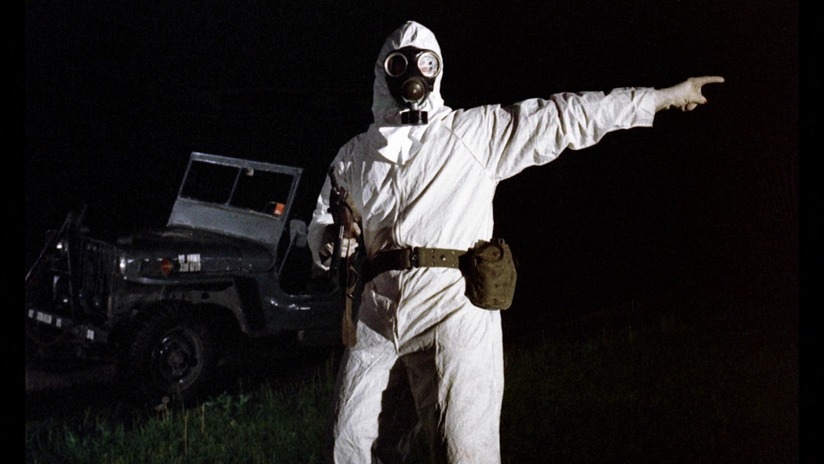
The change in attitudes between 1958 and 1988 is most obvious in the subplot the film adds. Midway through the film, government agents – clad in white containment suits that recall Romero’s “The Crazies” – descend on the town. At first, they appear helpful and kind. However, it soon becomes clear that the well-being of the townsfolk is irrelevant to them. They are there to capture and contain the Blob. Which, we discover, isn’t an alien life-form, as in the original. Instead, the Blob was created as a biological weapon, designed to be dropped over Soviet countries. The government conspiracy angle is overused today. It had even been done before in 1988, with the “Alien” films. However, it does add an extra angle to “The Blob.” The authorities can’t be trusted. Meg and Brian have to put aside their differences if they want to stop the monster. The original has been read as about the Red Scare and communism. The remake is, instead, about distrust of the government. Time changes, indeed.

It’s not often that a remake outdoes the original. The original “Blob” is still a charming, well-made creature feature. The remake, however, takes the same premise to far more grotesque and frightening places. The cast, led by Shawnee Smith and Kevin Dillion, is likable. Russell’s direction is clever and inventive. Really, the overdone score is the only thing I don’t care much for. Though not successful at the time – it grossed 8 million against a 19 million budget – “The Blob” has definitely garnered a cult following. I’ll be surprised if the next remake overcomes it. [8/10]


Evil Bong (2006)

Let me tell you a story. Back in 2013, I got to meet Full Moon mastermind Charles Band at one of those Monster-Mania cons I go to every year. Though I’ve heard plenty of less than flattering things about Mr. Band, he was nice to us. JD happened to ask Charlie about the origins of the “Evil Bong” series. He laughed and replied that his son came up with the character while – you guessed it – smoking a bong. And from those ignoble roots emerged “Evil Bong.” Because weaving the thinnest of stupid jokes into on-going franchises of increasingly cheap direct-to-DVD movies is apparently what Full Moon Features does these days. Really makes you miss all those killer puppets movie, doesn’t it?

Here’s a stupid question. What’s the plot of “Evil Bong?” Alistair is a stereotypical nerdy college student in search of a cheap place to live. This brings him to Larnell’s apartment. Larnell is a massive stoner. His other roommates, ex-jock Brett and surfer dude Bachman, also smoke way too much pot. Despite not sharing this interest, Alistair stays in the apartment. The girl he has the hots for, the friend of Brett’s main squeeze, may be the reason why. Anyway, Larnell orders a haunted bong out of the back of High Times magazine. Turns out there’s still such a thing as truth in advertising, as the large bong is indeed an entity of evil that slowly drains the life force of all who suckle upon it.

Because I’m gunning for the Most Obvious Statement of the Year Award, I’ll say the following: “Evil Bong” is a dumb movie. That dumbness mostly manifests in the form of ridiculously broad characters. You’d think in 2006, an exaggerated nerd stereotype like Alistair wouldn’t exist. Yet there he is, with his antiqued language, weirdly parted hair, button-downed shirts, glasses, and pocket protector. To the movie’s credit, at least he’s the hero of the film. Brett is a typical asshole jock, with his pot-smoking being the only thing distinguishing him. Larnell punctuates every statement with “bro,” but his occasional pot-fueled rants are sort of funny. Even the supporting cast of “Evil Bong” are excessively obnoxious. Larnell’s wheelchair-bound grandfather drops ridiculously detailed insults. Brett’s girlfriend, played by “The Gingerdead Man’s” Robyn Sydney, does an insane dance/dry hump combination which has her jumping on a pogo stick. It’s all stupid and doesn’t even amuse but at least it’s mildly memorable.

As for the Evil Bong itself, it’s not the most active antagonist. It can’t move and the prop is barely animated. Someone named Michelle Mais provides the vulgar voice over, which is the Bong’s primarily form of communication. Once someone has partaken of the Bong, the smoker is transported to an alternate world. Otherwise known as a strip club. Inside the club, the doofus dudes are killed by strippers wearing Monster Bras, real accessories Band used to sell through his website. Because nothing has to make sense when you’re stoned, the club is also full of references to older Full Moon movies. The Gingerdead Man and Jack Attack from “Demonic Toys” show up. Full Moon regulars Phil Fondacaro, Tim Thomerson, and Bill Moseley all drop in for cameos. Thomerson reprises Jack Deth, his “Trancers” hero. Bill Moseley plays a loud-mouthed mob boss before directly asking the audience what he’s doing here. That may be the comedic peak of the movie. Mostly, these scenes just remind you of the days when Full Moon movies sucked in a far more charming way. But at least there’s the cheap thrill of naked boobs.

“Evil Bong” is cheap but it is admittedly less cheap then “The Gingerdead Man.” Like that movie, the entire film seemingly takes place on all of two sets. In this case, it’s the bros’ apartment of the Evil Bong’s strip club netherworld. However, the actors seem to be slightly more professional. At least they bring some life to their roles. “Evil Bong” has a full soundtrack, composed of pot-themed rap songs. Sometimes, the music is so loud that it drowns out the dialogue. The scenes in the strip club always have a border of swirling pot leaves around them. I don’t know why. I also don’t know why they’re wacky scene transitions, also composed of swirling pot leaves. Charles Band’s direction is still incredibly flat and stationary. At least there’s a recognizable movie star in the movie for more then four minutes. Tommy Chong is hardly a big name but the performer still has a molecule of comedic ability in him, slightly enlivening his handful of scenes.

So yeah, “Evil Bong” is pathetic schlock. You don’t need me to tell you that. Yet the standard for modern day Full Moon is so low that “Evil Bong” comes off as slightly better. Really, it’s not. It’s dumb, lazy, cheap, crass, and manages to make 86 minutes feel like four hours. But I laughed twice, which is more then I can say for “The Gingerdead Man.” I’m still not bothering with any of the film’s four(!) sequels. Even if their increasingly punny subtitles – King Bong, Wrath of Bong, Evil Bong 420, High 5 – tempts me. [4/10]


Tales from the Crypt: Only Skin Deep

“Only Skin Deep” is a surprisingly dark episode of “Tales from the Crypt.” Carl is a physically abusive asshole who crushes a friend’s Halloween party, despite his battered ex being there. There, he meets a masked woman called Molly. The two head back to her apartment in an abandoned building. They make an agreement not to take off their mask or tell each other their full names. After a night of rough sex, Carl makes a startling discovery about Molly.

“Tales from the Crypt” is usually about assholes getting their comeuppance. Carl, however, is even more of an asshole then usual. He’s short-tempered, violent, gruff, and mean-spirited. The episode deals with his resentment towards women and his dark desires. The sweaty, extended sex scene confronts his issues head-on. He only sees women as a way to meet his sexual wants and, when they transgress against that, he smacks them around. In short, he’s your typical sexist piece of shit. There’s also a layer of sleazy, discomforting body-horror to this episode, with its focus on sweaty flesh and physical deformity. William Malone has never impressed me with his features but his work here is moody. I like the opening shot panning out from inside a jack o’lantern. The performances are ratcheted pretty high but Peter Onorati and Sherrie Rose are effective. Though pretty nasty, “Only Skin Deep” definitely succeeds at its goals. [7/10]


So Weird: Grave Mistake

“Grave Mistake” starts off promisingly before falling to many of the same mistakes other season three episodes have. An old friend of the family named Margaret requests to stay with Molly and the kids. She claims that a ghost is threatening to kill her. Annie is sympathetic but the rest of the family doesn’t believe her. Until the words “You’re dead” begins to appear all over the house. It seems the ghost has followed Margaret to her new location.

“Grave Mistake” has a decent first act. There’s a decent sense of foreboding as the old woman moves in. The start is mildly spooky, as we see the door open on its own and footsteps appear across the kitchen floor. However, the episode soon lays down too many cards, too soon. It’s immediately obvious that the ghost is Margaret’s deceased husband, trying to make her understand that she’s a ghost too. When we hear an old man’s voice coming from a half-seen spectre, the audience has already figured it out. The first appearance of “You’re dead!,” written on a foggy surface, is somewhat startling. But the episode returns to that too often. By the time the word is appearing in dropped Legos or spilled tomato sauce, it’s become silly. Maxine Miller’s performance is definitely overdone. The ending flat-out explains what is going on. Once again, it’s evident that the season three writers don’t respect the viewers’ intelligence. “Grave Mistake” has an interesting idea but handles it in a clumsy, obvious manner. [5/10]