Last of the Monster Kids

Last of the Monster Kids
"LAST OF THE MONSTER KIDS" - Available Now on the Amazon Kindle Marketplace!
Showing posts with label sci-fi. Show all posts

Saturday, September 5, 2026

Halloween 2026: October 5th

 
John Carpenter's “The Thing” ranks near the top of any list of obvious future classics that were initially dismissed by audiences and critics. This is the most basic piece of trivia about the movie. Nine years after the film's unsuccessful theatrical run, enough of a cult following had built up to make a continuation of some sort commercially viable. That's when “Darkman” screenwriter Chuck Pfarrer pitched Universal on a sequel. The studio passed on the treatment but it would re-emerge as a comic book from Dark Horse. (Re-titled “The Thing from Another World,” to distinguish itself from Marvel's ever-lovin', blue-eyed variety.) Three further comic book arcs sprung off from that one, proving that there was demand for more Things. This would kick off a series of attempts to sequelize Carpenter's remake but, in the metamorphic nature of the alien threat, always in mediums other than film. There was an almost well received video game in 2002. Three years after that, Frank Darabont attempted to produce a four hour long television mini-series for the Sci-Fi Channel. This would've depicted what happens when the Thing reaches a populated area. That didn't get made but, in 2007, you could walk through a Halloween Horror Nights maze based on the film.
 
All of this suggested a serious desire to replicate the 1982 film. During the horror reboot hungry new millennium, rumors of a remake of Carpenter's remake sprung from the ice. Quickly realizing that an imperfect clone would be unflatteringly compared to the progenitor, it was decided to follow the second most hacky trend of the time and do a prequel about the Norwegian camp instead. Dutchman Matthijs van Heijningen Jr. quickly boarded as director and a new “Thing” finally grew. Much like another horror reboot Universal made around the same time, the film was subjected to clueless executive meddling and reshoots. Fans and critics generally saw the prequel as an unconvincing copy of what came before. Though it did duplicate Carpenter's work in the sense that it also didn't make much money at the box office... Despite general audiences rejecting the premise twice now, there has been some hubbub recently about another stab at “The Thing.” It remains to be seen if anything will sprout from that but it did prompt me to revisit this prequel, to see if it was better than I recalled from a decade ago. 

And so we return to the frozen wasteland of Antarctica, slightly before the last time we visited it. A Norwegian research team from Thule Station are crossing the ice when their vehicle plunges through the surface. Within, they make two startling discoveries: An apparent otherworldly space craft and, a short distance away from it, the frozen remains of its very inhuman passenger. Kate Lloyd, an American paleontologist who specializes in excavating fossils from the ice, is called in to assist. The team successfully removes the hunk of glacier containing the life form and takes it back to the station. Team leader Dr. Halvorson is ecstatic to have made the paradigm shifting discovery that man is not alone in the universe. Kate and the others, including American helicopter pilot Sam, are less certain. That feeling grows when the thing in the ice breaks out, springing back to life after millions of years. Worst yet, the creature possesses the ability to assimilate and perfectly replicate living tissue. Now, much like an American team will discover in the near future, the residents of the station must contend with the shapeshifting Thing and their own paranoia about who could possibly be it. 

While the uncertainty of its ending has been endlessly discussed, Carpenter's "Thing" is greatly served by ambiguity all throughout. Who among the cast is the monster is rarely certain. The "what" around the creature is largely explained, "where" remains a vague answer of outer space, and the "why" is totally unrevealed. What happened at the Norwegian base is a purposely intriguing question, meant to draw the audience in further and foreshadow what will happen to the Americans soon, but the specific details were a mystery. All of these touches are what makes "The Thing" the intriguing, involving film it is. The prequel, meanwhile, seeks to answer as many questions as possible. Heijningen and his team went through the exploratory scene set at the abandoned base with a fine-tooth comb. They then built their film around showing us the exact steps that led to each little detail. Even minor ones like an axe embedded in a wall or an overturned shelf. It's a well-intentioned but flawed thesis, misunderstanding the purpose of a scene meant largely to entice and forebode as backstory that must be breathlessly detailed. This is the kind of fan boy brain better applied to wikia pages than narratives. 

This is not the main bone of contention people have to pick with 2011's "The Thing" though. No, the prequel was vexed by the exact annoying bullshit everyone feared from a modern day follow-up. Tom Woodruff Jr.'s Amalgamated Dynamics created practical creature effects for the project and they were used on-set. After test audiences complained that the results "looked like an eighties movie," CGI was hastily plastered over the rubber and latex. The effects team were so dismayed at the last minute changes that Woodruff ended up crowdfunding his own "Thing" inspired, all-practical (and totally forgettable) movie. Heijningen, meanwhile, has expressed regret over kowtowing to a clueless studio. Some internet users have petitioned for a release of the unaltered footage, if not a full director's cut of the prequel. This presents a tidy, fan-favorite narrative, of the promising young filmmaker having his vision ruined by air-headed execs. Of a disregard of hand-made artistry in favor of shiny, modern technology that will age far quicker and far worse. 

Now, I have no doubt that the practical creature make-up was easily superior to the rushed out CGI the final film utilizes. The digital effects are often poorly combined with the live actors. A face splitting in two or the final adversary both look especially unconvincing. However, Woodruff has clarified that his team's designs were maintained, the puppetry merely replaced with identical if less convincing CGI. None of the monstrous forms on-display here compare in any way to the work of a sleep-deprived, coked-up, young and hungry Rob Bottin. The original film featured asymmetrical creations, flesh that twisted and warped with a vicious nightmare logic. It combined the very familiar frailty of our human bodies with unexpected sights and sounds, to create a truly alien seeming entity. The prequel, meanwhile, always seems to center a face or jaws in its mutations. There are a lot of vagina dentata like maws or stabbing tentacles shooting forward like arrows. Bodies bend and flop around but are still recognizably human. The one clever gag the film has, an arm suddenly detaching, is quickly squandered by the film returning to gaping, toothy, screeching mouths. While the mediocre digital blanket job does the designs no favor, they repeatedly show a lack of imagination. Never once did the transformations make me wonder what the hell I was looking at, which is kind of an essential quality for this material. 

That lack of imagination is apparent in other elements of the film. While not technically a remake, 2011's “The Thing” essentially operates as one. Many of the iconic moments have similar sequences here. The beloved blood test is reprised, this time with fillings in teeth being used as the indicator that someone is still human. The aforementioned bit with the arm clearly recalls that time a head skittered across the floor. The prequel also concludes with a stand-off between the hero and the monster in its own lair, climaxing in a fiery explosion. Rather than expand on the first film, the script is content to merely repeat what worked before. Except Matthijs van Heijiningen Jr. isn't John Carpenter, with the rest of the crew clearly being similar downgrades. Instead of a score that emphasizes quiet unease, dramatic moments are punctuated with loud notes on the soundtrack. Instead of focusing on generating a feeling of isolation, the film goes for shit jumping out of the dark at you. 

2011's “The Thing” functions a lot like a modern legacy sequel, in the way it seems designed to simply remind viewers of a better movie with most of the changes being cosmetic. While Carpenter's “Thing” is famously devoid of female characters, this one has two. Mary Elizabeth Winstead stars as Kate. You'd think inserting a woman into an all-male space, especially in a story set in the early eighties, would present opportunities for commentary on gender dynamics or sexism or something. Kate is treated badly by Dr. Halvorson but not because she's a woman. It's because he's an asshole who is angered by anybody who challenges his plans. If a man had played this part, her function in the story would be entirely unchanged. Which is either the most progressive position you can take or renders the choice so arbitrary as to make you wonder why it was done at all. Having the French doctor also be a woman doesn't make this a male-exclusive environment anyway, so I guess it doesn't matter. 

Perhaps I'm nitpicking, complaining about what a film isn't and not about what it is. However, if a quasi-remake does little more than make changes simply to be different from the original, something has gone astray. A pun about how the authors of this "Thing" were not as good at copying as their titular menace is unavoidable. Personally, I think if you are going to make a belated follow-up to an iconic film, you're better served not blatantly emulating scenes and story beats from such a highly regarded work. Maybe the next remake should go back to the monster being a plant guy. What makes this "Thing" more unnecessary is that a far more clever remix of Carpenter's classic was released the year before. Peter Watts' short story "The Things" retells the 1982 events from the perspective of the alien, aghast that Earthlings are unable to shapeshift and unwilling to be assimilated. I don't know how you'd translate that story cinematically but it would make for a more interesting variation than this unimaginative prequel. [5/10]


You might not have heard of Raju Patel but he had a curious life and career. The son of an India born filmmaker, he was born and raised in Kenya. His dad, Sharad Patel, had some success with the biopic about Idi Amin where imprisoned journalist Denis Hills played himself. With business dealings in both England and America, Patel would have a pretty big hit with sex comedy “Bacholer Party” at only 24 years old. He would work on Disney movies, Hindi-language productions, and collaborated with random names like Mark Damon and Michael Jackson. He then checked out of life early, dying in his forties of colon cancer. Despite his eccentric career, Raju Patel would only direct one feature. That would be “In the Shadow of Kilimanjaro,” an international co-production that nonetheless still qualifies as one of the few horror movies made in Kenya. It's a trap-on-VHS cast-off that has a pretty good title, which is why I remember it. After all, if you're going to put a famous African mountain in a horror movie, probably a good idea to go with the one that has “Kill” in its name.

Within the shadow of the titular mountain peak are the key locations the film takes place in: The small village of Namanga, a school building for the local youths, a mining operation overseen by an Australian named Chris Tucker, and a hotel/bar that largely serves the miners. The area is caught in an on-going drought and it's causing the local wildlife to behave aggressively. American zoologist Jack Ringtree, while awaiting for his wife to arrive in the village, discovers a child orphaned after her mother is killed by unknown animals. This proceeds further violent attacks, the responsible party being a large troop of vicious baboons. Jack tries to alert the authorities and evacuate the area but his concerns are dismissed. It's not too long before the baboon attacks increase in frequency and intensity, soon trapping the locals within the hotel. 

Among the various dangerous wildlife of the African plains, the Chacma baboon probably ranks far below the more well-known body counts of lions, elephants, hippos, cape buffalo, wild dogs, hyenas, and so forth. Which is not to say that the baboon can't make for a properly intimidating visual. They have those massive fangs after all, the puffy face pads, the big red butts, the sinewy little bodies. While their primate intelligence has made them nuisances to people over the years, it's mostly the fact that they are exceptionally crazy looking when pissed off that makes the baboon a decent movie monster. “In the Shadow of Kilimanjaro” exploits this nicely. The baboon attack scenes, mostly done with real animals, get a lot of mileage out of the apparent ferocity of these monkeys. A swarming pack of angry baboons going right for your face is, indeed, a scary thought. “In the Shadow of Kilimanjaro” emphasizes this with some surprisingly gory special effects, of severed limbs and other body parts slumping to the ground as the beasties tear people apart. 

At the same time, the premise of “In the Shadow of Kilimanjaro” may strike some as, at the very least, unlikely. Baboons are not historically known to be man-eaters and, in some lights, can be kind of cute. The film tries to deflect this thought by claiming to be based on a true story. (An internet search on the topic mostly redirects back to this movie, meaning it couldn't have been too well known an event.) Despite that, “In the Shadow of Kilimanjaro” still generates outrageous chuckles more often than gasps. A rather robotic looking baboon puppet is used for a few scenes. I do applaud the actor playing an airplane pilot in one sequence, who keeps on flying while a very real mad ape is going at his head. Despite that intensity, it's still a deliriously silly sequence. Vicious as they can appear, I guess there is something inherently comical about monkeys sometimes. Still, in its last third, when the film becomes something of a siege picture about a stranded group of survivors hiding in a single location from the rampaging horde, it does generate some okay tension. The wind blowing on the plains at night, wild beast with glowing eyes emerging out of the darkness through a broken window, isn't a bad effect.  

By some improbable coincidence, this is the second jungle-set movie I've reviewed this year that features John Rhys-Davis sporting a preposterous accent. This time, the Welsh thespian adopts an Australian accent as the overseer of the mining operations. He's joined by Timothy Bottoms as Jack. If all animal attack movies are “Jaws” rip-offs of a sort, Rhys-Davis would probably slot into the Quint role. Bottoms is a combination of Sheriff Brody – the low-level authority whose reasonable warnings are ignored by those in command – and Hooper, an animal expert. Unfortunately, the film does not flesh its lead characters out any beyond that. The subplot of Jack and his wife's stormy relationship is nothing but filler. There appears to be an undercurrent in the script, criticizing white industrialists exploiting the natural resources of Kenya. This is most apparent in Don Blakely's role as the elderly, fairly racist hotel owner. This idea never germinates into anything substantial though. The film misses the chance to have its clueless town leader get munched by some crazed monkeys. I guess that correlates with the mayor making it out of “Jaws” unscathed. 

The underwhelming character work pairs with an abrupt and unsatisfying ending, though I suppose it's as logical a conclusion as you'd expect from a story about a drought. “In the Shadow of Kilimanjaro” never quite comes together. The script is too thinly sketched and unable to mine consistent thrills out of its fuzzy threats. Which isn't to say that there isn't some novelty to a baboons go bananas horror flick, especially one set on the actual African continent. (Which distinguishes this one from “Shakma,” whose trailer is slightly funnier, on the short list of baboon-sploitation flicks.) Raju Patel, or at least the team he hired, does show a semi-decent handling of the material, suggesting he probably could have made better movies than this one further down the line. I guess the experience of wrangling a pack of literal baboons did not endear the directional process to the guy. This is definitely a film I wanted to like more than I actually did, if only because of its novelty, but there's not quite enough here to make it stick. Though that airplane attack scene is hilarious. [6/10]


Wednesday: Woe What a Night

 
I feel like any time I review a modern streaming series, all I do is complain about how these shows are paced, plotted, and structured. The fourth episode of "Wednesday" is a case study example of how sloppy this style is. The show has stacked up a collection of plot threads that it can leap between whenever it wants, with no concern for tonal consistency, satisfying pacing, or overall coherence. This installment sees Wednesday digging deeper into her investigation of the wide-eyed monster in the woods, presenting her evidence to an annoyed and stunned Sheriff Galpin. She discovers that it takes body parts from each of its victims and seems to find its cave lair. She spots some scratches on Xavier's neck and uncovers his secret art studio, which includes paintings of the beast. Suspecting him of being connected to the killer, Wednesday instead ends up asking Xavier out to the upcoming school dance to cover for herself. 

This uncorks a mess of soap opera-like romantic entanglements. Enid goes to the dance with another guy, one of the bullies in town, to make Ajax jealous after he stood her up the other night. Xavier apparently genuinely likes Wednesday and, when he discovers that she only asked him out because of the mystery, he asks his siren ex-girlfriend to erase his memories of the Addams. But Wednesday still has a date to the dance cause Thing, of his own accord, asked normie townie boy Tyler to take her instead. That's not all of the melodrama at work here, as nerdy beekeeping boy Eugene is also harboring a crush on Enid. Oh my god, what the fuck. How is this an "Addams Family" show? Netflix really did take a premise designed to deliver goofy, morbid sight gags and turned it into a "Twilight" style supernatural romance for teenagers and fandom-brained Tumblr users. 

By 2022, however, the comic strip and sitcom that spawned her was long since overshadowed by the snarky goth girl archetype that Wednesday Addams became in the popular consciousness. "Wednesday" is a show more for people who saw the Barry Sonnefield films as a kid and caught a crush on Christina Ricci or fans of some YouTube cosplay account than anything else. I mean, the character imprinted on young me too, leading to an unfortunate life long fascination for women with dark hair, black clothes, cyanide wits, and undiagnosed BPD. Tim Burton deserves a lot of blame for the commodification of the goth subculture too, which makes his involvement with this show almost satirically on-the-nose. This episode really gets at how annoying this entire shtick has become in two moments. That is when a character tells Wednesday how he admires how free and unburdened she is by social expectations. Once again, it is hammered that Wednesday is a self-styled outcast, unpopular with her peers. A bit hard to buy that when she's at the center of two separate crushes in this episode alone and her family clearly has a long history with the school she's attending. Another scene has Wednesday criticizing the "objectification of women and the male gaze," a tweet misconstrued into dialogue. The episode then features the obviously movie star pretty Jenna Ortega doing a wacky girl dance at the goth prom to a Cramps song. It is a moment so tailor-made to appeal to people with a fetish for superficial strangeness that it's really as objectifying and othering for the young woman at its center as a strip tease would be. 

Of course, that scene became a viral sensation and is probably the main reason "Wednesday" became such a hit for Netflix. Like I said, I'm part of the problem. I liked that scene. It is one of the few moments "Woe What a Night" emerges from its own mess of subplots and rehashed cliches to show a spark of energy or wit. The "Carrie" homage that follows is predictable as can be but Ortega's enthusiasm and then disappointment with the stunt actually got a laugh out of me. So did how she stumbles through her attempt to ask the long-haired pretty boy to the dance. Or the genuinely cool shot of her and Enid in their dorm, split right down the middle between their two distinctive aesthetics. All of this suggests that if "Wednesday" was as much of a sitcom as the show that spawned it, merely about contrasting the protagonist's particular behavior against stratified adolescent social rituals, it would probably be consistently funny. Alas, such a humble pleasure is beyond the modern media landscape and I have four more episodes of this show, that I very stupidly promised to review, to wade through. [5/10]


The Twilight Zone: To Serve Man

As with past installments I've covered, I know the twist ending of "To Serve Man," the 24th episode of "The Twilight Zone's" third season, very well.  The rest of the episode is discussed less often. Alien beings known as the Kanamit arrived on Earth. They come in peace and, moreover, generosity. The beings speak to the United Nations from a book and offer endless treasures. While people are skeptical at first, the Kanamits lives up to their offers. They turn barren deserts into verdant fields. They offer impenetrable force fields to each nation, ending all international conflict overnight. They also willingly submit themselves to any tests the Earth governments ask for. Among these is an attempt by the American government to translate the significant book the aliens brought with them, whose title means "To Serve Man." Chambers, a cryptographer, and his assistant Patty work at the task. As pleasure cruises from Earth to the Kanamit home world begin, Chambers decides to join such a ride. As he boards the vessel, Patty arrives to inform him of the book's true purpose... 

The outlook of Rod Serling's work was usually pessimistic. Many of his stories reflect a belief that, while the individual person might be good, the human race is destined to destroy itself over petty grievances. "To Serve Man" is a bit unusual in that an outside force is the antagonist. Nine foot tall, dome-headed aliens arrive extending a glad hand only for it to hide more sinister intentions. It is tempting to read the moral as xenophobic or at least extremely cautious: Don't trust any offer that seems too good to be true. It reminds me of Hansel and Gretel, where endless generosity and a shelter in a storm are only a precursor to pure predation. All that kindness is to disarm you. All those sweets are just to fatten you up. While "To Serve Man" is ultimately cynical in its perspective, I do think Serling is criticizing mankind's preference for easy answers and gluttony more than anything else. Alien saviors arrive and resolve all our problems instantly. It makes us so happy that we can barely stop to consider their motivations. Moreover, the Kanamit promises endless pleasures too. Why, as a man boarding their ship excitedly shouts, they even have baseball on their home world. Maybe that fairy tale comparison is apt and the episode should be taken as a simple warning that good intentions are not always what they seem. Now, as then, tis simple truth, sweetest tongue has sharpest tooth. Literally, in this case. 

My initial reaction to "To Serve Man" is once again astonishment at how economical vintage television could be in its story telling. This is a far reaching story, about the entire planet's reaction to otherworldly visitors, and ends in outer space. Despite that, it runs a half-hour and mostly takes place in a few simple rooms. The action is mostly composed of people talking. Somehow, the stakes never feel artificial and the audience never feels cheapen. The U.N. setting establishes the global impact of these events and the seriousness with which each actor approaches the material makes the consequences feel fittingly important. I really like the montage in which leaders of various countries thank and welcome the alien visitors, speaking in their own languages with the translation appearing as a news ticker at the bottom of the screen. It shows that newsreels and stock footage – notable examples immediately recognizable as from "The Day the Earth Stood Still" and "Earth vs. The Flying Saucers" – can indeed be used to create a sense of scale and wide-reaching events. It's never the budget of a project but always the people utilizing it. 

"To Serve Man" doesn't have the intense expressionistic visuals of "Eye of the Beholder" nor the surreal nightmare logic of "It's A Good Life." Director Richard L. Bare – who would go on to direct "Wicked, Wicked" and 166 episodes of "Green Acres" – mostly keeps things simple. Though I do like the Kanamit being introduced first as a towering shadow on the wall before we see its face. Beloved tall guy Richard Kiel plays the lead alien. While the bulging cranium and white robes are typical of extraterrestrial depictions of the time, the Kanamit communicating strictly via telepathy means their faces are unmoving. Their eyes seem to project dull, animalistic instincts while their mouth droops open slightly, like a dog salivating over a ham bone. Maybe that's meant to be a hint to their motivations being hunger, not kindness. The ending is one of bitter irony, the title being revealed as a sick punchline, and the final moments being a grim conclusion that the wilier predator is always destined to eat the lesser one. Pretty good stuff. A tasty meal served quickly and effectively. [7/10]


Friday, September 4, 2026

Halloween 2026: September 4th

 
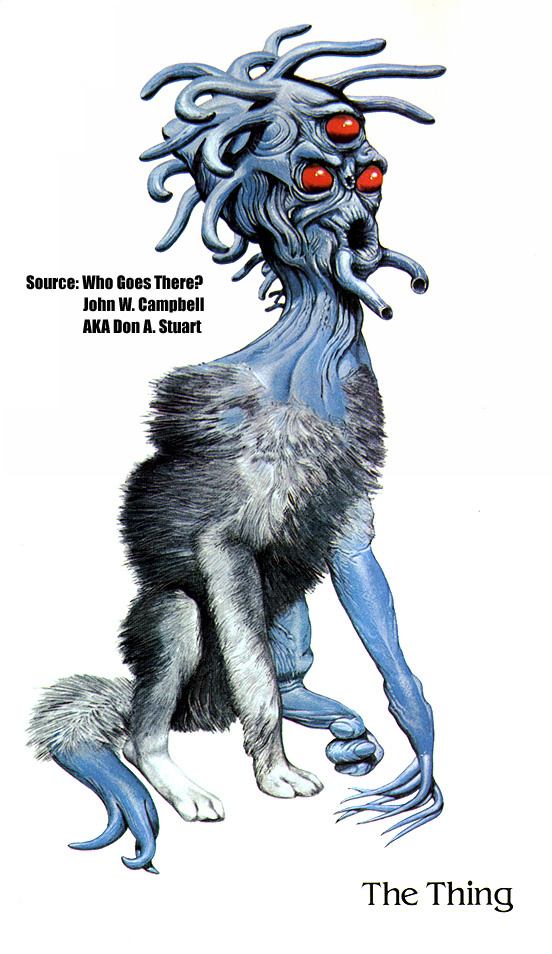
1938 would see the publication of "Who Goes There?" by John W. Campbell. It is a tale of an isolated Antarctic research team uncovering and unleashing a shapeshifting alien threat, that fully assimilates and then perfectly imitates any living being. Campbell seemingly invented a new type of monster, an ever-shifting and totally insidious invader that is so alien to human form and thought that it can only be called a thing. The literary thing first appears as a blue-haired, telepathic beastie with three glowing eyes before assuming a litany of other forms, via grotesque mutations of the flesh. Such a creature was beyond the special effects capabilities of the film world for many years. In 1951, Christopher Nyby and Howard Hawks would turn the amorphous thing into a seven foot tall vegetable-man in a medical jumpsuit with a Frankensteinian flat head, spikes sprouting from its knuckles, and a taste for human blood. A far looser, unofficial adaptation in 1971 made it into a psychic virus initially housed in the body of a red-eyed sasquatch. 

A few years after that, Universal began to develop a new cinematic take. Tobe Hooper's idea, set on a submarine with a non-shapeshifting thing, was discarded. Other notable names briefly linked to the project were Sam Peckinpah, Walter Hill, Michael Ritchie, John Landis, Deric Washburn, Nigel Kneale, and Richard Matheson. John Carpenter was approached early on but, as a big Howard Hawks admirer, was reluctant to commit. After reading the source material and teaming with writer Bill Lancaster, Carpenter's "Thing" would begin to take shape. By then it was the early eighties and creature effects in Hollywood were about to undergo a major renaissance. Monster makers like Baker, Winston, and Bottin were redefining what could be done with rubber, latex, inflating bladders, and robotic puppets. Bottin's achievements on "The Thing" stands as a major landmark of this time, Campbell's shapeless monster finally being realized as a cinematic nightmare.

Lancester's script would maintain the general outline of Campbell's story. Most of the adaptational changes made are of a strictly practical reason: 12 men stationed at Antarctic Outpost 31, rather than the novel's thirty. The Thing is no longer telepathic and its base form is never revealed. The biggest difference is that the research crew led by R.J. MacReady no longer discovers the alien life form. Instead, the near-by Norwegian camp uncovers the thing, their excavation of the flying saucer glimpsed as a proto-found footage movie on their monitor. While 1951's “Thing from Another World” played up on atomic era fears of strange threats coming from the sky as much as any fifties sci-fi movie, this change re-contextualizes the story in a global context. America never had nuclear tensions with Norway but the barrier of another language characterizes the early eighties setting. As Mac says, “Nobody trusts each other now and we are all very tired.” Anybody possibly being the Thing speaks to Cold War paranoia about the possibility of anyone being an enemy spy or government spook. This anxiety runs so deep that those taken over by the extraterrestrial threat aren't even aware of it. Imagine that: Your neighbor or sibling or yourself being an agent and not knowing it. 

Another element taken directly from the source is the understanding that, should the Thing escape the frozen continent, the consequences would be massive and immediate. This is the first film in Carpenter's informal Apocalypse Trilogy for good reason, the alien threat liable to consume all of humanity within months. As the film progresses, the characters increasingly face the possibility that none of them can survive this ordeal. For the betterment of mankind, to ensure that the Thing never escapes, they'll all have to perish. The much discussed and often referenced final scene isn't only a statement on the film's theme of distrust. In the context of the Cold War, MacReady and Childs agreeing to wait for a little while and see what happens – an admission that they'll both freeze to death before either concedes defeat – reads like a metaphorical Mutually Assured Destruction. It speaks to an international mood of apocalyptic paranoia, where it doesn't matter if you survive so long as the other guy doesn't win.

As pertinent to 1981 as the film's ideas were, “The Thing” endures because its themes are also timeless. The Berlin Wall fell a long time ago but the American Century of Global Anxiety is never ending, meaning an inability to distrust your fellow countrymen is as relevant as ever. Other signifiers root the film to the eighties decade. The way the guys are constantly drinking alcohol or smoking weed hearkens to a post-Vietnam era of national burnout. Blair is left alone in a cabin with just a flask of booze, a quiet agreement among the men that there's nothing left to believe in but the next high or bender. The year of “The Thing's” release also saw the first documented case of HIV, meaning it definitely wasn't on anyone's mind during production. Nevertheless, a sequence of protracted suspense around the purity of blood inevitably brings it to mind. Like that other great eighties remake of a fifties monster movie, Carpenter was speaking to a more generalized fear of bodily uncertainty that unknowingly spoke to the pandemic of the day. All of us are at the mercy of bodies and minds that will fail, will decay, and will turn on us. The explosive eruption of the Thing from its humanoid disguises are like out-of-control tumorous growths for a reason.

But let's go down the “Thing as AIDS metaphor” trail a little further. Because it gives me an excuse to talk about one of my favorite things: Homoerotic subtext in eighties hyper-masculine media! Like the second thing everybody notices about this movie is that there are no women in it. That trivia usually accompanies a mention of the sole female performer in the entire film, Adrienne Barbeau as the voice of MacReady's chess playing computer in his introductory scene. Which he then calls a "cheating bitch" and murders by pouring whiskey into its processors. So right away, this environment is hostile to any feminine essence. A repeated indicator of the Thing's presence is torn-up long johns, stained with bodily fluid. The discovery of which precedes further paranoia and infighting among the men. In the finale, the assimilated Blair murders Gary by shoving his fingers into his mouth and fusing with his face. Death via oral fisting. The blood test scene is a long build-up of men in a cramped room, groaning and ejecting more genetic material, that ends in an orgasmic frenzy of bodily expulsion. Including the Thing unfurling a tongue and pulling its reluctant victim towards its mouth. While the alien's motives are totally inscrutable, the repeated mention of assimilation suggests an abandonment of rugged individuality and an embracing of togetherness. The Thing just wants to bring these boys together but they are too closeted, even the kind of swishy roller skating Nauls, to allow it. It's certainly a reach to read "The Thing" as a story of a bunch of guys so afraid of being vulnerable, open, penetrable, that the last two men standing would rather freeze to death than cuddle. But I think something like these ideas are definitely buried in the twisted flesh, under the permafrost. 

Ultimately, I think that's what “The Thing” is truly getting at: A sense of isolation, from the rest of the world, from other people, from our own bodies. This is cooked into every element of the film. The opening effects shot, of the flying saucer careening towards Earth, takes place in the desolation of outer space. Not that the endless white of ice and snow on this planet is anymore hospitable. The soundtrack of pulsating, distant synth emphasizes this chilly, empty landscape. Carpenter's direction is tight and quiet. He often fades to black at the end of some scenes, furthering the impression that all of this is being watched by a dispassionate God. This is combined with those trademark Dean Cundy tracking shots, smoothly sailing through the hallways as people rush around in panics. The two techniques combine to accurately reflect what the characters must be feeling. A mixture of unending and freezing boredom that is broken up by sudden, raw panic. 

Notoriously, upon its original release, many critics were dismissive of “The Thing.” A common criticism was that the film was overly reliant upon its gory special effects, that these were somehow poor excuses for shock and scares. That truly undersells the power of the film's effects work. Rob Bottin was overworked, leading a bigger team than he had before, and apparently sleeping sporadically. When he would dream, it was often of creature designs, which he then incorporated into the film. This is evident, as the sheer visceral intensity of “The Thing's” effects pushes into the nightmarish immediately. It's sinew and flesh, bone and meat of unidentifiable origin but clearly pulsating and alive, twisted up in itself and coming right at the viewer. The film is edited so tightly that these sudden intrusions of hellish mutation function better than any well engineered jump scare could. The defibrillator scene is a great example, the circumstances shifting suddenly, violently from the sane and rational to the inexplicable. Even when the seams do show, a hand puppet here, a stiff movement there, it only adds to the surreal feeling of what is captured on-screen. 

In other words, if “The Thing” had nothing else going for it but Bottin and his team's make-up effects, it would still be a landmark motion picture of incredible power. Luckily, the film around it is also excellent. The cast, filled with many beloved character actors, some of whom where only beginning their career, manages to overcome what is the film's only real failing. We rarely get a sense of who any of these guys are, beyond stray characteristics here and there. I guess that's why you cast Keith David and Wilford Brimley, performers whose mere appearance and voice bring with it a world of experience. Ya know, I don't know if “The Thing” is the greatest horror movie ever made, as some have trumpeted. It's probably not even my favorite Carpenter film, as I find myself returning to the wacky looseness of “Big Trouble in Little China” or the meta-fictional brain teasing of “In the Mouth of Madness” more often. But there's no doubt that this movie truly is pretty damn great. [9/10]


Rooms for Tourists (2004)
Habitaciones para turistas


Argentina has had an active film industry since the Lumière brothers' days but it seems the nation's first horror movie wouldn't appear until 1934. In the decades after, the genre would make sporadic appearances among the country's cinematic output. A Poe adaptation here, a gothic monster movie there, the odd grisly thriller or mad scientist flick. If IMDb's listings are correct, a low-budget horror scene began to emerge in the early 2000s. More recently, directors like Demián Rugna and Cristian Ponce have made waves internationally, really drawing horror fans' attention to the country. But the first Argentine horror director I heard of was Adrián García Bogliano. His 2004 feature debut, "Rooms for Tourists," got a positive review in Fangoria and the title has stuck in my brain ever since. Time to finally catch up with this one, for my Horror Around the World stopover in the land of the gauchos and Aconcagua.

Five young women ride a train to the Argentine countryside. They are quiet and shy Theda, high-strung Elena, blonde party girl Ruth, film student Silvia, and the pierced and punky Lydia. The otherwise unconnected cadre all miss their bus ride and become stranded in a small village. The locals are standoffish. They observe an apparent exorcism performed within a church. A friendly man named Nestor offers them rooms for the night at his family home, where him and his brothers rent out their extra rooms to tourists since the death of their mother. Theda is having religious themed visions and all the girls seem stressed by something more than merely getting delayed. That night, a masked intruder murders one of the group with a meat cleaver. The killer comes for all of them next. This leads to a night of terror amid the strange home, the discovery of what links these strangers, and why they are being targeted. 

The first thing I noticed about "Rooms for Tourists" is its visuals. The film is shot by cinematographers David Bermeo and Veronica Padron in high-contrast black and white. The shadows are very deep and dark. They are broken up by piercing rays of light, grey-tinted clarity among the pitch black angles. Once the murderer begins stalking the girls through the isolated inn, the sole source of light is often a single lamp or a burning match. I can't find any information on whether "Rooms for Tourists" was shot on film or digital video. Either way, the movie has the kind of grit to its look that I very much associate with the indie horror scene of the early 2000s. The camerawork is often intimate, focused on faces and tight close-ups. This is, I suspect, not only for stylistic reasons but also to disguise the lack of resources the filmmakers were working with. There are occasional lapses in coherence or tact: An opening assault of shocking violence, an occasional burst of shaky cam, a rare heavy metal needle drop. However, "Rooms for Tourists" is mostly a very well tuned production. The camera movements are precise, the editing is tight, the shots are clear. (All the more impressive considering it was shot, "Eraserhead" style, over the course of four years and with a piecemeal crew.) 

The lo-fi but moody visuals are most apparent during Theda's hallucinations. She sees nun-like figures standing backlit in dark rooms, shots right out of a goth rock music video. Throughout, there is this sense of discomfort around organized religion in "Rooms for Tourists." When watching the sermon and apparent exorcism, the girls do so from the streets outside the church. They are not part of the congregation but excluded from it. The pastor stops by for dinner and the conversation he has is not outwardly aggressive but condescending. Faith seems to be a tool to push out undesirables, not to bring people together. This is especially hard for Theda, played with sincerity by Elena Sirrito, who seems like a quiet and unassuming young woman. The motivation for the murder spree and what brings the girls together is, cleverly, slowly revealed through dialogue here and there. When the understanding all comes together – that they have been targeted from the beginning for specific reasons by malicious actors – it ties in nicely with the theme of religion used not as a beacon but as a bludgeon. The final image is bleak and sudden, a chilling statement on how some in this world feel it is their duty to discard empathy and only punish those they deem evil. 

The social commentary and stylized visuals were a deliberate effort on Bogliano's behalf to elevate what would otherwise have been a standard first-time indie horror feature. By which I mean, "Rooms for Tourists" is a knowing innovation of genre traditions with stated references to the filmmaker's influences. Once a masked killer begins to chase the girls through an isolated location, this one's status as a slasher movie is crystalized. Vivid hallucinations in a boxy, shadowy room bring "Repulsion" to mind. The premise has shades of "Texas Chain Saw Massacre" and "Psycho," the latter of which is referenced in dialogue. Not to mention a scene where Sylvia starts talking about her favorite Argentine movies, specific shout-outs that are lost on this dumb-ass American. Unlike a lot of low-budget films of this type, "Rooms for Tourists" is not burdened by its kinship to past classics. This is a pretty creepy slasher. The killer wears a white stocking that removes all features from his face, an element rendered more nightmarish by the monochromatic visuals. The chase scenes are well done, the film capturing the increasing sense of hopelessness the girls feel as the night goes on. The gore is limited but well utilized, injuries occurring in close-up to maximize their distressing quality. 

It all works well for the first hour or so. There's a specificity to the locations and faces we meet, also going a long way to distinguish the story from its familiar element. Unfortunately, you also get the impression that the director was more accustomed to making shorts than features. The script starts to meander at the end of the second act. A few subplots, such as a reoccurring blind woman glimpsed in the distance, never amount to much. The ending is well done but also feels apart from the story's main action. Simply put, I'm not sure there's enough actual plot here to fill the runtime. The characters are well realized by their actors but remain frustratingly archetypal in many ways. We get glimpses at their wider histories – Lydia snorting a line, Ruth popping a pill – but the film does not flesh out these attributes much. I guess the idea was to keep the film focused in the present but devoting a little more to each woman's interior life or past would've been a good way to beef up the more meager sides of the film. 

Bogliano was actually born in Madrid and he's made films in Mexico and Spain since his debut. (Including a demonic kids story I couldn't quite get into and a werewolf flick with a strong cast I've been meaning to watch.) Despite that, I'm going to assume Argentine is the cultural identity he most connects with, considering the clear context that provides "Rooms for Tourists." This is a shocker that makes the most of its limited budget and resources, creating a few striking images and some nice tension along the way to a pointed cultural critique. [7/10]


Wednesday: Friend or Woe

 
The third episode of “Wednesday” delves more into the back story of its setting, the town of Jericho. She puts the torn out page seemingly depicting her in a painting from decades before into its source book, seeing the other half features Joseph Crackstone. That was the town's puritan founder. That dovetails with the school's Outreach Day, with Nevermore students working for a day at the pilgrim-themed tourist attraction. While searching for the genuine structures from the colonel days, she has a vision. It turns out that the sanitized version of Jericho's history covers up a legacy of indigenous bloodshed. Crackstone burned 'witches” and massacred the local native population. Which included Wednesday's identical ancestor, Goody Addams, whose mother was indigenous. Meanwhile, the bug-eyed monster continues to lurk in the woods. Potential love interest Xavier becomes aware there's a cover-up involving his roommate's disappearance, among yet more intrigue in and around the town and school.

There's a moment in “Friend or Woe” that genuinely caused an annoyed sound to escape my lips. When Xavier is talking about psychic visions – apparently his dad is a famous clairvoyant –  Wednesday glares at him and asks if he's “man-splaining” to her. This follows an earlier moment while, in perfect German, she explains to some tourist in a fudge shop the historical inaccuracy around the sweets and the chocolate industry's history of child slave labor. I would hope my years of writing have revealed my personal politics as insufferably left-wing. Which left me wondering why these moments made me clinch my jaw so hard. It's probably because this is the sort of corporate approved “woke” language that feels utterly inauthentic in any off-line discourse. Has anyone unironically used the word “mansplaining” since 2013? Furthermore, “Wednesday” was a multi-million dollar product produced by a billion dollar company. This episode includes blatant product placement for Taco Bell. (Disguised as a joke but that's what it is.) It is difficult to take any anti-exploitation message it may espouse very seriously at all. 

More than that, the series seems completely incapable of specifying what type of outcast Wednesday Addams is supposed to be. Is she a member of a family famously devoted to each other or an angsty teenager mad at her mom? The residents of Jericho are derisively referred to as “normies,” a slang term with a complicated history, by members of Nevermore. As much as the school is a supposed bastion for supernatural oddities, it maintains its own strict social hierarchies and cliques. This means Wednesday is an outsider both in regular society and at the school for outsiders. Later, she defends stereotypical dweeb Eugene from some bullying jocks, via her sweet martial arts moves. Afterwards, she clarifies to the boy that she defends him because he reminds her of Pugsley, her little brother... The same little brother that she has a history of torturing and attempting to murder. Later, she blows up a statue of Joseph Crackstone as a clear political statement. The Addams Family are always at-odds with the society around them but rarely through openly antagonistic means. They exist simply as their off-beat selves and that's enough to freak out the squares, who often enter into the Addams' spaces uninvited anyway. Trying to make Wednesday a darker, fairly leftist agitator like this seems at odds with that attitude. Revealing that the family has Native American roots, and where victims of Puritan persecution, is another idea motivated more by a conscious effort to make the program appear progressive than a genuine expression of a personal belief. 

And about that flashback. The word Joseph Crackstone uses to refer to the indigenous people he massacres is “outcasts.” That feels anachronistic at best but points towards this show's own uncertainty around that term. Tim Burton's movies have always been about societal outcasts striking back at conformist culture, rooted in the extremely privileged world of adolescent suburban alienation. That's what the scene of some white-bread guys picking on a glasses-wearing dweeb, and him vomiting directly in their face, is an expression of. This is the same Tim Burton who was making lisping Asians jokes in 2012. Moreover, conflating the plight of indigenous peoples to jocks pushing you around because you're a nerdy, gothy teenager feels miscalculated. Wednesday is a hyper-confident bad-ass, a freaky freak into murder and bondage, cooler than anyone else, an outsider at odds with the social structures around her, a young hero at the behest of superpowers she can't control, a typical teenager dealing with typical teenager feelings, and the apparent heir of some sort of ancient prophecy. Maybe pick an outsider lane and stick with it, guys. 

The town of Jericho is obviously inspired by Salem, Massachusetts. That's a city that functions as both a historical site teaching an important lesson about moral panic and a kitschy Halloween tourist attraction. Exploring those inconsistencies is a good template for a TV show. “Wednesday” isn't interested in that, not really, of course. However, the scenes of the title character snarking at her supervisor at the historical reenactment park, usually in a faux-16th century accent, are still one of the better moments here. Once again, Jenna Ortega is actually a fairly amusing Wednesday when cracking cheesy jokes. However, Ortega and the rest of the young cast's energy clearly flag anytime they have to deliver the utterly route exposition. This points towards how completely cookie-cutter and lifeless the actual plot of “Wednesday” is. I don't care about the backstory of Jericho or Nevermore Academy or the conflicts between the various forces at play. A scene where Enid and the guy she likes have to clean weird taxidermy animals at a shop are by far more entertaining. Suggesting once again that this show built around a sitcom character probably should have just been a sitcom, instead of a half-assed fusion of “Harry Potter,” “Stranger Things,” and a supernatural detective show. I liked the orchestral cover of “Nothing Else Matters” that plays over the obligatory end-of-the-episode montage. [5/10]


One Step Beyond: The Last Round
 
John Newland greets us from within a storage shop for unclaimed items following the bombing of Britain in World War II. He presents a ghost story within a ghost story: American boxer "Yank" Dawson is preparing for a bout along London's waterfront. His manager is concerned about his fighter's health while Dawson ignores these questions, only interested in winning one more fight so he can take the money and retire. That is when his opponent's promoter enters and mentions the story of Patty Teron, another aging American fighter who once grace these halls. It seems Patty died following a match, when a knock-out punch from the other guy dislodged a blood clot. The same boxer later claimed to see Patty's ghost before another match, seemingly warning of his own death. He ignored the omen and died on the mat that night. Since then, the spectre of Patty Teron has become a foreboding visitor warning of impending doom for anyone who sees him. Naturally, Yank encounters the ghost shortly afterwards. He sees him in the crowd during the match too. While this is dismissed as an attempt at psychological warfare by the other fighter's team, might something more mysterious be going on here? 

Once again, "One Step Beyond" is one of the more melodramatic and heavy handed of the classic genre anthology shows. "The Last Round" continuously points towards its own conclusion. Dawson is introduced as getting long in the tooth for a boxer. A tense exchange with the rival promoter reveals him as suffering a bad hit in a previous fight, following the repeated discussion of his ailing health. The appearance of Patty's ghost – who wears a sweater with his name stitched on the front in big letters, just in case you didn't understand who he was – is so heavily foreshadowed that any surprise or shock is gone. The twist that pushes this story into the realm of the supernatural is belabored during an exchange with a police officer. Newland's post-war introduction essentially spoils the episode's ending and what the ominous spirit's multiple appearances in this stadium foretells. I guess you could miss that this story takes place during a brief moment of All Clear during the Blitz but you would have to be really distracted not to figure out where this is going.

While "The Last Round's" ending is never much in doubt, there are still some interesting elements to be found.  Two of Charles Bronson's earliest television credits had him playing boxers, a role he was clearly still typecast in as the sixties started to roll around. While sans mustache and displaying a beefy physique, Bronson's sun-beaten facial features are still immediately recognizable. (Making it funny when his manager repeatedly calls him "boy." Chuck was about to turn forty at the time.) Something Charles Bronson was not well known for was his range. The steely gaze and monosyllabic delivery of the "Death Wish" films have not quite presented themselves. Bronson is clearly trying to be vulnerable and uncertain in this role and can't quite sell it. He's also given a fair bit of dialogue, shakily delivered in that famously clipped quasi-Lithuanian accent of his. Despite these shortcomings, Bronson always had magnetism. Simply as a hunk of chiseled meat, delivering punches in the ring, he is a compelling figure. He's surrounded by a collection of extremely British character actors, who do far better delivering the foreboding exposition. 

Most of "The Last Round" is fairly flat in its visuals composition, not atypical for this series. However, there are a couple cool looking shots within the boxing ring, the fists flying ahead and under the camera. I also do like Patty's second appearance, spotlighted in the back row of the crowd and smiling impishly. This episode probably needed more of that playful energy to truly work but, as an on-the-record fan of the future Paul Kersey, "The Last Round" is an interesting dispatch from the early years of his career. [6/10]


Tuesday, September 1, 2026

Halloween 2026: September 1st

 
Destiny (1921)
Der müde Tod
 

Owing to German Expressionism's influence on the foundational films of the genre, Fritz Lang is heavily associated with the classic horror era. This is despite him debatedly never making a proper horror movie. “M” would birth cinema's first serial murderer but exists outside the conventions of the killer thrillers that would eventually form. Dr. Mabuse, with his hypnotic powers and ability to swap bodies, would go on to influence many mesmeric villains but Lang's films with the characters are as much crime stories as they are anything else. “Metropolis” is, of course, epic science fiction despite its mad scientist, inhuman android, and hellish machinery obviously inspiring countless horror films. Another good example is 1921's “Destiny.” An omnibus feature that, like “Waxworks,” features three tragic tales across time and, like “The Phantom Carriage,” is also a fable about Death as a personified being. That pushes it close to the margins of horror, so I supposed it's as good a silent classic as any to kick off this year's Halloween season.

A young couple, deeply in love, ride a carriage into a medieval village. They pick up a hitchhiker, unaware that the sunken-eyed passenger is Death himself. Years before, Death had bought a small plot of land in the village before erecting a massive, impenetrable wall around it. Later that day, the couple meet the strange man again in the tavern. It is during this encounter that the woman's lover seemingly vanishes. She quickly deduces the true identity of the man she met that day, wailing in front of that wall for her lover to be returned. Death takes pity on her and explains the situation, that he's merely following God's will and that it was her boyfriend's time to go. He makes a wager with the girl and presents her with three candles, each one representing another love story happening somewhere in the world. If love can triumph over death in these scenarios, he will give the woman her partner back. The three tales involves: An infidel in love with the sister of the Caliph deep within the Muslim world, a love triangle set in Venice, and a story of a Chinese emperor demanding the assistant of his court magician and the extreme steps she takes to escape his lust. 

“Destiny” is loosely adapted from the Hindu legend of Sati Savitri, as filtered through Lang's grief over the passing of his mother and a childhood fever dream of Death itself lingering over his bed. Fittingly, the film feels very much like a transcription of a genuine folk tale. The plot device of a chance meeting with the personification of Death is present in many European folk tales. As is the idea of making a wager with an otherworldly power, whether it be the Grim Reaper, the Devil, or some sort of fairy-like being. The idea that a giant wall was built by Death itself as an entrance point into its realm feels like a mythic origin for some ancient protoglyth. It's also a very suitable metaphor for the divide between the living and the dead, a barrier impossible to breach except for that final one-way trip. This is a fairy tale, in the Brothers Grimm sense, the kind of story that we – by which I mean, all people everywhere – have been telling for eons. 

At the same time, “Destiny” is a movie very specifically of the era in which it was made. The sample size of German Expressionistic films I've been exposed to is admittedly small, out of the already comparatively small number of films from this time and place that still exist. Having said that, it's weird that “Destiny” is the second omnibus feature from this period I've seen that also has an Arabian Nights inspired segment. Naturally, both the depiction of Islamic and Chinese cultures are not the most sensitive through modern eyes. In addition to featuring white actors in yellow and brown-ish face. That's to be expected from a 105 year old motion picture. So is a fair deal of melodrama. If anything drags “Destiny” down for me, it's that element. Both the first and second historical sequences are extremely heavy on the love triangles, secret betrayals, plotting and scheming, sneaking around, and all of that. The Venice segment is almost difficult to follow at times, because of its conflicting plot points. Even as someone fairly familiar with silent cinema, it can be a bit hard to follow at times and also not that compelling in its own right.

Of course, silent films can often overcome of-the-time stiffness with their stylized, striking visuals. “Destiny” has a number of those. The most iconic of which is a gothic arch-like opening in Death's wall, a massive staircase revealed on the other side. That's exactly the kind of dreamy visual that I seek out in older films like this, that appeal directly to the subconscious. Of the stories-within-the-story, the third tale is my favorite. Set in ancient China, it's the most outwardly fantastical. The emperor's wizard presents him with a miniature army of little humanoids. His magic wand can transfigure people into animals and objects, the most memorable example being when a human body twists into the shape of a cactus. There's also a flying carpet and a magic horse that can run across the sky. All of it brought to life with the quaint but suitably otherworldly special effects work of 1921. Filmmakers got stuck on the idea of realism eventually but that was less of a concern in the medium's early days, allowing cinema to be the shadow play and puppet shows it has always been. 

“Destiny” might be one of the rare omnibus features where I found myself far more invested in the framing device than the stories contained within. While the tale of the third candle is neat enough in its own right, I did feel my interest waning some during the other two segments. Meanwhile, the story of the young lovers and Death has an universal quality to it. We all must face our own mortality but I believe that love survives. Or, at least, that the acts of kindness that speak to the greater need for love and compassion ripple through time further than those of cruelty or selfishness. That's what the last act of “Destiny” is about. It is, unsurprisingly, the most poignant narrative collected here, despite also partaking in the same sort of protracted melodrama that you see throughout the film. Lil Dagover is, perhaps, a bit hammy as the girl but I do find her final act touching. 

Through it all, there's the enigmatic figure of Death, as played by Bernhard Goetzke. His glaring eyes, under a perpetually heavy brow, is a striking image. The reaper is characterized here as someone with a pretty shitty job. He is simply obeying the natural order of things, that all that is alive must also die, but everyone hates him for it. This is best displayed in a brief moment that is on most of the posters, in which Death arrives to take a newborn child. I don't think “Destiny” is as strong as the other Lang directed features I've seen. However, its mythic themes still resonate. There are definitely moments and imagery here that still has power over an audience, a century later. And a gloomy fable about what fades away and what lives on is probably a good pick to kick off my annual season of Halloween festivities, as the leaves are turning brown and the weather grows cooler. [7/10]


Earlier this year, in what was either some early guerilla marketing for “Disclosure Day” or an attempt to distract from the casual malevolence and stupidity of the current administration, the United States government declassified a collection of documents about so-called unidentified flying objects. (Or unidentified anomalous phenomena, if you're nasty.) It was, as is usually the case with things of this nature, a whole lot of nothing: Blurry photos and videos of indeterminate shapes in the sky, among pages of reports of wildly varying credulity. If nothing else, it showed that the government's interest in the possibility of extraterrestrial life is not a recent event. Not that I needed to be told this. As a genre dork raised on a steady diet of old B-movies, I'm well aware that covert government operations have been investigating possible alien invasions for decades now. Look at 1958's “The Brain Eaters,” a low-budget quickie distributed by A.I.P. and produced by/starring “Night of the Blood Beast's” Ed Nelson. The film contains what has to be among the earliest depictions of the feds going about and collecting Files on some eXtraterrestrial life. 

Weird shit is happening in the small town of Riverdale. Glenn Cameron discovers a large structure in the woods, shapes like a rocket's nose cone and surrounded by dead animals. People in town are acting strangely and there's been a rash of murders. With Archie presumably too busy at the malt shop to investigate, the government dispatches Senator Powers and a team of federal agents to look into matters. They find the interior of the cone is full of maze-like tunnels. Glenn's dad, the mayor, is discovered to be acting unusual and violent. This proceeds a more horrifying discovery: An otherworldly parasite has attached itself to the back of the mayor's neck, taking over his mind during a 48 hour process of fatally sucking his brains out. The mayor is not the only victim, as several of the town's residents are under the sway of these strange creatures. Cameron, Sen. Powers, and a group of scientists and assistants attempt to stop and control this invasion before it grows any more powerful. Yet any of them could also be possessed by these brain eaters at any time...

Roger Corman claimed to have been an uncredited producer on "The Brain Eaters," helping the filmmakers scrounge up a budget that maxed out at all of 26,000 dollars. With so little money at their disposal, the producers could not afford even a Paul Blesidel-made rubber monster suit. Instead, the film falls into that cheapest category of alien invasion stories, often favored by B-movie producers: The body snatcher narrative, in which humans are taken over by malevolent, otherworldly, and usually off-screen intelligences. Unlike the likes of "The Day Mars Invaded the Earth" or "They Came from Beyond Space," there are at least monsters of a sort here. As in Corman's "It Conquered the World" and Heinlien's "The Puppet Masters" – which the film resembles enough that the author sued – small beasties attached themselves to the spinal cord to take over the body. The special effects are not impressive. The brief glimpses we get at the Brain Eaters reveal them to be exactly what they are: Wind-up toys with fuzzy patches from a fur coat and pipe cleaner antennas glued on. Horror host Seymour derisively dubbed the movie "Attack of the Bunny Slippers" and that's not an unfair joke. 

Despite its obvious budgetary short-comings, I do think “The Brain Eaters” has some qualities that make it mildly interesting. Without spoiling too much about this obscure, sixty-eight year old monster movie, the eventual origin revealed for the titular menace may not be exactly what you are expecting. The finale features a future sci-fi icon, in make-up that makes him look like Moses but immediately recognizable because of his voice, appearing to pontificate on the nature of the parasites. He describes a society of collective conformity, without fear or anger. The obvious comparison is “Invasion of the Body Snatchers,” which similarly had its otherworldly invaders promising a world of peaceful co-existence at the sacrifice of all individuality. “The Brain Eaters” does not have any room for ambiguity. The invaders are villains and are clearly meant to invoke fears of communist ideology that defined the Cold War period. They can look like any person on the street but an insidious outside threat lurks within them, a danger to our basic American freedoms, the script seems to say. Yet simply giving the monsters the space to express why they feel their way of life is superior does add an interesting wrinkle to the material. It fleshes the standard plot out a bit. 

“The Brain Eaters” was directed by Bruno VeSota, a distinctive looking character actor that had appeared in several previous Corman productions. VeSota had also previously co-directed the dream-like “Dementia.” While “The Brain Eaters” is not nearly as visually memorable a motion picture as that one, cinematographer Lawrence Raimond does engineer a few good shots. The sequence set inside the mayor's office are at an askew angle, to create a sense of disorientation. A shot of several mind-controlled citizens lurking outside the heroine's apartment are similarly moody. In general, “The Brain Eaters” is possessed of a certain noir-like pessimism. The ending is strangely downbeat. More-so than in your typical fifties creature feature, there's a sense that the government are almost powerless to stop the invaders. Scientists repeatedly emphasize that they have no idea where the structure came from or how it works. The local cops and politicians both fall victim to the brain-sucking manipulators, as if to suggest that our traditional voices of authorities are not exempt from the influence of outside threats. There's a sense throughout that the structures we trust to protect us are far less sturdy than they appear.  

This unexpected streak of cynicism is enough to distinguish “The Brain Eaters” from the many other similar movies from the same era. The film is definitely cheesy in terms of its special effects and plotting. The runtime is barely over an hour, leaving little room for any additional depth. Its characters are as stock-parts as you'd expect. However, the script throws in enough curve balls to keep me guessing and I was mildly impressed by how hopeless the movie ends up feeling at times. I guess, on the verge of a new decade, even the B-movie makers were beginning to loose some of that post-WWII optimism. It's entirely possible I am easily charmed by the quirks of motion pictures such as these and willing to forgive its flaws. But if you've not caught up with this one, and you've got a taste for bullshit of this strain like I do, give it a look. It might poke into your brain in unexpected ways. [7/10]


To anybody who has done a minute of research on such matters, it is understood that the world of low-budget film marketing is essentially a carny act. It's harder these days, when a simple glance at your phone can tell you more information on any given movie. Dig deep enough into the guts of Tubi, however, and you can still find motion pictures that depend on an intriguing or salacious title, eye-catching poster art, or the promise of a known star (who may only be on-screen for minutes at most) to get people to watch it. Back in the days of drive-in theaters or video stores, that was enough to get an audience to put their money down on a ticket or weekend rental. If the advertising was ultimately not exactly representative, it was not the producers' problem, as they already had your dollar. Or your loonie, as the case may be for our neighbors to the north. That's where a motion picture with an especially misleading – perhaps even confusing – title was produced and released straight-to-video in 1987. What would you assume the central threat in a horror flick called "Blue Monkey" to be? Probably a member of the Old World monkey species cercopithecus mitis. Or at the very least a periwinkle primate of some sort. An azure ape, perhaps. But no. "Blue Monkey" is about a giant mutated bug thing. The title, as far as I can tell, stems from a single scene where a child uses the phrase as if it is well-known slang for a generic boogeyman or creepy crawlie of any sort. I am not familiar with these words meaning that and it would seem most people who saw "Blue Monkey" aren't either, judging from the reviews. Nevertheless, it is certainly a memorable title, enough so that I immediately thought of this otherwise obscure film when I went in search of a Canadian movie to watch this September. So I guess misleading marketing does work. 

This tale of a monster that is neither blue nor a monkey begins in the greenhouse of an elderly woman. She has received a new species of flower, currently only found on a recently emerged volcanic island near Micronesia, that has grown extraordinarily overnight. A visiting handyman seems to prick his finger on a thorn, despite the plant not having thorns. He quickly grows sick and collapses, after which he's taken to a local hospital. Doctors Rachel and Judith are on the case, the man already developing gangrene and a high fever. The emergency team is distracted when police detective Jim Bishop arrives with his partner, who was recently shot. Shortly afterwards, an unidentifiable larva emerges from the sick man's mouth. It seems to bring with it a disease that takes the man's life, forcing the hospital to go into lock-down. All the regular staff and patients are now trapped inside. The weird larva continues to mutate, especially after some kids feed it some growth hormones. It grows into a giant cricket/mantis type thing that begins to prey on the unsuspecting staff. Detective Bishop, Doctor Rachel, and an etymologist are on the case to stop the creature before anymore lives are taken. 

While the monkey remains elusive, there is a lot of blue coloration in this film. "Blue Monkey" was directed by William Fruet, the Canuxploitation veteran who gifted the world with "Killer Party" and a few other titles of minor notoriety. Its cinematographer was Brenton Spencer, formerly an assistant cameraman on "The Changling" and "First Blood." Both of these guys would go on to mostly work in the world of low-budget, Canadian-lensed, genre television. The standards of such things were different in the eighties which means "Blue Monkey" actually looks pretty damn slick. The tunnels, storage rooms, and industrial areas of this hospital are often lit in atmospheric purples and, yes, blues. There's a lot of billowing mist, to add to the mysterious ambiance. The film utilizes quite a lot of point-of-view shots to suggest its beastie lurking around and sneaking up on potential victims, a trick that works decently to build a little suspense around the monster. I've seen a lot of generic creature features set in non-distinct buildings and warehouses so I can say that the "Blue Monkey" team went the extra step to light the hell out of these sets. 

So the film makes the most of whatever production values it had. What about that monkey, err, monster? The man-sized invertebrate is properly bug-eyed, mandibled, clawed, and chitinous to suggest any number of real world creepy crawlers. The effects are decent, with enough slime and pulsating thoraxes to make this creature intimidating. The only time the seams start to show is when the bug starts flopping around in insectoid frenzy or walks upright like a man. Otherwise, "Blue Monkey" does an okay job of mining some ick factor out of its beast. Victims are webbed up in fleshy cocoons, gooey eggs are squeezed out, and there's a good gag where somebody's chest explodes and tosses blood around. Obviously, "Alien" was the main source of inspiration here but Fruet and his team imitate Ridley Scott's masterpiece competently. The problem arises with how long the film takes to get to the good stuff. The monster remains in its larval stage for longer than is advisable. The middle section seems devoted largely to simply watching the bug stand around. It feels a bit like the action doesn't start until about the last half-hour. This was probably a conservation of budgetary resources, the filmmakers trying to build as much movie as they could around as little footage of an expensive, temperamental special effect. But it does not lead to the most exciting watching experience. 

In order to fill space when the monster isn't around, "Blue Monkey" occupies itself with a quarantine subplot. It makes sense that a weird creature getting out would lead to the government locking a public location down. Despite that, there's still a lot of coming and going around the building in its first half. The speed with which the government contains this building seems improbable to me. (I'm tempted to make a joke about efficient socialized Canadian healthcare but, despite its production origins, the movie appears to be set in the U.S.) The quarantine storyline results in only a handful of meaningful scenes of people in bio-hazard suits assembling around the hospital and shooting one person who attempts to escape. It is, obviously, an excuse to keep people in this building with a murderous monster when they otherwise could have simply left. The result feels half-formed. As if the producers decided to shove a pandemic thriller into their monster movie after realizing the big bug was not quite enough to support a feature length runtime. 

Hey, at least the actors being chased around this hospital are likable enough. Steve Railsback stars as our detective, bringing the amount of intensity you expect of him to a fairly generic part. Gwynyth Walsh makes a professional seeming heroine, a random doctor thrust into an extraordinary situation. The most familiar faces are maybe in the supporting cast. John Vernon plays a classically hard-assed John Vernon-ian part as the jerk administrator of the hospital. Don Lake is a name you probably don't know but you might recognize his face, from his appearance in nostalgic 90s favorites like "Terminator 2" or "Super Mario Bros." (I remember him as the Crazy Eddie parody in "Short Circuit 2.") He plays the insect specialist and brings a likable eccentricity to the part. I wondered if his character would play the expected arc of a scientist wanting to study the monster, but Lake is too affable for that and goes the humanist route. A name you'll recognize but a face you might not is Sarah Polley, the beloved Canadian character actress having an early career role as one of the obnoxiously adorable moppets wandering around the hospital. That's the kind of movie "Blue Monkey," investing its minor characters with more quirks than they probably otherwise needed. Like the alcoholic blind lady who convinces her teetotaler room mate to take up the bottle. Or Joe Flaherty randomly showing up as an expectant father who has done the math so exactly, he can perfectly pinpoint when his wife is going into labor.

Would Flaherty's Count Floyd character declare “Blue Monkey” to be “verry scarry” or not? Hard to say but I bet he would also be a bit bewildered by the title. Some overseas distributors made the decision to re-title the motion picture to “Insect.” Which might not also be strictly accurate. I didn't look to check if the bug monster had six legs and three body segments, but it's certainly a far more suitable title. Damned to VHS-only purgatory for many years, “Blue Monkey” has now been given the prestige Blu-Ray restoration, proving again that any eighties horror movie is going to get that treatment in the boutique DVD era. It's got one or two things about it that I can recommend while also being fairly un-extraordinary in other ways. Not to keep harping on this but maybe this one would have more of a cult following if it actually was about a sapphire sasquatch of some sort on a rampage. Just saying, that has more novelty than a mutated bug-thing! [6/10]


Usually, when a film becomes best known for its ending, it's a testament to the impact a twist or reveal had on audiences. People remember that the Planet of the Apes is Earth or that Bruce Willis was a ghost because they add new context to everything that came before. Sometimes, however, an ending becomes famous for the wrong reasons. If all you hear about a film is that the ending cheapens the ninety minutes before it, someone fucked up during production. That was mostly what I heard in 2005 about "Cry_Wolf," that it had a deeply unsatisfying twist that made the entire experience feel like a prank. Despite that notoriety, like most wide release horror films of the last twenty years with the mildest of slasher vibe, defenders have since emerged. I skipped "Cry_Wolf" back in my own high school days but that was a long time ago now – two decades, in fact – so let me see if this one is as lame as everyone said or if it's actually a clever subversion of genre conventions. 

Following scholastic failures at past schools, rich British kid Owen is transferred to Westlake Academy, a fancy American boarding school. He quickly falls in with a group of friends led by Dodger, a pretty redhead with a mischievous glint in her eyes. The gang is composed of jockish Tom, preppy Mercedes, metal head Randall, nerdy Regina, token black guy Lewis and characteristics-free Graham. They gather every weekend. They drink and play a game call "Cry Wolf," in which someone is secretly designated with the role of the Wolf and everyone else must determine who that is. In recent news, a former student named Becky is found dead in the woods outside the academy. Dodger and Owen take inspiration from this for a school wide game of Cry Wolf, kicked off by a mass e-mail describing a masked serial killer. However, the "game" soon gets weird, as rooms are trashed, threatening private messages are sent, and people within the group begin to disappear. Owen begins to suspect that the Wolf is real, that he's targeting his friends, and that the killer is someone they all know. 

One of the first shots in "Cry_Wolf" is a close-up on the tiny screen of what I think is a Nokia cellphone, the blocky black-on-white text containing plot relevant information. A few scenes after that, Owen plays for a second on his N-Gage before flipping over to its notoriously cumbersome phone feature. Mobile phones are prevalent all throughout the film, such as when Mercedes sends Lewis a sexy selfie. He complains about how long it takes to receive the pic, a good indicator that the film is set in the paleolithic era of our modern wireless age. Characters use instant messenger and e-mails to communicate extensively. That marks "Cry_Wolf" as an obvious attempt to re-imagine the classic slasher movie set-up for the hip youth of 2005. Further evidence of this is seen in the then-trendy fashion, such as Randell's mall-goth eyebrow piercing or Mercedes' boy-shorts lingerie. "Cry_Wolf" is also dated precisely to my junior year of high school by the casualness of its ideological impropriety. Homophobic slurs are thrown around a few times. Young men boast proudly of their un-gentle sexual conquests. A teenage girl having an affair with an adult male teacher is a plot point. While the script briefly pauses to consider the obvious power imbalances in such a relationship, the ending basically plays the trope of a jailbait femme fatale entrapping an older man straight. 

I bring all this up not to clutch pearls or to mock the clumsiness of dated technology. Instead, it all points towards "Cry_Wolf's" hunger to be seen as a very cool film of its day. The movie was the result of a contest by Chrysler and Universal to award a new filmmaker with a million dollar budget, suggesting it was a deliberate attempt to capture the voice of a new generation. In some ways, the embracing of how mobile phones and the internet were already starting to change the way people communicate and the flow of (mis)information makes it tempting to call "Cry_Wolf" ahead of its time. However, "Serial Experiments Lain," this ain't. We hear about how rumors spread online but we don't see much evidence of it. The legend of the Wolf, an internet-birthed bugbear four years before Slenderman, seems to spread entirely off-screen. The movie ultimately uses the ever-present inter-connectivity of the online era as a gimmick added to a meatspace-centered thriller construct. The Wolf still mostly exists via scenes of him chasing people down or lurking around a corner. Suspicion grows via misplaced knives, bloody evidence, or a chance glimpse at a secret meeting. The film is ensouled with this "how do you do, fellow kids" attitude, desperate to appear in-the-know but unable to use these ideas in any way that isn't awkward.
 
The sheer 2005-ness of the movie is also unbearably present in its visuals. Some of the shots of life in the idyllic, New England setting have a nice autumnal warmth to it. The entire film has a lot of orange/red in it, to match its Halloween setting and the highly visible ski mask the villain wears. However, other shots are murky to an impenetrable degree. Since cell phones are so central to the story, maybe they were used to light the film too. In general, whenever the masked figure appears on-screen or their murderous rampage is being described, the film lapses into a shaky, intentionally washed-out, spasmodic style. In general, the editing is fast and choppy, making several overly dark scenes even harder to follow. "Cry_Wolf" was shot with an R-rating in mind, cut down to a PG-13 for theaters, and then restored to its bloodier nature in DVD. Despite that, the film does not seem that concerned with showcasing gory set pieces. The music video style inserts genuinely seem to be the only trick the film has up its sleeve. 
 
That strange lack of tension is present all throughout "Cry_Wolf." Even if you went into the film unaware of its "April Fools' Day" style plot, from the minute Lindy Booth's eyes sparkle mischievously at Owen, you can tell that this story is one of massive game being played. It's all a fake-out. While suspense could've been derived from the question of who is behind this manipulation, or how far it may progress, there's little doubt about the answers to those questions. The main character ends the film as a sap, perfectly strung along every step of the way by a game master whose identity is never a mystery. The result is a mystery completely devoid of intrigue and a thriller totally without thrills. This is further compounded by a cast of characters who are one-dimensional at best. Most of the performances are similarly one-note, with Jared Padalaki and Jesse Janzen especially blustering through their dialogue. Julian Morris is a wide-eyed wisp of a protagonist, with little depth. The weakness in the casting can also be seen in the decision to have Jon Bon Jovi, during his brief attempt at starting an acting career, as the grabby teacher. To say his on-screen presence is living on a prayer is giving his stiff shrug of a performance too much credit. 

As Dodger, Lindy Booth turns up the purring, pixie sensuality and it's very easy to see how a teenage boy could instantly fall for this redheaded trickster. The script denies her, and every other character, any depth though. Aside from that and the camp factor in its 2005 signifiers, "Cry_Wolf" has little else to give. Director Jeff Wadlow did not become the voice of a generation. After trying out action with "Never Back Down" and "Kick-Ass 2," he now specializes in the schlockiest of Blumhouse's horror flicks. This is an example of a film dressing in the drag of the slasher genre in service of an attempt at something clever, without any interest in what that style can do well. A straight ahead gory murder mystery assuredly would have been a lot more entertaining. Whatever defenders that have emerged for this one, I cannot count myself among them. [4/10]


In April of 2025, thanks to my dog being too excited about meeting other puppies on her morning walk, I fell with an outstretched palm onto some asphalt and broke my arm in two places. To facilitate proper healing, I had a surgery in which a small metal plate was screwed into my bones. I guess this thing is just a part of me until the crematorium operator digs it out of my ashes. Shortly after I got my cast off and wrapped up physical therapy, I saw “Metalosis Maligna,” a 2006 film from Dutch animator/multi-media artist/prankster Floris Kaayk. The seven minute short operates as an educational documentary about the titular condition. It is a streptococcus bacteria that can infect the flesh around metal implants during their insertion. The disease lies dormant in the body for several years, symptoms starting and stopping without warning. Those symptoms include the metal implant “growing,” not merely spreading through the healthy tissue but replacing it entirely. What begins as painful bumps under the skin can quickly escalate to metal protrusions through the flesh. In extreme case, metalosis maligna can cause entire body parts to be replaced with jagged, metallic growths. There is no known cure for the disease.

Metalosis maligna is, thankfully, fictional. However, Kaayk's film does everything it can to convince a not-so-savvy viewer otherwise. It is done in the style of a television documentary, the kind of thing you would expect to see as part of a news program. Or broadcast as an infomercial to raise awareness of the condition. Clips of random people on the street, CGI animation depicting how the disease spreads, and interviews are included like you would expect to see in any scientific documentary about a specific pathogen. The presentation is intentionally low-key, the female narrator speaking softly, the musical score quiet and unintrusive. The interviewed doctor relates the details of the disease and how little we know about it with stone-faced seriousness. The specifics of the condition are obviously fantastical. I'm fairly confident metal can't “grow.” Tthat a human being would die if metallic matter started stabbing through multiple parts of their body. This contrast is most obvious in the last act, when we see people having whole areas of their limbs and head replaced with jagged collections of screws, plates, and metal bars. However, the dryness with which all of this is shown and assembled goes a long way towards making it seem that the titular infection is real. Show this to a child or someone especially gullible and they would probably think it was. 

The verisimilitude with which Kaayk depicts this made-up disease is furthered by some very convincing looking effects. A shot of red lumps rising up through the skin is wince inducing. The time-lapse sequences depicting the disease's progression through a series of X-rays or slowly consuming a man from the inside out feature some seriously unsettling sound effects. If the comments on YouTube are any indication, some people find "Metalosis Maligna" to be humorous. There is indeed an obvious absurdist element to what we are seeing. The climax has the same droll, unemotional doctor asking a man whose head has been entirely replaced with quasi-skeletal metal bones to attempt to speak. The final image is of an infected rat in a laboratory, its head similarly consumed by a mess of corkscrewing metal fibers. If you can detach yourself enough from "Metalosis Maligna's"  visuals, and really find the irony in the seriousness it's all treated with, I suppose you could find this humorous.

I, on the other hand, found "Metalosis Maligna" to be extremely unsettling. Maybe that's primarily because I'm right in the demographic to be freaked out by this, as someone who recently had a metal implant added to their body. The detail that the condition can lay dormant for years after the surgery before sprouting seems especially designed to make a viewer paranoid. I've always found the idea of invasive diseases that cause radical changes or internal growth through the body to be especially horrifying. "Metalosis" reminds me of especially extreme conditions like petrified muscle or treeman syndrome, which are only slightly less terrifying than scrap metal infecting your body.
 
The short also reminds me, obviously, of "Tetsuo: The Iron Man." Much like that weirdo cult classic, it's easy to read the Kaayk's work as a literalization of anxieties about technology overtaking our bodies. When this short was made in 2006, smart phones were only beginning to take shape but their current omnipresence must've been a natural extension of the way internet was already creeping into every corner of our lives back then. On the other hand, a fear of disease, deformity, and the failing of our own bodies is universal. "Metalosis Maligna" hits so hard for me because of how it marries the visceral horror of bodily decay with the age-old idea of modern convenience having unforeseen consequences. That it is carried out so convincingly results in one of the most disturbing seven minutes of film I've ever seen. I'll let you know if I start to sprout any metal barbs from my arm, which truly does sound like one of the more horrifying ways to die conceived by a filmmaker. [9/10]