Showing posts with label gamera. Show all posts
Wednesday, April 30, 2014
Series Report Card: Gamera (2006)
12. Gamera the Brave
Chiisaki Yūsha-tachi: Gamera /
Gamera: Little Braves
The Heisei Gamera trilogy completely redefined what Gamera was for an entire generation of monster fans. The cutting-edge special effects, serious story lines, and dark and gritty content were as far as you could get from the campy silliness of the Showa period. Gamera use to be a joke but now things had, perhaps, gone too far in the other direction. Entire fandoms knew the giant turtle, not as the giddy Friend to All Children, but only as the grim Guardian of the Universe. Yet these things tend to go in cycles. Just as Christopher Nolan’s hyper-realistic “Dark Knight” trilogy made way for the awesome-for-awesome-sake’s “Batman: Brave and the Bold,” the violent and bleak “Gamera 3: Revenge of Iris” led to “Gamera the Brave.” Made just a year late for the big turtle’s fortieth anniversary, the film attempted to combine the kid-friendly spirit of the Showa age with the advanced special effects and serious storytelling of the nineties series.
In the 1970s, the original Gamera self-destructed to destroy a flock of attacking Gyaos, as witnessed by a group of people, including a young boy. Thirty years later, that boy has grown into a man, with a young son of his own. The man’s wife and the boy’s mother recently died, leaving young Toru confused and uncertain. In his loneliness, Toru finds an egg, a seemingly normal turtle hatching form it. Naming it Toto, Toru quickly discovers the turtle is anything but normal. Able to fly and breath fire, Toto is the off-spring of the original Gamera. When the town is threatened by another giant monster, the quickly growing Toto has to inherit his father’s legacy as defender of the human race.
“Gamera the Brave” does a rather astonishing thing. It roots a giant monster action movie in a very human story. Toru, who can’t be any older then nine, is introduced kneeling at his mother’s grave. The boy’s father assures him that his mother is watching them from heaven. Toru isn’t so sure. The boy’s relationship with his father is slightly strained. Toru is a meloncholey kid and his dad, struggling to run a small business, doesn’t truly know how to deal with that. The young boy seems surrounded by death as his closest friend Mai, the slightly older girl next door, is suffering from a potentially fatal heart condition. Like the best of Speilberg, “Gamera the Brave” has an acute understanding of how lonely childhood can be.
When Toru discovers the turtle egg, things change for the boy. He shares a bond with the little reptile. Toru’s mother nicknamed him Toto and he, likewise, names the turtle the same. The pet, whose friendly chirping is more eligible then your typical turtle, brightens the boy’s outlook. He keeps the turtle a secret from his father, especially when he discovers Toto can hover through the air. An attempt to set the animal free just makes their bond stronger, when Toru saves the critter from an oncoming truck. The turtle even opens Toru’s social life, giving him a reason to strike up a friendship with two other boys in town. While a normal dog or cat can’t compare to a flying turtle, “Gamera the Brave” understands how the mutual love and friendship of a pet can open up a child’s world.
As Toto grows from a palm sized turtle to a larger tortoise, “Gamera the Brave” grows with him. The three boys sneaking the growing creature out of the house to a safer location reminds me of “The Goonies,” “Explorers,” and other classic kids-on-an-adventure flicks. Toru has quiet talks with the turtle at the beach-front tree house. As he learns about the history of Gamera, how the original self-destructed, the fear of death looms again. Around the same time, Mai heads into the hospital for surgery. The two events are obviously connected. The young boy has to confront his fear of death head-on. As Toto grows into a mighty Gamera, battling a deadly foe, the story becomes about the will to survive in the face of death’s inevitability.
When images of a cuter Gamera appeared on the internet, fans of the darker ‘90s series were dismayed. Was the Gamera series returning to its sillier roots? Both yes and no. “Gamera the Brave” does indeed feature some goofy, cute turtle antics. When Mai catches a glimpse of Toto as he flies, both girl and turtle shriek in surprise. Left alone at the house while Toru plays with his new friends, the turtle goes exploring. He bounces down the stairs, a hilarious sight gag. Once in the kitchen, the baby Gamera just barely avoids being detected by Toru’s skeptical father. The turtle tests out his fire-breathing powers on a knife, a cutesy reference to “Gamera vs. Guiron.” Moments like this perhaps push things too far. Toto sliding around a buttered pan as Toru races around a skate park is too on the nose. Your enjoyment of these scenes probably depends on your tolerance for cute animal antics. As a long-life fans of turtle, I have to say I loved these moments.
With its focus on childhood and character development, you might forget that “Gamera the Brave” is a kaiju film. The script drops hints throughout the first act concerning its threat. Ships and sailors have been vanishing, pulled down into the waters by a strange force. About midway through the film, Zedus leaps on-screen. Inspired by marine iguanas, Zedus is introduced with no explanation. Where the monster comes from and his motivations are purely up to the audience. The film doesn’t waste time on exposition. In his first attack, Zedus threatens Toru and his friends. Sensing a child in peril, Toto leaps into action. Now the size of an eighteen wheeler, the young Gamera battles the greater kaiju. He is outmatched at first, tossed through the town’s buildings. However, Toto bests the other monster not with greater fire power but by outsmarting it, cleverly utilizing the surrounding buildings and his budding fire breath. As far as first fights go, it’s an exciting, if brief, encounter.
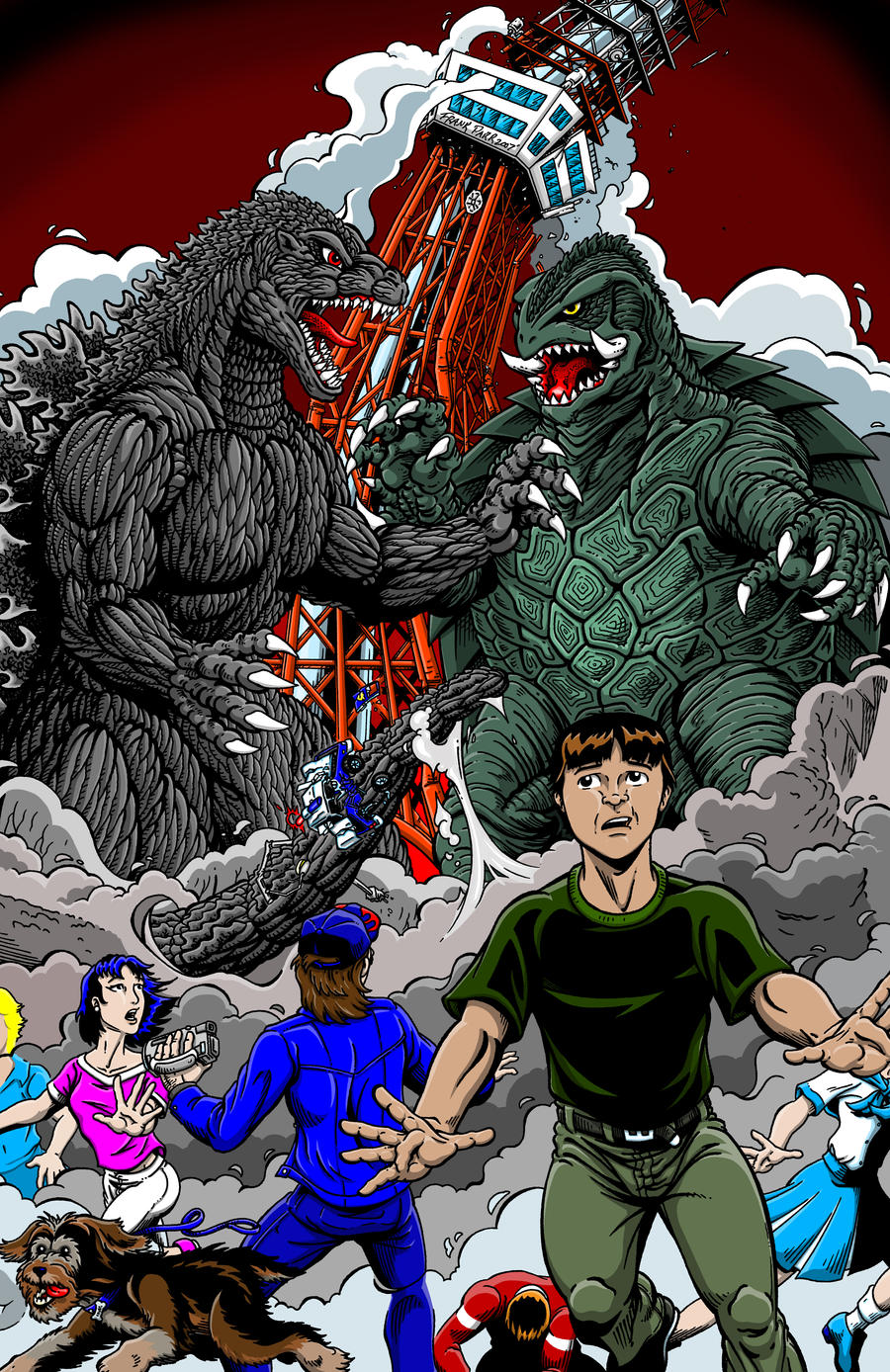
As an infant, Toto resembles a normal turtle. As he grows, he starts to look like a tortoise, with slightly wider, more expressive eyes. In his mature form, Toto gains a pair of big, anime eyes, along with stubby, incomplete tusk. The cuteness of the design is probably pushed too far in this final form. Even Showa Gamera was never cuddly. However, for the purpose of the film, the Toto design is effective. One of the film’s weaknesses is that Zedus, the enemy monster, is a somewhat uninspired design. The reptilian monster eats humans, like Gyaos, and attacks with his extending tongue, like Barugon. A “Godzilla vs. Gamera” movie, a kaiju fan dream film, has been discussed for years. “Gamera the Brave” almost plays like an unofficial version of that battle. Zedus’ reptilian appearance, lizard-like posture, and long tail certainly recalls the King of the Monsters. Zedus’ spear tongue is an interesting weapon but his second distinctive feature, a neck frill, winds up looking somewhat awkward. His brief screen-time allows for little personality. Zedus is easily the least memorable Gamera villain this side of Jiger.
Another flaw of the film is its brief government subplot. Early on, we get some brief mention of Japan having a special government unit devoted to giant monsters. This actually makes a lot of sense. However, with the focus being so squarely on Toru and his relationships, this subplot isn’t allowed much growth. When the callous scientists capture Toto for testing, it comes off like a typical plot turn. Naturally, the giant turtle escapes custody, just in time for the final fight. The military and scientists put in some token appearances afterwards but they’re ultimately an underdeveloped part of the film.
Any of the script’s problems are forgiven during the masterful last third. Zedus reappears, Toto ready to face the big lizard down. The two monsters scrap and wrestle through the city, knocking each other down with their claws and head. An especially inspired moment comes when Zedus hooks Gamera with his tail. The enemy monster swings off a building, flicking his tail through the air, catapulting Toto into a near-by sky scraper. Imagine if pro-wrestlers had tails and you’ve got a good idea of what a neat stunt that is. Even if he’s an overall uninspired design, the lizards giant stabbing tongue is certainly a dynamic weapon. The way he climbs buildings seem very natural and appropriately animalistic. Say what you will about the designs but the suit performers do excellent work.
The film’s best moment actually only involves the monsters in a background capacity. Mai holds the red stone that could give Gamera the charge he needs to win. However, she’s stuck in an emergency shelter, far away from the action. A compassionate child hears her cries and grabs the stone. She runs into the city, handing the stone off to another kid when the trip becomes too difficult. Understanding implicitly, that child continues the race, handing the prize off to another kid and another, until the stone finally reaches Toru. Low on dialogue and scored to Yoko Ueno’s excellent music, the scene plays out like a sweet, natural poem. For years, Gamera has understood children on a natural, innate level. “Gamera the Brave” shows them returning the favor. The act of bravery is enough to turn Toru’s dad around. He helps the boy up the tower, allowing him to reach Toru. Before handing the healing stone over to the turtle, the boy makes a stirring speech, letting Toto know how much he means to him and making him promise that he won’t give up, that he won’t die. The giant turtle nods, understanding. Recharged, he drops from the building, taking flight, and delivering the killing blow needed to defeat Zedus. As far as last acts in monster movies go, “Gamera the Brave” has one of the most poignant and elegantly constructed I’ve ever seen.
The film is helped by its excellent cast. For a young actor, Ryo Tomioka never falters as Toru. He doesn’t go for big, broad emotion, keeping things honest and personal. Tomioka holds the entire film together with his quiet, self-assured performance. For an actor that young, it’s an impressive achievement. Also great is the solo-named Kaho as Mai. The actress has the tricky job of playing both Toru’s older sister figure and his potential love interest. The two have a cute, believable interaction, a proper amount of concern on either side of the relationship. When Mai starts to believe in Toto near the end, Kaho really sells the emotions fantastically. Also notable is Kanji Tsuda as Toru’s father. Tsuda can never come as too harsh, keeping the balance between concern and frustration with his son. He does a great job, especially since the father holds a secret appreciation for giant flying turtles himself. Overall, the soulful script of “Gamera the Brave” wouldn’t matter half as much as it does without the excellent cast bringing it to life.
This was director Ryuta Tazaki’s first film not to have Kamen Rider in the title. He adapts well to the different material. “Gamera the Brave” was not successful at the Japanese box office, squashing much hope for a new series. Even fan reaction has been mixed, many finding the film too cute and whimsical. Yet “Gamera the Brave” is everything I’ve always wanted from a Gamera movie. It’s got plenty of well-orchestrated monster action, with all the outrageous effects and kaiju blood you’ve come to expect from the series. At the same time, the film deals with serious themes while accurately capturing the spirit of childhood. It’s cute, exciting, and poignant in equal measure. The final moment, when Toru bids the now-fully-grown Toto a strong but soulful good-bye, nearly got a tear at of me. Maybe I’m a big softie for giant monster movies but I can proudly say that “Gamera the Brave” is my favorite of the entire series. [Grade: A]
Friday, April 25, 2014
Series Report Card: Gamera (1999)
11. Gamera 3: Revenge of Iris
Gamera Surī: Jyashin Irisu Kakusei /
Gamera 3: Awakening of Irys
After redefining the Gamera series, and some would say the entire kaiju genre, with the first two Heisei films, Shusuke Kaneko took a two year break from giant monsters. When the time came to produce a third and final Gamera film, Kaneko wrote a script that brought many of the plot points first raised in “Guardian of the Universe” full circle. The result was the darkest Gamera film ever made, one that attempts to weave a very personal human story in with the epic kaiju action while bringing the series to a satisfying conclusion.
Two years after Legion’s attack on Japan, the country is still recovering. A teenage girl named Ayana, whose parents died during Gamera’s battle with Gyaos in 1995, still holds a burning hatred for the kaiju. Now, a new race of even deadlier Gyaos has appeared, putting the entire world in peril, forcing Gamera back into action. Series protagonist Mayumi and Asagi attempt to aide Gamera in defending Earth and against a military that has dubbed him a threat. Meanwhile, Ayana discovers a strange new monster, a tentacled beast that feeds on human life force. Naming the creature Iris, she teaches it to hate Gamera as well. With some assist from a pair of anti-Gamera occultists, the two mighty monsters are put on a path of violence towards each other.
“Revenge of Iris” is widely regarded as the best Gamera film, if not the best kaiju film, ever made. While “Attack of the Legion” was most ambitious in its special effects, the third feature is more ambitious in story and character. Usually, in the daikaiju genre, the human story and the giant monster story co-exist, feeding into each other, while rarely fusing into one. “Gamera 3” builds upon the connection between humans and monsters the last two films featured. The young girls at the story’s center don’t just give the giants a last minute power boost. Instead, they are directly involved in the battle, motivating the creatures, driven by the same desires. Ayana’s desire for revenge powers Iris, the occultists project their own feelings on the monsters, while Asagi and Mayumi both believe Gamera will save the world.
All of that is well and good but the question has to be asked: Is “Revenge of Iris” truly a Gamera movie? The series’ investment in its own mythology has reached critical mass. Early on, we see a Gamera graveyard, the ocean floor littered with giant turtle bodies, failed prototypes made by the Atlantians. Much attention is paid to the concept of “mana,” the Earth’s life force. Gamera and Gyaos’ reemergence is directly tied to Earth’s “mana” levels being low. None of this has much to do with the classic conception of Gamera. While the last two films mostly went off on their own stories, they at least paid homage to the original series. “Revenge of Iris,” meanwhile, is more interested in its own ideas. Swap Gamera and Gyaos out for original monsters and the story would be completely unchanged.
Kaneko’s last two Gamera films explored the kaiju genre from a deconstructive angle. Yes, if two giant monsters fought in a packed city, people would get hurt, innocents would die. “Revenge of Iris” takes this further then ever before. The entire plot is motivated by collateral damage, human lives inadvertently lost during Gamera’s heroic battles. This comes into sharp focus during the first major battle. Gamera and a group of Gyaos touch down in Tokyo. The bird monster is bloodied, an eyeball dangling from its smashed socket. In the course of the fight, Gamera sets the entire city block on fire, visibly murdering people, claiming hundreds of lives. It’s a visceral, unsettling scene. The film is doing this intentionally, making you question if having the big turtle around is even worth it. Eventually, it does answer that question, proving that Gamera does care about humanity. However, the story can’t support a topic this heavy. It becomes difficult to root for Gamera when he has so much blood on his claws.
The script is uneven. Ayane’s storyline is interesting and loaded with potential. Ai Maeda gives a fine performance, showing a secret rage behind her calm eyes. At school, she meets a boy named Moribe. Moribe’s family has protected a near-by shrine for centuries. He knows something bad lurks inside but that doesn’t stop him from showing Ayane. The two youngsters have a romantic bound. Moribe is nervous about expressing his desire, realistically so. When Ayane is swept up by Iris, he saves her, running to her aide. When the monster attacks Kyoto, the girl caught in the crossfire, Moribe tries to help her. He is out of his element though. The magical knife the temple gave him to defeat monsters winds up being completely useless, in what is either sloppy writing or a hilariously subversive joke. Nozomi Ando is extremely good in the part.
However, the teens’ storyline has to compete for screen time with the film’s other concerns. Bringing Mayumi and Asagi back into the story was a sound idea. Neither character is given much to do though, mostly forced to discuss the plot with other people as the monsters rage off-screen. Mayumi’s plot is tied in with Inspector Osako, a minor character from the previous film. Osako has become homeless, Mayumi helping to reform the man. Osako’s story doesn’t go much of anywhere. The film’s human villains, Mito Asakura and Shin’ya Kurata, are also problematic. They mostly exist as plot devices, a way to get Ayane into Kyoto before the film’s last act. Both characters’ rant about the monsters’ purposes and their mystical origins. Tooru Teduka goes way over the top as Kurata, acting like a preening hipster. Senri Yamazaki as Asakura is mostly a non-entity. The film probably should have focused more on Ayane’s struggle instead of splitting time with these other plots.
Compared to the exciting, visceral kaiju action of the last two films, “Revenge of Iris” comes up short. Throughout the film, we hear about Gyaos attacking major cities around the world, Gamera fighting them off. Bafflingly, all of these battles are kept off-scene. CGI is heavily utilized during the fights. Gamera spins through the air, colliding with the flying Iris, missiles bursting around them. The computer graphics were, no doubt, cutting edge in 1999. However, they look incredibly dated by modern standards. The action direction is shaky, making it difficult to see what is going on at times. When Gamera and Iris finally reach the ground, their battle is disappointingly brief. Most of the fight takes place inside a cramped train station. The monsters impale and claw each other in close quarters. There’s little of the theatrical kaiju action fans crave. The fight concludes with a shrug, Gamera finishing Iris off with a mostly unexplained special move.
For all its faults, “Gamera 3: Revenge of Iris” works extremely well at times. Iris is a fantastically realized monster. The creature doesn’t look like any previous monster ever put to screen. The pointed head lacks a traditional mouth or eyes, producing a truly alien appearance. The natural armor, crystalline and jagged, is very memorable. The orange tentacles, topped off with clasping pinchers, are a highly dynamic weapon. Instead of flying with rockets or wings, Iris floats on the air using a clear membrane spread between his tentacles. The relationship between the monster and Ayane is interesting. As a cute baby-thing, she feeds it. When it starts to grow, Iris wraps Ayane with its tentacles, a moment dripping with Freudian implications. The kaiju also has a bad habit of sucking people’s life force, turning them into dried out mummies. When the corpses are discovered, it provides the movie with a horrific edge. Iris’ confrontation with the military, the giant monster easily finishing off the soldiers, is the movie’s sole moment of satisfying action.
“Gamera 3” works the best, not during its kaiju fights, but its quieter moments. The film’s emotional climax isn’t when Gamera banishes the evil monster. It is, instead, when Iris takes Ayane inside its skin. Falling through a psychedelic cascade of color, Ayane experiences Iris’ memories. She realizes her hatred has motivated the monster. She sees, firsthand, the creature decimating her village. For the first time, she questions her motivations. Despite doing nothing but hating him, Gamera rescues the girl, gorily pulling her free of Iris’ grasp. This moment makes it clear that the giant turtle fights for mankind, not just for the Earth. As Iris dies, Ayane is suddenly torn, the creature she’s devoted her life to hating being responsible for saving her. It’s a complex, fascinating moment, one the film needed more of.
In my review of “Gamera 2,” I suggested that the filmmakers had turned Gamera into a Christ figure. I was being sarcastic but “Revenge of Iris” continues in this vain. Gamera works in mysterious ways. Yeah, thousands of people wind up dead because of him but, ultimately, he wants to protect mankind. Even those that have abandoned him aren’t above his love. Ayane’s hatred might have unleashed a horrible new threat but Gamera doesn’t care. He forgives all. Just to make the subtext even more explicit, Gamera gets crucified. Iris stabs a huge hole through his chest, nearly killing the turtle. Not long after that, the giant turtle gets a massive spike hammered into the palm of his hand. Comparing a giant turtle that flies by farting fire to Jesus is pretty funny. The subtext might also be completely unintentional. Yet it’s hard to imagine Keneko didn’t know what he was doing. Framed in this context, “Revenge of Iris” becomes a story of faith tested and ultimately renewed.
“Gamera 3” ends on a deliberately ambiguous note. After defeating Iris, a swarm of Gyaos fly towards Tokyo. Gamera, despite being seriously wounded, with no guarantee he can win the fight, marches forward into battle. It’s tempting to say the film cuts off right before its most exciting moment. Yet that ending is film’s most definitively “Gamera”-like moment to me. The giant turtle’s primary characteristic over the years has been his undying tenacity. The suggestions that he might go down fighting, or even succeed against impossible odds, is in keeping with his character. The ending didn’t satisfy everyone, as enterprising fans later produced a fan-film called “Gamera 4: Truth,” wrapping up the storyline. I, personally, like the ambiguity.
I’m ultimately surprised a film as uneven as “Gamera 3: Revenge of Iris” is so beloved. The film’s script juggles more plot lines then it can handle. Its treatment of the monsters is uncertain and the movie holds back on the action. Yet there are some amazingly serene moments and an ultimately thoughtful heart behind the messy story and tone. If nothing else, the movie introduced an unforgettably odd monster to kaiju fans. “Gamera 3” wraps up the defiantly unique Heisei era in a defiantly unique way. [Grade: B]
Labels:
gamera,
giant monsters/kaiju,
heisei eiga,
horror,
j-horror,
sci-fi,
series report card
Thursday, April 24, 2014
Series Report Card: Gamera (1996)
10. Gamera 2: Attack of the Legion
Gamera Tsū: Region Shūrai /
Gamera 2: Advent of Legion
After the critical and financial success of “Gamera: Guardian of the Universe,” there was no way a sequel wasn’t going to happen. Director Shusuke Kaneko and writer Kazunori Ito wisely stuck around. The sequel, rolled out a year later, has more action and a bigger, badder threat. Unlike the previous film, “Gamera 2: Attack of the Legion” would have the giant turtle facing off against a brand-new foe, created specifically for the film. Considering Toho’s attempts to do something similar with their Godzilla series hadn’t worked out for them, could Gamera make it against a brand new baddie?
A year after Gamera and Gyaos’ battle through Tokyo, the city is still recovering. The military watches the ocean, preparing for another monster to appear. Another monster does appear but not out of the ocean but rather from the sky. While out with her students, science teacher Honami spots a star falling from the sky. Soon afterwards, strange creatures begin to appear in the city, attacking humans and consuming glass. The insect-like monsters quickly multiple, building a giant flower in Sapporo. Feeling the world is threatened, Gamera reemerges from the ocean. The new threat, quickly dubbed Legion by the Japanese military, proves a difficult challenge for Gamera, doubly so when the creature’s massive queen appears. If Gamera can’t defeat the Legion, all of Japan could be in peril.
The previous Gamera film went out of its way to distance itself from the silly shenanigans of the Showa era. “Attack of the Legion” is no different in that regard. However, the film introduces a stalwart element of the classic series: Aliens! Legion isn’t a devious invader like Viras or Zigra. It doesn’t even arrive in a flying saucer. Instead, the kaiju is a thoroughly modern alien. They arrive in a meteor as microscopic organisms. Like ants, the Legion function as a hive, with hundreds of soldiers and builders reporting to a massive queen. Their form of mass transportation, building a giant, explosive flower, is also something you’d see in nature. The alien monsters have no concise plan. They function as a mindless virus, arriving on a planet, stripping it raw, and leaving for the next. They intentionally recall the xenomorphs of the “Alien” franchise or any other parasite-style sci-fi monsters.
The comparison to “Aliens” is apt. “Gamera 2” is the first Gamera movie since the original to actually feel like a horror film. Near the beginning, security guards at a beer warehouse are spooked by an ominous shadow and a strange giant eye. Passengers in a subway are attacked by the Legion drones, human blood splattered on glass. We’ve seen plenty of kaiju blood over the course of the Gamera series but never red human blood. That’s somewhat startling. An entire tunnel fills with the crawling, snapping monsters, looking like a cross between stag beetles and spiders. Once the giant monster fights start in earnest, the film abandons any attempt at horror. Yet the sudden harsher elements still come as a surprise.
The focus is squarely on the alien threat for the first half-hour of the film. These sequences are successful but they do leave the viewer wondering when Gamera is going to show up. Luckily, “Attack of the Legion” is very good at establishing continuity with the first film. The battle between Gamera and Gyaos has left a lasting effect on Japan. The two monsters are mentioned frequently. The debate continues to rage about whether or not Gamera is truly an ally of humanity. A clever visual cue is when we spot the Tokyo Tower, still broken in two, under construction. The best nod to is when Asagi, the inadvertent priestess of Gamera from the first film, comes back. Though mostly kept on the sideline, Asagi continues to be an important character, her tear-drop medallion providing a serious plot point. When kaiju films frequently have non-existent continuity between them, “Gamera 2” being a true sequel is much appreciated.
Something that was surprising about “Guardian of the Universe” was how captivating its human story was. “Attack of the Legion,” on the other hand, can’t live up to that precedence. Honami, as played by Miki Mizuno, is fine in the role. She’s even charming, the actress rightfully playing up the character’s quiet tenacity. The problem comes when the movie creates a romantic storyline between Honami and the film’s military hero, Colonel Watarase. Toshiyuki Nagashima gives a slightly bland performance as the young colonel. Furthermore, you never get a romantic vibe between him and Mizuno. The two seem more like casual friends then star crossed lovers. When the movie attempts to play up their relationship, like the two separating at an airport, it doesn’t work. The final act separates the love birds, Honami forced to watch the kaiju battle from the streets while Watarase waits tensely in a secured bunker. The human plot is not smoothly integrated with the monster action and the characters aren’t that captivating on their own.
Despite these issues, “Gamera 2: Attack of the Legion” is successful. Watching the movie as a monster fan, it might be one of the most ambitious, effects-heavy kaiju films ever made. Gamera is given a slight redesign. The ridge on his head is more prominent, his forearms spinier. When flying, his arms extend into aerodynamic fins, like a sea turtle, a slightly silly if interesting visuals. The titanic turtle is more fearsome then ever before. The CGI, though still primitive, is integrated smoothly with the live-action suits.
Perhaps the filmmakers were hedging their bets. If the enemy monster was going to be brand new, it had to be impressive. And, boy, is it ever. The mother Legion is massive and ornate. The design pushes the art of suitamation as far as it can go. Legion has multiple thin legs extending from its head and body, constantly thrashing back and forth. An additional set of legs extends from the monster's back, reminding me of a weta’s sharpened spurs. Legion’s head is topped with a pointed crest, his vertical jaw snapping left and right. Inside its chest, it even carries a nest of immature Legion drones. The huge insect is even taller then Gamera, towering over the hero. Never does the monster look like a man in a suit. Instead, it’s a living, breathing, bizarre creature, that carefully balances looking plausible, alien, and awesome. Even the monster’s energy weapons, blue bolts shot from its mouth or red laser whips extending from its head, are creative and convincing.
Having created an intimidating adversary, effects director Shinji Higuchi orchestrates some impressive monster battles. Once Gamera appears, his body is quite literally covered with Legion drones. Spinning through the air, he attempts to shake the bugs off. Having been wounded, he instead splatters his green blood over half the city, an unforgettable image. The Showa series focused on Gamera’s bleeding simply for the cool factor. Kaneko and Ito seem to be intentionally playing up the turtle’s vulnerability. During his first fight with the queen Legion, he is impaled twice with the bug’s massive spikes. Green blood floods from wounds. A chunk of his shell is blown off, his head is cracked, and holes are burned through his skin. The giant tortoise takes a beating.
As in “Guardian,” a particular focus is given to the damage the monsters reek on the city. Upon arriving in Sapporo, Gamera crashes through a building. We see his huge foot smashes through the roof, making a rough landing. The camera is constantly placed at ground level, puny humans fleeing from the battling giants. The military is uncertain to trust Gamera and, considering how much property damage he creates, maybe they shouldn’t. The second act turn comes when Gamera attempts to bring down the Legion flower in Sendai. Upon pulling the huge plant apart, a massive fireball consumes the city, leaving the metropolis a steaming crater. (Considering Sendai was devastated during the 2011 Miyagi earthquake, this scene plays very differently now then it did in 1996.) The last act is motivated by whether Gamera survived the blast and, if he didn’t, can the military defend Tokyo from the encroaching Legion without him.
Gamera, of course, does survive the explosion. The titanic tortoise always pulls through from whatever damage is inflicted on him at the movie’s half-way point. Always has, right from the beginning. However, “Attack of the Legion” adds a different layer to the familiar plot point. The villainous monster is named Legion by one of the soldiers, quoting Mark 5:9, the infamous “For we are many” line. This adds a religious element that was previously lacking from the kaiju genre. Where do you think I’m going with this? Gamera died for your sins. The Friend to All Children suffers an injury, is seemingly deceased, only to be resurrected by the beliefs of his followers. Reading too much in to it? Oh yeah, definitely. Yet I have to wonder if some of this was at least intentional.
For the final battle, the action moves to the outskirts of Tokyo. Gamera confronts Legion, extra-pissed off. He tears the monster’s legs and jaws off, wounding it. The two kaiju wrestle, clawing and biting at one another. Even with an assist from the Japanese military, who finally comes around to the big turtle, it’s a rough fight. It honestly seems like Legion might win, whipping the terrapin into submission with his laser weapons. At the last minute, Gamera seems to draw energy from the life force of the Earth it self. With this boost, he charges a special attack, something powerful enough to finish off the enemy monster with one shot. That’s right, guys, Gamera just threw a Spirit Bomb. The script’s biggest flaw is this last-minute Hail Mary move. Underneath his chest armor this whole time, Gamera was packing a super weapon. Why didn’t he just use that in the first place? It’s a fairly lazy move, one that is introduced with zero foreshadowing.
Even if Japan was left in ruins, Gamera leaves victorious, a hard-fought victory finally won. “Gamera 2: Attack of the Legion” ends with an interesting message. Monami delivers her belief that Gamera wasn’t fighting for mankind but rather for the earth itself. And, should we continue to mistreat the Earth, the Guardian of the Universe might turn on us. Nothing else in the film supports this eco-friendly message yet I like it anyway. The idea of kaiju as gods above humanity, indifferent to us, is a potent one. It also, in an odd way, brings the Christ metaphor full circle. In other words, guys, get your shit together or else Jesus is going to come back pissed. And this Christ-figure just happens to be a giant turtle that spits fireballs…
While not as strong as its predecessor, “Gamera 2: Attack of the Legion” remains a fantastically entertaining monster brawl. Kaneko’s direction and Koh Otani’s music remain interesting while the special effects are out of this world. For that reason alone, it’s required viewing for monster movie fans. [Grade: B+]
Labels:
big bugs,
gamera,
giant monsters/kaiju,
heisei eiga,
horror,
j-horror,
sci-fi,
series report card
Wednesday, April 23, 2014
Series Report Card: Gamera (1995)
9. Gamera: Guardian of the Universe
Gamera: Daikaiju Kuchu Kessen
I can’t say for certain what Japanese monster fans thought of Gamera by the late 1990s. Perhaps some fans appreciated those films for the campy wonders they are. Others probably dismissed them out right as ridiculous kid stuff. Either way, I bet the news of a “dark and gritty” Gamera reboot was met with eye-rolling and derisive signs. How do you grimdark up a fire-farting giant turtle? Somehow, director Shusuke Kaneko and screenwriter Kazunori Ito succeeded. Not only did “Gamera: Guardian of the Universe” fill the kaiju-sized void left by the end of Godzilla’s Heisei era, it has gone on to become one of the most beloved kaiju film of any age.
The film presents a Japan that has never been attacked by giant monsters before. Two strange events open the plot. First, a mysterious atoll, floating towards Japan, appears in the Philippines sea. Secondly, a giant winged creature is attacking and killing people on Goto Island. Expert Mayumi Nagamine investigates the latter, discovering a giant carnivorous bird species that grows very quickly and are born pregnant. Professor Kusangi, meanwhile, discovers a strange monolith atop the atoll. Just as the birds, named “Gyaos” by an ancient text, descends on Japan, the atoll reveals itself to be the giant, flying, fire-breathing turtle Gamera. Nagamine, Navy officer Yoshinari, and Kusanagi’s daughter, along with the rest of the Japan, are soon caught up in the battle between the two monsters, an ancient rivalry that goes back thousands of years.
As absurd as the idea sounds, “Gamera: Guardian of the Universe” is indeed a dark and gritty reboot of the silliest kaiju franchise. The film, at first glance, has little to do with the campy original series. Many of the defining characteristics of both Gamera and Gyaos are removed. Gamera no longer sucks fire into his mouth. Gyaos’ undoing isn’t a stiff, unmoving spine. Even the most serious of the Showa era had ridiculous things happening on-screen. “Guardian of the Universe,” meanwhile, plays its premise with dead seriousness. That sounds like a betray of the source material but, against all odds, the film works incredibly well. “Guardian of the Universe” is a complete reinvention of the Gamera series.
The sixties Gamera series never had any sort of unifying mythos. The ’95 film corrects this, building a surprisingly deep mythology around the monsters. Gamera and his enemy are linked with Atlantis. The original film briefly mentioned that the giant turtle came from Atlantis but none of the subsequent films brought it up. Both monsters are revealed as being genetically engineered by the ancient society. Gyaos was created to protect the world from pollution. When the flying monsters became impossible to control, Gamera was created to protect humanity. It was too late though, Atlantis already destroyed. Now, rising pollution has awoken the monsters again. Linking the creatures with both an established mythology and an ecological message gives them far more resonance then ever before.
Surprisingly, “Guardian of the Universe” almost plays like a deconstruction of the daikaiju genre. Gamera is Earth’s protector but surprisingly ambivalent to the man on the street. Upon appearing in Fukuoka, he knocks a Gyaos into an oil field, starting a huge fire that claims several lives. Throughout their battle, the two giant monsters wreck buildings, sending crowds of innocent people fleeing in terror. Kaneko’s direction is stationed on the ground, looking up at the massive monsters, emphasizing their huge size. Kaiju battles have always featured plenty of collateral damage but rarely has the human danger been this accentuated.
Even though the heroes quickly recognize Gamera as a good monster, the military still decides to attack him. Why wouldn’t they? It’s a giant monster that suddenly showed up and started smashing buildings. Gyaos is a deeply visceral threat, scooping up innocent people, devouring them whole. A growing monster of that size has to eat a lot, after all. The appearance of the beasts has an immediate effect on the country. Public transportation is choked with fleeing people. The stock market plunges. News broadcaster attempt to stay up to date on the story but are quickly outpaced. The Japanese senate votes on whether or not to attack the monsters, the decision made with great reluctance. The populace mostly responds to the creatures in fear. Yet one small child seems excited and a pair of partiers, on the way from a sporting event, want to place bets on the battle. The film had this experienced kaiju fan considering aspects of the genre he had never thought of before.
The film plays with the conventions of the genre while still delivering on the giant monster thrills. Both creatures are brought to life fantastically. Gamera’s design is updated with modern effects without deviating too much from his classic look. His face is more angular, the ridge on his head more pronounced. The turtle’s shell is more jagged, appearing harsher then before. Ridges, bumps, and extra armor are added to his body, giving Gamera an earthier, more intimidating appearance. I also like the touch of giving him big, green, expressive eyes, which roots the grittier design with personality. Gyaos, meanwhile, has been completely redesigned. The bat-like creature is given a more reptilian look, its skin red and scaly. The stiff posture is ditched for a more mobile body and neck, the monster now moving swiftly and believably through the skies. The changes make Gyaos more then just a Rodan rip-off. However, the designers were smart enough to keep the monster’s trademark element. Gyaos still has a sloping, triangular crest on his head and, notably, the monster still feasts on human flesh.
Initially, the film keeps coy about both monsters’ ability to shoot projectile weapons. Gyaos appears to be a big, hungry bird at first. However, the creature’s super-sonic cutting ray is maintained, fantastically revealed when two of the monsters cleave through the bars of their cage. Gamera’s fire breathing, now shown as condensed fireballs instead of long streams, gets a similarly dramatic reveal, flying out of nowhere. Both abilities play almost like in-jokes. Small references like that are sprinkled throughout, marking it as a true Gamera film. The giant tortoise takes the time to protect a child in the heat of battle. Destructive though he may be, Gamera doesn’t fight back when the military attacks him. He’s still a good monster. When severely injured, his green blood still running from open wounds, Gamera retreats to the ocean to heal himself. Though ditching the high-strung silliness of the classic series, “Guardian” maintains at least some of the spirit of the original films.
The kaiju fights are incredibly dynamic. Gyaos’ early attack on the island, a screaming man grabbed out of his car, is actually frightening, something you can’t say of most giant monster movies. Gamera’s grand entrance is exciting, headbutting a Gyaos into an explosion. The monsters encounter each other again in the forest. With a single fireball, Gamera explodes one of his enemies, monster guts flying everywhere. The film’s heroes, along with an innocent child, are caught on a bridge between the fighting beasts, raising the stakes of the fight considerably. The military attempts to shoot Gyaos down, the monster withstanding missiles strikes. He even redirects some rockets into Tokyo Tower, having the landmark. Memorably, the monster then nests on the wrecked structure. Gamera’s enters the final fight by exploding out of the ground, wrecking buildings and streets in the process.
That last battle is when the action truly shifts up. The digital effects of Gamera and Gyaos flying haven’t aged well, often looking fake. However, Kaneko’s direction is incredibly lively. The monsters race through the city, the camera flying with them. Gamera shoves his enemy into a building, the camera watching from inside as Gyaos’ head crashes through it. The creatures take to the air, flying up into the upper atmosphere. Gyaos’ wings pass before the moon before both monsters tumble back towards the Earth. Gamera crashing into another refinery, causing a massive explosion, seems to be the monster’s end. Until the film remembers the turtle’s rarely mentioned fire eating ability. He adsorbs the flames, supercharged, finishing his rival off with a giant blast to the face. That’s a satisfying moment. The final battle is incredibly exciting, one of the best in all of the subgenre.
The script is smoothly constructed. The opening minutes drag a bit, the two plot lines existing separately. The movie quickly brings them together, the characters realizing the connection between the two kaiju. A clever solution to stopping the Gyaos threat is introduced. The three bats are lured to a giant sports stadium, trapped under the dome. Actually, the plan probably would have worked if Gamera hadn’t come along, smashing the structure open. Early on, the story introduces Kusanagi’s daughter, Asagi. As a gift, she is given a strange pendent found on the atoll. This makes her a priestess of Gamera, developing a spiritual link with the monster. Now, when he is wounded, she is wounded too. When the turtle falls into a healing slumber, she does as well. At first, this subplot comes off like a clumsy device, a way to give the heroic tortoise a last minute energy boost. However, Asagi winds up being the story’s emotional heart. Gamera’s defeat would mean her death. Literally tying in the monster’s fate with one of the human cast members is a smart idea, getting the audience doubly invested in the fight. Though mostly a serious affair, Ito’s screenplay even sneaks in some humor. Comparing the flesh eating Gyaos with the Japanese ibis leads to a deadpan response. A taxi driver’s reaction to a military blockade provides a big laugh as well.
“Gamera: Guardian of the Universe” has a uniformly strong cast, something you couldn’t always say about the Showa films. Shinobu Nakayama is more then just a damsel in distress. Mayumi is motivated and courageous, devising ways to defeat the monstrous threats and putting her own life on the line to project an innocent child. Nakayama has solid chemistry with Tsuyoshi Ihara’s Yoshinari. While in most kaiju films, the military man Yoshinari would have been the hero. Ihara instead plays the love interest. The quiet moments between the two characters, such as a brief aside during Gyaos’ attack on Tokyo, really stand out. Another memorable quiet moment is when Professor Kusangi, played by Akria Onodera, pauses inside his sleeping daughter’s room to question how well he truly knows her. Onodera brings a surprising gravity to the part. As a man of science, he is reluctant at first to accept Gamera’s Atlantian origins. However, evidence piles up, forcing him to acknowledge the truth. Kusangi remains most concerned with his daughter though, which the film gets some great mileage out of in the final lap.
Aside from an ecological message that is introduced without much precedence and not commented on again, “Gamera: Guardian of the Universe” works incredibly well. It’s amazingly exciting, fantastically directed, well written, and features great special effects. It successfully re-birthed Gamera, exposing a new generation to the flying turtle and completely changing the character’s public perception. [Grade: A-]
Labels:
gamera,
giant monsters/kaiju,
heisei eiga,
horror,
j-horror,
sci-fi,
series report card
Monday, April 14, 2014
Series Report Card: Gamera (1980)
8. Gamera: Super Monster
Uchu Kaiju Gamera
With the bankruptcy of Daiei, the Gamera series was brought to an abrupt end. The remnants of the studio eventually fused with the Touma Shoten publishing company, birthing a new Daiei. With the revival of the company, a revival of its trademark franchise was only a matter of time. Either the budget or the public’s appetite for giant flying turtles (Or, most likely, both) had run dry. The “Gamera” series has always been shameless about its use of stock footage. However, the would-be comeback film, “Gamera: Super Monster” pushes that attitude to unheard of new lows. It’s less a movie then a clip show, a best-of reel were nearly every monster appearance is recycled from an older film.
The plot, as it is, starts up when an evil space warlord named Zanon decides he wants to conquer Earth. However, first he must remove Earth’s protectors. No, not Gamera. The Superwomen, a trio of cape-wearing superheroes who can fly, change size, teleport, and turn their van into a bitching space ship. Unfortunately, whenever the women transform, it attracts the attention of Zanon’s laser beams and the female agent he sends to Earth. Instead, Gamera, who may or may not be a little boy’s pet turtle, has to protect the planet. In order to defeat the titanic terrapin, evil lord Zanon sends all of Gamera’s former enemies to battle him, hoping to best the flying turtle.
The cheapness of “Gamera: Super Monster” extends even beyond its liberal use of stock footage. The film shamelessly rips off other film and television series that were popular at the time. Right from the beginning, this is obvious. A space vessel, nearly identical to a Star Destroyer, passes over the camera in a shot ripped directly from “Star Wars.” Even the music is designed to bring to mind George Lucas’ genre-busting blockbuster. The rip-off game doesn’t end there. The Superwomen trio was obviously inspired by the Christopher Reeves “Superman” series, still climbing box office charts at the time. Their capes and flight are indebted to American superheroes, while a set they wind up on is like the low budget version of Richard Donner’s crystalline Krypton sets. The Superwomen also owe much to the Japanese superheroes that are perennially popular on television. Before transforming into their costumes, the women do a dance, cocking their arms at odd angles and spinning around. The trio’s van and cars don’t measure up to Kamen Rider’s motorcycle, instead being ordinary vehicles that undergo unconvincing transformations. In other words, the parts of “Gamera: Super Monster” that aren’t literally recycled from older movies are figuratively recycled from older movies.
The film’s derivative nature speaks to its massive laziness. We never actually meet the evil lord Zanon, the villain kept completely off-screen, only heard as an ominous voice. His female agent, the improbably named Giruge, is deeply incompetent. For most of the film, she nearly waits around for the Superwomen to transform in front of her. She does nothing to aide Zanon’s monsters. (Of course not, that would require new scenes be filmed.) Her proactive actions boil down to kidnapping the child protagonist, ineffectively, and one ridiculous kung-fu fight set on a playground. Giruge’s character arc - to be defeated by the heroes, abandoned by the villain, and converted to the side of good - is the kind of juvenile writing you’d find in countless Japanese manga. Perhaps this was intentional since the movie directly references manga early on.
The Superwomen aren’t the most impressive superheroes ever committed to film either. Each has a human identity. Kilara, the vaguely butch leader of the team, runs a pet shop. Marsha is a car salesman, allowing for some blatant product placement from Mazda. Mitan is a school teacher. When no one is looking, they do their little dances, switching into unflattering off-white body suits and red capes. The heroines’ flying ability is displayed early in the film. However, whenever they reveal their powers, they attract the villain’s attention. So, in a clumsy money-saving measure, the superheroes spend most of the movie in their citizen identities. Most of the time, they move around in their unimpressive vehicles, which they pilot with electric keyboards. The Superwomen dominate the first half of the movie, making you wonder when Gamera will show up.
For all the unrelated crap in the movie, “Gamera: Super Monster” is still a Gamera film. As you’d expect, the film has a child protagonist. Keiichi appears to be a lonely child, with few friends, who spends a lot of time in his room alone, practicing songs on an electric organ. His mother comes off as a control freak, forcing him to neglect hobbies he loves. After Keiichi adopts a turtle from Kilara’s pet shop, an animal he dearly loves, his mom passive-aggressively talks him into getting rid of the reptile. The movie is too thinly written to address the melancholies of childhood in any meaningful ways. Basically, the most interesting thing about the film is barely in it.
Which leaves us with Gamera. The movie, oddly, hints that Keiichi’s freed pet turtle is also, somehow, Gamera. This bit of whimsical magic realism is barely addressed. Gamera, when not brought to life through scenes from the earlier, better movies, is realized as an awkward hand-puppet. “Super Monster” is mostly free of hilarious bizarreness that makes the earlier films so much fun. Save for two moments. In Keiichi’s dreams, he sees Gamera flying along side Space Cruiser Yamato and the Galaxy Express 999. As in the famous anime space ships. As in cartoons. A rubber kaiju suddenly interacting with animated spaceships is a bizarre, amusing moment that appears without explanation or further elaboration. The movie needed more oddball touches like that.
It’s tempting to call “Super Monster” a best-of reel. It does, after all, feature the fight scenes from the previous movies, usually in their entirety. However, even the stock footage is handled clumsily. The new electronic musical score drains the crazy combat of much of its energy. The fights are awkwardly re-cut and presented in an odd order. Because the footage is untouched, Gamera flies to an alien planet midway through the film just to battle Guiron before flying back to Earth. By the time the fight with Barugon is recycled, the movie is nearly over, leaving little room for the footage to breathe. Gamera fans will have to watch the dam sequence from “Gamera vs. Barugon” for a third or fourth time. The movie at least has the sense to recycle the original film’s footage on a black-and-white TV.
The movie attempts to provide the series with a conclusion. Gamera sacrifices himself at the end to destroy the evil Zanon’s star ship. Giving the heroic turtle a proper send-off is appreciated. Yet “Super Monster” is a less then dignified film for the kaiju to exit on. Midway through Gamera’s Tokyo rampage, he overturns a poster for a “Godzilla” film. It’s a mean spirited jab at Gamera’s rival monster. And a wholly unearned one. “Gamera: Super Monster” is laughable and cheap but not in the fun, energetic way. The flying, fire-breathing turtle would end his classic era on a whimper.
[Grade: D]
Sunday, April 13, 2014
Series Report Card: Gamera (1971)
7. Gamera vs. Zigra
Gamera tai Shinkai Kaiju Jigura
Daiei continued to crank out Gamera movies on a yearly basis, racing neck and neck with Godzilla for the hearts and minds of Japanese children. However, studio misspending and executive shuffling led to Daiei going bankrupt in 1971, abruptly bringing the Gamera series to an end. How abrupt was it? A script existed for an eighth film in the series, “Gamera vs. Garasharp,” and pre-production was far enough along that storyboards exist. Seems to me the people working for the studio weren’t even aware of Daiei’s impending fate. So with no prior planning or expectations, “Gamera vs. Zigra” would be the final Gamera film of the Showa era.
After the more grounded approach of “Gamera vs. Jiger,” “Zigra” returns the series to outer space. Rather literally as well, as the film opens with a flying saucer attacking Japan’s moon base. On Earth, oceanographers Dr. Wallace and Dr. Ishikawa have no such concerns, worried more about their responsibilities at an aquatic wildlife theme park. Their six year old kids, Kenichi and Helen, are even less careless. That all changes when the doctors and their children witness the UFO landing in the ocean. The four are abducted by the alien, Zigra, and his brainwashed human servant. After hypnotizing the fathers, Zigra and friend set about conquering the world, a plot that mostly involves brainwashing more people and threatening radio broadcasts. It’s a good thing that the denizens of Earth have Gamera on their side. But will it be enough?
Proving once again that space is the place, the plot’s sci-fi silliness injects some much needed energy into the starting-to-sag series. To quote the film’s characters, “Gamera vs. Zigra” is groovy. The movie has a lot of fun with its human villain, the mysterious Woman X, another sinister space-babe in a tight-fitting suit. At first, she reasons that it would be easier to conquer Earth just by Killing All Humans. However, Zigra convinces her that a subtler approach is needed. Marching onto land, the woman hypnotizes a group of teenage sunbathers with her flashing eyes. Now clothed in a slinky bikini, providing even more eye-candy for the dads in the audience, she goes about conquering minds at the film’s Sea World-style setting. The most amusing moment in a film full of ludicrous bullshit is a chase scene. Now clad in a mini-skirt and go-go boots, Woman X chases the kid heroes around the park. They repeatedly get the drop on her, locking her behind doors and leaving her in the dust. When the chase attracts a crowd’s attention, humorously, the woman knocks the entire group unconscious with her eye rays. About thirteen adults go limp. By the way, all of this is set to a swinging seventies score, composer Shunsuke Kikuchi’s funkiest work yet. It is, in as few words as possible, fucking hysterical.
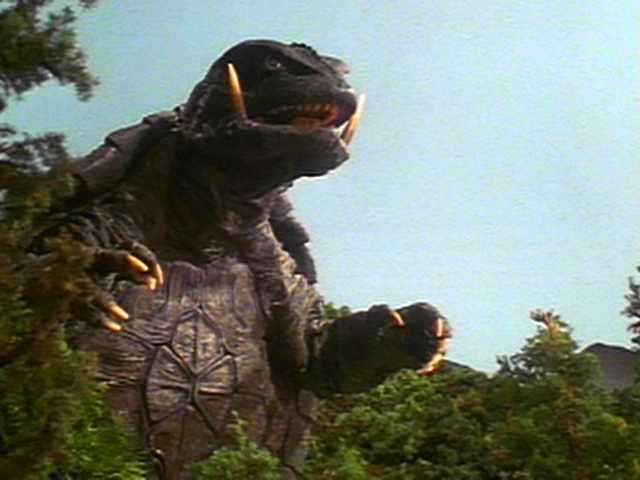
Yet the movie’s grooviest element is its kaiju final boss, Zigra. The monster resembles the goblin shark with its lilac-colored armor and pointed horn on its head. Zigra’s long fins and beak-like mouth also brings a bird to mind. The film seems to acknowledge this when it has Zigra fly through the air late in the film. To up the chances for the series’ trademark gore, Zigra is also covered with sharp edges, on his fins, face, and back. Most ridiculously, the fish-like monster even stands up and walks around on his hind fins.
However, oddball monster designs are par the course for the Gamera series. What truly makes Zigra special is the way he acts. This is a giant monster with a serious superiority complex. He wants to conquer Earth because he considers the planet’s ocean to be unworthy of humanity. Also, because humans are delicious and he wants to eat all of us. He reasons it’s fair for a sea creature to eat land creatures since land creatures eat sea creatures. Sound logic. First appearing as a disembodied head, Gamera frees Zigra when he blows up his space ship. Exposed to the ocean’s different pressure, Zigra grows to giant sizes. This seriously pisses him off. We know all of this because Zigra can talk. He speaks in a booming, reverberating voice, often dictating verbose monologues. My favorite is when he declares himself beautiful and plots revenge on humanity. By giving their monster a little more personality, Daiei created one of Gamera’s most entertaining enemies.
Once again, the series pairs up a Japanese kid and an American kid. However, the formula is shaken up a little bit. Instead of two sons, it’s a little boy and a little girl. The two act like brother and sister, despite not being related. They even live together, their mothers harping on them for different reasons. Amusingly, the two disagree on Gamera’s nature. Kenichi, of course, believes Gamera to be Friend to All Children while Helen is more skeptical. This attitude changes when Gamera swoops down to save the kids from Zigra’s giant fin, scooping their boat up. When put down on land, the kids encounter a strange man dressed in rags. Kenichi immediately deduces the pair has traveled back in time. Amusingly, the old man proves otherwise when he pulls a radio out of his pocket. Just to add to the fun, this character never appears again.
The movie diverts a little from the series’ formula, showing the filmmakers having a little fun. When Zigra starts his rampage, blowing up a few random boats, panic grips the coast town. The manager of the theme park tries to talk to the top animal trainer. Instead, the trainer says “to hell with humanity,” he wants to die with his animals. For all its fun shake-ups, “Gamera vs. Zigra” follows the series’ established structure closely. Gamera shows up and fights his opponent. They tussle for a few minutes, Zigra flying circles around Gamera, before the turtle hero goes down. This time, Gamera is knocked unconscious by Zigra’s eye-freezing ray.
A little too much of “Gamera vs. Zigra” is focused on the plight of the kids’ parents. Upon being taken aboard the space ship, Woman X drops a load of exposition on everyone, explaining the aliens’ motivation. The fathers are knocked unconscious by the woman’s glowing eyes, spending a large portion of the film in a catatonic state. Eventually, the kids realize they can wake their fathers up with super sonic sound. Is that the second or the third time sound has been used as a weakness in this series? The dads go down in a bathysphere to investigate the monster, the kids once again stowing away. The monster puts them in peril, leaving them to die. Too much time in the film’s middle section is devoted to this subplot. The way it resolves is disappointing too, the humans more-or-less tricking the monster into saving them. Worse yet, the humans don’t even end up reviving Gamera, that duty falling to a convenient lightning storm.
When Gamera awakens for the final round, the movie’s pace perks back up. The turtle’s shell protects him from Zigra’s energy waves, something he probably should have realized sooner. In the ocean, Zigra has the advantage, swimming around, slicing up Gamera’s belly. Once the fight reaches land, the tide turns. Gamera blunts Zigra’s nose-horn by sticking a big rock on it. Pinned to the ground, Gamera picks up another rock. He taps the rock against Zigra’s back spines, playing them like a xylophone. Naturally, he plays the Gamera theme song! Afterwards, the film’s soundtrack joins in, Gamera going into a spastic dance, swinging his arms back and forth, roaring repeatedly. Down for the count, Gamera sets Zigra ablaze with his fire breath, the shark monster burning to ashes in minutes. It’s not as gory a defeat as some of the series’ other enemies but it’s still strangely satisfying.
“Gamera vs. Zigra” ends on an educational note. As Gamera flies away in victory, the kids shrieking out his name, Kenichi’s dad stops them. He explains that humans have to be more protective of our oceans and take better care of its wildlife. This ecological moral is set up earlier, when Zigra briefly mentions that his home world was ruined by pollution. Notably, this film was released the same year as “Godzilla vs. the Smog Monster,” another kaiju movie with an anti-pollution message. Considering the Godzilla film laid that message on thick while “Zigra” just tacks it on at the end, I don’t think this was an intentional emulation. Instead, environmental concerns seemed to, ahem, be in the air at the time.
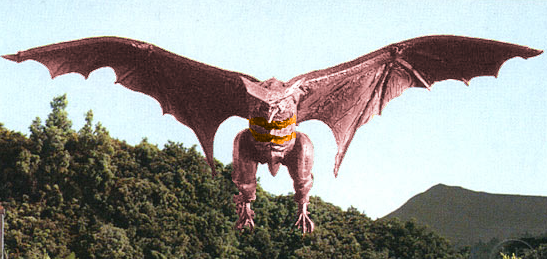
It’s difficult to grade the Showa Gamera movies on any conventional metric. Even the best films in the series are most valuable for their campy imagery. “Gamera vs. Zigra” is not as smooth as “Gyaos” or as out-of-this-world as “Guiron.” However, it’s a noticeable step-up from the maudlin “Jiger” and features some delightfully screwy moments. As far as moments to take the classic series out on, a giant turtle playing music on a giant shark’s back isn’t bad. It isn’t bad at all. You might even call it groovy. [Grade: B]
Saturday, April 12, 2014
Series Report Card: Gamera (1970)
6. Gamera vs. Jiger
Gamera tai Daimaju Jaiga /
Gamera vs. Monster X
The Gamera movies were cranked out so quickly that I’m not sure if the Daiei executives in charge even had time to take the previous film’s reaction to heart before working on the next one. In the unlikely scenario that they did, it’s easy to see “Gamera vs. Jiger” as a reaction to the sci-fi goofiness of the last two movies. Yes, for his sixth film, Gamera comes back down to Earth. Which isn’t to say the movie’s sane. There’s still crazy monsters jumping around and all that shit. But it’s slightly more reserved then the last few outings.
Set during the construction of the real world 1970 Worlds Fair at Osaka, the story follows two plot lines. The first involves Hiroshi, a Japanese kid around ten, and his best friend, you guessed it, an American boy named Tommy. Both boys have sibling, Hiroshi's bratty older sister and Tommy's high-pitched younger sister. Hiroshi’s dad, an unnamed scientist with - I’m not kidding - a Hitler mustache, has built a hi-tech new submarine for the fair. This will be important later. Tommy’s dad, and the starting point for the second plot, is an archeologist determined to remove a strange ancient artifact called the Devil’s Whistle from the exotic Wester Island. Sensing this is bad news, Gamera shows up to scare the scientists off. They don’t listen, removing the stone spire from the ground and heli-carrying it to Osaka for the Fair. They should have listened to the fire-belching turtle. The tower was holding back a giant monster, the horned, needle-spitting, parasite-implanting Jiger. The monster sets about wrecking havoc on Expo ’70, Gamera forced once again to save the day. When Jiger’s bag of tricks puts the turtle down, the kids have stand up and save their enormous reptilian friend.
“Gamera vs. Jiger” is strictly formula. The film follows roughly the same outline that the series has been using for a while now. For the third time in a row, the kid heroes are a Japanese boy and his American best friend. Like the radio-watches in “Viras” or the perfect aiming skills in “Guiron,” a minor plot element introduce early on helps the characters out of a jam later on. The submarine is reminiscent of a similar vehicle used in “Gamera vs. Viras.” As in every entry since “Gamera vs. Gyaos,” our turtle hero has several fights with the villainous monster. The first battle takes Gamera out of the story for a while, allowing the evil monster to wreck some havoc and for the human heroes to take the center stage. “Gamera vs. Jiger” actually does this twice, Jiger having two special abilities it can deploy. Rescued by his human friends, Gamera returns to gorily dispatch his enemy. Rinse, repeat.
The last two Gamera movies at least had the benefit of being fucking crazy. “Jiger” stripes away the aliens, flying saucers, and wacky sci-fi elements that characterized parts four and five. Jiger’s origins are, instead, rooted in Earthly mythology. The monster was contained eons ago by the lost civilization of Mu, the Devil’s Whistle being the sole remaining artifact. What was with Japan and lost civilizations in the early seventies? Atlantis popped up in all sorts of shit, “Ataragon” also featured Mu while “Godzilla vs. Megalon” featured Lemuria. Wester Island is clearly a stand-in for Easter Island, a connection “Megalon” would also make. The movie doesn’t even feature a contrived, ridiculous way to kill the monster. When Jiger’s weakness is revealed, it turns out to be high-pitched sounds, a rather mundane reveal. The Devil’s Whistle being a literal whistle is a clever move but Jiger’s weakness isn’t utilized much. By dialing back the craziness, Daiei made a very typical, middle-of-the-road kaiju movie without anything new to offer the audience.
Well, mostly anything new. Jiger is not the most outrageous of Gamera’s enemies but she is one of the best designed. First emerging from the ground, the creature gives the impression of a triceratops. Unlike the ungainly Barugon or the deliberately goofy Guiron, Jiger seems like something that could actually exist. The creature’s movement is lumbering but plausible, moving like a living animal. The horns on its heads and fin down its back make it look like a misplaced dinosaur. As realistic as Jiger looks and behaves, it wouldn’t be a Gamera monster unless it had some unlikely power. Jiger can actually fly, via compressed air jets shot on its back. It has three offensive weapons. Stabbing barbs shoot from the animal’s horn. A red ray projects from the center of it head, sending out a burning ring of energy. Finally, the monster can implant its offspring into other animals through a stinger on the end of its tails. Naturally, each of these powers is displayed in the movie. Jiger isn’t a flashy or over-the-top design but it is a very well executed one.
By this point, the Gamera series is a delivery system for ridiculous giant monster antics. The sixth film backs away from that a little bit, seemingly trying to recapture some sense of realism. Yet it wouldn’t be Gamera without some wackiness. The first battle between Gamera and Jiger is fairly straight-forward, the turtle slamming the reptilian monster around by the horns. The tide turns when Jiger impales Gamera’s limbs with the projectile barbs, preventing the turtle from pulling his arms into his shell. Suddenly, Gamera is a normal turtle, rolled onto his back, unable to right himself. He rolls around, swinging his arms and legs, eventually wrapping his tail around a rock. When he finally frees his legs and rockets into the air, a triumphant reprise of the Gamera song plays. As he sails over the sea, he pulls the spikes from his hands. Fuck yeah, Gamera!
Jiger’s rampage across Osaka is fairly unexceptional. The urban destruction feels very routine and lacks energy. The monster wiping out entire city blocks with its ray weapon is surprisingly bleak and treated in far too off-hand a manor. Humans are stripped down to the bone by Jiger’s ray, which is shown through bizarre, hilarious special effects. Gamera has returned to his habit of crashing into buildings when he lands. The funniest moment probably comes when the two monsters use a knocked-over tower as a seesaw. That second fight comes to a sudden conclusion when Jiger stabs Gamera with its stingers, the turtle freezing in its place, skin turning white.
The scientist exposition crew immediately figures out what’s happen, with some help from a giant, satellite-hosted x-ray machine. In order to illustrate the situation, the scientist shows some disturbing, real footage of an elephant, its trunk slit open to reveal masses of parasites. Stealing their dad’s submarine, Hiroshi and Tommy go under the ocean. The kids pilot the sub into Gamera’s mouth, entering the monster’s body. After wandering around Gamera’s insides for a while, they encounter the little baby Jiger. The small Jiger can shoot a glue-like substance and the boys, rather accidentally, discover that the monster is weak to radio waves. The monster twitching and dying from a walkie-talkie glued to its head is amusing. However, the sound weakness doesn’t come up again, only lulling the giant monster to sleep.
Healed again, Gamera enters the final fight. There are only a few highlights from this battle, set among the Expo buildings. Gamera smashes Jiger’s tail with a piece of wreckage, tearing off its stinger. Jiger’s heat ray proves ineffectual against Gamera’s shell. The best moment comes when the terrific terrapin shoves two telephone poles into his ears in order to block the enemy’s noise. That’s pretty funny. Typical, the evil monster is finished off in a surprisingly grisly way. Gamera retrieves the Devil’s Whistle and, as the two monsters fly towards each other, the heroic turtle stabs Jiger in the head with the stone structure. Ouch. To add insult to injury, Gamera carries the dead body off, returning it to its island home. Good job, you wacky giant turtle.
The boys at the story’s center are slightly older then what you’d expect from the last few flicks. Tsutomu Takakuwa as Hiroshi and Kelly Varis as Tommy aren’t particularly memorable. However, the kids don’t give bad performances either. The interaction they have with their siblings and adults is especially interesting. The boys frequently argue with their sisters about whether or not Gamera is a friendly monster or not. Those moments are amusing. Once again, the film is given a loose theme of adults needing to maintain the hopeful outlook of children.
Attempting to bring the series back down to Earth was an interesting tactic. The Godzilla series had, from time to time, some success with darker reinventions of the character. Even at his most serious though, Gamera is still a giant turtle that flies by farting fire. Backing away from the silly science fiction elements actually lessens the fun. Though still featuring some great moments, “Gamera vs. Jiger” is one of the more average entries in the series. [Grade: C]
Subscribe to:
Posts (Atom)