Thursday, June 19, 2014
Director Report Card: Henry Selick (1996)
2. James and the Giant Peach
While “The Nightmare Before Christmas” was not a huge hit right out of the gates, Disney was obviously pleased with it. Not long afterwards, Henry Selick and producers Tim Burton and Denise De Novi went to work on a new project. Their next project was “James and the Giant Peach,” a somewhat loose adaption of a book by Roald Dahl. Though the film maintains some of “Nightmare’s” visual sensibilities, the movie was an opportunity for Selick to step out of Burton’s shadow and make a film that was totally his own.
Roald Dahl was the Children’s Book Author Who Didn’t Fuck Around. The film “James and the Giant Peach” lightens the book’s darkness somewhat but only somewhat. James’ happy life with his parents still ends suddenly when Mom and Dad are killed by a runaway rhino. Though in the film, the rhino is a giant black specter instead of an escapee from the zoo. James goes to live with his aunts, Sponge and Spiker. The film is less forthcoming about the aunts’ abuse but it’s obvious the boy is mistreated and miserable. Befitting the film’s fable like tone, that changes when a strange old man appears to James and hands him a bag of strange, green glowing objects. The squirm-y things cause a peach to grow to giant size. The bugs inside also mutate into more human-like form. Soon, James joins the insect on the peach and an adventure starts rolling along.
Despite mostly only taking the beginning and end from Dahl’s book, “James and the Giant Peach” maintains the strange fable-like tone that was the writer’s specialty. Dahl’s stories frequently occupy a strange world between harsh, realistic cynicism and childhood wish fulfillment. His writing frequently operates under the moral that the things will not always go your way – and the world will probably shit on you a lot – but the pure of heart will succeed in the end. This is very clear in “James” which is about a boy starting out in terrible circumstances but eventually, through a wacky adventure or two, his dreams come true. The good are rewarded, the bad are punished, but the world still isn’t a nice place.
“James and the Giant Peach” was Selick’s first chance to make a feature without Tim Burton’s name overshadowing his own. The film shows Selick struggling to pull away from his former partner’s creative style. The character designs featured here superficially resemble Burton’s style. However, the faces are more rounded, the bodies fuller. The designs resemble the somewhat grotesque, original artwork of Nancy Ekholm Burket while still being wildly different from it. Selick’s trademarks are most noticeable in his innovative animation direction. Once again, the director is not content to simply have the stop-motion models move on sets. Instead, he presents brazenly cinematic shots and angles. A notable moment has James crawling into the peach, changing from a live action actor to an animated character in one shot. The inside of the peach proves an incredibly atmospheric setting and the way the cast of bugs is introduced features some beautifully realized lighting and effects.
However, the film does not entirely escape Tim Burton’s shadows. The Burton influence is most obvious during the opening, live action sequences. The aunts live in a house on the hill. The building is thin and twisting, seemingly following the natural curves of the hill its set on. The sky is always overcast and the whole area is painted in flat greys and black. Not only does the set design and decoration blatantly recall Burton’s films, the way the aunts are presented are reminiscent of the director’s other works. Actresses Joanna Lumley and Miriam Margolyes both resemble illustration in Burton’s style. Lumley’s Aunt Spiker is tall and thin with harsh, sharp facial features. Margolyes is rotund and grotesque, with a pockmarked face and flabby arms. Both dress mostly in black and have their faces painted bright white by excessive make-up. When the film reaches New York City at the end, the Burton comparison becomes apt again. The metropolis is present as an art-deco painting, full of shimmering, vertical towers, each topped with glowing points.
While Selick’s animation direction is excellent, he doesn’t adapt to live action as well. The opening and closing sequences are obviously shot on sets and the director makes no attempt to disguise this. The sets are fantastic but the intentionally artificial lightning makes them appear much cheaper then they actually were. The director attempts to recreate some of his far-out angles with live actors, most notably during James’ encounter with Pete Postlethwaite’s strange old man. However, restrained by actual actors on actual sets makes the artistic attempts somewhat clumsy.
Its flaws aside, “James and the Giant Peach” is frequently a visually gorgeous motion picture. The movie’s fantasy storyline presents some truly memorable images. The peach rolling free from its tree and across the countryside is an elaborate, well carried-out moment. The massive fruit bouncing, just barely, over a church is an early highlight. The tunnels and interiors of the peach maintain that detailed, Earthly beauty that characterizes all of Selick’s films. Some of the film’s memorable moments are big and orchestrated. While the peach floats through the sky, the pink clouds around it form into the shape of teapots and pans. The “Family” musical number at the end has celestial bodies floating around the characters. An image that has always stuck with me is James and the Spider swimming through the Arctic waters, the characters and the ships being cast in shadows against the moody blue water. Other notable moments are more small, such as the Spider tucking James into a bed made of webbing or the frozen seagulls having the ice shook off their feathers. The movie is fantastically colorful too, full of bright blues, vibrant oranges and browns, and clear whites.
As a kid, what I loved most about “James and the Giant Peach” were two fantastic action scenes that make up the middle bulk of the movie. While crossing the ocean, the giant peach and its residents come across a huge, mechanical shark. The shark is one of the picture’s most clever creations, a steam-punk nightmare of harsh iron, billowing steam, and expanding manifolds. No explanation is ever given for the shark’s entrance into the story but it's still a hugely creative adversary. It’s gnashing mouth is a spinning tunnel of sharp teeth. It fires harpoons from a cannon in its nose, the projectiles shaped like smaller fish. The attack scene, which has the Centipede dangling precariously from the cord and each of the insects inside the peach coming to his aide, is exciting and beautifully pulled off. Plus, the sequence ends with a big explosion. There are few things more satisfying then that.
As great as the robot shark is, the haunted pirate ship is probably better. A trip in the Arctic has the film’s heroes exploring a downed ship in search of a compass. Before the Centipede can snatch the compass away, the skeletal pirates spring back to life, holding him captive. Though their role is small, each of the pirates are gifted with a personality and style of their own. The ship is full of nautical stereotypes, from a Viking, to an Eskimo, to even, most bizarrely, Donald Duck. The scene is moodily directed, shot in deep black and vibrant purples. The action is great too, comical without defusing the danger of the situation. The way the bodies spring around through the water recalls classic cartoon tomfoolery but the ghost pirates remain deadly threats, even coming close to chopping a character in two. And it doesn’t hurt that the pirate captain uses the same model as Jack Skellington, providing something of a cameo for Selick’s most beloved (co-)creation.
One of the most admirable attributes of Selick as a filmmaker is that, despite ostensibly making children films, his movies aren’t afraid to go to dark places. Aside from the harsh treatment James receives at the hands of his wicked aunts, two other elements of the film were sure to cause nightmares in young viewers. James is haunted by the huge, black specter of a wild rhino. The phantasmagorical rhino, which claimed his parents’ lives, seems to be a metaphor for death. The creature, huge and unstoppable, appears out of nowhere, striking randomly. Though terrified by its initial appearance, through his adventure and his new friends, James builds up a new courage. The story’s climax, the boy standing up against the giant beast, is symbolic of a traumatized child learning to conquer his fear of death and move on from his past traumas.
Another memorable bizarre and macabre scene is a nightmare James has his first night on the peach. Brought to life through an oddball combination of stop-motion, traditional animation, and paper cut-outs, James sees himself as a caterpillar peacefully munching on a leaf. Until his vile aunts appear, both visualized as the objects they’re named after. The deadly rhino appears again in this scene, as a giant black cloud of death that destroys everything in its path. The boy runs from the beast, hiding in an alcove before being cornered. Considering the sequence contributes little to the story, beside reminding the viewer that James’ troubles are far from over, I wonder if it wasn’t placed in the film simply to freak out the young ones in the audience.
The colorful cast of characters is easily one of the most endearing elements of the picture. Each of the insects is essentially a cultural stereotype. The Centipede is a tough Brooklyn guy, suspender and cigar included. Richard Dreyfuss’ saucy vocal performances help defuses the fact that the character’s brass, egotistical personality causes most of the story’s problem. The Spider is probably my favorite of the bunch. She’s an artsy French type which is evident by the black-and-white strips on her body, the beret on her head, and the leather boots on all eight of her legs. Yet the character is weirdly maternal towards James. Her yellow eyes, each socket containing two pupils, are really neat. Susan Sarandon’s smokey vocals are nearly unrecognizable and perfectly suited to the character. The Grasshopper is an English intellectual, with his monocle, tailored suit, and his love of classical music and the arts. Though not beyond haughty attitudes, the Grasshopper remains a lovable character. The Ladybug is everything that’s nice about old English ladies, sweet and matronly though not without a tough streak. The neurotic Earthworm probably gets the most laughs of the cast, as he’s constantly worrying about death and decay. David Thewlis’ shaky English accent is well suited to the part.
“James and the Giant Peach” is a musical, with words and music provided by Randy Newman. While watching the movie, I recall thinking that the lyrics were repetitive and not Newman’s best work. However, the melodies have been stuck in my head ever since watching the flick. “That’s the Life for Me,” which sets the film’s journey towards New York in motion while also establishing each of the cast’s personality, is probably the best number in the film. “Eating the Peach” is probably the least essential song in the film, as it doesn’t advance the plot much. However, the song is incredibly catchy and the nonsense lyrics are quite memorable. The repetitive lyrics are most notable during “My Name is James,” a melancholy number introducing James’ hopes and dreams. Newman’s talent for catchy hooks, quirky lyrics, and homey melodies make him a good fit for the story’s style.
“James and the Giant Peach” did not set the box office on fire upon release. However, like “The Nightmare Before Christmas,” it found its audience on home video. This was another tape I frequently popped into the VHS player. It’s not a film I think about very often yet, upon rewatching it, I found an amazing amount of the film stuck in my brain. The funniest things make an impact on us as kids. It’s a solid work from Selick though probably his most middle-of-the-road film. If that’s true, it’s still pretty good, a charming, interestingly detailed children’s fantasy full of unique, lovely visuals. [Grade: B]
Tuesday, June 17, 2014
Director Report Card: Tim Burton (1996)
7. Mars Attacks!
By 1996, my future status as a film nerd was solidifying. I was aware that movie director was a thing people could do for a living and that fascinated me. There weren’t many directors I was aware of by Tim Burton was definitely high on that limited list. I loved “Batman Returns” and “Edward Scissorhands” as a kid and, even to an eight-year old, Burton’s distinctive style was obvious. The point of this meandering introduction is that I was pretty pumped for “Mars Attacks!” when it was coming out. Tim Burton paying extended homage to fifty B-flicks? Count me in. When I finally saw the film, I was disappointed. I found it overly mean-spirited and unfocused. Watching the movie for the first time in 18 years, I find my opinion hasn’t changed very much. “Mars Attacks!” is the director’s first major misstep.
Inspired by the infamous Topps’ bubble gum card series, “Mars Attacks!” has bulbous-headed Martian invaders attacking the Earth, swiftly crushing our armies with their advanced heatray weaponry. The film approaches the story like an Irwin Allen disaster flick, focusing on a number of divergent characters, all caught up in the alien invasion. The pacifistic President of the United States at first attempts to reason with the Martians, according to the advice of the naïve Professor Kessler, the laid-back General Casey, and the horny White House Press Secretary. Meanwhile, the warmongering General Decker wants to nuke the Martians as soon as they land. The image obsessed first lady and the president’s brooding daughter are more neutral to the landing Martians. All attempts to communicate with the aliens fail and, as promised by the title, Mars attacks the Earth. The film also focuses on the teenage son of a redneck family, his gun-obsessed parents, his senile grandmother, his jar head older brother, the brother’s unfaithful girlfriend, a ditzy fashion reporter, her narcissistic news reporter husband, a retired Vegas boxer, the wife and kids he’s trying to reconcile with, a sleazy casino developer, his New Age believer/recovering alcoholic wife, a rowdy gambler, a showgirl, and Tom Jones. I think that’s every body.
The sprawling cast of “Mars Attacks!” is perhaps its biggest problem. By splitting screen time between twenty-four named characters, and an alien invasion, the viewer is left without a main protagonist to sympathize with. Every character is a thin sketch, with no defining characteristics beyond a token attribute or two. In a more focused film, Lukas Haas’ alienated Richie would probably be the audience surrogate. In a Tim Burton film, you’d expected the isolated teenager to be the main character. Instead, Richie’s personality mostly boils down to preferring his Grandma over the rest of his obnoxious family and working in a donut shop.
In a traditional fifties sci-fi flick, the movies “Mars Attacks!” is ostensibly parodying, the hero would certainly have been Pierce Brosnan’s Professor Kessler. Brosnan nails the egghead, condescending attitudes the iron-jawed scientist heroes always had in those films. He even sports a head of hair that wouldn’t look out of place on Rex Reason or Hugh Marlowe. However, Brosnan’s character is never likable. His constant assertions that the Martians are peaceful, even after they begin murdering hundreds of people, makes him too dense to be related. Jack Nicholson’s President has a similar issue. Welcoming the Martians with open arms, at first, is one thing. Refusing to attack them back until the last minute is another entirely. His indecisiveness makes him seem incredibly foolish.
In all truth, the film’s sprawling star-studded cast presents few likable characters. Most are shrill and cartoonish in their obnoxiousness. Jack Nicholson, for reasons the film never justifies, plays two characters. His second part, would-be casino kingpin Art Land, is callous towards his recovering wife and continues to pitch a casino to backers even while the Martians are destroying Las Vegas. (Nicholson never attempts to hide his trademark tics, making you wonder why he wanted to play two roles.) Sarah Jessica Parker’s Nathalie is a bubble-brain cliché, playing a pure Paris Hilton type during a time when Paris Hilton types were at least expected to host TV shows. Martin Short’s Press Secretary is mostly defined by his weakness for hookers and is stupid enough to let an obvious Martian spy into the White House. The usually likable Paul Winfield plays a smoozing ass-kisser. An overqualified Glenn Close has her defining moment early on, when she shoos away her troubled daughter while redecorating the White House. Rod Steiger, also playing beneath his talent, mostly screams about blowing things up with nukes. Haas’ parents are obnoxious redneck stereotypes, right down to the trailer they live in. Jack Black, as their favorite son, is even more annoying, playing an incredibly shrill dumbass would-be patriot. Christina Applegate looks lovely as his trampy girlfriend but seems to have been cast mostly to play off the actress’ preconceived fondness for trampy characters.
The movie even has the audacity to cast Michael J. Fox, probably the most likable screen prescene to ever emerge out of 1980’s Hollywood, as an asshole, a reporter more preoccupied with his job and his own looks then anything else. The movie’s obnoxious cast is best signified by Danny DeVito’s role as the Rude Gambler, a character with no other name. DeVito heightens his innate, and usually better used, abrasiveness to play a character that contributes absolutely nothing to the plot.
Yet in all the screaming broadness, one or two interesting roles peak their heads out. The most sympathetic character in the film is Jim Brown’s Byron Williams, a washed-up boxing champ now forced to work in a casino. Byron is attempting to put a shattered marriage back together. In one brief scene, where Art tries to recruit him as a debt enforcer, Williams makes it clear that he’s a man who’s done bad things in his life but is trying to put everything back together. Jim Brown has limited range as an actor but the part speaks perfectly to his down-to-Earth charm. He even gets to revive his glory days as an action star, challenging a horde of Martians to a boxing match. Fellow blaxploitation icon Pam Grier plays his estranged wife. A fretting mother might seem like a part beneath the famously tough Grier but she makes it her own, especially when dragging her truant kids onto a bus and yelling at them. In a more focused film, Natalie Portman’s Taffy, the isolated First Daughter, certainly would have had more to do. In the few scenes she has, the character plays like a less-Goth-y version of Lydia Deetz.
In Richard Schickel’s positive review of the film, he lauded the movie’s lack of likable cast members as an intentionally subversive element. Perhaps it is. However, if “Mars Attacks!” is making some sort of satirical point, it’s hopelessly muddled. The politicians in the film are painted as completely clueless and ineffectual. Nicholson’s President is so soft-handed that he practically invites the Martians' advances. Steiger’s general might be a gun-crazy nut but he’s actually right. His “nuke first, ask questions later” tactic probably would have saved a lot of lives. In that light, is “Mars Attacks!” a conservative critique on Democrats pussy-footing around conflict? As a lifelong liberal, I’ll admit that the Clinton administration wasn’t perfect but I’m fairly certain even Slick Willy would know to attack the aliens after they killed all of Congress. An explicit political basis seems unlikely, especially since the movie seems to have contempt for the military as well. All authority figures in the film are idiots so any attempted satire is thin and sketchy.
For a fact, “Mars Attacks!” seems to be on the Martians' side. The movie delights in extended scenes of the aliens wrecking havoc. However, there’s little fun to be had from the chaos. The movie seems to find humans being reduced to red and green skeletons intrinsically whimsical and repeats the gag over and over again. It’s not. Truthfully, people writing in agony as their flesh is burned off is as disturbing as the PG-13 rating will allow. Large portions of the run time are devoted to the aliens destroying Earthly landmarks. The destruction of Las Vegas or Big Ben plays out in extended detail, the camera lingering on the beautiful miniatures exploding fantastically. The effects are nice but the tone is hopelessly unsure. There’s very little of Burton’s sense of humor in the destruction. The only truly funny gag is when the Martians try to flatten a troop of boy scouts under the Washington Monument. The aliens posing in front of an exploding Taj Mahal or bowling down Easter Isle’s Moa statues at least attempt to incorporate humor into the violence. Mostly, “Mars Attacks!” is uncertain if the audience is supposed to laugh at the mayhem or be horrified by it.
Truthfully, there’s very little about “Mars Attacks!” that marks it as a Tim Burton film. The director’s trademark gothic style is nowhere to be seen. There are no Expressionistic sets or black-and-white spirals in sight. Only a few minor elements are appropriately Burton-esque. The fashion and uniforms are 1950s retro. The Martians have their suits pressed onto them by a giant squeezing device. At one point, the aliens deploy a giant robot which wrecks a trailer park. This effective scene is the director’s homage to the kaiju films he loves. (That love is blatantly displayed when Godzilla makes yet another cameo.) Some of the more surreal gags seem like the director’s work, like the woman-headed dog falling in love with the decapitated man. The scene that most obviously belongs to Burton focuses on his then-girlfriend, Lisa Marie. Marie plays a Martian spy, disguised as a big-haired woman with a tiny waist, breakneck curves, and torpedo tits. Marie never blinks or speaks, instead smoothly gliding from scene to scene. She brings a truly other-worldly element to the part. Turns out the best way to get a good performance out Lisa Marie is just not to have her speak, as she’s far more effective here then in “Ed Wood.” “Mars Attacks!” is so lacking in Burton-ness that I, at first, assumed it was a work-for-hire job for him. Nope. The director developed the film from the beginning and even co-wrote the screenplay. The movie doesn’t seem to belong to Burton and yet the evidence proves otherwise.
With an unfocused script, an expansive cast, and an uncertain tone, the only thing about “Mars Attacks!” that truly holds the viewer attention is its special effects. The film maintains the Martian designs first seen on the trading cards. The giant brains, skull-like faces, and spindly bodies made them an iconic example of a 1950s bug-eyed alien. Burton had originally wanted to bring the Martians to life through stop-motion animation. Budget cutbacks had them created with CGI instead. Though the computer graphics have undeniably aged, the Martians still look pretty cool. The way they move and the expressive quality of their faces recalls stop-motion anyway. The creatures don’t look real but, then again, I don’t think they were supposed too. The flying saucers are right out of “Earth vs. the Flying Saucers” and are brilliantly brought to life. The smooth, spinning ships are like Ray Harryhausen’s dreams fulfilled.
The special effect designs successfully recall the films that inspired “Mars Attacks!” The score does the same. After taking a break during “Ed Wood,” Tim Burton and Danny Elfman reunited for this one. Elfman’s score is theremin driven, combining the director’s trademark willowy choirs and ramping orchestration with a sci-fi style sound. The film’s main theme builds nicely and the several reprises heard throughout help along the action.
“Mars Attacks!” came out the same year as “Independence Day,” another film that attempted to update the classic alien invasion for a then-modern sensibility. That more serious film mostly stole this one’s thunder, as brain dead blockbuster action apparently appealed to movie-goers more then retro ironic detachment. The movie performed under Warner Brothers’ expectations. However, it did lead to a pretty bitchin’ action figure line and a re-release of the classic “Mars Attacks!” trading cards. That’s the up-side to all remakes, reboots, and updates. They reintroduce classic series and ideas to a new generation. So “Mars Attacks!” might be a dud but at least it turned some new kids onto funky fifties sci-fi and bug-eyed aliens. [Grade: C]
Monday, June 16, 2014
Recent Watches: Batman Forever (1995)
Warner Bros. liked the millions of dollars Tim Burton’s Batman movies made them. What they didn’t like was that parents, and more powerful parents groups, complained about the dark tone of the films, especially the kinky, nihilistic “Batman Returns.” Those complaint let to Happy Meal deals ending and millions of unsold Penguin beach towels. The studio more-or-less forced Burton out of his own franchise. Flashy work-for-hire director Joel Schumacher was brought in to replace him on the third film in the series, "Batman Forever." Schumacher was responsible for shiny, populist fare like “St. Elmo’s Fire” and “The Lost Boy” and had just come off of “The Client,” a decent sized hit for Warner Bros. Schumacher delivered the kid friendly, highly marketable Batman film that the studio demanded, dramatically changing the direction of the franchise.
Once again, villains threatened Batman’s city of Gotham. After a splash of acid horribly scars one side of his face, district attorney Harvey Dent becomes the duality obsessed, sadistic villain Two-Face. During his personal quest against Batman, Two-Face murders the acrobat family of angry young man Dick Grayson. Bruce Wayne tries to adopt Grayson, who isn’t exactly happen to be taken in. Meanwhile, inventor Edward Nygma has invented a device that can drain people’s intelligence into his own brain. Nygma is also obsessed with Bruce Wayne and, after becoming the question-oriented villain the Riddler, seeks vengeance against him. The two villains soon strike up a partnership. Even further meanwhile, sexy shrink Chase Meridian is romantically pursuing both Batman and Wayne. All of these divergent story lines eventually come together to form some sort of plot.
If it wasn’t obvious from that plot description, “Batman Forever” takes the wrong lessons from the-still-pretty-good “Batman Returns.” The movie stuffs in too many characters and too many plotlines, creating a film that feels too full and unsatisfying. “Forever” frequently feels like two movies squashed together. The first focuses on mental characteristics. Bruce Wayne’s romance with Chase Meridian helps him find the origin of his reoccurring nightmares and resolve his identity issues. The Riddler has identity issues of his own and his obsession with knowledge, riddles, and the mind feeds into this. The second movie is about Batman and Robin coming together as a team, Robin pursuing Two-Face, and the hollow price of vengeance. Either story alone probably would have made a decent third Batman movie. Both slammed together makes a decidedly not-decent third Batman movie.
Two-Face’s split personality could have potentially been a bridge between the two plotlines, fitting into the film’s themes of duality. However, the Two-Face in the film is only a vague outline compared to the character in the comic. The film spends no time on Harvey Dent before the acid attack, making his transformation meaningless. The friendship between Bruce and Dent is only giving a passing mention at the very end. No mention is made of how the violent Two-Face personality is actually a voice he’s lived with all his life and is tied in with childhood abuse. The character’s obsession with duality, and how his coin imposes black-and-white order on a chaotic universe, is reduced to a gimmick. Two-Face uses his coin sparingly. In one character-negating moment, he even flips the coin repeatedly until he gets the results he wants. The usually reliable Tommy Lee Jones doesn’t help. Jones tries to out-Nicholson Nicholson’s Joker, going far over the top, a choice totally wrong for the character. His insistence in referring to himself as “we” suggests that Jones thought he was playing Venom instead of Two-Face.
Much of the film’s advertising was focused on Jim Carrey’s role as the Riddler. Carrey’s Riddler is mostly an invention of the film. His Edward Nygma is obsessed with Bruce Wayne for reasons that aren’t expounded on. His invention of a machine that can invade people’s mind has no precursor in the comic. Though it explains the character’s genius, the Box plot device is inconsistently used throughout the film, being forgotten about for long stretches of time. The Riddler’s central gimmick, of leaving riddles predicting his crimes, only crops up a few times too. The riddles have no connection to his plans for revenge against Wayne. The idea of a character being a business rival to Wayne is an interesting angle and one under-explored. Nygma making his own fortune happens between scenes. Finally, the film makes no mention of Nygma leaving riddles as an obsessive compulsion he has little control over. Carrey, in his favor, adds a lot of energy to the film and does a fairly decent Frank Gorshin impersonation, even if his antics are sometimes hard to take. For the most part though, “Batman Forever” gives two of Batman’s most psychologically fascinating villains the short stick.
This is all the more disappointing since when “Batman Forever” stops to focus on its title character’s mental state, it actually becomes potentially interesting. Bruce Wayne is suffering from reoccurring nightmares about his parents' death and a strange book he doesn’t remember. Chase Meridian is infatuated with Batman but Bruce starts to see her as a patient, drawing her interest. Meridian accurately guesses that Bruce’s nightmares are repressed memories. When he explores these, we see the classic image of Bruce, as a small child, tumbling into a bat cave, being frightened, and realizing his own destiny. These flashbacks are moodily shot, in blacks and blues. It’s one of the few times Schumacher’s film positively recalls Burton’s Bat-flicks. By getting at the emotional root of Batman’s obsession, the movie presents some interesting story angles. By forcing these story lines to the background, it does the movie a disservice.
Since the beginning of the Bat-franchise, the studio has been wanting to include Robin. At certain points during the production of both “Batman” and “Returns,” Marlon Wayans was going to play Robin as a street kid Bruce befriends. The Robin seen here has nothing in common with that idea. His origins are similar to the comic character, a circus acrobat whose family is murdered in front of him. Beyond that, there aren’t many similarities. Dick Grayson, as portrayed by Chris O’Donnell, is a college age smart ass who rides motorcycles, actively resents Bruce, stumbles onto the Batcave, and is consumed by revenge. He is annoying, as his tough guy act grows short quickly. His prickly relationship with Bruce isn’t very likable. He is also absurd. Grayson first displays his martial art mastery while folding laundry. When he takes the Batmobile out for a joy ride, it’s probably the most ridiculous moment in a fairly ridiculous film. In TVTrope parlance, he is what we would call a Scrappy, an obnoxious character that takes up too much screen time and adds little to the story.
The Joel Schumacher Batman films are most notorious for how different they are, visually, from the Burton films that precede them. This is very true and, at first, makes for quite a harsh culture shock. Compared to Burton’s Expressionistic Gotham, Schumacher’s Gotham is day-glo. Every thing is covered with neon lights or glowing dark-light paint. Burton’s gothic industrial nightmare is traded out for a cartoonish city that doesn’t even seem possible within the film’s universe. Schumacher’s direction matches his exaggerated visuals. He frequently employs Dutch angles. The characters, from the main cast down to Two-Face’s henchmen, are broad caricatures too simplistic for even a comic book.
It’s clear that Schumacher’s main inspiration were not the gritty Batman comics of the eighties but the Adam West TV series of the sixties. I actually love the West series but Schumacher seems to be emulating the wider pop culture conception of that show, as simply a campy spectacle, instead of the frequently subversive satire it also was. The film’s forced campiness is most evident in two scenes. The first is the street brawl Dick gets into after jacking the Batmobile. He drives the car into a cartoonish part of town, accosting a group of exaggerated hookers. He then fights a street gang that would be too over-the-top for “The Warriors,” guys in neon face paint who swing mops around and are led by an overdubbed Don “The Dragon” Wilson. The last act is when the movie’s production values go insane. The Riddler and Two-Face hang out on a secret island base, shaped like Nygma’s invention. They attempt to kill Batman and Robin with a weaponized game of Battleship. The entire island is a death trap. Batman even gets dropped into a pit of lowering spikes. He survives the trap by shooting fire on of his boots, seriously. For a fact, Schumacher seems to have confused Batman with Roger Moore-era James Bond, as the Batman suit and utility belt are filled with all sorts of scenario specific tools.
Schumacher’s movie is even more notorious for something else. Yes, I’m talking about the nipples on the Batsuit. Both Batman and Robin’s suits look awful, as they are overly muscled and rubbery looking. The emphasis on Batman’s chest, codpiece, and rubber-covered ass are just the most prominent example of the film’s gay subtext. Dick is a walking young gay stereotype, right down to the earring in his ear. His relationship with Bruce is laced with gay subtext. The moment when the two finally agree to become partners is hilarious, perhaps unintentionally, for how obvious it makes the homoerotic content. Two-Face has a pair of scantily clad female henchmen but his relationship with the Riddler seems awfully gay too. The two are frequently touching each other. They appear to be living together and spent most of their screen time together. The Riddler himself prances around in skin tight leotards and even goes full Ziggy Stardust at the end, with glitter, styled hair, and a question mark over one eye. Schumacher is openly gay but you wonder what his intentions were when he decided to make “Batman Forever” the gayest superhero movie since “Zorro the Gay Blade.”
The disconnect “Batman Forever” has with Burton’s film is also obvious in its recasting. Val Kilmer, on paper, seems like a more natural choice for Batman then Michael Keaton. He’s actually a pretty good Bruce Wayne. The scenes where he’s out of suit and sleuthing around work fairly well. However, whenever Kilmer’s in the suit, his performance completely falls apart. First off, his face looks ridiculous in the cowl. Like Keaton, he can barely move in the suit, making the hand-to-hand fight scenes absurd. The few remaining cast members from Burton’s film, like Michael Gough’s Alfred or Pat Hingle’s Commissioner Gordon, look increasingly out of place. Even Wayne Manor looks totally different.
All of this is overlooking the blatantly stupid stuff in the movie, like Alfred letting the bad guys into Wayne Manor, the Riddler blowing up the Batcave, or the dramatic dive that somehow saves both Chase and Robin. “Batman Forever” is not without its moments but the film, overall, is incredibly shallow. It’s a triumph of meaningless style over substance and meandering camp. Warner Bros. got their family-friendly Batman movie, their McDonald’s tie-ins, action figures, and beach towels. It was not for the good of the franchise. [5/10]
Sunday, June 15, 2014
Director Report Card: Tim Burton (1994)
6. Ed Wood
For the first five films of his career, Tim Burton had directed elaborate genre films. Even “Edward Scissorhands” and “Pee-wee’s Big Adventure” were special effects films. Perhaps after the stylistic excesses, and massive box office performances, of the “Batman” films, the director was looking for something more down-to-Earth. In the mid-nineties, Burton quickly dropped out of “Mary Reilly,” which was probably a good decision, to make “Ed Wood,” a biographical film about the man widely considered the worst director to ever live.
Set in 1952, the film follows Edward D. Wood Jr., a struggling filmmaker and heterosexual cross dresser. He admires Orson Welles and considers them kindred spirits – full time auteurs that write, act, and direct. His career isn’t going anywhere, his plays get terrible reviews, and the patience of his long-suffering wife Doris and his close-knit group of friends are running thin. On a chance encounter, Ed meets Bela Lugosi, a Hollywood legend that has fallen on hard times in his old age. The two strike up an unlikely friendship, Bela joining Ed’s ragtag team of film misfits. Lugosi’s star power, faded though it might be, finally gives Ed the leverage he needs to get his mircobudget B-flicks made. Despite getting several films under his belt, success eludes the ever-optimistic Wood.
The biggest attribute of “Ed Wood” is that Burton never mocks the title character. The character’s enthusiasm sometimes leads to creative oversights. The wacky happenstances he finds himself in are frequently comical. The movie recognizes that Wood wasn’t a great filmmaker. However, it’s obvious that Burton relates to him. The character fits in neatly with the director’s band of outsiders, on the same page as Edward Scissorhands and Lydia. Ed is an outsider to the Hollywood system. He cheats sleazy, fly-by-night producers to make his personal epics. He scrounges up funds for his movies independently. He tells outrageous lies to money people, forces his friends to get baptized, just so he can get a monster movie made. If his movies hadn’t been awful, Wood probably would have been an early icon of the independent film movement. Burton is also nonjudgmental towards Wood’s cross dressing, treating it as another element that makes him a true outsider to the world around him.
There’s another element of the story that Burton obviously relates too. The director admitted as much in interviews. Ed Wood’s relationship with Bela Lugosi mirrors the director’s own relationship with Vincent Price… To a degree. Vincent Price was never washed up to the degree that Lugosi was. I don’t think Burton has ever been as desperate to make movies as Wood was. However, both Tim and Ed admired Vincent and Bela. Both directors were lifelong fans of the actors. In the film, Edward’s friendship with Bela is born out of fan boy enthusiasm but a mutual respect eventually evolves. It’s hard to know if Lugosi the character really knows how lousy Wood’s scripts are. He seems to just like working. In a weird way, the adventures the films set him on give the old man hope, something to look forward to. Though it doesn’t occupy every scene, the relationship between Ed and Lugosi powers the entire movie, providing its rich emotional heart.
Burton made the decision to shot the film in black and white, one that made Columbia Pictures pass on the project. This obviously roots this film visually to the kind of low budget, monochromatic flicks Ed Wood made. Occasionally, Burton creates scene that look like they're out of classic film noir. A few scenes set in bars are filled with dark shadows and half-obscured faces. From time to time, Burton adapts the kind of flat shooting Wood and other low budget filmmakers of the time used. Amusingly, this is done usually during the scenes when Wood himself is shooting movies.
Mostly though, Burton shoots “Ed Wood” like a Tim Burton movie. The director’s love of framing actors in the middle of a wider tableau surfaces here again. Two notable shots include Ed falling to his knees in front of Vampira or a lingering close-up on real life oddball Korla Pandit. However, Burton’s main stylistic choice is his use of forward-facing moving shots. Near the beginning of the film, while working as a stage-hand grunt, Wood holds a fake tree and moves around the back lot. The camera is in front of him, watching him go. Later on, as he walks down a rowdy theater to his film’s premiere, a similar move is employed. The best use of this trick comes when Lugosi decides to check himself into rehab. In the heavily shadowed room, we focus on a nurse at the front desk. The camera moves towards her, as she looks up in surprise. That moment is shot like a horror film which serves two purposes. It recalls Lugosi’s proudest moments, contrasting with his current situation, and also characterizes this, his darkest hour, as a personal moment of horror.
“Ed Wood” is the movie that might have confirmed Johnny Depp’s leading man status. Though Depp had led a number of interesting projects up to this point, “Ed Wood” seems to be the movie that finally had critics taking him seriously. His portrayal of Wood is one of unfailing optimism. That enthusiasm for making art leads him through tough times. Depp adopts a higher pitched voice then his own, a spark of hope always coming through Ed’s words. Yet Depp’s performance isn’t one note. He brings a depth to Wood, showing him as a fully formed guy whose love for film making, and being creativity, drove his entire life. Depp’s acting suggests that Wood’s films were campy not because he lacked talent but because he just wanted to get as much done as soon as possible. Despite the strength of his performance, Johnny Depp didn’t win any awards for this one.Johnny didn’t win an Oscar but his co-star Martin Landau did. Landau’s performance as Bela Lugosi is halfway between flat-out impersonation and a more personal interpretation. Landau copies Lugosi’s Hungarian accent without ever perfectly capturing it. However, the strength of Landau’s performance overshadows any of these flaws. The script nor the actor back away from the man’s many flaws. The movie captures some of Bela’s darkest moments. Twice he calls Eddie up in the middle of the night, begging for help. The first time, Bela has collapsed on the floor, his addiction to morphine sapping his strength. The second time, and by far the darkest moment in the film, has Bela pulling a gun on Ed and himself, threatening suicide. The desperation in Landau’s voice conveys a man at the end of his rope, facing down a lifetime of regrets. At this point in his life, Lugosi was so desperate that he actually greets a crowd of paparazzi, happy to have the attention.
Yet the film captures the lighter side of Lugosi’s personality too. His introduction, swearing at a coffin salesman, is darkly comical. While the others are horrified by a film premier gone wrong, Lugosi laughs it off, calling it a “good time.” Lugosi's profanity-laced tirades against Boris Karloff is one of the movie's best reoccurring jokes. One of the stand-out moments of the film, and the scene that probably won Landau his Oscar, is when a post-rehab Bela recites a speech from “Bride of the Monster” for a street side crowd of on-lookers. The scene is shot from a low angle, amplifying the actor’s mythic status. Landau gives the silly dialogue a real power, imbuing the lines with Lugosi’s meloncholey. That he dies soon afterwards lends that a moment bitter-sweetness. Though it’s easy to say that Samuel L. Jackson was robbed that year at the Oscars, you can’t say Landau doesn’t give a great performance.
One of the best aspects of the film is how well it captures the sense of camaraderie among Ed and his group of friends. They are true misfits and classic Burton-esque outsiders. The film gathered together some great actors to portray this motley group. Jeffrey Jones doesn’t imitate the Amazing Criswell’s particular speech but does captures the man’s unique charm. I also like that the movie confirms that Criswell was a self-aware huckster. Bill Murray is a surprisingly big name for the relatively small part of Bunny Breckinridge. An open homosexual, Breckinridge was a real life eccentric and his role in Wood’s gang isn’t never well explained. Murray brings an animated spaciness to the part. Murray gifts much of his dialogue with a surreal hilarity. Pro-wrestler George Steele seems naturally cast as pro-wrestler Tor Johnson. Like Tor, Steele has a limited range. Also like Tor, he has an odd, good-natured, natural charm. One of the funniest roles is also one of the more minor. Norman Alden plays Cameraman Bill as a slightly agitated but loyal fellow who doesn’t seem surprised by any of the strange things that happen. Alden’s deadpan delivery adds to a lot of the film’s humor.Not all the performances are charming. “Ed Wood” possibly does a disservice to Ed’s ex-wife Dolores Fuller. At first, Dolores is unfailingly supportive of Ed’s endeavors. It’s not long before the cracks in her composure start to show. All too often, the film paints Fuller as a shrewish woman, unwilling to tolerate her husband’s eccentricities. Sarah Jessica Parker is fine in the part but can’t overcome the limitations of the script. Also in the cast are Lisa Marie as Vampira and Juliet Landau as Loretta King. Marie was Burton’s girlfriend at the time while Juliet is Martin Landau’s daughter. Considering both actresses’ performances, you wonder if nepotism had a hand in their casting. Marie, though she fills out Vampira’s infamous outfit beautifully, plays the part in an oddly flat way. Landau is similarly flat and spaced-out, though sometimes hilariously. Both actresses seem to be imitating the acting style of people in Ed Wood’s movies instead of in his life. Marie’s limited range certainly does a disservice to Maila Nurmi’s bizarre, fascinating life.
The film boldly considers Wood’s fetish for angora and women’s clothing. It briefly explores the origins of his obsession, how his mother would dress him in girl’s clothing as a child. Wood’s cross dressing is a coping mechanism. The movie isn’t too proud not to get laughs out of Wood’s habit. When he dons a harem girl’s outfit and angora sleeves, dancing a belly dance, it’s played for laughs. The film’s last act has him visiting a bar and film set in a dress and heels. However, the movie takes a generally mature approach to Wood’s transvestism. The basis of his love for his last wife, Kathy O’Hara, is based mostly out of her accepting Wood’s habit at face value. One of the best scenes in the film is when Ed tells Kathy about his cross dressing in the middle of a broken down fun house. The slight tears in Depp’s performance and the kind acceptance of Patricia Arquette’s performance makes the moment sweet and lightly humorous.
You can’t overlook how funny “Ed Wood” is. The low production values of Wood’s films, and how the director dealt with them, are frequently played for laughs. An early moment of humor has both Bela and Tor having trouble getting through a door. A malfunctioning rubber octopus leads to a highly amusing moment. One of the film’s best reoccurring jokes is producers wondering out-loud if Lugosi is dead. When this gag is lastly revisited, after Lugosi’s actual death, the joke takes on a sadder quality. The movie mines a lot of humor out of ironically comparing Wood’s real life with his films. While frustrated with producers, the director mirrors one of the funniest lines from “Plan 9.” The last scene, where Ed claims that “Plan 9 from Outer Space” will be the one he’s remembered for, is dripping with irony, both cruel and sincere.The film is an idealized biopic. The script brushes over Wood’s real life alcoholism, depression, and womanizing. No less a source then Bela Lugosi Jr., who is left out of the film entirely, has suggested that Wood was taking advantage of the aging Lugosi. The film portrays the two as close friends instead. Ultimately, you have to wonder if the film’s presentation of Wood’s life is even meant to be taken at face value. The film’s climax involves Wood meeting Orson Welles in a bar. The two auteurs compare their similar production problems. That one director is talking about “Touch of Evil,” a great classic of cinema, and the other is talking about “Plan 9 from Outer Space,” maybe the most unintentionally funny films ever made, is knowingly played for laughs. The encounter between Wood and Welles is obviously imaginary. On this viewing, I have to wonder if it isn’t imaginary within the movie as well. Perhaps Wood’s encounter with his idol is purely meant to be the filmmaker pumping himself up with confidence when he needs it the most.
Once voted the Worst Filmmaker of All Time, public opinion has softened on the works of Edward J. Wood Jr. Maybe it’s because the internet has made the works of far worst filmmakers, like Andy Millgan or Coleman Francis, more widely recognized. Or perhaps people have come to appreciate Wood’s ear for surreal dialogue or the fact that his movies are rarely boring. Probably, more then anything else, “Ed Wood” has made the guy too sympathetic to dislike. Considering Tim Burton is a self-professed Ed Wood fan, perhaps that was his intention. “Ed Wood” the movie is a comfortable break from Burton’s usual style and a good indication that the filmmaker could do more then just special effects movies. It’s a well-shot, funny, and infectiously fun biopic. [Grade: B+]
Friday, June 13, 2014
Director Report Card: Henry Selick (1993)
So here's the concurrent report card I promised to go along with my Tim Burton reviews. Covering Burton and Selick's careers at the same time is logical since the two are irreversibly intertwined. Originally, I was just going to review "The Nightmare Before Christmas" as a Recent Watch. However, I've been wanting to talk about "Coraline" for a while now. I figured why not throw in "James and the Giant Peach" and "Monkeybone" while I'm at it? This dismissive attitude definitely does a disservice to Selick though, who is an immensely talented and interesting guy, whose career has frequently been overshadowed by another name.
1. The Nightmare Before Christmas
Henry Selick directed the most popular and enduring animated cult classic of, probably, all time. Originally considered a red-headed stepchild by Disney, shuffled out under their Touchstone label, “The Nightmare Before Christmas” has become a massive money maker for the studio. A hit that popular and renowned should have made Henry Selick a world famous name. Instead, he had the misfortune of directing an amazingly successful and popular film that had another director’s name above the title. It’s a popular misconception that Tim Burton directed “The Nightmare Before Christmas.” This misconception has led people to believe that everything Selick has directed has been a Tim Burton joint. While the film is deeply indebted to Burton’s sensibilities, the film is undeniably Selick’s work.
“The Nightmare Before Christmas” becoming such a beloved classic is due to numerous reasons. The story blatantly recalls familiar Christmas special conventions. Jack Skellington’s decision to take over Christmas for a year superficially resembles “How the Grinch Stole Christmas,” an admitted influence. Finding a passage way to another world, hidden away in the middle of the forest, recalls countless other fairy tales, lending a mythic quality to the story. In a more general sense, the story’s construction of Jack growing tired of his life, exploring something new, and rediscovering a love for his passion is a plot outline even the youngest kid could be familiar with.
The archetypal nature of Jack’s arc speaks to something else as well. It might not be immediately obvious but “The Nightmare Before Christmas” is about a guy’s mid-life crisis. Jack is disillusioned with fame. Without saying too much about it, the audience can presume that he’s worked hard to reach his status as the Pumpkin King. Now having achieved that goal, he finds it unfulfilling. Being the scariest motherfucker in Halloween Town, and having the citizens constantly remind him of it, doesn’t make him happy. He’s reached the middle point of his life and now wonders if anything else can happen. Christmas isn’t the best fit for a living skeleton nor a town of ghouls and monsters. Jack isn’t interested in hearing that, pursuing his new obsession doggedly. Only after that new dream falls apart does he realize how much his established life means to him. Would it be reading too much into it to say that this film might be a post-“Batman” Tim Burton reflecting on his own success? Probably. Yet the basic themes are still there in the story.
The film also seems to have filled a void in the holiday tradition. The idea of a special, fantasy land devoted to each holiday probably existed before this one. However, the film truly crystallized that concept in the public’s consciousness. For those of us that spend all year planning for the next Halloween or Christmas, it’s a very appealing idea. Secondly, the movie provided Halloween with a face. Christmas has Santa Claus, Easter has the Easter Bunny. Even Thanksgiving has the generic ideas of turkeys and pilgrims to represent it. Halloween, for all its traditions and symbols, never had a character to identify with the day. Jack Skellington is certainly much better known then the obscure Stingy Jack or the nonexistent Great Pumpkin. For many, the film and its mountains of merchandise has become as much a part of the holiday as trick or treating or carving pumpkins.
Selick is underrated not just because another director frequently gets credit for his work. He shows a fantastic visual eye. Stop-motion animated films in the past, probably due to the complicated nature of the art form or low budgets, tended to be shot in a very flat style. Look to the Rankin/Bass Christmas specials of the past for an example. (The film being made in this format is, itself, a reference to those iconic, if cheap, specials.) In “Nightmare,” the shooting is boldly cinematic. This is evident from the opening scene, where a first person camera dives through a door. The moving camera is strikingly deployed during several sequences. The camera slowly moves with Jack as he steps down the curling hill. The audience swooshes with him as he glides through Christmasland. The first person camera is used a few times, like when Santa Claus is forced down a tube or a jack-in-the-box is filled. It probably doesn’t have much to do with the film’s enduring popularity but “Nightmare” is one of the best shot animated films of its era.
Selick’s contribution should not be overlooked. Yet Burton’s sensibilities undeniably lead the film. The movie brought his sketchbook to life. The exaggerated characters seem to come in two styles. Jack, Sally, or supporting members like Dr. Finklestein or the Devil are rail thin. Their limbs are long and gangly with broad shoulders being their sole extending features. Other cast members, like Santa, Oogie-Boogie, or the Zombie family, are rotund and low to the ground. Their legs are stumpy and thick, their heads growing out of invisible necks. Compare Jack to Edward Scissorhands. The similarities are obvious. Moving pass the characters, Halloween Town carries on many of the director’s trademark visuals. The buildings, with their odd angles and swirling staircases, are taken straight from Expressionistic cinema and classic monster movies. The grey stone, Gothic gates, and slouching towers recall both Burton’s work on “Batman” and “Scissorhands.” “The Nightmare Before Christmas” is the most Tim Burton-y movie that Tim Burton didn’t actually make.
The film is also full of Burton’s reoccurring themes. The director’s specific fascination with contrasting Christmas with the macabre only became explicit in his last two film. However, the filmmaker’s entire career is built on fusing the mundane with the fantastic, with everyday suburban settings contrasting against ghastly elements. The citizens of Halloween Town grossly misunderstanding the holiday, by making monstrous gifts out of dead animals, is mostly played for laughs. But both Halloween and Christmas are holidays based around childhood whimsy, about accepting something impossible on a simpler level. Connecting the two makes sense.
As far as memorable images or sequences go, the film is full of them. An early moment, that made the poster, has Jack stepping down a hill that unfolds under his foot. The advertising department were wise to slap that scene on the posters, as it's iconic, unique, and unforgettable. Another moment that always sticks out to me features no dialogue. In order to escape her master, living doll Sally tosses herself from a tower. An unusually dark moment for a kid’s movie, the camera focuses on her dismembered body. Sally, of course, springs back to life, sewing her shattered limbs back into place. By leaving dialogue out of the moment, it brings the haunting tone to the forefront. The film’s intense visual sense reaches it peak in the last act, as Jack confronts the villain in his lair. The skeletal hero swoops around swirling blades or blasting guns. The color is intense and the movement, when you imagine how much work must have gone in to it, is especially impressive.
The best sequences are tied directly into the film’s musical numbers. It’s impossible to separate what’s good about the movie from its music. “This is Halloween” is a bold opening statement. The animated ghosts swirling through the Gothic tombstones or, my favorite, the jack o’lanterns falling onto iron gates are fantastic images. The camera swirls around each creature as they introduce themselves. The Thing Under the Stairs gets probably the most dramatic introduction, though the witches riding out of a well are a close runner-up. The sequence concludes with the amazingly dynamic image of a scarecrow, caught aflame, leaping into a fountain. The song itself is extremely catchy and gave the holiday the anthem it desperately needed.
“Jack’s Lament” is probably my favorite musical sequence in the film. Jack sadly miming his way through a moody graveyard is brought to life fantastically. “What’s This?” is another standout as the hero swings around the Christmas setting. I love the cotton candy smoke clouds coming out of the toy train or the silhouettes of happy elves seen through windows. Jack’s spider-like movement is graceful. “Making Christmas” is another stand-out number, incorporating quite a bit of humor with the music, while also giving some of the supporting town members a clearer spotlight. The “Oogie Boogie’s Song” is another atmospheric moment, the black-light effects establishing that character’s domain as a very different place.
“The Nightmare Before Christmas” is also fantastically paced. At a short 75 minutes, the film moves along at a rocket’s pace. The film understands the number one rule of musicals: That each song and dance scene has to advance the story. There’s not a single bit of narrative fat on these bones. “This is Halloween” introduces the film’s world. “Jack’s Lament” gave us a succinct look into the lead character’s head, letting us understand his motivations better then dialogue could. “What’s This?,” repeatedly used in countless unrelated trailers, shows us the effect the discovery of Christmas has on Jack’s psyche. “The Town Meeting Song” perfectly shows Jack trying to introduce the holiday to his natives and them not quite grasping the point. “Jack’s Obsession” has the main character coming to grips with his own interest in Christmas. “Kidnap the Sandy Claws" and “Oogie Boogie’s Song” introduce the film’s antagonists in full. The finale brings both holidays together in harmony. “Nightmare” balances its story and music expertly, never letting one overpower the other.
If the film is the most Tim-Burton-y movie ever made, the score is the most Danny-Elfman-y score ever made. The music brings together everything the composer likes. You’ve got souring strings, a creepy choir, jaunty brass, and sweeping orchestration. Elfman himself provides Jack’s singing voice, an element of the film that is impossible to overlook. Elfman’s incredibly powerful vocals, ranging from high-pitched laughs to raspy baritones, is the centerpiece of many of the songs. Elfman’s sharp delivery distinguishes his songs here from his work with Oingo Boingo. Elfman’s powerful vocal performance certainly stands out against Chris Sarandon’s blandly heroic work as the talking Jack.
One thing you could legitimately criticize Burton’s previous films for is his inability to handle a romantic subplot in a meaningful way. Enter Henry Selick, who creates a more captivating love story between two puppets then Burton could create with flesh-and-blood actors. Sally is a fairly fascinating character. Her relationship with Dr. Finklestein, voiced by a perfectly raspy William Hickey, is weirdly unclarified. The character appears to have been created as a mate but is treated more like a rebellious teenage daughter. Her interest in Jack begins as unrequited. Her first attempts to reach him are sidelined by the Christmas-obsessed hero. How this makes her feel is captured fantastically during “Sally’s Song,” probably the darkest song in the movie, a haunting lament of unrequited love. She not quite a damsel in distress, as she at least tries to rescue Santa before being captured. Finally, after saving her and dealing with his own problems, the two realize a mutual connection. The final image, of the two embracing on the snow-covered hill, before a burning yellow moon, is heart-warming in how it wraps up the story. Catherine O’Hara’s quivery vocal performance is suited fantastically to the character.
In light of Burton frequently receiving sole credit for the movie, it’s been easy to dismiss his contributions totally in favor of crediting just Henry Selick. Ultimately, the film’s creative and financial success is equally the effort of Selick, Elfman, and Burton. “The Nightmare Before Christmas” is a beautifully realized fable, with amazing visuals and unforgettable music. [Grade: A]
Thursday, June 12, 2014
Director Report Card: Tim Burton (1992)
5. Batman Returns
The studio system depends on sequel driven, superhero tent pole releases these days. Aside from the moribund “Superman” series, there was no prior example of a long-running superhero franchise in 1992. Even if “Batman” made a shitload of money, there was no guarantee its sequel would. Tim Burton was a proven hit maker by that point but was reluctant to return, citing dissatisfaction with the first film. Warners Brothers enticed the director back by promising him more creative control. With “Batman Returns,” Burton made the world of Gotham totally his own, creating, if not the darkest Batman movie, then certainly the weirdest one.
Set an undetermined amount of time after the first, Gotham continues to be under Batman’s protection. Out of the sewers emerges a new threat, a deformed crime boss known as the Penguin. The disfigured Penguin, in order to advance his own nefarious plans, presents himself as a heroic figure, winning the favor of Gotham’s citizens. Meanwhile, wicked industrialist Max Shreck plans to build a power plant that will drain energy from the city, hoarding it for his own fortune. When his dowdy secretary Selina Kyle finds out, he pushes her out a window, leading to Selina's rebirth as Catwoman. The different plots converge when Shreck decides to back the Penguin as a candidate for mayor. At the same time, Catwoman teams up with the Penguin to take out Batman, the thorn in their mutual sides.
The original “Batman” was a dark film to begin with, filled with shadowy images, intense violence, and dark themes of revenge. “Batman Returns” takes this even further. The movie explores ideas of identity. Both Batman and Catwoman struggle with who there are, battling against their own darker instincts, perhaps finding redemption in their romantic feelings for one another. The movie is also a dark political satire, presenting Gotham as such a fucked-up place that it would be willing to back a deformed, homicidal freak as mayor. Meanwhile, it’s main business magnet, Max Shreck, commits murder with little motivation and plans to steal from the city. "Returns" is about as bleak as superhero movies are allowed to get.
Penguin and Batman are presented as parallel figures. Both were born in luxury. One is an orphan, the other is abandoned by his parents. One keeps his darkness inside while the other is visibly warped. Batman uses his inner darkness to fight for the innocents of the city while Penguin plans to commit mass infanticide, as perceived vengeance against his parents for abandoning him. Such dark elements inform the entire film.
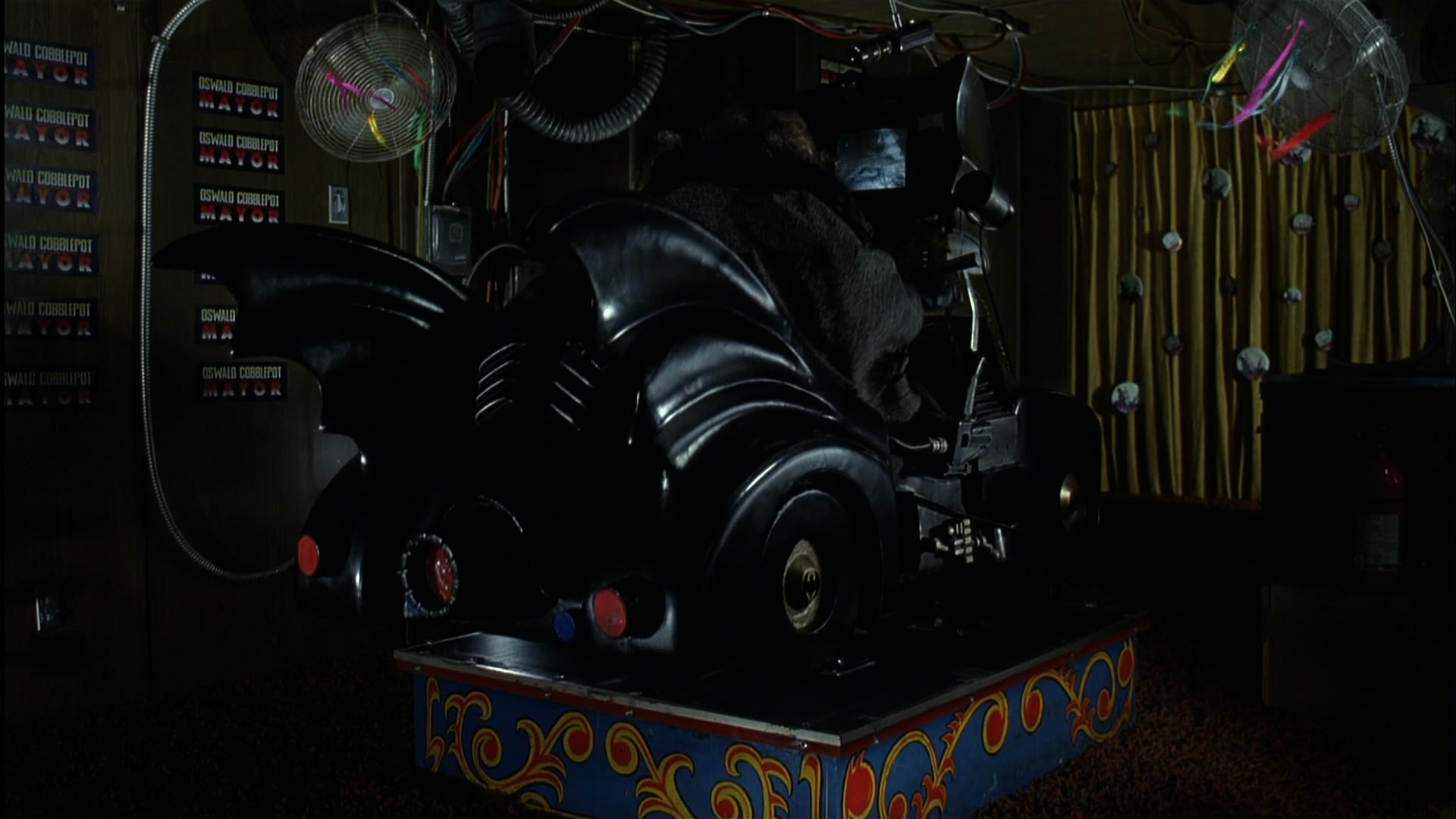
“Batman Returns” is not well regarded among comic enthusiasts for taken wild liberties with the source material. Both the Penguin and Catwoman are radically altered. In the comics, the Penguin is a dapper gentleman thief with a slight bird obsession, operating out of an Arctic themed night club. In the movie, the Penguin is a vulgar, grotesque flipper baby who lives in the sewers and plots to kill babies. Black slime occasionally leaks from his mouth, he chews on raw fish, bites a guy’s nose off, and crudely hits on most of the women around him. He is more Penguin then man. For reasons never explained, beyond Burton liking it, the Penguin hangs around with a circus-themed gang of criminals, a move probably better suited to the Joker. About the only obvious connection this version of the Penguin has with his source character is a shared affinity for umbrellas.
Catwoman is significantly altered too. In the comics, Selina Kyle is a morally ambiguous thief who steals for the excitement, for herself, and occasionally to help other people. Her origins have varied over the years but she usually has a checkered past and is working to move pass it. In the movie, Selina starts out as a dowdy secretary. Nearly being killed pushes her to a mental breakdown. Catwoman is reimagined as a darkly feminist avenger. She takes revenge on Shreck, blowing up his department stores. She protects women on the street from assault yet comes dangerously close to blaming the victim. She’s a psychologically damaged character. Bipolar in her desires, she’s torn between having a happy life with Bruce or taking bloody revenge on Shreck. Burton’s Catwoman is as strong and independent as her comic’s counterpart but is considerably more twisted and complicated.
Fan boys also criticize “Batman Returns” for its more surreal tone. The first “Batman” went out of its way to separate itself from the Adam West TV series. One of the plots of “Returns,” meanwhile, was directly inspired by that series. No matter how weird Gotham is, it’s preposterous to think that this version of the Penguin could ever be a plausible political candidate. When the city turns on him, they pelt him with rotten vegetables, a cliché the character points out. Catwoman looses several of her nine lives in increasingly silly ways. While falling from a roof, she conveniently lands in a truck of kitty litter. Secondly, she’s dropped through a glass greenhouse. Her subsequent screams shatters the glass. Even some of Batman’s lines, like “Eat floor – High in fiber” are incredibly goofy. Not to mention sillier scenes like the Penguin’s kiddy-ride version of the Batmobile or Bruce Wayne “scratching” a CD like it’s a record.
A big problem with the first “Batman” was its muddled screenplay, the writers never giving the Joker a consistent goal. “Batman Returns,” unfortunately, carries on that tradition. The Penguin’s political endeavors dominate most of the movie. Despite trying to win the public’s trust, he continues to carry out villainous acts. After his dreams of being an elected official are crushed by Batman, the Penguin turns towards his plot to murder the first born sons of Gotham. After exactly one attempt to pull this plan off, a plan he’s been plotting the entire movie, the Penguin changes strategy again. He shifts gears and decides to blow up the city with his army of weaponized penguins. The constantly shifting villainous plan makes it seem like the screenwriters never had a clear bead on the character. Even Catwoman’s motivation suffers. Her campaign against Shreck makes sense but there’s never a good reason for her rivalry with Batman. Her partnership with the Penguin is short-lived and not well thought-out. It’s rather naïve on her part to think he wouldn’t murder to further his goals. With all these separate plot lines buzzing around, the movie still has to make time for Max Shreck’s corrupted business schemes. This is mostly forgotten by the half-way point. With such much going on, it’s no wonder the last act feels a little cluttered.
Despite having so many characters and subplots, “Batman Returns” still winds up giving Bruce Wayne more to do then the last film. He spends more time in the Batsuit, fighting more thugs on a one-on-one basis. Michael Keaton and Michelle Pfeiffer have great chemistry together. Their romantic scenes wind up powering large portions of the film. Selina Kyle is a more believable love interest then Vicki Vale, as the two have more in common and more visible passion together. Bruce also has several great scenes with Alfred, the butler given more of a supporting role in his master’s quest against crime. Batman even gets to do some detective work, investigating the Penguin’s past and ultimately bringing the villain down more with his brains then his brawn. (Though I object to the Batmobile’s computer system being so easily hacked.)
Befitting the rules of superhero sequels, “Batman Returns” features more action then its predecessors. How much of that action works is a matter of opinion. Batman’s first encounter with the Red Circus Gang works fantastically. The Batmobile continues to be a dynamic device, as he takes out evil stilt-walkers and motorcycle riders with the car’s gadgets. Batman’s martial art skills are displayed again, as he fights off a gang. However, the suit continues to be stiff, making it difficult to buy him as a kung-fu master. One of the more embarrassing scenes has a circle of thugs standing around while Bruce takes them out with a Batarang. There are still some strong action beats, like Batman escaping Gotham Plaza on a hang-glider. Probably the stand out sequence is a car chase. The Batmobile, taken over by the Penguin, careens through Gotham, overturning cars. The cops chase after him which leads to a fairly dynamic crash, the Batmobile shedding its armor to fit through an impossibly thin alley. Burton’s strengths aren’t in action direction but “Returns” is probably smoother in that regard then the first one.
Despite its many flaws, “Batman Returns” is still a hugely entertaining film. The colorful cast is a huge reason for this. Danny DeVito, Pfeiffer, and Christopher Walken are all perfectly cast and allowed to go nuts. DeVito speaks with a course voice throughout the whole film. This fits the character, who is frequently vulgar. Yet he can still inhabit the character’s speech with sincere pathos. He is frequently hilarious, adding a lot of comedic punch to small lines. Daniel Waters’ sarcastic dialogue is a great fit with DeVito’s ability. Pfeiffer, meanwhile, makes Catwoman totally her own. She plays the pre-accident Selena as a flighty spinster. After her transformation, Pfeiffer has a ball playing up Catwoman’s kinky, bipolar nature. Her performance, eccentric but committed, would widely define the character for a generation or two. Christopher Walken, meanwhile, does his thing, exploiting each line of dialogue for maximum Walken-ness. The actor’s unique delivery not only makes Shreck far more memorable then he would have been otherwise but also makes minor lines of dialogue hilarious and unforgettable.
Burton being given more control over the film not only shows itself in the darker themes or weirder tone. “Batman Returns” drips even more with his trademark visuals. Gotham appears practically apocalyptic here. The buildings, towering and crowded together, recalls “Metropolis” even more then before. We frequently see beautiful matte paintings of the city, looking like the World’s Fair has gone to hell. Every building in the city seems to jut out at an awkward angle. When straight angles come, they are oppressive and blank. The Gothic architecture is given a more exposure, like the weeping statues in Gotham’s main square. The Penguin’s underground lair, set in an abandoned zoo/amusement park, is highly Burton-esque, full of Expressionistic spirals, black-and-white swirls, and off-putting illustrations. As is the villain’s main mode of transport, a giant rubber ducky on wheels. The director continues to frame shots like comic panels. My favorites are a solitary, snow-covered Wayne Manor or Catwoman being carried over the city by Penguin's helicopter-umbrella. To further prove how much of a Tim Burton movie this is, the story is set at Christmas, which is blatantly contrasted against its dark and violent content.
The film’s treatment of its villains also show Burton’s sensibilities. The Penguin is a classic Gothic grotesque. He is unrepentant in his villainy and hideous to look at. However, there’s something sympathetic about him. The character is frequently framed by bars. The bars on his cage as a child become the bars of the sewer. He becomes a monster through the world’s rejection of him. His decision to commit to villainy, to abandon redemption, is mostly treated as a dark joke. However, it speaks to the film’s themes, that there’s no room in the world for true freaks. After he dies, the Penguin is carried to his watery grave by his penguin cohorts. Throughout the whole film, he was searching for acceptance, without realizing he had a family beside him the whole time. He’s a despicable, disgusting character but you ultimately feel bad for the Penguin. Even Batman shares something of a kinship with him, recognizing him as similarly misunderstood. This further connects the film with the themes of classic horror movies. Burton even blatantly acknowledges this, with visual references to “Cabinet of Dr. Caligari” and “Phantom of the Opera,” not to mention Max Shreck's familiar name.
Matching the film, Danny Elfman’s score is even darker and more brooding then his work on the first. Each of the three central characters is given a reoccurring motif. Batman’s powering, iconic theme from the first film returns, often appearing to pump the audience up before big action scenes. The Penguin’s tragic roots are powered by a forlorn, Gothic organ. Catwoman’s splintered mind is represented by chaotic strings that also bring to minds a cat’s moaning and scratching. Unlike the first film, this one even organically incorporates pop songs into the score. Though Siouxsie and the Banshee’s dark, seductive “Face to Face” is far better fit to the material then Prince.
Is “Batman Returns” an accurate adaptation of its source material? Probably not. Is it the best Batman movie Tim Burton could have made? I’m inclined to think so. Though suffering from many of the same problems the first film faced, it’s a far smoother ride. By entrenching the material so firmly in his own sensibilities, Burton made “Batman Returns” unlike any other superhero film before or after it. It’s fabulous to look at, fantastic to listen too, and frequently great to watch. [Grade: B+]
Subscribe to:
Posts (Atom)


-large-picture.jpg)


+3.jpg)
+6.jpg)