Last of the Monster Kids

Last of the Monster Kids
"LAST OF THE MONSTER KIDS" - Available Now on the Amazon Kindle Marketplace!
Showing posts with label halloween 11. Show all posts

Tuesday, November 1, 2011

Halloween 2011: October 31 - HALLOWEEN

Halloween day was mostly spent with an all-day horror movie marathon. We got snow in my area recently, if you can friggin' believe that, so most of my weekend plans ended up being canceled. So JD and I didn't make it to the "Rocky Horror" experience this year. Maybe next year.

I tried to make the most of the situation, by dressing up in my "All the Big Summer Movies of 2011" costume, carved pumpkins, and handed out candy to the few trick r' treaters we got. (Three groups for a total of 9 kids.) Over all, the day was kind of lackluster.


House of 1000 Corpses (2003)
Rob Zombie is probably the most divisive figure in the horror fan community in recent memory, but, if I remember correctly, “House of 1000 Corpses” was fairly well liked, at least by fans, upon premiere. The film had a protracted post-production and, if it had been released in 2001 as originally planned, before the turn of the century horror revival really started, it probably would have been even better received.

It’s a conflicted film and I’m tempted to say it’s not very good. Honestly, the movie is a lot like being inside the “Dragula” video for 88 minutes. (The movie even features the song-title-lending “Munsters” episode.) The stock footage, the psychedelic imagery, and the constant cutaway sequences certainly feels more like a Rob Zombie music video then the 1970s grindhouse fare the movie aspires to. This style has a twin effect of making the movie schizophrenic and borderline incoherent while also establishing an appropriately nightmarish tone early on. It’s distracting at first but, once we get to the titular house, it actually starts to work in the film’s favor. The Firefly family exists in its own exceedingly twisted world and this movie is willing to take you there. The movie is the product of a mind that has seemingly consumed nothing but old horror movies, southern hick culture, and drugs his entire life. If it was a better movie, I’d say it’s the apotheosis of low-culture, trash cinema.

Rob Zombie’s white-trash obsession and often vulgar, abrasive dialogue makes his films most definitely not for everyone, but it’s hard to deny he can create memorable, distinct characters. (Or at least a few. More on that in a minute.) We meet Sid Haig’s Captain Spaulding in the first scene, a character both hilarious and disgusting. It’s not surprising that Haig, who gives a very funny, energetic performance, would go on to become something of a genre mainstay after this film. If he hadn’t all ready been in movies for over thirty years, I’d say this was a star-making turn. Sherri Moon can be just as divisive a figure to the fans as her husband is, because of her perceived questionable talent and Rob’s insistence in sticking her in everything. The character of Baby is pretty much the movie in a capsule: Psychopathic, sadistic, existing in her own weird horror universe, annoying, but arguably unique. Bill Moseley’s Otis is undeniably the brightest star of the film. Moseley made Chop Top a lovable fan favorite and, while Otis is nowhere near as manic or funny as that character, Moseley brings the same level of charisma and gusto to an exceedingly more cruel, sadistic character. A delightfully trashy Karen Black rounds out the film’s psycho ensemble. (For the record, my favorite character in the movie is actually giant, silent, comparatively benign Tiny.)

And thus we come to one of the main problems with Rob Zombie’s skills as a screenwriter. While he can write a great psychopath, his normal people come off as much less likable and well rounded. Jerry, the bearded one, is kind of an abrasive asshole and seems to do nothing but force his friends into more danger as the movie continues. Rainn Wilson’s character is clueless and any likable attributes he has are because of the performer, not the script. The two girls are indistinct from one another and defined solely by their relationships with their men. When the hard ass Tom Towles cop is the most interesting non-murderous character in your movie, you’ve got problems. So basically the middle section is about enjoying the mayhem, torture, and depravity the psychopaths inflict on these victims. Honestly, horror fans do that all the time in films like this but the torture and murder here is just grimy, explicit, and unlikable enough that this becomes a somewhat queasy, uncomfortable experience. (The rape, torture, and necrophilia performed upon the cheerleaders are the hardest bits to swallow.) Despite heavily referencing and featuring the Universal Monsters films, this as about as far removed from the benign horrors of those films as you can get. Having said that, the middle part of the film is probably the best, solely due the great cast. The movie sort of falls apart in the last act too, partially because the focus is shifted back to our victims, but primarily because the movie slips totally into incoherence. Why do the Fireflies have zombies in a cave system under their house? What’s the point of the weird, backwards tape they play? Why are their old guys in bunny suits wandering the caves? Are we to believe the Fireflies have really been killing and torturing people for that long, totally undetected? (The real reasons the old guys are there is to get our final girl out of her own bunny suit.) And while Dr. Satan is cool looking, his collection of retarded weirdoes makes for something of an anticlimactic final reveal. The movie descends totally into standard, slasher-chase stuff at the end before the obvious twist. Honestly, when your psychos are your movies main selling point, removing them from the story at the end leads to a weak end.

Despite these reservations, the movie does have some fantastic elements. The entire “I Remember You” sequence, in which our villains gun people down to the strings of an old country song, is pretty great. (But I sort of always love musical juxtaposition.) And the set design of the film is particularly notable. Rob Zombie’s past as a designer really shows here. I love how the Fireflies home is decorated totally with old monster movie posters, scrawled children’s drawings, and kitschy Halloween decorations. And also bones and chickens and scarecrows and shit. And while cut-aways to color-reversed redneck rants about a rapin’ skunk ape and a random, old, violent black man ranting incoherently about Heaven and Hell add nothing to the story, they’re certainly interesting. And that’s “House of 1000 Corpses” in a nutshell, more or less. It’s not surprising the film had a cult following, even before the sequel and action figures. (6.5/10)


The Car (1977)
I legitimately like this movie a great deal. Yes, the premise, essentially “Jaws” in the desert with a phantom car instead of a shark, is hokey. But the movie has likable characters, a laidback setting, some genuine thrills, and a unique main threat in its favor. Of course, I’m somewhat partial to car chase movies in general and killer car movies in particular.

Which is weird, because it’s not like I’m a motorhead or anything. Car culture kind of mystifies me, to be honest. I think why the killer car is such a good horror threat is because you’re way more likely to be killed by a car then you are by a vampire or werewolf or what have you. The titular Car in this film is a fantastic creation. First off, it just looks cool. Designed by the same guy who made the Batmobile and the Munsters Koach, the Car is specifically designed to make an everyday object look as threatening and sinister as possible. Its squat cab emphasizes the face of the car. The prominent headlights, wide grill, and angled hood gives the Car a glaring, grinning face, perfect to commit murder. Beyond being an excellent design, the Car just does cool shit, like flip onto its side and roll over two oncoming police cruisers. And if it’s possible, the vehicle is even driven in an expressive, personality filled way. Just look at the scene where, after being denied access to its victims because they’ve fled onto holy ground, the Car does donuts in frustration. Or the way he pushes and manipulates other vehicles around. This is why, despite being ridiculous, the Car works as a horror movie monster.

Another reason why I think I like the film so much is because it’s small Utah town setting is so appealing. Very quickly and early on, the town is established as a comfortable little town. Our cast of characters are equally lovable. James Brolin is the pillar of the community, a noble, family man of a sheriff that’s extremely ethical but far from unfaultable. Kathleen Lloyd is especially likable as Brolin’s girlfriend and the local school teacher. She’s got two great scenes: When she’s found that one of her teenage male students has drawn a picture of her naked and the older, heavier, teacher’s response to it, and when she mocks, taunts, and yells at the Car from a safe distance. Lloyd is such a delightful presence that when she exits the film, it registers as a real shock. Ronny Cox has a great role as the Barney Fife of a deputy. Other quirky characters in the film include a French Horn playing hitchhiker, a drunken wife-beating asshole who still gets off some funny lines, and an American Indian deputy who doesn’t take any nonsense off of anyone. Also, an old woman yells “Cat poo!” (Or “Tadpole,” so says the DVD subtitles. Hmm…)

Most surprising of all, the movie actually has some real thrills in it. As mentioned above, spoiler alert!, Kathleen Lloyd doesn’t make it out of the movie. The scene is set up during a stormy dark night. She stands in her kitchen, talking on the phone, getting increasingly panicked, worried about the Car. And THEN, two bright headlights appear in her window, slowly getting closer and closer, until that hellish horn honking breaks the night…! Other notable horror moments in “The Car” includes the vehicles first appearance, where it pushes two bicyclists off a bridge, and when the Car appears in Brolin’s garage and attempts to asphyxiate the man with fumes.

So, whatever. Opinions differ but “The Car” is a goodie in my book. I think as long as you accept and get over the innate ridiculousness of the premise, you’ll enjoy it as well. (7.5/10)


Dr. Terror’s House of Horrors (1965)
I love a good horror anthology. Amicus Production, the rival to Hammer Studios, got a lot of the same stars Hammer had but, in order to distinguish itself from that iconic studio’s output, it focused on and specialized in the anthology format. “Dr. Terror’s House of Horrors” was actually the first anthology film they ever did. It’s… Not as good as I remember.

The set-up is classic Amicus. Five guys get on a train car together, among them Christopher Lee and Donald Sutherland, and are soon joined by a strange man calling himself Dr. Shriek (Back when that name was associated with the German word for terror, not a CGI cartoon ogre.), played by a nicely ominous Peter Cushing. Using his deck of tarot cards, Dr. Terror proceeds to predict each of their futures, all of the predictions ending in violent death via supernatural creature.

The first three stories are a major drag. The opening sequence features an old house, an entombed werewolf, a family curse, and a kind of cool twist ending that’s sort of predictable. But the segment spends most of its time on set-up and only gets really good in the last few minutes. Following that is a story about murderous creeping vines. This story has a lot of droll scientific information in it, takes place mostly on one set, and has a seriously anticlimactic conclusion. The third story has the fun premise of a pop song writer stealing the melody to a voodoo ritual song. But it goes on way too long. Far too much of the segment is devoted to musical performances. It’s actually the longest story in the film and feels every minute of it. It does have a somewhat spooky walk down a darkened street and a decent conclusion.

The movie doesn’t actually start to get good until the last two stories. The fourth story stars Christopher Lee as a wonderfully catty and bitchy art critic and co-stars Michael Gough as the painter who is destroyed by the bad reviews. When Gough looses a hand in a car accident, it’s not hard to figure out what happens next. Seeing two Hammer all-stars like Lee and Gough face off, especially when given juicy material like this to play with, is the main treat here. Once the disembodied hand comes calling for Lee, the movie makes the ridiculous threat work by just making the damn thing indestructible. The last story, in which Donald Sutherland is convinced by his doctor that his new wife must be a vampire, has an obvious twist ending you see coming immediately but the good performances and a decent horror mood makes it worth watching.

The framing device then concludes in a very memorable, darkly amusing way. (The same ending that Amicus would continue to use in many of their other horror anthology films.) Honestly, because of that ending, the cast, and the last two stories, I always remember “Dr. Terror’s House of Horrors” being a lot better then it actually is. The fact that the film has never been released on DVD and I watched it on my well worn, very dark VHS didn’t help any. While it’s the first one made, the best place to start if you want to get into Amicus horror is “Asylum” or “Tales from the Crypt,” two of the best films the company would make. (5/10)


Curse of the Fly (1965)
A very strange sequel. There’s no fly monster in this movie. The curse of the title refers to the Delambre family’s bad luck with teleporters. The movie also seems to heavily retcon the events of the first two films, letting Andre get out of the mishap of the first film unharmed and changing Philippe to Henri. (And into a huge asshole.) The fly DNA being mixed into the family bloodstream has caused Henri’s son to have accelerated aging and he must take a shot to prevent a sudden on-set of death. None of this information is given to us until well into the film itself. The movie starts with a scene of a woman in her underwear escaping from a mental institution in slow-motion. (While a slow paced, romantic version of the “Fly” theme plays.) Though Martin Delambre, his dad, and the teleportation technology enters the story soon afterward (After the crazy woman falls in love with Martin), the movie is mostly about this girl, a concert pianist recovering from a nervous breakdown. Either somebody had an unrelated screenplay he decided to latch to a sort-of-popular franchise, or somebody decided to take this series in a vastly new direction. Or they couldn’t afford a fly monster? Either way, “Curse of the Fly” is an odd film and definitely a product of the sixties.

If you’re thinking, “None of that sounds like a horror movie,” wait, there’s more. Martin and Henri have been experimenting with cross-Atlantic teleportation… And they have the stable full of mutants to prove it, among them Martin’s ex-wife. (Ex in the sense that he’s ignoring her now that she’s a mutant. They’re still technically married and this is a plot point.) While turning humans into deformed mutants and then treating them like animals is pretty evil, Henri insist they keep it up, “in the name of science.” Patricia, that’s escaped mental patient girl, is keeping her own secret from Martin and folks, making “Curse of the Fly” partially a film about secrets and how they can eat away at otherwise healthy relationships. An aged blind Inspector Charas from the first movie (though played by a different actor) shows up briefly as well, just to tell us some back story.

It’s not a bad film. Carol Grey gives a good performance as the increasingly panicked woman and all of the strange, divergent plotlines build nicely to the ending. The film has some atmospheric black-and-white cinematography. The radiation deformed mutants are an early example of body-horror and an interesting addition to the story. (The name Martin and the presence of creatures like that makes me think this film was an influence on “The Fly II.”) The lack of Vincent Price does hurt the film and it’s easy to see how the part of Henri was originally imagined as Price’s character. He probably would have done a better job then Brian Donlevy, who can't seem to combine the character’s nice and insane attributes. The movie was a British production and directed by Don Sharp of “Kiss of the Vampire” fame. It’s not really good enough to be a hidden gem and instead is more or less an odd curio for “Fly” fans. (6/10)


The Descent (2006)
It’s weird that after a huge hit like this, that Neil Marshall would kind of disappear. Was “Doomsday” really that big of a bomb? I haven’t seen “Centurions” but it didn’t look very interesting. “The Descent” remains as effective now as it was upon release. What’s really exciting about the film is that this is a monster movie that didn’t need any monsters at all. If this had just been a movie about a group of girls lost in a perilous, unexplored cave system it would have been just as good and probably just as exciting. There’s a solid hour of claustrophobic suspense before the Crawlers even show up. The scenes of Sarah getting stuck in the collapsing cave or the sequence of Holly falling and shattering her leg are particularly harrowing.

But once the monsters do show up, the film really ramps up into frenzied terror. One of the things I've always admired about “The Descent” is that, despite being shot on sets, it feels like it was shot in a real cavern. Never once do you feel like the characters are in a false environment. The darkness and red light of flares makes it clear that our protagonists are not in their own world. This puts them at a definite disadvantage to begin with and, when the Crawlers appear, it becomes clear just how defenseless they can be. Why I don’t think they’re super original designs, the gray, shrieking, skittering Crawlers are effectively creepy horror movie monsters. The movie makes it clear that anybody who faces these things unprepared is going to meet a nasty end. After establishing the creatures as a threat, the movie then delights in putting our characters in constant peril from them. More then once, someone has to keep absolutely still and quiet while a monster sniffs around them. It’s an old trick but it works, and never better then here.

Another thing that’s so strong about this film is that there’s nothing simple about it. Our characters are not unambiguously the good guys. The Crawlers are obviously wild animals, defending their territory. They’re no more evil then a grizzly bear. Towards the end, as our heroines tear the monsters apart with picks and their bare hands, the film doesn’t shy away from suggesting that the humans in the story can be just as vicious as their attackers. From the Crawlers’ point of view, this could be a movie about strange invaders coming into their area and wrecking havoc. There’s a lot of deceit and distrust among the girls as well. I’ve always thought what Sarah does to Juno at the end of the film was kind of a dick move but the film makes it clear that Juno isn’t exactly a good person.

The cast is strong, even if only about four of the girls get any real decent development. Sam and Rebecca are mostly Crew Members 5 and 6, to be honest. The boisterous, adrenalin junky Holly has always been my favorite character. The movie seems to intentionally design her as the most fun character, since Sarah’s in morning, Juno’s somewhat duplicitous, and Beth is mostly the mediator between the rest of the group. But because this is a horror movie, a particularly uncompromising one, the most likable character is the one who bites it first. (Pun.) Holly essentially fills the same role Burt Reynolds did in “Deliverance,” the person you’d think would be the most help and the big hero in the story who actually ends up becoming useless fairly early on. Shauna MacDonald and Natalie Mendoza also give very good performances as Sarah and Juno. These are the two characters that really shape the world of the film after all and drive the plot forward.

I also love that the movie is unapologetically symbolic. Sarah blames her self for the death of her husband and child and has never really recovered from the grief. When she climbs down into the cave, she’s really climbing down into her own psyche, a frightening, dark place full of demons. The “Apocalypse Now” sequence of her emerging from a pool of blood a stronger, more dangerous person is rife with feminine symbolism. By bathing in the blood, a classic symbol of primal femininity, she’s gotten in touch with her own inner wild mama bear. (The fact that she immediately kills a female Crawler after this scene isn’t an accident.) And it’s only then that she’s able to leave the cave and move on pass her own psychosis… At least in the American ending. In the original ending, she doesn’t make it out of the literal cave or the cave of her own making, as some people never do. While I like the character enough to want to see her live, I can’t deny that the intended ending is the stronger thematic one. (9/10)


A Night at the Movies: The Horrors of Stephen King (2011)
Basically “Danse Macabre: The TV Special.” While I’m not exactly a huge Stephen King fan, the guy is knowledgeable about the genre he works in. (And should really only talk about his own genre. His “Entertainment Weekly” column was often excruciatingly tin-earred.) To listen to him chat about his favorite horror films or his opinion on the facets of the genre in general is basically like just sitting down with another fan and chatting with them. The way he compares the “I Was a Teenage…” series of the fifties with the modern “Twilight” fad is an interesting thought and I generally agree with his assessment of the vampire genre. I also find myself agreeing with his disinterest with the “gore-for-gore’s sake” spectacle that rules the genre today, even if I think it’s perfectly all right to relate too and route for the killers and psychos in movies. The anecdotes about him first seeing “Carrie” in an urban theater full of large black men or watching “Earth Vs. The Flying Saucers” as a child only to have the showing interrupted by the news of Sputnik’s launch are anecdotes he’s told before. But they’re good stories and ones well worth hearing again.

What’s really fun about this special is hearing King’s opinions on the adaptations of his own work. It’s good to know he holds “Cujo” and “Christine” in such high regard, two adaptations I’ve always thought were underrated. His frankness about his dislike of Kubrick’s “The Shining” and his performance in “Creepshow” are interesting and refreshing. Despite his massive fame, King has always come off as a generally laidback sort of person. While wholly inessential, “The Horrors of Stephen King” is a fun little feature. Turner Classics Movies is good at this kind of thing. (7/10)

The Innocents (1963)
When you’re a nerd, wither it be a horror, movie, comic book, or anime nerd, you probably find yourself sitting down and making up a mental list, if not an actual list, of all the stuff you consider essential to the genre. It’s either a list of all the stuff you need to see but haven’t seen yet or a list of all the stuff you think you have to see before you can call yourself a proper fan. In my on-going journey through the horror genre that I’ve been on for about twelve years now, there aren’t too many essential films left that I haven’t seen all ready. Lots of obscurities or hidden gems, sure, but not too many have-to-sees. “The Innocents” is one such film that has escaped my sights until tonight.

I watched this at 2 in the morning and it’s getting super late, so I don’t have a super lot to say about this one. I also think I need to re-watch it to absorb all the layers and subtleties there. But I can tell this is an excellent film. Deborah Kerr gives a wonderful performance as a repressed woman who, by trying to save a pair of children from a perceived threat, actually says more about her own conflicted faith and repressed sexuality. Martin Stephens, who would go on to play the exact opposite side of the “horror movie kid” scale in the original “Village of the Damned,” gives maybe one of the best performances from a young child I’ve ever seen. His character is an old soul, somebody very young who seems to know quite a bit, and Stephens himself seems like one as well.

The film starts out slowly, introducing us to this world and its characters. However, there’s a distinct point when it really begins to work. Miss Giddens see an apparition of a man atop the manor tower. She rushes inside and looks up the center of a spiral staircase. This is the first example of such rich, atmospheric direction and soon after we find ourselves in a house full of shadows, full of whispering voices and spectral faces. We have stepped over into the world of the unknown. There are severally extremely creepy moments here. The scene of Kerr discovering an old photograph in the cobweb ridden attic is followed up with a man’s face appearing in a window and then coming closer, the music building. Kerr quickly becomes more and more frenzied as the film goes on, convinced of her own theories. Even up to the end, the movie is ambiguous about wither or not there really are ghosts at work her or if Kerr is just delusional. The film keeps piling on strangeness and unnerving behavior before building up to the incredibly intense finale. (They put an innocent little turtle in peril, a moment that I won’t deny totally got me.) Once the tension in that moment subsides, the movie immediately builds it up again for the real finale. It’s an ending liable to leave you with just as many answers as questions, but that’s what’s great about it. If any story should be mysterious and ambiguous, it’s a ghost story. (Or a story about the dark recesses of the repressed mind, depending on how you look at it.) The movie explores the secret world of children and, in an unsettling move, suggests a child corrupted by the sexual advances of an adult. The scene of Martin Stephens kissing Deborah Kerr deeply on the lips is just as unsettling as any of the ghost moments. Because the film gets the audience to sympathize with Kerr’s potentially dubious world so much, simple scenes like a kid dancing alone by the lake or riding a horse become raked with tension.

“The Innocents” is, overall, a hugely successful mood piece. The shadowy atmosphere, provided by future Hammer and Amicus director Freddie Francis, is extraordinary and the movie makes great use of music and sound design. I really should have seen this one sooner. With this and “The Haunting,” 1961 was a good year for ghost stories. (9/10)

So in total, this Halloween I watched 88 movies and television episodes and wrote reviews for 79 of them. I was hoping this would be a substantial improvement over last year but, nope, not really. Last year I wrote 84 reviews. I guess, considering all of this year's reviews were much, much longer, that is an actual improvement. (I've probably doubled my yearly word total just this October.) And I did attend my first horror con this past fall. I suppose Halloween 2011 was a major improvement in that sense. But I definitely had a lot less fun this October in comparison to last year.

Oh, well. Better luck next year, I guess. More updates coming soon. And I mean it this time.

Sunday, October 30, 2011

Halloween 2011: October 30

Island of Lost Souls (1932)
This is pretty much the DVD release of the year for me. As you know, I’m a classic horror aficionado, particularly of the Universal cycle. While “Island of Lost Souls” was actually a Paramount production, Universal owns it and it was released as a part of the Universal Monsters video series in the early nineties. The film is widely regarded as a classic of the genre but its been unavailable for a long time. It’s never gotten a DVD release and TV airings are rare. I had hoped for a long time that “Island of Lost Souls” would be shuffled onto one of the classic horror sets Universal was releasing almost ever year there for a while and figured that would be the best release we’d ever get. So when Criterion announced that the film was coming out, I got pretty excited. I was eagerly counting down the days for its release. So much so that when Amazon said it wouldn’t be at my house until November 2, after the end of my Halloween viewing, I was pretty disappointed. Luckily it arrived in time.

So, anyway, this movie’s a masterpiece. Have you ever seen a film so good that it makes you kind of mad that you haven’t seen it before? There are a couple big differences between golden age Paramount horror and Universal that I’ve noticed. As I pointed out earlier, Paramount’s cinematography is generally more expressive then the stagey, silent film style Universal had. The movie has a lot more dollying and some very creative staging, including a fantastic shot seen entirely in the reflection of a lake. But the movie stands besides the Universal films because of its wonderful use of shadows. In at least two scenes, fleeing characters shadows are cast on the wall behind them, looming large. Early fog filled boat sequences also recall the Universal films of the same era. Over all, the titular island is a deeply atmospheric place. The print restoration is incredible. On DVD, the film practically looks brand new.

Secondly, Paramount’s pre-code output was very daring, pushing the envelope on sex and especially violence. “Dr. Jekyll and Mr. Hyde” featured sexuality and sexual sadism as a major theme and “Island of Lost Souls” follows suit. A major subplot involves Dr. Moreau’s intention to mate Parker with the seductive Lota the Panther Woman, his most perfect creation. Parker nearly goes through with it too, charmed by Lota's raw animal sensuality, before realizing that this attractive young lady isn’t exactly human. As soon as Parker’s fiancé Ruth arrives on the island, the Beast-Men eye her hungrily and it’s not long, with a little prodding from Dr. Moreau, before one of the animal men attempts to have his way with her. And the movie’s hideously violent. As in the book, there's a preoccupation with vivisection here. A scene where Dr. Moreau calmly uncovers a recently performed-on animal man, still bloody and screaming, is particularly unflinching. It’s not really the level of violence that makes the movie unsettling so much as it’s the stifling mood of cruelty that hangs over the entire film. “Island of Lost Souls” is a movie practically about the politics of cruelty, of control, and oppression. When Dr. Moreau’s creations inevitably revolt and destroy him, it’s not shown so much as evil being overthrown, as the cycle of violence starting over again. The movie ends in flames and deafening screams of agony. “Island of the Lost Souls” is one of the most oppressively nihilistic horror films of the 1930s.

Charles Loughton is unsettlingly good as Dr. Moreau. He rules over his island with an iron fist. He considers himself a god to his animal-men creations. Though relatively soft-spoken, Loughton’s Moreau is always plotting. You can see the evil wheels turning in his head. But what’s really frightening about the character and the performance is that Moreau is completely self-justified in his sadism. When our shipwrecked sailor claims his vivisection of live creatures is cruel, he waves him off. “Don’t bother me with such petty horrors.” This is a man that can justify anything in the name of science. As portrayed here, Dr. Moreau might be the most devious and sadistic of any of the golden age horror villains. (Rivaled perhaps only by Lionel Atwill in the similarly grisly “Murders in the Zoo.”) Kathleen Burke, though naturalistic and untrained, suits her role of the Panther Woman extremely well. Bela Lugosi, as the Sayer of the Law and the eventual leader of the Animal-Men, gives a tortured, passionate performance. I’ll say it’s a better performance then his Dracula.

The Beast Men are fantastic creations. Though the make-ups, composed mostly of hair glued to face, is primitive, it’s incredibly effective. The low-key make-up is actually one of the things that work very well for the film, since it makes it seem plausible. Unlike the Universal monster movies that featured supernatural, fantastical creatures, “Island of the Lost Souls” has creatures that seem oddly possible. So not only is the film grisly, disturbing, and actively concerned with hot button concepts of bestially, evolution, misintegration, racism, fascism, torture, sadism, and cruelty, but it seems like it can actually happen too. Now that the film’s finally been released on DVD, perhaps this classic can be rediscovered by a new generation of classic horror fans and film watchers. (9/10)


Slither (2006)
Pretty much the closest thing we have to a modern “Evil Dead 2.” This is a horror-comedy that is just massively entertaining. It’s a shame the film bombed. It should have transformed Nathan Fillian into a modern matinee idol. At the very least, he could have so easily been the new Bruce Campbell. Instead, he’s doing some cop show… Sigh. The movie seemed to have stunted James Gunn’s career some as well, since it took the admittedly excellent “Super” a long time to get made. In an alternate time line, “Slither” was a big hit and James Gunn has since pleased us all with many more funny, twisted, endlessly entertaining pictures.

The movie has got crazy worm things, acid-spitting space zombies, great gore effects, a woman growing up into a giant ball of flesh and then exploding, and mixes body horror, sci-fi, redneck, zombie, and eighties creature feature tropes extremely well. The creature effects are phenomenal and Grant Grant, in his slug form, is one of the best monster designs in recent memory. And there’s some fantastically quotable dialogue here. (Even the DVD special features are highly quotable. “I’m Bill Pardy,” indeed.) But there’s more here then just all that and Nathan Fillian mugging it up. The central love story(?) between Starla and Grant Grant provides the movie with a heart. Despite being a marriage of convenience for her, Grant is crazy about her and she really does feel something for him. Michael Rooker really does give a good performance. I especially like the scene where he has to pull himself away from her, holding back his evil alien tentacles' need to impregnate her with his space seed.

I don’t really have a lot to say about “Slither.” The movie more or less speaks for itself. It’s a great flick for horror fans. (9/10)
Them! (1954)
Ah, the movie that kicked off the giant bug craze of the fifties. And I’d argue that’s its more or less the only really good one, at least out of the stuff I’ve seen. (“Tarantula” isn’t bad though.) I’ve always dug this film since I was a little kid. While the giant ants may very well be scientific impossibilities, they are honestly pretty real looking. They’re pretty effective special effects. I think, in a weird way, the film predicted the sci-fi special effects action extravaganza that flood the theaters every summer. The scene of a cop taking a machine gun to one of the giant ants feels a lot like the 1954 equivalent of Michael Bay. Despite lying more over to the sci-fi/action side of the horror scale, the film still has it’s effective horror moments. The little girl screaming out the film’s title is a pretty memorable scene, as is the ants attack on the police outpost. Good stuff.

The movie plays a lot like a mystery throughout its run time. James Arness, Joan Weldon, and Edmund “Santa Claus” Gwenn form kind of a central power trio, as they follow leads and clues, trying to find the latest ant colony. I especially like the scene of three spelunking down into the ant colony, stepping over the dead giant ants. Weldon ordering everyone to get out of the colony immediately is a good moment. The final military invasion of the new ant colony, formed in the city sewer systems, is an intense sequence and nicely plays up the cramp quarters.

What has really made the movie endure and elevates it above the copy-cats that would follow are the numerous quirky elements in the film. Edmund Gwenn plays his scientist as a knowledgeable but somewhat absent minded man. The scene of him fumbling CB terminology is cute and funny. Future Davey Crocket Fess Parker has a memorable small role as a fighter pilot claiming adamantly he’s not insane. Even more entertaining is the very active, and very funny, drunk that provides the final clue needed to find the ants. Overall, the film is intelligent, witty, funny, and also a bit scary. (8/10)

Saturday, October 29, 2011

Halloween 2011: October 29

Return of the Fly (1959)
A pretty routine sequel. Twenty years after the events of the first film, history repeats itself when Philippe, the son of the original fly, decides to continue his father’s research into teleportation technology, despite the warnings of his uncle, played by a very somber Vincent Price. Philippe is a bad judge of character, so his lab assistant turns out to be a real asshole, planning on stealing the teleporter blue prints so he can pay off his gambling debts, I think. (His partner in crime is a neurotic mortician, one of the few interesting parts of the film.) After beating him up, the asshole intentionally sends Philippe through the transporter with a fly, creating another fly-headed monster. This proves to be a bad move and backfires spectacularly for our villains. Fly-Monster Philippe, after awkwardly wandering around the woods for a while, tracks both guys down and murders them. Luckily, his girlfriend and his uncle find the fly with the human head, sends both through the teleporter, leading us to a happy ending.

Despite the short running time, the movie drags a lot. None of the fly stuff happens until well pass the halfway point, so the first half revolves mostly around Philippe worrying about flies (His phobia is one of the film’s few clever bits) and Vincent Price warning him not to mess around with that teleporter shit, man. (“I told you about teleporters, bro. I told you.”) The film starts with a funeral and the overly somber tone continues throughout. There’s none of the humor here of the first film… At least not of the intentional value. The film’s special effects are big step down from the first one. There’s some gigantism thrown in with the teleporting for some reason, so our inevitable fly-monster has a giant head. This is incredibly awkward for the stuntman playing him, who stumbles a lot, and you can tell the prop head almost falls over a few times. The human-head fly is created through cheesy photography tricks, as is the human-handed rat critter that shows up too. If the creations in the first film where absurd in an unsettling way, these are absurd in a strictly hilarious way. In the first film, the teleportations sequences was a series of flashing lights and phasing, while here people in the glass box just vanish abruptly.

There’s also some pretty big logic holes. If a guy went through a teleporter with a fly again, whose to say it would pop out exactly like what happened in the first film? Why doesn’t Philippe just have a giant fly ass or something? And why would sending the two hybrids back through together fix things? Wouldn’t that just lead to more gene-splicing? One of the things they talk about in this movie is teleporting somebody and then leaving their atoms just floating around in the air overnight, which seems dangerous and a wild abuse of science. Fox went to the expense of shooting this flick in Cinemascope, but not in color. Of course, I love black and white, but it’s not use all that well here. The direction is pretty bland. The scenes of a body jumping out of a casket is pretty much the only effective moment in the whole film. “Return of the Fly” is a blatant retrend of the first film with none of the energy, character, humor, or suspense. (5/10)


Community: “Horror Fiction in Seven Spooky Steps”
I don’t watch a lot of TV. I’m pretty squarely a movie guy. So it’s not often that a TV show really grabs my attention and gets me to tune in every week. But I love “Community.” I really do. After the shaky season two, season three has been excellent so far. Every episode has been a winner.

The last two Halloween episodes have been total classics. The season one Halloween episode is got me into the show in the first place and last year’s “Epidemiolgy” is, not only pretty much the best zombie movie I’ve seen in years and such an improvement over the handful of zombie homages we’ve seen in the past decade, but it’s also probably my favorite episode of the whole series. “Horror Fiction in Seven Spooky Steps” isn’t as good as either and, in particular, doesn’t really live up to its horror anthology premise, but it’s still a solid B+ in my book. The show is very character oriented so each variation of the story really tells us more about the character telling them then anything else.

The episode is still full of very funny moments. Britta’s retelling of the Hook story includes the character’s all talking in her mumbled, awkwardly paced style of speaking. Abed’s story features characters that follow the rules of the genre strictly, relying on a hilarious super-logic. Annie’s “Twilight” spin gets especially funny when she has to stop and teach the vampire how to read. (It also features some fantastic Allison Brie cleavage, something this episode is full of.) But my favorite segment is Troy’s story, which is a bro-tastic, silly spin on the mad scientist concept, recasting himself and Abed as super-awesome jet fighters who get super-awesome psychic powers.

Any way, anybody who’s never seen an episode of “Community” probably has no idea what I’m talking about so I’ll finish this up. In short: Good episode. Also, watch this show. (8/10)


Ghost Story (1981)
Funny story behind this one: When I was around, I don’t know, ten maybe, and right in the beginning stages of my horror movie obsession, my mother told me the plot of “Ghost Story,” detailing everything. It sounding like a fantastic film but I didn’t get to see it until many years afterward, once Netflix finally rolled around. I was immensely disappointed. The movie in my head was so much better. But, in the services of fairness, I decided to give this one another shot.

The film is notable mostly for bringing together an ensemble of some of the most respected actors of Hollywood’s Golden Age. In today’s youth obsessed market, I can’t imaging a horror film being sold starring nothing but elderly men, even if it’s based on a national best seller. In order to compensate, the movie throws in a lot of nudity and sex, including some male full frontal. The story revolves around the Chowder Society, a group of friends who gather to tell frightening stories and have done so since the early 1900s. And now, as these things happen in the movies, a ghost from the past has come to pick the men off one by one. The story telling format lends the film an episodic feeling. Twice, the current flow of the film halts abruptly so a character can drop some back story.

Oddly, the movie works best when it travels back to the early 1900s and replaces its old man cast with a group of younger actors. The movie seems to be of two minds. The direction is very strong during the period settings and the director seems fine with the explicit romantic scenes. But the movie falls apart during the scenes of horror. Many of the deaths involve someone being startled by the gruesome sight of the ghosts and falling to their deaths. However, while there’s certainly nothing wrong with the corpse make-up, it’s never as shocking or disturbing as the movie needs it to be. A bizarre subplot features a homeless man and his little brother as servants of the ghost woman. For reasons that are never explained, the little boy roars and makes animal noises. It’s not a scary effect, for a fact it’s quite comical. (I hear these characters get more development in the novel.) It’s really not until the movie’s very end, when the camera roams the dark, abandoned house, that the movie begins to have any success as a horror film at all. The effects work in general is kind of clumsy, including a scene where a car flipping over sounds like a toy car rolling around in the snow.

When the movie does work, it’s strictly because of its prime cast. Fred Astaire is the only really likable member of the Chowder Society, though John Houseman commands a lot of authority with his deep voice and intimidating figure. I like a moment when Melvyn Douglas breaks down from the stress. But it’s really Alice Krige, future Borg queen, as the vengeful ghost who gives the best performance. While the movie oversells her beauty a bit too much, she still manages to be very sexy when she needs to and appropriately sinister at the same time. “Ghost Story” is mostly a failure though. The film seems to have no idea how to create a successful horror atmosphere. (5/10)

Halloween 2011: October 28

The Prophecy (1995)
Here’s an example of overheated schlock that would probably be completely unwatchable, or at least unlikable, if not for its cast. And what a grossly overqualified cast it is. The pay must have been phenomenal because the majority of the actors are far above the material.

“The Prophecy” details a war in heaven and the humans caught in-between the warring factions of angels. The idea of angels being jealous of God’s love for humanity and people’s possession of souls is an interesting idea, in the “Neon Genesis Evangelion” mode, as is exploring angels as morally ambiguous characters. The movie is gleefully blasphemous too, recasting Archangel Gabriel, a righteous figure by most accounts, as a ruthless cartoon supervillain and even having Satan more-or-less save the day. And God is silent in all of this too! Over all, apocryphal Christian mythology is a great place for a genre film to start.

However, the film uses these potentially daring concepts in services of a potboiler chase plot. Its clichéd story includes a Catholic cop who has lost his faith, the unstoppable horror antagonist, a prophecy about the end of the world, magical American Indians, and a possessed child who says creepy, inappropriate things. The Christian concepts are used strictly as plot points and devices, and the film doesn’t seriously explore any of the philosophical implications its plot raises. The director brings all the flash and style of a secondhand Segal flick. The straight-out-of-the-nineties-era-Skinnemax electronic score drives the film towards its puzzling narration-provided moral. (Something about not understanding God’s plan. It doesn’t really make any sense.) Worse yet, the movie is completely convinced its plot and ideas are original and ingenious, treating the material in an extremely self-serious manner. The movie is humorless…

Except for one thing: Christopher Walken. This man single-handedly makes “The Prophecy” worth watching. Dressed like a door-to-door Bible salesman, his black hair slicked back, and swaggering like a Southern Baptist televangelist, Walken sinks his teeth into every juicy, hammy line. I suspect much of his dialogue was improvised, as Walken’s humorous quipping is far more clever then anything else in the script. Great moments in Walken: The back forth he has with his undead slaves, especially during the grave digging scene; hamming it up as he sets Eric Stoltz’ face on fire and generally tortures the guy, relating how he is responsible for shushing every human at birth, sharing breath mints and his trumpet with a gaggle of school kids, his monologue about how humanity can never understand the motivation of an angel, walking into a hospital and forcing a random nurse to sleep, a hilarious scene where he selects his next zombie servant among the terminal ward, passive-aggressively badgering a waitress at a diner, flying through the windshield of a pick-up truck and becoming increasingly pissed-off, etc. Basically, if you love to watch Christopher Walken just get his Walken all over things, this movie is worth seeking out.

Like I said, the cast is incredible in this thing. The Weinsteins must have gotten this script and “Pulp Fiction” in some sort of two-for-one bargain because, aside from Walken, it also features Eric Stoltz and Amanda Plummer. Indispensable character actor Elias Koteas plays the faith-lapsed cop. It’s a hoary cliché of a part, but Koteas does his best with the material and makes for an easily watched lead. Virginia Madsen has certainly appeared in her fair share of schlock but, Christ, she’s an Oscar nominated actress. Her part as the school teacher drawn up in the chase is the flimsiest role in a film full of ‘em. I don’t know what she saw in a part as hopelessly thin as this (The paycheck, probably) but she certainly makes it go down easier. Eric Stoltz is at his best here when beating the shit out of people, but his interaction with the little girl Mary is good. Amanda Plummer is highly amusing as a dying-dead-dying-again ghoul, playing miserable in a very funny way. Steve Hytner delivers some brisk comic relief as a chatty mortician. And attempting to out-ham Walken, and almost succeeding, is a pre-“Lords of the Rings’ Viggo Mortensen as the Devil himself. Glowering, cackling, and delivering every line in a horse, sarcastic whisper, Mortensen makes a character that is essentially a walking deus-ex-machina and exposition dropper very entertaining. I love the scenes where he describes Hell as being open “even on Christmas,” mocks Koteas’ praying habits, and tries to pursue the heroes over the dark side while snacking on Walken’s recently removed heart. If Walken makes the movie worth watching, then Mortensen makes it worth watching until the end.

Bizarrely, “The Prophecy” went on to spawn four sequels, all of them direct-to-video, two of which somehow manage to snag Christopher Walken. I guess he just really liked the character? I remember two being along the same lines as the first and three being just about unwatchable. (Walken’s part in it is very small.) Considering their lack of Chris, I never bothered with four or five. During the dried-up, dead nineties, I guess horror fans took what they could get and just about anything could blossom into a franchise. Despite all of the criticism above, “The Prophecy” really is rather entertaining, in spite of itself. Dock your brain, all of it, at the door. (7/10)


Ringu (1998)
I love urban legends. I can’t exactly say why but I suspect it has a lot to do with my interest in pop culture sociology, symbolism, and archetypes. The same drive that makes me want to obsessively collect as much information as possible on horror archetypes and icons, and indeed figuring out what even constitutes an archetype or icon, probably also drives me to read up on as many urban legends as possible and to postulate just what exactly they mean. American urban legends and Japanese urban legends both feature malevolent figures that trick and destroy people for little or no reason, often with elaborate back stories of their own. The big difference is the menacing figures in American modern folklore are more likely to be escaped mental patients, murderous gang members, or phantom cars, while the frightening figures of Japanese urban legends are often ghosts, spirits, and demons, many of which with their roots in mythology. (Obviously, America lacks a centralized mythological background. Our cities worry more about violent crime so of course that’s the background our stories drawl from. The ghosts in classical American urban legends tend to be more of the Vanishing Hitchhiker variety – less likely to violently mutilate you then just to freak you out with their mere existence.) But I digress. Many Japanese myths directly involve ancient spirits or ghosts directly interacting with modern technology or moving among modern cities, representing Japan’s position as a country indebted to tradition and a deep mythological history but also a country at the peak of scientific advancement and technological progress. And thus my long, meandering diatribe brings us to “Ringu.”

The opening sequence plays like an urban legend brought to life. On paper, the concept of a killer video tape sounds absurd but the film’s execution is straight-faced and creepy enough that it sells it. It successfully plays on the gullible, easily frightened part of your brain. The film shifts into a mystery, as Nanako Matsushima, a likable relatable lead, goes about trying to solve the enigma of the killer video tape. When he she finds the tape, the story takes another turn into to the undeniably creepy. And now the sleuthing continues but the stakes are much higher, and the film smartly continues to elevates. By the time we get to the island and the facts in the mystery are laid out… Well, getting all that information dumped on us doesn’t sound very fun, but the first part of the film is so successfully mysterious that the reveals feel like a proper pay-off. The climb down the well sequence proves to be an exciting, satisfying conclusion, but the screws aren’t done turning yet. The true climax, in which we get a real payoff to all this “You’ll die in one week” business, is one of the most disturbing, get-under-your-skin moments in horror history, in league with the shower sequence from “Psycho.” The movie then wraps up on a surprisingly mean-spirited note.

Perhaps the film’s story wouldn’t work at all if the movie wasn't so damn creepy. The movie doesn’t waste too much time before showing us the infamous video which is just as disturbing, unusual, and freakish as its reputation implies. Even before we see the creepy video, there’s a sense of dread hanging over the whole film. While the film doesn’t back away from the occasional jump scare, it’s more interested in building an unsettling horror atmosphere. The excellent sound design, which amplifies every creek while adding a great deal of odd, discordant noise, contributes to this greatly. Basically, “Ringu” is a film that commits to being as freaky and creepy as possible and, more or less, succeeds at this goal.

The film spawned sequels, remakes, and so many rip-offs that the ghost girl with the long black hair became as ubiquitous in Japan in the early 2000s as the slasher killer was during the American eighties. The American remake is generally considered as good as the original by most but not me! Like most American remakes of foreign films, its slicker, louder, less intelligent, and has less mystique. A lot of people say the Japanese original is confusing while the American version is more concise. I had the exact opposite reaction, finding the American remake convoluted and complicated. Yes, in Japan, most of the story revelations come from random psychic flashes and subconscious hints, but that somehow works more for me then the loose ends and tail eating featured in this country. If you have a choice between the two, always go with “Ringu” instead of “The Ring” (8/10)

Thursday, October 27, 2011

Halloween 2011: October 27

Friday the 13th Part II (1981)
Another part two beloved in the slasher fan community that I’ve never been impressed with. I had always regarded it as a cheap cash-in and retrend of the first, with some elements blatantly swiped from superior proto-slashers like “Twitch of the Death Nerve” and “The Town That Dreaded Sundown.” I’ve always felt that the franchise really didn’t find its strength until Jason found his trademark mask. (The point when some people think the franchise lost its spark.) Obviously opinions differ. But it had been a long time since I had seen “Friday the 13th Part II” and I decided to give it a fair chance. After all, the slasher genre, more so then any other horror subset, is built primarily on formula and stealing from better movies.

The first thing I immediately noticed about the film this time around is Steve Miner was a director who could build up a set piece. The long, drawn out scenes of characters going about their business in silence, waiting for something to jump out at them loudly, is and was a cliché, even in 1981. But Miner makes it works. (It’s a good thing too, because this film is loaded with jump scares. If there is such a thing as the cheap jump scare, I suppose these are expensive jump scares?) The reason the camera lingers seems to come more out of a legitimate interest in atmosphere and building tension as opposed to just stocking up for the next shock. Dare I say, the way the camera patiently watches is almost naturalistic and artful.

Anyway, the point is: The opening sequence is great. The very first shot is of a little boy’s feet splashing in a puddle, who is then called inside by his mother. Immediately following, the boots of Jason Voorhees (who, of course, audiences in 1981 wouldn’t have recognized or related to) splashes through the same puddle. This image phrases the first film's hook visually: The safety of childhood, for example summer camp, being invaded and violated by malevolent forces. (I’m probably reading too much in to it.) The camera voyeuristically watches Alice, the original film’s sole survivor, already subconsciously invading her privacy while suggesting the killer’s presence, another trick swiped from the Italians. Alice is all ready living in a violated world, haunted by the memories of her long night at Camp Blood, which the movie helpfully recounts for newcomers, and nagged by a mother who is worried about her but Alice regards as a nuisance. The mother is an important figure in this franchise’s mythology, an idea blatantly taken from “Psycho,” and Alice’s trouble with her own mom seems to foreshadow the decapitated head of another mother in her fridge. Anyway, THE POINT IS: I like the scenes of Alice milling about in her home, oblivious to the danger about to pounce on her. It works and builds atmosphere. The Spring-Loaded Cat that is thrown through her window is a bit much but the movie, like good porn, builds successfully to the money shot: Alice finding Mrs. Voorhees’ still squishy head in her fridge and then getting an ice pick buried in her temple. The jumping kitty watches the violence, licking its lips. If Steve Miner is as smart as I’m beginning to think he possibly could be, could this image be a metatextual comment on the audience’s own hunger for carnage? Is it possible that a franchise as brainless, vulgar, and unapologetically derivative as “Friday the 13th” has really been biting the hand that feeds it as early as part two? As the proceeding film demonstrates, probably not, most definitely not, but its fun to think so.

All of this suggests that the movie is a lot better then it really is. Because, let’s face it, this isn’t high art, this is “Friday the 13th.” Once we get back to the summer camp, we are immediately introduced to a disposable cast of interchangeable twenty-somethings-playing-teens. None of these characters have any fucking personality. There’s an obnoxious pranksters who brings a real spear to camp for some stupid fucking reason. There’s a paraplegic jock and the girl who wishes to bone him and a couple defined solely by their desire to bone, all vague character sketches at best. As for the rest, who the hell knows and/or cares? The movie establishes its crass streak around this time too, with menstruation jokes and a protracted shot of one of the mindless babe’s (admittedly very nice) ass straining to explode out of her Daisy Dukes. A very gross dead dog carcass is found too. (And Kane Hodder said Jason doesn’t kill dogs…) The sequels had the audience’s affection for Jason to fall back on and usually took the time to at least designated stereotypes to his victims. I’m completely indifferent to this cast of indistinct knobs. Final girl Ginny is well-regard in the fandom and far from the virginal stereotype, since she’s got a grabby boyfriend, but even she’s thinly defined at best. Her only real character moment is when she questions and discusses Jason’s motivation during a buddy-buddy bar drinking spree and her only real trait is feisty determination in the face of death. I suppose this is a decent start for the nascent slasher franchise, but Amy Steel isn’t Jamie Lee and Ginny isn’t Laurie Strode.

Once all that set-up bullshit is out of the way, night falls and the movie gets down to its purpose. Our final girl and her boyfriend are removed from the setting. Exploitation reigns as people get naked, show off their gross tan lines, have sex, and think about having sex. And then the movie can go about whittling down its cast. Any time a character is left alone, you now their time has come. Very few of the death scenes, the foundation upon which the entire franchise would eventually rest, are memorable. A guy hanging upside down in a noose becoming a victim is a good idea but undermined by soft special effects and some fake looking blood. The wheelchair jock getting a faceful of machete and rolling back down some steps is cool, but unoriginal. The best death scene, the double impalement of the aardvarking couple, is, as I said, a total rip-off of Bava. I didn’t even remember how Terry, who is apparently the skinny dipper in the short-shorts, got killed and had to look it up just now. The elaborate executions Jason would engineer as soon as part three are nowhere to be seen here. He seems content to solemnly stab and slash throats, with little energy or interest. Crazy Ralph, another holdover from part one, and a random cop pad out the body count further. At least the movie goes about its business briskly. Everyone’s dead and we’ve rolled around to the third act before you know it.

And somewhere in the middle of all this tedium, we get moments of visual spark. Vickie, that’s the chick who wanted to pork Wheelchair Jock, has a great death scene and it’s completely without blood. Looking for the horny couple who were her friends I guess, she instead finds Jason hiding under the bed sheets. It’s the first clear look we get at Baghead Jason and it’s a fitting introduction. Slowly, he pulls a knife and corners the girl. The camera focuses on the blade as he slowly approaches her panicked face, her screams building. It’s an intense, sadistic moment of cruel horror. There are other occasional sparks. We see Jason drag one of his victims down the stairs, the camera focusing on her feet as they fall from step to step, in a surprising moment of stark horror. The movie needed more flashes like that.

Anyway, once Ginny and Paul, that’s her boyfriend, make it back to the camp, the movie stops sucking and gets good again. The first film paused its last act chase with occasional safe spots but part 2 is unrelenting. Poor Ginny is pursued for a very long time. Jason was obviously still learning the ropes here and I like how she occasionally outwits and outmatches him. It’s here that I begin to understand the affection for Amy Steel. Ginny does the standard amount of running and hiding, including another unnecessarily gross moment of bladder betrayal, but mostly she fights, fights with tooth, nail, and even chainsaw. The big, dumb, loud score pounds away during the chase scenes and stops during the soft scenes, preparing us for Jason to stick his hand through the window or a pitchfork through a door. These jump scenes are oddly effective though. Like I said, Miner knows how to play the waiting game just as well as he knows how to play the jumping game. The image of Jason running towards Ginny, as glimpsed through a window, is also oddly memorable. The finale, where Ginny confuses Jason with a sweater and then he goes down like a total bitch from the kind of shoulder wound that wouldn’t even faze Part Four’s Jason, is a total cheat but, what the hell, it works. If nothing else, it shows our final girl as more resourceful then the rest. The final jump scene, a moment first employed by “Carrie’ and then every other horror movie afterward, is unnecessary and also doesn’t make any fucking sense but, whatever, it was standard issue even in 1981. Let’s look at Jason’s make-up and throw our popcorn out of our laps!

“Friday the 13th Part II” is undeniably sloppy. The merry prankster character disappears without reason midway through the film. (Not that anybody missed him.) Just where the hell was Jason hiding? I always assumed the death of his mother prompted some sort of supernatural resurrection but, nope, the movie makes it clear that he was just hiding out in the woods for thirty years. How come he never attempt to contact Mom, who was obviously around? How come he never killed before? And, most importantly, how come none of the people living or working around the lake noticed before? Jason’s behavior is obviously inconsistent throughout the series but it’s inconsistent throughout the film itself. Why did he kill the cop? Why does he spend so much time watching when he could have just been killing right from the get-go? And how the hell does Ginny’s little gambit at the end even succeeds? Jason’s might be murderous but there’s no evidence to suggest that’s he’s delusional. Aside from all the other indicators, like the shitty writing, there’s time when it’s very obvious this sequel was rushed into production with little thought for quality or logic.

But, what the hell, I don’t hate the movie. All of my criticism stands but there are moments when it’s undeniably effective, like the badass opening scene. Eventually, Paramount would ramp “Friday the 13th” up into a tight cheap-thrills-delivery machine, churning out back-to-back series best with Part 3 and 4 and later 6 and 7. Part 2 represents the series, as a series and not a stand alone film, at its earliest and shakiest. It’s messy, it’s stupid, it’s unreasonable, it’s ultimately not very good, but I’m beginning to maybe see what seemingly everyone else sees in this one. And, fuck, who doesn’t love Muffin the dog's completely inexplicable cameo appearance at the end? Also: Holy cock, did I really just ramble on about this goddamn movie for over three pages? I need to reconsider my life decisions. (6/10)

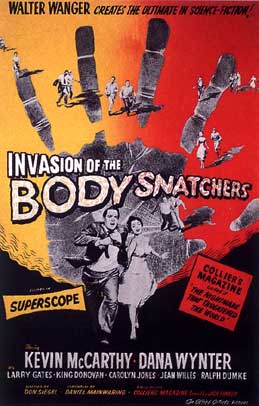
Invasion of the Body Snatchers (1956)The ultimate classic in paranoid horror. I really don’t have a whole lot to say about this one because I was kind of dozing while watching it. Which is appropriate, considering what happens to the characters in this film when they sleep. So here’s some disorganized thoughts about 1956’s “Invasion of the Body Snatchers.”

- Kevin McCarthy gives a really good performance. I love the way he gets increasingly more panicked as the film progresses, climaxing during the brilliant, iconic, amazing, one of my all time favorite scenes in movie history, shots of him screaming at people on the highway. He correctly illustrates what high stress and a lack of sleep will do to a person. But, even when at other volumes besides screamingly insane, he’s good. It’s really easy to tell why this guy is such a pillar of his community. There’s not much to the supporting cast, but I like Dana Wynter.

- The sequence where Larry Gates, after being replaced by the pods, talks about how nice thoughtless conformity can be is really successful. It actually makes having your individual soul stripped away by pods from space sound kind of inviting.

- Seems like a lot of movies based on the Body Snatchers premise makes the pod people cold, emotionless, and robotic. But not so here in the original. The pod people seem content, almost jovial at times. These aren’t soulless robots, these are creatures with a mission, determined to take over the world. And what better why to do that then with a smile? The threat is truly insidious. And, best yet, you never noticed the pods have won until it’s all ready too late. The paranoia really builds in the second half of the movie, when it becomes apparent that the people McCarthy thought he could trust have all ready been replaced.

- McCarthy and Wynter trying to blend in and then escape the compromised town is a fantastic situation, iconic for a reason. There’s something subtly sinister about the shots of pods being piled on trucks and shipped out of town. And what a way to build suspense! “Don’t show any emotion.” Has a better metaphor for subversives trying to hide in the crowd ever been written? And how their cover is blown is just as much a classic as anything else.
- The movie is widely regarded as sci-fi but, make no mistake, this is a horror movie too. The gooey creation of a pod person ranked high on the gross-out scale back in 1956. The detailless blank pod person prototype seems to have confronted concerns about the Unreal Valley fifty years before it really became an issue. Our protagonists hiding from the running crowds of attacking foes under flimsy floorboards is played for fantastic suspense. But the movie’s biggest shocker moment comes quietly, when McCarthy kisses Wynter and realizes she’s not the girl he fell in love with. It only takes a second, one slip up, to loose your entire personality and be taken over. Remember what I said about this being the best in paranoid horror?

- The opening and happy ending feel as tacked-on as they really are. McCarthy’s expositionary voice-over is also unnecessary and intrusive. Imagine if Don Siegal could have gotten away with the ending as originally planned. The studio added the epilogue because the ending was unsettling which, of course, was completely the point. I think it would have blown many a teenage mind in 1956 if, the last thing they saw before walking out of the theater, was Kevin McCarthy’s sweating, panicked face, screaming directly at them, “YOU’RE NEXT!” Which brings me to…

- So Don Siegal, the cast, and writers made it more then known over the years that they never intended the film to have any subtext. The majority of the film seems to support that theory, since it’s less about one specific group robbing us of our personalities, souls, and rights, then it is about the overwhelming power of conformity in general. I don't think the film and its premise would endure so much otherwise. But then there’s the scene where our hero looks out the window, down into the town square. A pod person stands before a crowd and dictates from a list all of the duties that need to be done today. This, to my sleep-deprived two AM brain anyway, seems to intentionally bring Communist Russia to mind. Maybe it’s just me…

While where here, I’ll just say I’m not a fan of the 1978 remake. The majority of people seem to prefer that version to the original but I found the self-absorbed seventies Me-Generation cast to be largely unlikeable. I do like the 1993 Abel Ferrara version however, with its icky body-horror-style pods and brutal anti-military themes. But the original is the version I saw first and one I’ve always liked the most. (9/10)

Psych: “This Episode Sucks”
The Halloween episodes of “Psych” are usually pretty good. Nothing has ever topped the slasher episode they did a few years back. That’s my favorite horror-related episode and my favorite episode from the show in general. But I would put this on par with the werewolf and haunted funhouse episodes from past Octobers. I like that the show focuses a little more on Lessiter’s human side, since that character so often exist to be nothing more then an exaggerated foil for Shawn. The love story he has here is legitimately sweet, even if the show takes it too far at the end. And, man, Kristy Swanson looks great! I didn’t even realize it was her at first. She manages to bring the “Deadly Friend” cuteness at times while also being “Buffy ‘91” hot at times too.

The presence of a former Buffy isn’t the only in-joke here. Corey Feldman shows up in a bit part and they even play “Cry Little Sister” when he first appears. Shawn and Gus spend a large portion of the episode dressed as Lestat and Blacula. (People keep mistaking Gus for Count Chocula. Is the character of Blacula really that obscure for the normals out there? I feel so disconnected at time.) There are a couple of great jokes made about garlic and holy water here, even if I feel Gus and Shawn’s vampire obsession is maybe taken a little too far over the top. I also like the scenes involving the black cat, which is quite amusing. The show also takes the effort to throw some fog in there too, just for the classic horror look.

Overall, a solid episode of a reliably goofy, fun show. It certainly won’t changed the opinions of anybody who think the show isn’t serious enough or that the main characters are annoying or overly quirky. But it’s a good show to watch with your Mom. (7/10)