Last of the Monster Kids

Last of the Monster Kids
"LAST OF THE MONSTER KIDS" - Available Now on the Amazon Kindle Marketplace!
Showing posts with label dario argento. Show all posts

Wednesday, December 28, 2022

Director Report Card: Dario Argento (2022)


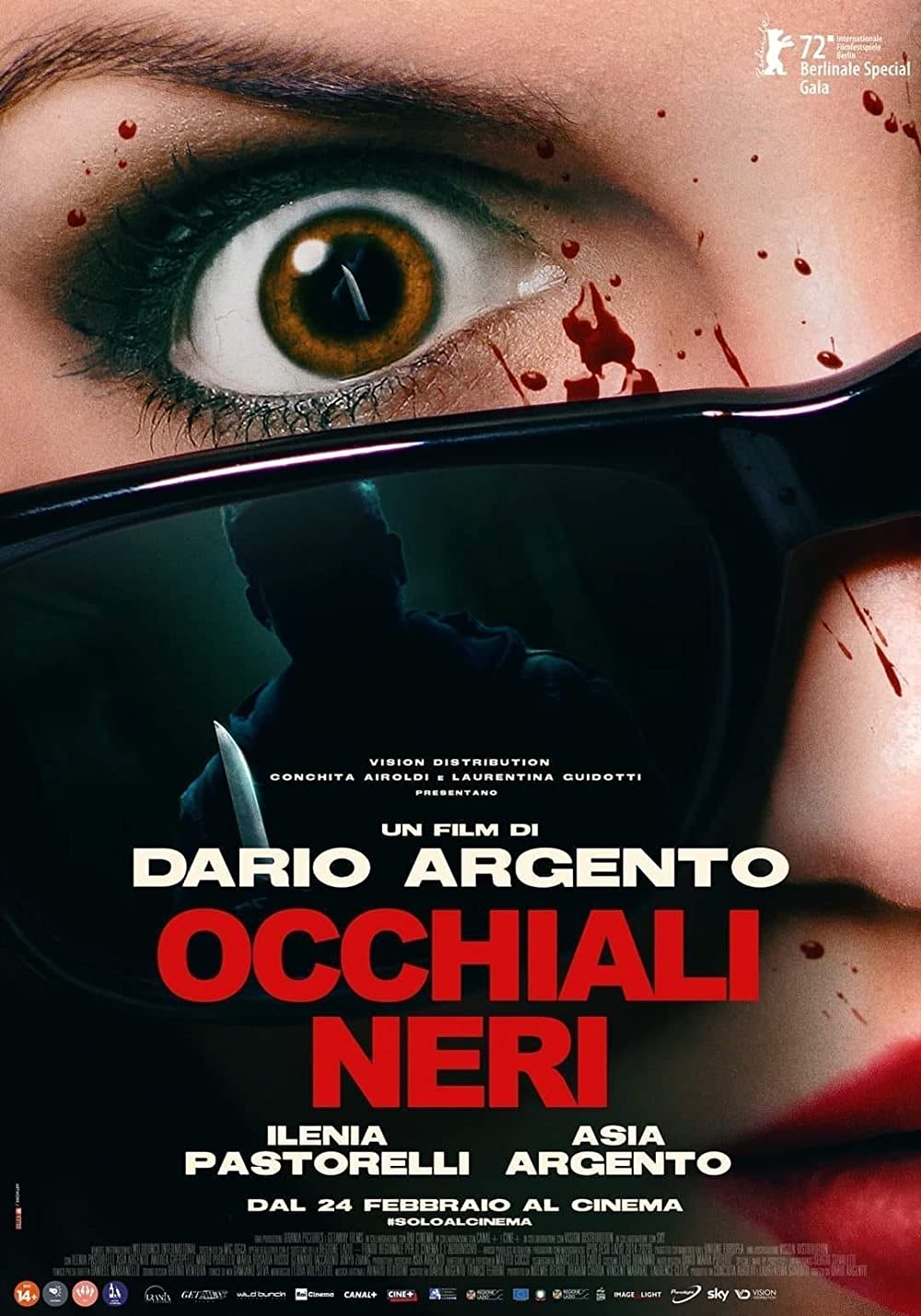
Occhiali neri

Dario Argento making his first movie in ten years should be an event. One of the major genre directors of the seventies and eighties returning to cinema for the first time in a decade would, ideally, be cause for celebration. Of course, Dario Argento's reputation in the modern age is more complicated than that. While few people can agree on when he last made a good movie, most understand that Argento isn't the filmmaker he used to be. Whether you consider 2012's “Dracula 3D” entertaining camp or an utter fiasco, it was hardly a dignified note for the director of “Suspiria” to end his career on. When “Occhiali neri” was first announced, I was skeptical it would even make it to theater screens. Once it was apparent the movie was actually coming out, I still remained cautious. I figured it was best not to get my hopes up. Now that “Dark Glasses,” as it's now known in English, is out and streaming on Shudder, it's time to determine if my apprehension was well placed or not. 

Diana is a high-class call girl going about her life in Rome. While fleeing a violent client, she is pursued by a serial killer who has been targeting sex workers all throughout the city. The chase concludes when she crashes her car into another vehicle. The wreck leaves Diana blind and kills the two adults in the other car, leaving only a boy alive. Diana attempts to rebuild her life as a newly blind woman. She feels guilty about the deaths and finds the boy, a Chinese immigrant named Chin, at an orphanage. The boy sneaks away to live with Diana, intrigued by the woman. They form an odd friendship... But the danger is not over. The killer is still at large and eager to reclaim the victim that got away from him. 

“Dark Glasses” is probably the best film Dario Argento has directed since the early nineties, which is admittedly the faint praise. It is a modest little giallo, not especially beholden to the director's past hits but vaguely reminiscent of many of them. There's a black-gloved killer, several scenes being told from his murderous perspective. A normal person who has, through bad luck, fallen into the position of detective must unravel the mystery before its too late. Though she doesn't do much investigating, instead the killer revealing himself to her. There's a pulsating synth soundtrack and stylized, close-up murder scenes. “Black Glasses” is an example of a director returning to the genre that he defined, playing again with the tropes and themes he started out with fifty years ago.

What does stand out about “Dark Glasses” is how charming the central relationship proves to be. When I first read the plot synopsis for the film, I thought it sounded like a giallo version of “The Life Before Us.” A bond between a sex worker and an orphaned immigrant child is so specific that I can't imagine this wasn't an intentional reference. Sentimentality is not something I really associate with Argento. Yet the bond between Diana and Chin proves somewhat touching. They come to rely on each other. I admire the script – co-written by Argento – for not mining cheap plot twists out of Diana withholding information from the boy. Instead, the guilt she feels for her role in his parents' deaths is what motivates her. You understand why these two come to rely on each other and it's fairly well done.

Considering the accusations of misogyny that have frequently been directed at his films, you don't expect a Dario Argento movie to feature the most sensitive portrayal of a sex worker. “Dark Glasses” surprised me in this regard. The film doesn't judge Diana for her job and treats it very matter-of-factly. Her clients are neither good-hearted suitors nor brutish sleaze balls. When her johns are abusive, that's when Argento utilizes the first-person perspective camerawork he's famous for... Only to have the attacker – and thus the audience – maced in the eyes. If that alone doesn't align the viewer's sympathies with Diana, the time the film devotes to her recovery and adapting to her blindness is surprisingly well thought-out. 

I don't think Diana's profession was chosen just for titillation factor or simply because it's a job that puts women in danger. In the second half of the film, she talks with Chin a lot about his mother. This can't help but make me wonder about the duality of the Mother and the Whore. (A dichotomy that is deeply ingrained in Italian culture, least we forget.) Diana winds up becoming something of a surrogate mother to the boy. Yet this doesn't overtake her profession either, as she continues sex work after becoming blind. Chin seems fine with her line of work. I don't know if “Dark Glasses” ever comes to a concise point about this topic. It's not really that kind of movie. But it is clearly an idea floating around in its head. It's another interesting angle to the story.

I think that's what I liked the most about “Dark Glasses.” There's a number of quirky ideas and themes bouncing around inside the narrative. You get the impression that Dario was interested in exploring something here, outside the standard genre framework of its story. Before the story gets moving, there's a brief scene where a bunch of people – Diane included – look up at an eclipse, wearing dark glasses for fear of going blind. There's a brief line bout how primitive cultures thought eclipses where signs of the apocalypse. Is this just foreshadowing? Or does it build into the idea of Diana being plunged into a world of darkness? The eclipsed sun even looks like the lens of a pair of glasses. What about the killer repainting his van from black to white, so that a brightly colored shape is one that foretells doom to Diana in her new shadow-filled world. Again, it's hard to say if there's a definitive point to these ideas but I'm intrigued by their presence nevertheless. 

An interesting reoccurring theme in Argento's early movies were the use of animals. This returns in a big way in “Dark Glasses.” Shortly after loosing her sight, Diana acquires a seeing eye dog named Nerea. She bonds with the furry creature quickly and it even protects her on multiple occasions. This is not the only time dogs appear prominently in the film. In the second half, it's revealed the killer has a connection with canines. Considering his sexist motivations, is this some commentary on how men are “dogs?” If so, why does Nerea end up saving the day too? The idea is definitely muddled yet it's interesting to see Argento, in a round about way, pay homage to the dog-centric scenes from “Suspiria” and “Tenebre.” And the German Shepherd playing Nerea is definitely a very good boy.

While Argento's best films have always been elevated by artistic, high-minded ideas, ultimately it is the stalk-and-slash scenes that he'll always be most remembered for. From time to time, to my pleasant surprise, you can see some of the old Dario in “Dark Glasses.” Probably the most stylish, suspenseful moment involves two detectives running into the killer outside Diana's apartment. Set in the tight corridor and lit largely by the van's headlights, there's some nicely unexpected camera angles in this scene. As well as a close-up of a knife blade penetrating a back. Later on, there's a mildly suspenseful chase, the camera gliding over and around the walls as our heroes run for their lives. It's not bad.

Granted, you still see signs of the tacky elements that sadly characterized most of Argento's work in the last thirty years. The first murder scene is a decently executed garroting, that sadly concludes with an ugly close-up of blood spurting from a very fake looking wound. The rushed climax is centered on some ridiculous looking gore effects too, with latex looking skin. The entire last act of “Dark Glasses” is an extended chase scene and it feels a bit aimless. Especially a totally gratuitous sequence set in a river, featuring some unfortunately CGI snakes. Still, compared to the gaudy excess and hideous effects in “Dracula 3D' and “Phantom of the Opera,” “Dark Glasses” still ranks as fairly restrained and well-balanced by modern Argento standards.

Also breaking from the traditions that have characterized Argento's work since the eighties, “Dark Glasses” does not star Asia Argento. She appears in a supporting role as the social worker who helps Diana get back on her feet, looking naturalistic and almost unrecognizable. Instead, Ilenia Pastorelli stars. It's an occasionally theatrical performance, Pastorelli sometimes going a bit into histrionics. Yet she has an easy-going charm as well, a lived-in quality that gives character and depth to Diana, making her seem more alive. She has good chemistry with Xinyu Zhang as Chin. Zhang is, honestly, fairly awkward as the young boy. His line delivery is hammy or stiff from time to time. It didn't distract from my enjoyment of the film or its characters but this is definitely an example of a miscalculated child actor.

When “Dark Glasses” was first announced, Daft Punk was announced as composing the score. That would have been quite a collaboration to imagine. Sadly, the wildly popular French electronica duo broke up before the movie could go into active production. Instead, another French pop musician in the form of Arnaud Rebotini was recruited to provide the tunes. Rebotini was definitely inspired by the classic Goblin scores of Argento's seventies masterpieces. The main theme is characterized by resounding bell-like tones and building synths. Rebotini incorporates a little more dance music flavor, via some thumping bass, than Claudio Simonetti probably would've used. But it's a solid score, that definitely helps raises the tension throughout the film. It's pretty catchy too, as far as these things go.

Some may accuse Argento's best movies of having abrupt endings. The likes of “Deep Red,” “Tenebre,” and “Suspiria” basically end right after the killer is defeated. This might be identified as a weakness but anytime his films have an epilogue, as in “Opera” and here, it always feels unsatisfying. “Dark Glasses” concludes on a weirdly downbeat and hopeless note. This is just the most glaring example of how it's a flawed film. Yet “Dark Glasses” still managed to exceed my measured expectations. I don't want to say Argento is back. Considering his age, who knows if he'll even make another movie. (Though he notably did act in a Gasper Noe movie this year as well, so maybe Dario caught the movie-making bug again.) Yet his comeback vehicle suggest the old master still has some of that old artistry in him. [Grade: B]

Wednesday, May 15, 2013

Director Report Card: Dario Argento (2013)

20. Dracula 3D

The sad state of affairs these days is that a new Dario Argento film isn’t cause for celebration. Usually, it’s cause for concern. When it was announced that his next film was going to be a 3-D adaptation of “Dracula,” fans got worried. After all, the director’s last foray into gothic horror resulted in “Phantom of the Opera,” a misfire of epic proportions. When the teaser trailer for “Dracula 3D” hit the interwebs, it was everything we feared and worse: Awful CGI effects, 3D eye-gouging, laughable acting, creepy Asia nudity and, most infamously, Dracula turning into a giant praying mantis. “Dracula 3D” was shaping up to be another sad marker in Argento’s increasingly discredited career.

I went in with incredibly low expectations. No doubt this affected my final opinion. “Dracula 3D” isn’t good. It’s frequently embarrassingly bad. It’s also not terrible. All the stuff we groaned at in the trailer, and more, is present. However, the movie frequently rises to the level of campy enjoyment.

Only the bare outline of Stoker’s novel is retained. Jonathan Harker travels to Castle Dracula, relocated to a village in rural Italy, not to sell him property but to work in the Count’s library. This ends up being a bad idea. Mina follows to the village soon after and shacks up with friend Lucy. Dracula’s reign of terror over the town, and his particular interest in the girl, becomes apparent soon. Van Helsing shows up eventually too.

What happens to Harker while staying in the castle has some similar to the events of the novel. There is an attempted seduction by Dracula’s bride, singular, which the count interrupts, as expected. He spies Dracula crawling up the side of a tower. Harker ends up not being a particularly important character. Renfield is in the movie but he doesn’t resemble the source character at all. Lucy’s nightly visit with the Count and her eventual fate are at least inspired by the original story. Otherwise, Argento’s “Dracula” follows its own muse.

And what an odd muse it is. The director definitely makes some odd additions to the story. The village below has a particular relationship with the Count. He provides the townspeople with financial support and increased social standing, with the agreement that he can take the town’s daughters whenever he wants. His single, blonde bride is given an extended back story. She appears to be a virginal daughter at first but, because Dario is such a dirty old man these days, she has a soft-core graphic sex scene with her married boyfriend. Her perceived jealousy of Mina seems like it’s going to be an important plot point but fizzles out before the end.

No doubt the thing about the film that will get the most attention is the alterations to Dracula himself. Yes, he turns into a giant praying mantis. As absurd as it sounds and looks, that’s actually one of the better sequences in the movie. It catches the audience off-guard, due to its sudden appearance and pure oddness. Drac also turns into a wolf, a giant owl, and a swarm of flies. It’s even suggested that the count has sway over rats and cockroaches. He’s got general psychic abilities too.

Beyond the wacky super powers, Dracula’s motivation comes from Mina being the apparent reincarnation of his lost love, straight out of Coppola’s “Dracula.” Also like Coppola, Argento explicitly connects the fictional Dracula with the historical Vlad the Impaler. This information is dumped on the audience in the late going and it’s revealed the entire story has been manipulated by Dracula to get Mina to him. However, not all the changes are bad. The scene were the movie most comes alive is when Dracula turns on the townsfolk. He tears six guys apart in quick succession, slashing throats, biting necks, and lobbing off a head. The gore isn’t realistic and it’s really no less goofy then the rest of the movie but it’s still pretty entertaining.

About the special effects. The make-up effects are from frequent Argento collaborator Serio Stivaletti and it’s some of his best work in years. Two pin pricks obviously wouldn’t do for Dario, so whole necks are torn out, strands of flesh stretching and dangling. My favorite gag involves a shovel to the head and several of the stakings involve plenty of red. The practical effects are fine. It’s the movie’s CGI effects where it really falters. They’re bad. Like Syfy Channel Original bad. Dracula’s transformation from wolf to man is maybe the worse moment. When dead, the vampires crumbled into piles of dust. That’s a simple effect and the movie can’t even do that right. I mean, how hard is that? “Buffy” did a half-way convincing job every week on half the budget. It’s obviously fake looking. As bad as that is, Lucy’s fiery death is even worse. There aren’t words for how rubbery and fake the CGI in this film is.

The script is sloppy. It’s never clear who the main character is. Is it Harker? He has several important scenes early on. Yet he disappears for most of the film before being quickly killed at the very end. Mina is the next likely target yet none of her actions drive the plot. Van Helsing shows up half-way through and starts hacking through the supporting cast. This is his main purpose and I don’t know if it’s enough to earn him protagonist status. Even Dracula himself isn’t given a lot to do. He’s mostly a snarling murderer or mysterious cipher throughout most of the movie. The last minute attempt to turn him into a romantic figure falls horribly flat.

The story is generally unfocused. Tania, Dracula’s bride, gets a lot of screen time but contributes little to the film besides blatant eye-candy. Renfield wanders in and out of the plot without contributing much at all. If Dracula is after Mina, why does he bother seducing and bleeding Lucy? Dracula has a henchmen in the village named Zoran. This guy’s purpose isn’t well established. He murders Tania’s mother, in a rather giallo-esque sequence, is forgotten about, before Van Helsing kills him at the end. And what about Mina and Dracula’s relationship? One minute, she seems into him, even egging the Count. Another, she is resistant and confused. The movie tries to explain this with Dracula’s hypnotic powers but it just comes off as sloppy writing.

At least the movie delivers on the 3D. That’s not really a good thing though. Everything from owls, to swords, to eyeballs are tossed in the audience’s eyes. The opening credits are projected at the viewer as the camera careens down gothic hallways. Sadly, this is as close as we get to the classic Argento style. There are no scares in the movie, despite the loud music blaring when a man touches a woman’s shoulder or a character comes upon a decapitated Madonna. Claudio Simonetti’s score is as loopy as the rest of the movie. When not hitting us over the head with pounding noise, it tries to build atmosphere with humming theremin of all things. I like it though it’s totally out of place.

The cast is a mixed bad. None truly stand out though some are better then others. Thomas Kretschmann isn’t a bad Dracula. His line delivery is a bit awkward and he can’t sell some of his dialogue. He does much better when tearing people apart. At the very least, the guy carries himself well enough and is believable in the part. He’s not a great Dracula but is a convincing one.

Rutger Hauer is fine as Van Helsing. Hauer is a veteran and always a professional. He is given a howler of a monologue to rattle off at the end but an earlier moment, where he recalls his first encounter with vampires, is much better. Asia isn’t always well used in her father’s film. She doesn’t seem lost or confused for once and has decent chemistry with Marta Gastini’s Mina. Yes, there’s an unnecessary nude scene but it’s actually a decent character moment. Gastini has a handful of natural moments but comes off as awkward and stiff for most of the film. The same is said of Unax Ugalde and Miriam Giovanelli. Meanwhile, Giovanni Franzoni plays it way over the top as the film’s odd version of Renfield. The English dub is incredibly bad which makes it hard to read some of the performances.

The best thing “Dracula 3D” has going for it? It’s short. At just a little over a half-an-hour, it never drags, quickly bouncing from scene to scene. The movie’s a mess but far too goofy and quick-paced to be boring. It somehow prevents being a total fiasco. When it comes to modern Argento, I’ll take it. [Grade: C]

Tuesday, March 27, 2012

Director Report Card: Dario Argento (2009)

18. Giallo

With modern day Argento, you’ve really got to leash your expectations. When you’re expecting so little, a complete mediocrity like “Giallo” almost comes off as a success. Despite the title, the film plays less like a homage to the films Argento made in the seventies and more like a standard police procedural. There’s no black glove killers, POV shots, politically motivated plot lines, or an overabundance of style to be seen. It’s instead a tepid cop chases serial killer story.

The plot is standard issue: Giallo, a serial killer so named because of his jaundiced skin, is stalking Malin, abducting girls in his taxi, torturing them for several days, before dumping the bodies. A cop with a dark past is on the case and is soon joined in his efforts by the sister of Giallo’s latest victim. The story unfolds with little suspense, generally shuffling from one plot point to the next with no energy. The killer is never given any motivation or introspection beyond the fact that he jerks it to violent images and was picked on as a child because of his skin condition.

What happened to Adrian Brody? After years of respectable character work, he wins an Oscar for “The Pianist” and has since mostly slummed it in direct-to-video work. Here, for no specifically defined reason, the actor plays both the cop on the case and the serial killer he’s chasing. Brody goes under an anagramed pseudonym, “Byron Diedra,” as the killer and is under heavy make-up. However, the make-up, which consists of a fake nose, chin, and some really bad false teeth, is far from convincing. It doesn’t help that the movie focuses on Brody’s very distinctive eyes. It’s obvious right from the beginning that the same actor is playing both roles.

And why? At first, especially since the movie goes to some measure to disguise that it’s Brody as Giallo, I was wondering if they weren’t building towards some sort of twist. Are the killer and the cop REALLY THE SAME PERSON?!! After it became obvious they aren’t during a brief chase scene, I was wondering if maybe they we’re twin brothers or something? But, nope, there’s no plot justification for the decision. Maybe the movie’s making some sort of belabored, trite point about how killer and cop share the same sort of instinct, especially since the detective has some blood on his own hands. It’s a curious move and, sadly, the most interesting thing about an otherwise drab affair.

Brody’s performance as Inspector Avolfi isn’t bad. There’s not a lot of substance there but he does have some swagger and style to the role. “Byron Diedra” garbles his lines through a bad Italian accent and mostly practices uninspired sick creep clichés. That guy has got no future in the industry! Robert Miano as Brody’s superior does a lot with a few glances but his part is severely underwritten. Neither of the actresses playing the sisters do anything wrong but neither are interesting or exciting. There’s hints at a romance between Brody and the sister but it never amounts to anything.

And that’s pretty much the phrase of the day with “Giallo.” In the very first few shots, when Argento is panning around opera houses and model walkways, I thought for a minute there might actually be some of that old style here. Nope. Things settle down into boring normalcy before long. The only real stylistic decision I notice here is that the flashbacks, of which there are many, have a yellow tint to them. Those flashbacks are actually the best shots in the movie, since they allow Dario to indulge his interest in childhood and voyeurism. (And, hey, good job casting agent guy for finding a young kid with an appropriately Brody-sized nose.)

Despite the plot synopsis sounding like this might be Argento’s take on torture-horror, there’s actually very little gore in the movie. We get a lot of blades being waved around threateningly. We see lots of cuts and slashes on girls’ faces but don’t see much of the actual cutting. Once, a girl gets a hammer to the head and while it’s initially shocking, soon it devolves into the same old thing Argento does nowadays. The blood looks fake, the wound looks latex-y, and the camera lingers on its fakeness for too long. The only deaths that have any jazz to them are, again, those in the flashbacks. And those just aren’t really the same thing.

Keeping with the television police procedural feel, the story wraps up in a neat little package, with the killer disposed off conveniently and the only person Brody has anything resembling a normal relationship with walking out of his life. But as the credits roll, we see that one plot point has intentionally been left unresolved. While I suspect there was a reason for that, it feels less like a sequel set-up or an artistic choice… And more like a cliffhanger that will be resolved on next week's episode!

The producers were apparently real bastards. They took the film away from its director, recut it without his involvement, and didn’t even pay Adrian Brody what they promised him. Even if Dario got final cut on “Giallo,” I can’t imagine it being much better. As I’ve said over and over in this review, the film isn’t a disaster. It’s certainly not a fiasco on the level of “Phantom of the Opera” or “Mother of Tears.” But there’s absolutely nothing daring or exciting about it. It’s a truly mediocre movie and that I’m saying this about a Dario Argento film is very disheartening. [Grade: C]


How's that for a journey into diminished returns? Argento's next project, currently awaiting release, is Dracula 3D. As the spoiler-filled, NSFW teaser trailer shows, it appears to shaping up to be another "Phantom of the Opera"-level fiasco. Honestly, considering how "Giallo" turned out, that's almost preferable. Yeah, the movie will be awful, but it will also be insane and hilarious, which is preferable to boring. All the modern Argento elements are present and accounted for: Obvious CGI, creepy Asia nudity, over-the-top gore, and stilted performances. But I will see it, because I'm a completest, a masochist, and because I want to see the Rutger-Hauer-plays-alot-of-vampires cycle come full circle, with his no doubt sleepy take on Van Helsing.

Like most of the seventies horror auteurs, Argento's modern stuff just doesn't make the cut. So it goes. His seventies and eighties output is still amazing. That's it for Argento Month here at Film Thoughts. Was it as good for you as it was for me? MORE STUFF COMING SOON! (Probably.)

Monday, March 26, 2012

Director Report Card: Dario Argento (2007)

17. Mother of Tears
La terza madre

The latter-day Argento malaise rolls on and ends up sullying the name of perhaps his trademark films. Twenty years of brain-storming and this is the epic conclusion to the Three Mothers saga he came up with? I’m not even that big of a fan of “Suspiria” or “Inferno,” and I’m embarrassed by this.

Summing up all of the problems of “Mother of Tears” is difficult. First off, very little of Dario’s usual directorial style is present. We get a few POV shots and a nice long tracking shot towards the end, but there’s certainly none of the overwhelming camera movements that characterize his best work. Horrifyingly, he actually seems to adapt a shaky-cam/Hollywood action movie style during several scenes. I understand why this wasn’t a small scale ghost story like the previous entries, but going wide drains any personal horror from the story.

Things are pretty silly throughout, almost to the point were you wonder if Argento was intentionally going for camp. No, the over-the-top levels of absurd insanity seen in “Phantom of the Opera” aren’t quite reached here but the movie comes uncomfortably close. The trio of attacking demons? The evil witches that look like extras from a Paula Abdul video? The ghost of Daria Nicolodi floating around, Obi-Wan style, helping her daughter out, while Asia yells “Mommy!?" The magical T-shirt? That monkey? And that’s really just the tip of the iceberg.

There’s a lot of exposition about the mythology of the Three Mothers and, honestly, I don’t mind it by this point. But did we have to get it through slideshows or passages of books being read out loud to us? Argento has always had the tendency to clobber ideas together without much sense. Lately, the ideas themselves are as senseless as the presentation.

The pacing is very weak, with far too much time devoted to Asia running from place to place. The police investigation aspect of the story is underdeveloped. When you think about all the other horrible stuff going on in Rome, would the police really devote that much energy to finding one person?

As for the acting… We all like Asia Argento, right? She can act, I’ve seen it myself. But anytime her dad’s behind the camera, it seems like she devolves into a scratchy voice shrieking little girl without a single bit of emotional restraint. I all ready mentioned how Daria Nicolodi makes a fool of herself. I really can’t stress how jaw-droppingly bad the whole mother-daughter plot line is.

The title character and lynchpin for the entire plot is played by model-turned-actress Moran Atias. It’s really quite obvious that Miss Atias has no formal training, as she mostly stands around naked and badly overacts. I suspect she was chosen more for her physical appearance and willingness to do nudity then for any ability to convey power or dread. Even then, I gotta’ question Dario’s judgement. A witch that’s been imprisoned for a hundred-some years probably shouldn’t have breast implants.

Philippe Leroy is supposes to be the male lead and Asia’s love interest. This is hampered by the fact that his character is completely useless. Moreover, he has very little actual interaction with Asia. Udo Kier brings his usual manic charm to his brief part as a homicidal priest and Valeria Cavalli, as an all-knowing lesbian, is decent. The movie needed more of those two.

Gone is the intimate terror of Dario’s previous film and he compromises with a bunch of shock value. Personally speaking, the guy’s obsession with child murder, previously displayed in his “Masters of Horror” episode “Jenifer,” is beginning to creep me out. And not in a good way. Three dead kids are too many for my taste. Maybe if the movie was actually trying to make some point with all the child killings, it would be different. Yet it’s all too obvious that at some point over the years, Argento got “scares” crossed with “shocks.” The taboo breaking is there simply because, I suspect, he can get away with more in this stage of his career.

There’s a lot of gore and it is pretty solid. Cleaver slashing, intestinal strangulation, head crushing, eye gouging... All good stuff. There’s at least one good jump scare (You’ll know it when you see it) and the weird sex stuff at the end, like witch orgies and butt-rope, is surprising, if nothing else. Claudio Simonetti’s score is decent but minor compared to his past work. Where are the overwhelming waves of throbbing synth cords? The hardcore shock-metal song that plays over the end credits is just the final crap cherry on the vomit sundae.

The movie ends in the same sort of nonsensical, frenzied way as the previous two parts of the trilogy. Only this time, we get some bad CGI, a ridiculously demise, a blatant call-back to “Phenomena,” and inappropriate laughing. It’s a clueless, abrupt conclusion to a largely clueless, abrupt film.

And this last point is a petty complaint, for sure, but I might as well throw it out there. “Mother of Tears” is a boring title. It doesn’t mesh with the other two films in the trilogy, at all. (Which is appropriate, I suppose, since the film itself sticks out horribly too.) The original Italian title is even worse, since it translates as just “The Third Mother,” and the U.S. working title of “Exhumed” is generic. “Suspiria” and “Inferno” were descriptive titles suggesting the film’s tone, themes, and central villain. In the alternate universe where Argento didn’t loose most of his talent after 1996, “Mother of Tears” was not only a lot better but it was also called “Hystericus,” a title that invokes the film’s Rome setting, the chaotic story and tone, as well as the villain’s association with panic and crying. It also fits the one-word titling scheme of the rest of the trilogy.

Is the magic gone forever? “Mother of Tears” is another manic, shrill misfire from an over-the-hill filmmaker. I bet all those fanboys begging for the third part of the trilogy are sorry now. [Grade: D]

Sunday, March 25, 2012

Director Report Card: Dario Argento (2004-2005)

15. The Card Player
Il cartaio

“The Card Player” isn’t a terrible film but is very listless. If it wasn’t for a key factor, I suspect it would’ve fallen apart completely. The movie starts with a striking opening sequence, one shot with light blues that has a nice Argento feel. Immediately afterwards, the plot gets rolling. These are good things.

Soon afterwards, the seams begin to show. First off, the film is badly dubbed. The lips match up but the voices sound like something out of an old AIP dub. Secondly, the biggest issue of the movie is that far too much of it is composed of people sitting around and watching/playing virtual poker. Which is boring, even if you like on-line poker, and even more so if you have no experience or understanding of the game. (*Points to self.*) Cards get clicked on, the intentionally, I hope, cheesy graphics flash, and we see a close-up of the struggling girl’s face. This repeats at least three times. So the major device of the film comes off as boring, which is perhaps why the overall film feels so half-hearted.

Another problem is the almost complete lack of blood. We see the box cutter waved in front of the camera and then the girl goes limp. Why, Dario? Why are you, of all the filmmakers in the world, holding back on the gore? The goriest sequences are all postmortem examination of bodies, which certainly don’t have the intensity you associate with Argento.

Simonetti brings in another score but even it is off balanced. The main theme is pretty decent but far too much of the music sounds like bad Europop techno. Some computer sounds are incorporated in, which only reinforces the cheesy feel.

The story also has issues. There’s a pretty big plot revelation towards the end of the film that makes very little sense. Spoiler alert: How can the murders be pre-recorded? How would the killer know if he would win the game or not? How do you account for the scene where the girl escapes? It’s sloppy writing and just doesn’t make any sense. The movie is paced like an old seventies cop show, which drags the entire flick down.

Chief among the few things that make the film work at all are the main two actors. Stefania Rocca gives a very good performance. She has an enchanting charm that makes her a joy to watch. Even that is somewhat spoiled by her character’s background, concerning her father’s past, that mostly comes out of nowhere and is brought up messily near the end. Liam Cunningham as the male lead is also good. His arc as an alcoholic cop is clichéd but the actor does decently with the material he’s given. The final fate of that character is also one of the standout scenes in the film. The two actor’s romantic subplot isn’t one of the great romantic subplots in Argento’s film but it does work. I also like the singing, dancing coroner. The scene where Stefania is assaulted in her home generates some suspense as does the climatic moments on the train tracks. And, if nothing else, Argento continues the tradition of his killers getting cool deaths themselves.

The reveal of said killer is clumsy and the very last scene is completely confusing and arbitrary. “The Card Player” feels lifeless and awkward. It’s just a really off day for the director... One that’s been on-going for about a decade now, I guess. [Grade: C]


16. Do You Like Hitchcock?
Ti piace Hitchcock?

How big of an influence on Argento is Hitchcock, really? Yes, both directors share a similar love and fascination for voyeurism. And “Psycho” was undoubtedly a huge influence on Argento’s career, but you could really say that for every horror director of the last three decades. Argento’s sensibility have always seem far more European to me, influenced more by the surrealism of the sixties' New Wave. The most obvious Hitchcockian element to Argento’s film is the use (overuse?) of the sweeping steady-cam and other inventive camera angles, something that could just as much be attribute to any other number of directors.

But, whatever, anyway, Dario made a straight-up homage to Alfred Hitchcock. (Or he made a Brian DePalma movie. Zing!) The movie name drops “Strangers on a Train” and “Dial ‘M’ for Murder” gratuitously, while also liberally referencing “Rear Window,” “To Catch a Thief,” and “Family Plot.” In a way the movie is less in the style of Hitchcock and more uses his films as plot elements.

The best thing about “Do You Like Hitchcock?” is how much it feels like Argento. Yes, it’s shot on the same digital film stock as his last few films and lacks the body and deep colors of classic film stock. However, Argento seems to be actively striving to reclaim his classic style, the intimate intensity. He doesn’t completely succeed but you can tell that he’s at least trying.

The attack on Sasha’s mother is the best example. Its focus on blood on a window reminds me a great deal of “Susipria” and its opening moments. The bright red blood doesn’t look as good on this film stock. While the movie is surprisingly free of “Psycho” references, the moment Giulio is attacked in the bathtub is another highlight of the film.

Another Argento trademark, aside from the rickety old elevator (which, sadly, no one is decapitated in), is the romantic subplot that drives much of the action of the film. I swear, if it wasn’t for all the murder and evisceration, Argento would’ve made a pretty decent romantic comedy director. Elio Germano and Chirara Conit do have pretty good chemistry, even if the gap between hotness of girlfriend and boyfriend is pretty wide. Elio Germano’s nerdiness does get in the way a few times, but I say it’s a good performance. Elisabetta Rocchetti and Cristina Rocchetti exist more as eye-candy then anything else… Not that there’s anything wrong with that. Anyone else notice that Argento is seriously becoming a dirty old man? An early sex scene almost feels like something out of some softcore skin flick. And, to think, this was actually made for Italian television.

The opening flashback sequence has little to do with the rest of the movie but I like it. It feels like a very personal moment from Argento, like something he himself could have experienced as a child. The direction is fairly subtle, with a number of close-ups being the main flamboyances. Pino Donaggio’s score is a little overdone at times but appropriately Herman-esque.

“Do You Like Hitchcock?” is far from a great film but it does represent something of a return to form for Argento. It’s more satisfying then most of his disappointing recent output. [Grade: B-]

Friday, March 23, 2012

Director Report Card: Dario Argento (2001)

14. Sleepless
Nonhosonno

“Sleepless” is a blatant attempt by Argento to recapture the magic. It’s an old fashion giallo. The excellent opening theme, provided by a reunited-strictly-for-the-purpose-of-writing-this-score Goblin, certainly made me feel good about things. The long opening sequence of a hooker rejecting her john, being rejected by her john, jumping on a train, discovering some creepy stuff, and finally being chased and killed is suspenseful. When the attacked woman bleeds all over a window, rain water running down on the outside, you honestly think Argento maybe got it back.

The plot mostly concerns a retired police detective, played by Max von Sydow, and the victim of a serial killer teaming up to solve a new string of murders in a case that was thought to have been solved twenty years ago. The story is one of the few times Argento actually seems to be handling a genuine theme. “Sleepless” is about aging and maturation.

Max von Sydow is very good as the old detective, somebody whose memory is shaky and feels increasingly out-of-place in today’s high tech world. Detective Moretti only has one real friend, his pet parrot, and gets involved in the murders only out of a sense of responsibility to Giacomo, a young boy who's mother was murdered years ago. As he delves deeper into the mystery, Moretti’s memory comes back and his life seems to be exciting again. Sydow is maybe a bit too jovial for the macabre material but it’s a fun performance. The character exits the film before the end and, when he’s gone, so goes a lot of the movie’s energy.

While Moretti comes to accept his age, Giacomo is returning to his home town and childhood friends in order to put old demons to rest. Stefano Dionisi’s performance isn’t great but he’s not bad by any means and makes for a decent lead. He has good chemistry with Sydow. The scenes of the two of them sleuthing together prove to be the most entertaining moments in the film.

The story has a few interesting angles to it. The primary suspect for the murders back in the 1980s is both a dwarf and an author of giallo novels. (Shades of “Tenebre,” perhaps?) While both of these elements are potentially interesting, neither are really followed up on. The killer cuts out a paper animal at each murder and seems to be taking his inspiration from a bizarre, morbid nursery rhyme about slaughtering farm animals. (Written by Asia Argento, too.) In addition to the animal motifs, there’s a creepy abandoned house and some mommy issues too.

The murder mystery is fine but it’s honestly the characters that make this one worth watching. Aside from the relationship of the detective and the son, Giacomo has a group of friends, including a best friend and a teenage lover that is now dating some older asshole. While the female love interest isn’t developed too widely, the actress is likable. Generally speaking, I found the movie to have a bit more character and heart then I expect from Dario in this period of his career.

But what about the trademark Argento style? The opening murder certainly promises a lot, but the style department is where “Sleepless” really lacks. There’s some nice, prowling shoots of the outsides of houses but there’s not much in way of sweeping cinematography. The second murder sequence, which is not actually the second kill in the movie, works well enough, making good uses of darkened corridors and a ski mask with shinning eyes. The victim being drowned also recalls a similar scene in “Deep Red.” My favorite kill involves a long tracking shot of feet passing by, before we see our victim’s dangling feet, followed by her decapitated head.

Somebody gets murdered with a clarinets, which is creative and nasty, but the gore use here reminds me too much of how the gore was used in “Phantom of the Opera.” A sleazy cab driver is stabbed in the head with a pen and a girl has her face smashed into a wall. While both of these kills probably read great on paper, their execution lacks a certain something. There’s too much focus on the fake blood and latex gore. The camera seems to linger on the make-up effects, instead of on the intimate terror of the attack like in Argento’s best film.

While Goblin’s main theme is excellent, the rest of the score is a bit pedestrian. After Max von Sydow leaves the film, the story begins to flounder. Everything is wrapped up in a confusing jumble of double crosses and reveals. An important character detail, crucial to figuring out the killer’s identity, is revealed at the last minute with no lead-up or prior clues. Moreover, the final confrontation between victims and killer, traditionally a strong moment, lacks tension.

Despite having strong characters and a decent mystery going for it, “Sleepless” drops the ball in the last act. Argento is either unable or unwilling to create the same sort of visually beautiful, intense sequences of horror that he once did, despite his best efforts. [Grade: C+]

Thursday, March 22, 2012

Director Report Card: Dario Argento (1998)

13. The Phantom of the Opera
Il fantasma dell'opera

This is a strange film. It is strange by Argento standards. It is strange by the standards set by “Phantom of the Opera” adaptations, which includes a glam rock musical and a Satanic slasher. This is a film that starts with rats raising a baby (Instead of, just, you know, eating it) and goes from there.

First off, the Phantom isn’t deformed, scarred, or wearing a mask. He does however have an unexplained psychic domain over the opera house. Julian Sands plays him as a shy outcast, a sincere lover, a sexual deviant, and a mindless killing machine. The script never settles on one characterization.

The Phantom isn’t the only character radically altered. Asia Argento plays Christine Daae as a wide-eyed, blank-minded, screeching princess. When the Phantom’s possessive side begins to show, she erupts into a petty screaming match, like a selfish teenage brat. Christine decides she hates the Phantom and must love Raoul, a crushed wimp with no personality, who she was platonic friends with just days before. Asia spends the latter half of the film screaming her head off and wearing ridiculous hats. It doesn’t help that the movie lingers on her obviously dubbed singing. Christine is also apparently the kind of girl who fucks on the first date, as the Phantom is humping her doggy-style (rat-style?) not long after meeting her. Near the end, when someone calls her “the Phantom’s whore!,” the audience isn’t given much reason to disagree.

The movie is unusually vulgar. Early on, a couple plots to steal the Phantom’s treasure, but not before the girl gets naked. As soon as they enter the caverns, he brutally kills them, impaling the dude on a stalagmite and biting the girl’s tongue off. There’s an unnecessary sequence where Raoul’s brother takes him to a Turkish bath, full of grotesquely fat naked people. When the Phantom threatens the Opera’s primadonna, he gropes her breasts for no reason. Of course there’s the scene where the Phantom undresses and lets rats crawl around on his body. Thankfully, the scene cuts away just before he takes off his pants, but the proceeding bestiality is more then implied.

Gore is to be expected from Argento, but kill scenes are placed without rhyme or reasons. The film opens with a guy getting cut in half off-screen, in circumstances that are completely impossible. The above murder of the couple is barely mentioned again. There’s an extended sequence where a dirty old man tries to bribe a young ballerina with some chocolate, before the Phantom tears his gut open. However, you’re not really sure what’s happening, since the camera just focuses on red meat and fake blood rolling around. None of these murders have any impact on the story.

The film is rife with other special effects failures. In the opening, we see a fluffy animatronic rat. There’s a gratuitous shot of a very fake CGI fly. And then there’s the chandelier drop, surely the center-piece of any “Phantom” adaptation, but spectacle is ruined by the presentation. The Phantom, shirtless with his long silver hair blowing in the wind, looking like he’s in a hair metal video, smashes the chandelier’s holding mechanism with a hammer. Obviously CGI cracks appear in the ceiling and an obvious model crashes down on obvious dummies. The scene is punctuated with a horrible blue screen shot of Carlotta running away from a falling statue. After the statue hits her, she gets up and coughs white smoke.

The what-the-fuck moments pile up quickly. White light shoots out of a crack in the wall. The Phantom sits on the roof of the opera house, with a very fake CGI city behind him, when he has a vivid vision of naked rat-men squirming in a mouse trap. This is followed with a vision of Christine dancing in a black-mesh outfit that most definitely does not fit the time period.

But no what-the-fuck moment is what-the-fuck-ier then when the Rat Catcher and his dwarf sidekick build a weird rat killing device. It looks like a roller coaster cart crossed with a jet ski. It has street sweeper brushes that push the rats into some vacuum tubes. They spin around in a rotisserie oven before popping out of the top, where the dwarf grabs the bodies. There’s also a giant swinging blade that serves no purpose. The Rat Catcher takes a rough turn and puts on the brakes but just produces bad CGI spraks. The cart careens off a cliff and crashes. The CGI blade reveals its purpose by dramatically decapitating the dwarf. This scene is utterly inexplicable. If Argento himself flies to my house and explains why this had to be in the movie, I still won’t understand.

By the time you see an opera attendee sitting in the audience, wearing a cast and bandages, you think Argento is fucking with you, that this is meant to be absurd. But then Julian Sands literally flies onto the stage and we get an earnest climax. The Phantom goes down like the Terminator, taking far more bullets and stabs to his body then is humanly possible. Asia’s screaming face transfers to a wandering, unstable view of the opera house auditorium, as the end credits play.

Just how the hell did the genius who made “Deep Red” create this disaster? Argento’s direction is stale and uninteresting when it isn’t hilariously inept, like when the camera ping-pongs between two faces. Argento also manages to make a real cave look like a cheesy set.

About the only thing I can recommend is Ennio Morricone’s score. While it’s rather bland over all, the main theme, “Sighs and Sighs,” is beautiful. It perfectly captures the loneliness and unrequited love central to the Phantom character. It deserves a much better movie.

I’ve got nothing else to say. This is a complete and utter train wreck from beginning to end. [Grade: D-]

Wednesday, March 21, 2012

Director Report Card: Dario Argento (1996)

12. The Stendhal Syndrome
La sindrome di Stendhal

“The Stendhal Syndrome” isn’t typical Argento but, unlike many of the atypical films that would follow, it’s not bad Argento either. It’s far more psychological then his usual output, while also being much darker. While his previous films approach violence in a theatrical fashion, “The Stendhal Syndrome” is a gritty, nasty picture. It’s an uncomfortable film because, obviously, all of the rape in it. For a filmmaker that has such an obviously… Problematic relationship with women, to see him approach the vilest of violation has potential to be… Off-putting. (Especially with his daughter in the role of victim.) For what it’s worth, Argento never seems to be getting off on the violence. His depiction is honest and unflinching but never eroticized.

While Asia Argento has proven herself to be a good actress over the years, her performances in her father’s films are highly uneven. Here she is given a juicy, dramatic role. Her character undergoes a gauntlet of emotional trauma, first having her mind assaulted by the title syndrome, before being physically assaulted (several times, in drawn-out, disturbing sequences) by the film’s antagonist. Thoroughly broken by the experience, Asia spends the second half of the film traumatized. Instead of descending into weepy depression, the film seems more interested in exploring her distressed, distorted psyche. A sequence that especially stands out is when she turns the table on her horny, pushy on-off boyfriend.

After she meets and falls for a new guy, the film goes in a sadly predictable direction. The killing starts again, you see. Despite a somewhat disappointing conclusion, Asia gives one of her best performances here, something recognizable even under a lousy dub.

As the nineties continued, seemed Dario became less interested in using his traditional style. “The Stendhal Syndrome” is definitely less stylish then his last film, but there are some arresting visual moments. The titular condition is brought to life nicely, despite some awkward, ugly CGI. The ocean of a painting comes sweeping up to Asia and she falls into it, absorbed into the art. Later, another on-set of the condition is cleverly used to give us a little insight into our protagonist’s history and the plot. In my favorite scene, Asia literally steps into a painting of a waterfall, letting it wash over her. (There’s also a bizarre, CGI shot of a pill being swallowed that is there for reasons I’m not entirely sure of.)

The movie isn’t without its suspenseful moments either. In my favorite moment of old-style Argento suspense, his camera roams a room full of giant sculptures, of leering faces and Greek statues, suggesting that anyone and anything could be behind them. In another scene, Asia flees from her attacker, who could be right behind her.

The movie certainly doesn’t skimp on the blood but instead focuses on the viciousness of the attacks. While this is kind of disappointing, it fits the grim tone of the film. The scene where Asia is kidnapped and held captive in the attacker’s lair for days is certainly unnerving and disquieting. The movie seems to wrap up most of its plot during the halfway point. The film introduces a new love interest for Asia which works okay but, since the killing has to continue, there’s only so many ways for the story to resolve itself.

To see a film that had been challenging and intelligent sink into formula like this is pretty disheartening. But, for the first hour and a half, “The Stendhal Syndrome” is an effective, nasty piece of work. It lacks the style of classic Argento, but makes up for it by being a successful thriller in its own right. [Grade: B]

Tuesday, March 20, 2012

Director Report Card: Dario Argento (1990-1993)

10. Two Evil Eyes (with George A. Romero)
Segment: The Black Cat

Edgar Allen Poe invented the modern horror story, of course. His work being adapted by two of the biggest names in the genre was an exciting prospect. “Two Evil Eyes” should have been a real blast for horror fans. Instead, it’s rarely spoken of today and is overlooked in both Romero and Argento’s career.

Following George Romero’s somewhat bland take on “The Facts in the Case of M. Valdemir,” a shot of frenzied Argento horror would have done the film good. His take on “The Black Cat” isn’t quite that, but it isn’t half-bad either. If nothing else, his half features a bit of the ol’ Italian style. There are a number of cool shots. The camera is attached to the swinging blade of a pendulum, a swinging noose, and a falling set of keys. More then once, the point-of-view prowls around the floor, like a cat. There’s more then a few sequences of roaming, sliding cameras. It’s not quite classic Argento but, in the post-“Opera” era, I’ll take what I can get.

Beyond the cinematography, there’s other elements here. Midway through the film, there’s an odd, extended dream sequence, featuring dwarves, pagan dancing, Renn-Fair style dress, and eventually an impalement. More then any other adaptation of “The Black Cat,” the fate that befalls the protagonist seems to be directly the result of his cruelty towards the titular feline. The score has some child choir singing in it too, even if it’s mostly unlike your typical Argento score.

What’s really odd about this half of the movie is its main performance. Harvey Kietel is a great actor and has given many fine performances over the years. But there’s something very off with him here. In the role of a crime scene photographer who proves to be very twisted himself, Kietel is frequently very flat. Flat in an off-putting way that, when it comes time for him to cover up his crime, leaves little doubt he’s guilty. When Harvey isn’t speaking in a creepy, flat monotone, he’s yelling and swearing. The script has him doing odd things like making a fake car passenger out of a large photograph and some paper and then using it like a puppet, adding to the off-center mood. The only time Kietel works in the film’s favor is when he’s delivering the brief narrations, which reminded me of the sinister opening narration of “Tenebre.”

Maybe the odd performance was just the result of an Italian-speaking director working with English speaking actors, because Madeleine Potter gives a strange performance too as Kietel’s often abused girlfriend. The only self-assured actor in the movie is John Amos in a small part as a police detective.

Neither half of “Two Evil Eyes” is particularly gory, though both segments have brief moments of blood. While there’s a clever murder and a bathtub full of bloody water, the real focus here is on post-mortem crime scenes. We get to see the nasty aftermaths of two gruesome murders. The first is a gory take on “The Pit and the Pendulum” (really, more pendulum then pit) while the second involves some improper use of dental tools. It’s pretty gross and was one of the first signs of Argento obsession with dead bodies.

“Two Evil Eyes” is fairly forgettable and doesn’t live up to its potential. Argento’s “Black Cat” is definitely the superior segment of the two but even it is mostly a trifle. The film seems to have been more a half-serious lark then a legit attempt to adapt Poe.
The Black Cat: [B-]
Film as a whole: [C+]


11. Trauma

“Trauma” wants to be “Profondo rosso.” It plays like a patchwork of Argento’s films, taking elements from as far back as “The Bird with the Crystal Plumage” to as recent as “Opera,” but it obviously wants to emulate “Deep Red” more then any other. The film shares far too many elements for it to be coincidence. The opening surreal scene of childhood toys, the use of animal motifs, a psychic talking about the killer, the romantic subplot, the presence of a curious child and a creepy old house, the way a tiny detail becomes a serious clue later, how visual memory can be misleading, the convoluted way the killings are investigated, how the mystery seems to resolve itself before really resolving itself, even the identity of the killer and way said killer is dispatched are curiously similar to that earlier film. Many of these are the reoccurring idiosyncrasies of the filmmaker but I doubt Dario didn’t intend the similarities. (Indeed, according to the excellent commentary track on the Anchor Bay DVD, the movie was almost called "Deep Blue.")

“Trauma” is frustrating that way. It’s Argento out of balance. The anorexia subplot, though clearly a personal subject for the filmmaker, doesn’t really go anywhere. It seems to me that the disease is something Dario wanted to tackle and instead of building an entire story around it, he inserted the concept into a giallo. Disconcertingly skinny young women show up several times throughout. It’s obviously meant to have subtext but I don’t see how it connects.

The affair between Chris Rydell and the anchorwoman seems to be setting up something that never happens. (We at least get a gratuitous sex scene out of it.) Pino Donaggio’s Hitchcockian score is nice at times but overly whimsical at others. The psychotropic berry scene is thrown in seemingly for the hell of it. The story wobbles in the last act and the main character’s drug relapse is really odd.

This is all the more frustrating because “Trauma” works really well at times. The séance scene is great, though it feels more Soavi then Argento. The steady-camera is fantastically used throughout. The way it swoops around the environment, like in the hospital or the murder scene house, is simple gorgeous, classic Argento. The whole movie looks beautiful on DVD, the rich blues and black coming through for the first time. The scene on the lake is my favorite, its dreaminess emphasized by the haunting musical theme.

The electric garrote is a unique murder weapon. Its use becomes more graphic as the film goes on, more being revealed each time. The first few deaths lack punch but each consecutive death is more intense. I love the head talking after decapitation, such a surreal sight. Tom Savini’s gore is top of line.

Brad Dourif’s death scene starts out fantastically but ends with laughable digital effects, totally breaking the mood. The little boy subplot pays off excellently. The closet scene is cracking intense, Nicolas’ origin is hypnotic, and the final death almost tops “Deep Red’s” climax. The murder mystery admittedly kept me guessing.

Chris Rydell and Asia Argento both give solid performance and have believable chemistry. (And, yes, she does have an underage nude scene, filmed by her dad. I don’t want to entertain the implications of that.) Piper Laurie is naturally operatic in her part. Nobody does over-the-top horror mom like her.

“Trauma” is grossly uneven. It’s so fucking good at times and then so out-of-shape at others. I can’t quite decide how much I like it or how disappointed I am. It's all down-hill from here. [Grade: B-]

Sunday, March 18, 2012

Director Report Card: Dario Argento (1987)

9. Opera
Terror at the Opera

Like “Tenebre” and “Phenomena” before it, “Opera” shows Argento evolving pass the giallo framework into creating films that aren’t quite slashers, aren’t quite supernatural horror films, but something distinctly Italian and wholly Argento. It’s a film that trades heavily in Dario’s beloved themes and obsessions. Childhood flashbacks, the killer’s damaged mind being shown visually, voyeurism, psycho-sexual frustration and obsession, architecture, animals, there’s even a precocious kid thrown in pretty randomly… Despite all of these returning concepts and images, the movie never feels derivative or tired.

First off, “Opera” is a gorgeous film. On a strictly visual level, it’s Argento’s strongest film since “Deep Red.” His camera glides, runs, floats, spins, peers, and prowls around the opera house, the protagonist’s apartment building, and just about every setting in the film. The camera voyeuristically probes the character’s private places, suggesting the killer’s presence and building suspense simply with a dolly pan. When the killer appears and attacks, the intimate framing and frenzied camera movement builds the film’s tension up to a fever pitch. The movie’s color palette is also fantastically atmospheric. While the opera house always seems to shimmer and sparkle, the dark is a cool blue. Many shots of the film are like a beautiful, half-remembered nightmare. There’s even a brief splash of “Suspiria”-like color.

Finally, during the film’s climax, the camera takes the point of view of a group of ravens as they swoop around the opera house auditorium, diving down at the audience. It’s such a fantastic sequence and the way it’s shot elevates it into one of my favorites. I’d recommend the film just based on its visual strength. -If the stylistic direction is the main reason people watch Argento films, the second reason are the fantastic murders. And, man, does “Opera” deliver in that regard. The murders start slow. Like the Phantom of the Opera, the killer is interrupted in his private opera box by a stagehand. The film seems to speed up as the murderer strikes at the man, pushing the back of his head repeatedly into a coat rack hook. It’s not an overly gory scene but it does display the ferocity that powers the film.

The first major kill of the film involves a big ass knife being shoved into the throat of a screaming man, so you actually see the blade extending out through his open mouth. The victim falls to the floor and the killer slashes him into a bloody mess, while a speed metal song blares on the soundtrack, informing the viewer that there is no escape, ramping up the viciousness and terror of the attack.

The second attack is more stalk then slash and has a long build-up. Two women discover an important piece of evidence and the intimate camera and cramped framing makes it seem like the killer will appear at any minute. When the murderer does show up, he quickly finishes the one girl with a pair of scissors, but not before she swallows the evidence. Later Argento would properly revel in the gore as the man cuts her open to retrieve the incriminating necklace, but all the slicing is kept off-screen and the sound design causes the audience to imagine something much worse then what the effects team could ever cook up.

The last truly operatic murder occurs about halfway through and it ranks very highly on my list of all time favorites. Trapped in her spooky apartment, Betty and her best friend, played by Dario’s ex-wife Daria Nicoladdi, try to find a way to escape without running afoul of the killer who may or may not be in the room with them. Daria Nicoladdi crotches down at a door peephole, convinced the man outside is the mad slasher. After a few minutes of trying to convince her he’s a cop, by showing his badge and his revolver, the man sticks the gun barrel through the peephole and fires. In close-up, we see the bullet blow through the glass and blasts out Nicoladdi’s head. The bullet then destroys the phone our protagonist was about to call for help on. While all of this might sound over-the-top gory, only one scene really piles on the blood. “Opera” isn’t the gory fireworks of “Tenebre.” It focuses more on suspense and terror.

Maybe the most ingenious act of “Opera” is the way it blatantly puts the audience in the character’s seat and intentionally plays up the inherent voyeurism of the horror genre. Throughout the film, our protagonist is captured by the killer, tied up, and forced to watch the murders of her friends and love ones. The horror doesn’t stop there, because the killer tapes a row of needles under her eyes, forcing her to watch completely. It’s a brilliantly sadistic device and does a great job of involving the viewer in the action.

This brings us to the actual plot of the film. When the lead actress in a high-tech production of Verdi’s “Macbeth” is hit by a car, young, naive, inexperienced Betty is brought on to play Lady Macbeth. Of course, a mysterious man is obsessed with her and soon the murder starts. The story actually works pretty well, pumping along steadily for the first ninety minutes of the 107 minute run-time. “Phantom of the Opera” is obviously an influence, what with a psychotic killer being obsessed with a talented, young soprano and the cursed nature of that Scottish play is brought up a few times.

One of the most interesting points of the plot is that the production of “Macbeth” is being directed by a young horror film director. The staging is radical and new wave, with lasers, a giant floating skull overhead, and a post-nuclear war inspired setting. It brings an interesting personal subtext to the film, since the character of Nigel is obviously inspired by Argento himself. (Dario himself has expressed a desire to direct opera before.) And it’s not a wholly flattering portrayal, since the director is kind of an asshole and even a suspect at one point.

We some times get a peek into the killer’s head, literally, as we see his brain twitching with the murderous impulse. The heroine has reoccurring images from childhood and we get flashbacks to a young woman being both sexually and physically menaced by the masked man. All of this builds up the killer’s motivation and back-story, which is still muffled and more or less just a pretense for the kills. Despite a few red herrings, the identity of the murderer isn’t too hard to figure out just from process of elimination.

The movie’s biggest problem is its lead character. Despite people she’s presumably close to being brutally killed before her very eyes, Betty never shows much concern, trauma, or any sign she’s really upset by this. Literally moments after the first murder occurs, she’s sitting in a car, calmly, idly chatting. Nor does Betty or the director ever decide to cease the opera production, despite the murderous rage it obviously inspires. Our protagonist’s dead, slutty mother is occasionally referred to and it’s, obviously, a plot point.

All of this builds up to the movie’s second biggest problem. After the killer is revealed in spectacular fashion and has an intense confrontation with his favorite opera singer, the story seems to have resolves itself and wrapped up all the loose ends. But we then get a gratuitous epilogue set in the Alps, a psycho killer homage to “The Sound of Music.” The story obviously isn’t done yet and we get a few more uninspired kills before Betty and the killer have their real final confrontation. It all feels rushed, uninspired, and tacked on. Dario is usually really good at giving his killers spectacularly gory send-offs, but not here. The final scene, of our heroine freeing a lizard trapped under a stick, seems to symbolize her being free of her mother’s legacy and emotional baggage. Which is fine, and might have worked, had she actually shown any real empathy or concern throughout the film. Ultimately, this sloppy ending brings the otherwise fantastic “Opera” down a notch.

Despite that, “Opera” is a spellbinding, visually beautiful, suspenseful thriller. Some people dislike the heavy metal on the soundtrack, but I think it actually works, powering the violence. It works as a nice contrast to the soft, atmospheric Simonetti and Brian Eno score. “Opera” would, sadly, be the end of Argento’s unassailable eighties run. It’s the last time his classic style is really apparent. [Grade: A-]