Welcome to the film-related musings, complaints, and comments of Zack Clopton, an amateur film-critic, scholar, and screenwriter. Featured here are Director's Report Cards, essays, and other reviews. Enjoy!
Last of the Monster Kids
"LAST OF THE MONSTER KIDS" - Available Now on the Amazon Kindle Marketplace!
The decade was only a few years old but it was already apparent: Action movies were changing in the nineties. It would take most of the decade before the changes became obvious. The eighties action brigade was still popular at the box office and even a few new stars, like Steven Seagal, would emerge. However, Arnold Schwarzenegger had started appearing in wacky comedies, like “Twins” or “Kindergarten Cop.” Perhaps fearful of falling behind his biggest rival, Sylvester Stallone would make his own stabs at goofy comedies. Unlike Arnold’s attempts, which were popular in their day and remain beloved as campy classics, Stallone’s comedies were less well received. “Oscar” was a critical and commercial failure while “Stop! Or My Mom Will Shoot” immediately became an embarrassing punchline. Stallone himself has called it one of the worst movies ever made. Twenty years later, the question must be asked: Is it really that bad?
Joe Bomowski is a L.A. cop with problems. He doesn’t get much respect in his precinct, especially after his partner gets shot in the ass. He just broke up with his girlfriend, who happens to be one of his commanding officers. Joe’s problems are crystallized when his mother suddenly drops into town. Mrs. Bomowski is a smothering mother who takes over Joe’s apartment, tells everyone near-by about his embarrassing childhood, and immediately begins micro-managing her son’s life. Bomowski’s angst only intensifies when Mom witnesses a murder, making them both the target of a weapons smuggling ring.
The entire joke behind “Kindergarten Cop” came from contrasting tough guy actor Arnold Schwarzenegger with a room full of precocious little kids. “Stop! Or My Mom Will Shoot,” henceforth referred to as “SOMMWS,” functions on a similar gag. Let’s bounce tough guy actor Sylvester Stallone off of a precocious old lady! Unfortunately, this joke is not as durable. The movie trots out a number of predictable, groan-worthy gags. Joe’s Mom shares photos of him as a little kid with everyone, when she’s not telling them about his bed-wetting days. She makes him a six-course breakfast. She cleans his apartment and, in an especially embarrassing sequence, his gun. This leads to the awful scene of the old lady buying a smuggled machine gun. Eventually, the movie builds towards the revelation that this annoying old lady is right about everything. The movie’s central joke is best expressed during a nightmare Sly has. In the middle of a tense shoot-out, he’s wearing a diaper and being chastised by mom, while surrounded by cops. Even Alan Silvestri’s score is mawkish, full of Mickey-Mousing and painfully obvious motifs.
It’s not that Stallone can’t be funny. He’s just not funny in this. He seems to find the material as eye-rollingly lame as the audience does. Stallone mostly seems to be suffering throughout the film. His embarrassment is clear to the viewer. Even when singing country music with Dolly Parton, he maintained some of his action movie dignity. None of that is to be found here, as the star shuffles his feet and mumbles through the dire screenplay. The romantic subplot, which features JoBeth Williams as Joe’s beleaguered girlfriend, is also fairly lame. JoBeth’s Gwen badgers Joe until he takes his mother’s advice. However, Sly at least seems more invested in Willliams while she at least finds some humor in the script.
Which brings us to Mom. Estelle Getty was a comedy veteran. For years, she managed to get laughs out of the broadest material possible on “The Golden Girls,” helping make the show some sort of weird ironic cult classic. Getty’s appeal lied in her timing and whatever ribald thing that came out of her mouth. Sticking her in the role of a smothering mother suffocates these talents. It’s doesn’t help that Mrs. Bomowski is quite an annoying character. She carries around a tiny rug dog, emotionally blackmails her son, manipulates the people around her, and gets the movie’s hero into trouble. Worst yet, we’re suppose to like the character for all of this. The script definitely agrees that Mom is always right. It seems impossible but Estelle appears embarrassed by the material too. She does not look proud when it comes time for her to tuck a giant pistol into her apron strings.
The movie awkwardly attempts to fuse comedy and action. The stakes are harmlessly low. The film’s villain is a limp corrupt business tycoon played by Roger Rees. Rees even puts on a ridiculous upper-crust accent. His team of henchmen, which include a fat guy who constantly sneezes, aren’t intimidating. A subplot about a group of burly bikers selling the stolen guns only muddles the story further. There are two honest-to-God action scenes in the film. The first comes when Joe has to carry his mom out of a building that’s falling down. Director Roger Spottiswoode, never onefor subtly, shoots this scene via melodramatic close-ups and slow-mo. The finale, where Stallone plays chicken with an airplane while inside an eighteen wheeler, is mildly diverting and probably the best scene in the flick. Which isn’t saying much.
“SOMMWS” concludes with Stallone rolling his eyes, making a goofy grin, and looking at the camera, which then freeze-frames on his face. Is this a cop movie or an early nineties sitcom? Despite being a lumbering embarrassment for everyone involved, “SOMMWS” became a minor commercial success. But it says a lot about the film’s quality that it makes “Kindergarten Cop” seem like a masterpiece in comparison. In conclusion: Yes, “Stop! Or My Mom Will Shoot” is really quite bad. Whether or not it is the nadir of Sly’s career remains to be seen but it’s certainly not a good movie. [4/10]
[THE STALLOWNAGE OF SLY: 3 outta 5] [] Frank Stallone or Frank Stallone-esque Inspirational Music [] Incapacitates or Kills Someone With His Body [X] Shows Off Buffness [X] Social Outcast [Bullied Cop] [X] Sweaty, Veiny Yelling
The excesses of the eighties action flick continued to mount as the decade went on. Heroes with ever-beefier biceps continued to pile up increasingly bigger body counts while walking silently away from constantly growing explosions. Even the introduction of the buddy cop concept did little to steam the tide of ridiculousness. By the time “Tango & Cash” came out in 1989, an action flick had to be insanely big to register with audiences. The movie achieved this by pairing Sylvester Stallone, one of the biggest stars of the decade, with Kurt Russell, no slouch in the action star department either. The resulting film had action that was so excessive, it bordered on self-parody. Despite this, and a production plagued by Stallone’s egomaniacal behavior and a revolving door of directors, “Tango & Cash” made money in the day. It continues to endure as an especially ridiculous artifact from a by-gone era.
Ray Tango is the number one cop in L.A. His suit, tie, glasses, and sensible stock investments betray his attitude. Tango is a cock-swinging tough guy who brings in the bad guys via ridiculous ploys. Gabe Cash is the number two cop in L.A. A cowboy cop that flies by the seat of his pants and never seems to have a plan, Cash nevertheless puts the crooks behind bars. Neither of these factoids sit well with Perret, the city’s biggest drug lord. He cooks up a scheme that frames both men for murder, locking them up in jail. Forced to work together, Tango and Cash have to clear their names and kill the bad guy… If they don’t kill each other first.
“Tango & Cash” came out on December 22 of 1989. This made it not only the last American film of the decade but the very last eighties action movie ever. Appropriately, “Tango & Cash” may very well be the apotheosis of the entire genre. The characters talk almost exclusively in catch-phrases. Stallone’s Tango quibs early on that “Rambo is a pussy.” The movie takes the buddy cop story outline, smashes it together with the prison movie, and ramps the action up way pass the point of no return. The villain is played by an unhinged Jack Palance, who oozes, hisses, and plays with his pet rats. Presumably because Giorgio Moroder was busy that day, the other great master of eighties action synth Harold Faltermeyer contributes the score. All “Tango & Cash” would need to be the most cliched eighties action flick is some pot-shots at the Soviet Union and a cameo from Arnold Schwarzenegger.
Usually, buddy cop stories feature heavy contrasts between the two heroes. Murtaugh is a by-the-book family man. Riggs is a suicidal wild card. “Tango & Cash,” alternatively, has the titular character being different sides of the same card. Both men are renegade cops who play by their own rules, getting the criminals at the risk of massive collateral damage. Both bristle under their commanding officers but aren’t fired because they get the job done. Since they are so similar, the script has to gift Tango with some eccentricities. He’s an accountant inside Dirty Harry’s body. Cash, meanwhile, is more rough-and-tumble. The film also embraces the homoerotic subtext any good buddy cop flicks has. Tango and Cash shower together in prison, commenting on each others' physiques. Cash winds up in drag at one point. Tango gets pissed because Cash expresses interest in a woman… Ostensibly because she is his sister but we all know the real reason. The two hate each other at first but, by the end, are high-fiving and calling each other partner.
Not merely satisfied with the clichés of the buddy cop and action genres, “Tango & Cash” also tosses the prison movie into the metaphorical blender. After being rail-roaded during their trial, Tango and Cash end up in prison. And not country-club prison, like was promised, but a sleazy prison full of crooks they put away. Thus, the film devotes a lengthy portion of its middle section to our heroes surviving in jail. There’s wacky cellmates, such as a giant black man and Clint Howard with a slinky obsession. There are thugs out for revenge, such as the recently passed and dearly missed Robert Z’Dar. (Z’Dar, always known as the Man with the Massive Face, plays a heavy named Jaws.) This climaxes in an overheated sequence where the heroes are crucified and slowly lowered into something perilous. The rooftop escape is equally absurd, the duo diving for electrified wire while pursued by guards and bad guys.
In its second half, “Tango & Cash” reaches previously unseen levels of preposterous action. Stallone dives through a door while swinging a wooden duck. Russell shakes down the audio expert that framed him. Most ludicrously, the two seek the assistance of Owen, a weapons technician played by Michael J. Pollard. Like some American variation of MI6’s Q, Owen toils underground, cooking up far out weapons for the L.A.P.D.. Aside from the stuffed dog with a cannon hidden in its mouth, Owen gifts an outlandish battle van to Tango and Cash. The two ride the armored truck into the bad guy’s base, exploding enemy vehicles. Which include a friggin’ monster truck, by the way. All the while, the heroes congratulate themselves on their actions, emphasizing the over-the-top quality of the sequence. To hammer the outrageous aspect home, Palance’s villain even kidnaps Tango’s sister, seemingly out of nowhere. It’s all fairly amazing to watch, even if it’s utterly absurd. The absurdity may be the entire point.
Stallone’s swaggering, self-assured performance is so broad, it barely registers. Marion Cobretti seems like a fully formed character compared to Ray Tango. Kurt Russell does better as Cash, bringing some free-form attitude to the part. Teri Hatcher, playing a stripper who doesn’t stripe, also has some okay chemistry with Kurt. It’s impossible to hate a movie that features Jack Palance molesting rats, Brion James getting a grenade shoved down his pants, and Sylvester Stallone and Kurt Russell riding a battle wagon into an insanely over-ramped war zone. “Tango & Cash” is absolutely campy claptrap and that’s why people love it. [7/10]
[THE STALLOWNAGE OF SLY: 5 outta 5] [X] Frank Stallone or Frank Stallone-esque Inspirational Music [X] Incapacitates or Kills Someone With His Body [X] Shows Off Buffness [X] Social Outcast [Disgraced Cop] [X] Sweaty, Veiny Yelling
Though he’s been characterized over the years as nothing but the star of big budget action movies, Sylvester Stallone has never been afraid of taking chances. Even during the eighties, when he was still one of the highest grossing stars in the world, he would occasionally appear in unexpected star vehicles. This is the guy who, at the peak of his box office hotness, made a country and western musical, after all. One such unusual Stallone movie is “Over the Top.” By 1987, inspirational sports movies had covered so many competitive events that arm-wrestling was the only topic left unexplored. Directed by Menahem Golan, Mr. Cannon himself, and scored by the king of eighties synth, Giorgio Moroder, Sly only became in involved with the film due to the 12 million dollar paycheck. Savaged by critics and beaten at the box office by “Mannequin,” “Over the Top” has long been regarded as one of the missteps of Mr. Stallone’s career.
Lincoln Hawk is a long-haul truck driver and a professional arm-wrestler. On the eve of a risky heart surgery, his ex-wife has instructed him to pick up his son from school. The boy has been coached by his resentful father-in-law to hate Lincoln. Despite this, the two begin to bond, Hawk even training the boy in arm-wrestling. When the mother dies, Mike’s grandfather tries to take him away from Lincoln. His attempts to rescue the boy land him in jail. Soon, Hawk’s entire life – his truck, his arm-wrestling honor, and the legal custody of his son – are resting on whether or not he can win the World Armwrestling Championship in Las Vegas.
“Over the Top” is a weird mixture of genres. The movie attempts to be a serious drama about a father fighting to keep his son and prove that he loves him. Yet it’s also a goofy underdog sports story about arm wrestling, of all things. Inside of this, “Over the Top” even tries to sneak in some typically Stallone-ian action. For example, after leading Mike to victory while arm-wrestling some punks in a dinner, men working for Lincoln’s ex-father-in-law kidnap the boy. Sly punches one before leaping in his truck, a chase ensuing over the road. The scene, expectantly, ends with some vehicle-on-vehicle shrapnel. A moment that made the poster comes when Lincoln drives his truck through the Cutler mansion gates, smashing into some light posts and statues. In keeping with this tone, Robert Loggia as Jason Cutler, the villainous father-in-law, is far too evil to be believable. You half expect him to put a gun to the little boy’s head.
Despite these burst of action, “Over the Top” is mostly focused on father/son bonding time. When we first meet Michael, he’s a stern, stuck-up kid who addresses every adult as sir. He out-right admits to hating his father within the movie’s first ten minutes. Yet over a short montage, the two become best friends. Stallone gives the boy inspirational advice, teaches him to drive, and the two bond over arm wrestling. Stallone is a better actor then he gets credit for but he never seems entirely committed to this material. He doesn’t have much chemistry with David Mendenhall, the actor playing his son. Mendenhall is fine and never annoying. Mostly, the father/son storyline is mawkish and emotional. The scene of the two meeting in prison is especially sentimental. The movie goes for big, sloppy, heart-string tugging emotion which it does not earn, not even in a campy, ironic sort of way.
The main thing I enjoy about “Over the Top” is it gifting the world with another weird Sylvester Stallone character. Lincoln Hawk is one of the most isolated of Sly’s leading roles. Hawk really doesn’t have any friends. His trucking leaves him alone for long stretches of time. He’s estranged from his ex-wife and his father-in-law despises him. Unlike most trucker movies, there’s not a single scene of Hawk chatting on a CB. How he got into arm-wrestling is never expounded on but it seems to be his sole hobby in the world. The guy takes showers in the truck stop parking lots and sleeps in his rig. He’s honestly kind of pathetic. The love he has for his boy is the sole shining light in his life. As I said, the scenes between Stallone and the boy are awkward. When Hawk is left to his own, the character becomes fascinating. This is surely one of Stallone’s most socially outcast social outcast characters.
But what about the goddamn arm wrestling? Arm wrestling is not the most cinematic of competitions. Two guys standing at a table, granting and straining at each other, does not leave a lot of room for exciting action. “Over the Top” tries to make the event as action-packed as possible. Golan’s direction makes use of slow-motion, dramatic yelling, and action-filled montages. The arm wrestlers are given bigger-than-life, pro-wrestler style personalities. The enormous Rick Zumwalt plays Bull Hurley, the reigning champion, as a raving lunatic who belittles his opponents before crushing them. Or their arms, anyway. Honestly, it seems impossible that a buff but small guy like Stallone could ever beat some of the mountains he’s up against here. The last act is devoted to the arm wrestling championship and it’s the liveliest part of “Over the Top.” As ridiculous as it is, the dumb lizard brain can’t resist the sports movie smultz of underdogs, haughty champs, and dramatic last-minute victories. There are also short interview segments with the different competitors, which give us a more intimate view into their motivations.
“Over the Top” is also eighties-as-hell. The soundtrack is packed start-to-finish with inspiration anthems. Aside from Moroder, there’s Sammy Hagar, Kenny Loggins, Asia, and, yes, Frank Stallone. The movie even received a line of action figures, which lined toy store clearance shelves for years afterwards. The father/son storyline is hopelessly lame. The arm wrestling scenes really are ridiculous, even though they end up being the best part of the flick. The film is middling Stallone material, with tedious moments and stupidly entertaining moments. It’s mostly remember as an artifact of eighties cheese, which is probably how it’s best approached. [6/10]
[THE STALLOWNAGE OF SLY: 5 outta 5] [X] Frank Stallone or Frank Stallone-esque Inspirational Music [X] Incapacitates or Kills Someone With His Body [X] Shows Off Buffness [X] Social Outcast [Dejected Trucker Dad] [X] Sweaty, Veiny Yelling
If “Commando" is the definitive Arnold Schwarzenegger movie, then “Cobra” is the definitive Sylvester Stallone movie. Here’s an anecdote I’m sure you’ve heard before. Stallone was originally offered the lead in “Beverly Hills Cop.” He would heavily re-write the script, remove all the humor and ramp the action way the fuck up. When the studio rejected his ideas, Stallone reworked many of the ideas into “Cobra.” Elements of Paula Gosling’s novel “A Running Duck” would also be incorporate into the film, though it’s a stretch to call this an adaptation of Gosling’s book. Though “Rambo: First Blood Part II” helmer George P. Cosmatos is credited with directing it, “Cobra” is Stallone’s baby through and through. The film is built upon his odd humor, utter toughness, sweaty machismo, massive action, and disturbing right-wing politics.
Lt. Marion “The Cobra” Cobretti is the toughest cop in the L.A.P.D. A member of the “zombie squad,” he deals with the nastiest criminals in the city with direct, severe prejudice. Cobra’s tactics, which frequently employ his customized pistol and knives, do not make him popular with his police chiefs. Meanwhile, the city is being terrorized by the Night Slasher, a serial killer who violently hacks up his victims and seems to have no patterns. When a supermodel survives being targeted by the killer, Cobra is assigned with protecting her. This becomes more difficult when he discovers that the Night Slasher isn’t one man but an entire cult of axe-wielding psychopaths.
When I reviewed the “Death Wish” movies a few years back, I found myself bracing between the enjoyable campy action of the series and its psychotic political leanings. “Cobra” walks a similar line. The story is essentially a ramped-up remake of “Dirty Harry.” A renegade cop pursues a violent serial killer. The cop sees the system as protecting the criminals and preventing justice. Eventually, he has to go outside the law and murders the bad guy. Cobra is even more single-minded in his pursuit of justice then Harry Callahan and braces against his superiors even more. The Night Slasher is even more violent and deranged then Scorpio. Andy Robison is in both movies but he’s down-graded from villain to pencil-pushing asshole here. Reni Santoni is also in both films, playing a partner named Gonzeles in both! The original “Dirty Harry” at least acknowledged the ambiguities of the situation but “Cobra” doesn’t have time for sissy bullshit like that. It’s hard to believe anyone actually agrees with beliefs like this but “Cobra” is one-hundred percent sincere in its right-wing nut-job-ery. Two of the film's theme songs, “Angel of the City” and “Voice of America’s Sons,” align the psychotic protagonist with working class, blue collar, all-American values. The extreme politics pushes “Cobra” even further into the reaches of camp.
By 1986, the slasher film had become popular and omnipresent enough in pop culture that even films outside the genre began to be influenced by it. The villains of “Cobra” meet in an empty warehouse, clanking axes together. They wear panty-hoses over their faces and wield bladed instruments. The killers chase victims into isolated areas, slashing and stabbing them to death. When the Night Stalker attacks Ingrid in a hospital, the film reminds me a lot of “Visiting Hours,” especially when the killer stabs through a door to get to her or hides under a bed to kill a nurse. Originally, the film was more graphic, received an X rating for its gore, and was drastically cut down from two hours to a sleek 87 minutes. Even in their tourniqueted form, the stalking and killing scenes still create some intensity. Despite its studio backing, the film certainly feels greasy and sleazy enough to be a low budget horror film. (Then again, the film was co-produced by Golan and Globus of the Cannon Group, the leaders in eighties action cheese.)
The villains are some of the most eccentric aspect of the film. The cult espouses a mantra of social Darwinism and seems to cross all genders and boundaries. The one female cop we see is a member of the axe cult and naturally betrays the hero. Considering the only other female characters in the film are either screaming victims or damsels in distress, “Cobra” maintains the eighties action credo of misogyny and exploitation. This is except when the bad guys are portrayed as generic bikers, dressed in leather and decked out in tattoos. The Night Stalker’s philosophy of wiping out the people they see as inferior is only so dissimilar to Cobra’s own beliefs, an irony the film only acknowledges in passing. The leader is played by Brian Thompson, whose voice is so deep and growling it sounds digitally altered. He wields a ridiculous knife, with a spiked knuckle-duster grip, which he spends all his free time sharpening. The goofiness of the blade apparently didn’t bother knife collectors any, as you can buy working reproductions of it.
Marion Cobretti is a distillation of the Sylvester Stallone Character Type. Despite being a Reaganite-era murder machine who shoots first and asks questions later, Cobra is not a slick movie bad ass. He’s actually kind of a weird dude. He lives alone in his swanky apartment. He cuts up his cold pizza with scissors, swills warm Coors, and keeps his gun in an egg carton. The character gives us a peek into Stallone’s unique ideas of what “cool” is. Cobretti wears aviator glasses, skin tight black muscle shirts, cowboy boots, and usually has an unlit match dangling from his lips. Stallone and Brigitte Nielsen were dating at the time. Yet their scenes together are incredibly awkward. When Ingrid is dousing her French fries in ketchup, Cobra’s idea of romantic banter is skin-crawling. These eccentric elements, such as Gonzeles’ love of junk food and Cobra’s chastising him for it, are the closest things this hunk of cheese has to a heart.
But cut the shit, Rick. What about the action? “Cobra” gives the audience action satisfaction, Jackson. In its opening minutes, a bad guy takes a grocery store hostage. Cobra’s solution to this problem is to throw a knife into the guy’s chest and shoot him six times. When the killers attack Marion in his apartment, we get a moodily directed scene of him punching, tossing and shooting the attackers over the railing. The car chase mid-way through the film is badly hampered by the movie’s re-editing but is still massively entertaining. There’s at least two massive explosions. The vehicles race over hills and curves in the road. The scene climaxes with Cobra’s supped-up car, a 1950s Mercury muscle car with the vanity plate “AWSOM50,” colliding with a boat and cork-screwing through the air. This shit is stupid but cool.
The entire second half of the film is devoted to action. The high-light of the film is when the Night Slasher’s gang corners Cobra and Ingrid at the hotel they’re staying in. A motorcyclist drives through the wall before Sly shoots him with his laser-sight outfitted machine gun. This leads to a massive action scene, where Cobra rides in the back of a pick-up truck, blasting attackers off their bikes. There’s even a brief stop through an orchard, where Cobra kills some more people. Because this is an eighties action flick, it concludes in a factory that seemingly manufactures only sparks and molten ore. Cobra sets a dude on fire before confronting the Night Slasher in psycho-on-psycho combat. The conclusion is grisly and sadistically violent. Stallone impales the villain on a massive hook and pushes him into an oven, while Thompson wails in agony. Holy shit. I told you “Cobra” doesn’t fuck around.
“Cobra” probably isn’t a “good” movie, by any traditional metrics. The story is derivative. The characters are thin and the writing is simplistic. Though never officially released, the complete two-hour cut is out there. Even in that form, I don’t suspect “Cobra” is much different. However, if you have any love for Stallone or eighties action cheese, you’ll find something to enjoy here. I mean, the movie even takes place at Christmas! If only Sly hadn’t kept his shirt on the entire time, denying us a perfect 5 outta 5 Stallownage score. [7/10]
[THE STALLOWNAGE OF SLY: 4 outta 5] [X] Frank Stallone or Frank Stallone-esque Inspirational Music [X] Incapacitates or Kills Someone With His Body [] Shows Off Buffness [X] Social Outcast [Renegade Cop] [X] Sweaty, Veiny Yelling
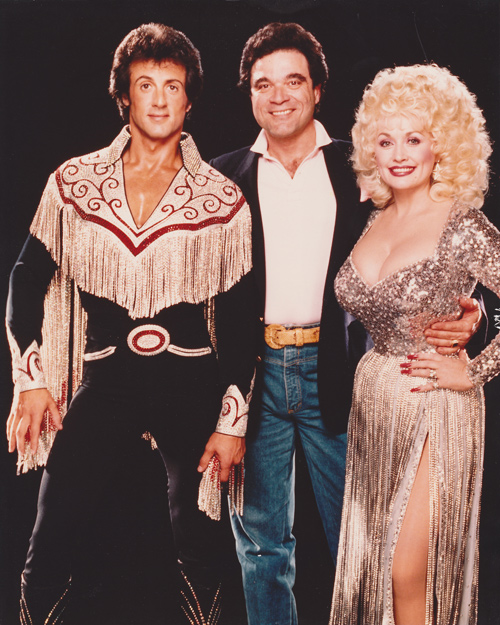
Even relatively early into his career, Sylvester Stallone was willing to experiment and stretch. By 1984, he had made three “Rocky” films and the first “Rambo” movie. He was well established as a guy who hit people on camera. For his follow up, what projects did he choose? A strictly behind the camera gig on “Staying Alive,” the camp-tastic sequel to “Saturday Night Fever,” and “Rhinestone,” a country and western musical co-starring Dolly Parton. “Rhinestone” is one of the movies that even Stallone is ashamed of doing. The Razzies named it one of the worst films of all time. But the Razzies guys are idiots. Though “Rhinestone” is frequently a surreal experience, it’s not nearly as bad as you’ve heard.
The misleading named Jake Farris is a beautiful country and western starlet. Unfortunately for her, she’s stuck in a New York rhinestone club after signing a contrast with the club’s incredibly sleazy owner. After an especially disastrous night, she strikes a deal with the guy: If she can turn anyone into a successful country act, he’ll let her out of the contract. If she can’t, not only will she have to re-up the contrast, she’ll also have to sleep with him. That “anyone” turns out to be Nick, an eccentric New York cab driver who lives with his parents in a funeral home. Nick agrees to the deal on a whim, travels with Nick to her Tennessee home town, and is taught the ways of country singing. Shockingly, he starts to like the music. Soon enough, he starts to like Jake too.
So let’s get the elephant in the room out of the way first. Sylvester Stallone sings in this movie. He wears cowboy hats and boots. He gyrates around in ridiculous, rhinestone-covered jumpsuits. He even rides a horse at one point! Yes, Stallone occasionally punches some people too. But the singing… How bad is it exactly? It’s not good, to put it gingerly. Stallone begins the movie incoherently yelling through songs. Later, he groans and grunts through a terrible number called “Drinkenstein,” a sequence that has to be seen to be believed. Later, his mumbling, spoke-sung vocals are drowned out by Dolly Parton’s considerably stronger pipes. The most unbelievable thing about “Rhinestone,” which is frequently preposterous, is that anyone would ever be satisfied with Stallone’s singing. Sly has said he regrets doing the film. The visible agony on his face during several sequences makes it clear that he’s telling the truth.
By the same accord, “Rhinestone” is not exactly terrible either. Stallone is only the co-star of the film. Large portions of the film rests on Dolly Parton’s shoulder. Parton is an incredibly charming presence and her abilities as an actress have always been underrated. She’s funny in the film. Moreover, she actually has some decent romantic chemistry with Sly. The love story is fairly absurd. The film wills it into existence, as the characters truly have nothing in common. Based solely on Parton’s twinkling charm, you begin to believe. An encounter between the two in a hallway, which nearly escalates to something heavier and hotter, is the best example of this. Not to mention Parton looks absolutely stunning in the film. No wonder Russ Meyer wanted to make a movie with her.
Don’t get me wrong. The plot of “Rhinestone” is goofy and broad. Ron Leibman’s entire character, the greasy club owner Freddie, is entirely ridiculous, especially once you see the inside of his home. The middle portion of the film is a fish-out-of-water story of Nick surviving in Jake’s southern home town. The expected beats here, of him learning to walk like a cowboy or screaming through his first live performance, will make the audience roll their eyes. It’s not all bad though. Tim Thomerson, he of “Trancers” and “Dollman” fame, plays Dolly’s unhinged ex-boyfriend. It’s amusing seeing Thomerson as a hard-drinking, shit-kicking good ol’ boy. The rivalry between him and Sly is strictly formula but Tim seems to be having a good time. Richard Farnsworth plays Dolly’s father and exudes a folksy humor and genuine warmth. When he tries to get Nick to take his gussy-uped cowboy suit, “Rhinestone” actually becomes funny and heartfelt.
Don’t get me wrong. Stallone’s singing is terrible. The break up Nick and Jake have to go through mid-way through the film is protracted and obvious. The movie, at nearly two hours, is far too long. The film was another odd entry in the incredibly diverse career of Bob Clark, the same man who made “Black Christmas,” “Porky’s,” “A Christmas Story,” and “Baby Geniuses.” Clark’s direction, such as when he cuts to animal reaction shots, is frequently mawkish. The script is silly and overdone. Yet this isn’t even Stallone’s worst movie. Its has its saving grace, most of them from Parton and the supporting cast. The film is too good-natured in its goofiness to be offensive, even if it did gift the world with “Drinkenstein.” [5/10]
[THE STALLOWNAGE OF SLY: 4 outta 5] [X] Frank Stallone or Frank Stallone-esque Inspirational Music* [] Incapacitates or Kills Someone With His Body [X] Shows Off Buffness [X] Social Outcast [Weirdo Cab Driver] [X] Sweaty, Veiny Yelling**
*Does Dolly Parton count as “Frank Stallone-esque?”
**Sly’s yell-singing is awfully sweaty
There was a time when Sylvester Stallone’s name was not synonymous with giant explosion and hundreds of Vietnamese soldiers being gunned down. After the underdog success of “Rocky,” he made a period drama and moresportsmovies. And though the “Rocky” films could arguably be called action movies, the earliest entries in that series really weren’t. As far as I can tell, the first true action film Stallone lent his star power to is “Nighthawks.” Though better known at the time of its release for its troubled production than its box office performance, the film would stick Stallone in a role he would play many times later on: The renegade cop hunting a dangerous killer across a big city.
Deke DaSilva is a New York cop who believes in arresting crooks on the streets and not being stuck in a classroom, being taught new methods. His equally rough, and even more unstable, partner Fox feels much the same. Meanwhile, an international terrorist for hire blows up a shop in London, killing over 20 people. Known as “Wulfgar,” the killer flees to New York. DaSilva and his partner are tasked with hunting the terrorist, cop and criminal quickly developing a burning hatred for one another.
“Nighthawks” was released in 1981 and presumably shot the year before. This was long before the clichés and tropes of eighties action cinema, many of which Stallone would help codify, were established. There’s no patriotic undertones, oiled biceps, and the body count is relatively low. Instead, “Nighthawks” feels more like a product of the seventies. The gritty, down-to-Earth tone is comparable to “Serpico” or “The French Connection.” (“Nighthawks” beginning life as “The French Connection III” probably had something to do with that.) The disco bars, apartments, and crowded police stations the film is set in feel distinctly seventies. So does the facial hair and the fashion. Finally, the movie is far more interested in battle-of-wills thrills then explosive action. There’s only three shoot-outs in the movie and they’re all mostly one-sided.
As a Stallone movie, “Nighthawks” is awkwardly positioned between Sly’s more character-orientated early years and the chaos of his later days. The movie tries to slip in a Rocky/Adrian style love story between Deke and his estranged wife Irene. However, most of these scenes got cut out before the movie’s release, leaving the subplot anemic. It leaves us with a few odd scenes of Stallone angsting over his relationship woes or having strained conversations with the woman. As a renegade cop, DaSilva butts heads with the authorities. He even gets chewed out by da chief, played by a typically greasy Joe Spinall. There’s one unexpected difference, though. Deke is instructed by the terrorism expert to shoot first and asks questions later. He’s reluctant to turn his gun on anyone, even a criminal. That’s right, Stallone’s bad ass cop doesn’t want to kill anyone. That’s a far cry from Marion Cobretti. Naturally, Deke embraces the way of killing later on. It’s still an unexpected character arc.
Since “Nighthawks” is not as focused on the action as you’d expect, how does the movie function as a thriller? An early scene, of Stallone undercover in drag, builds some decent suspense. The confrontation in a disco between Deke and Wulfgar is constructed nicely, the two trading long glances before shots are fired. A chase onto a subway train has the nice gag of Stallone doing a leaping-kick through a window. The proper climax of the film comes when Hauer and his associate take an entire cable car captive. It’s a long scene, escalating in tension, as the villain takes out a random bystander, tosses the body into the river, and Stallone has to lower himself out of the car with a rope. Other scenes are less successful, such an early moment of Hauer planting a bomb in a shop, which is weirdly devoid of tension.
As a performance, Sly is most entertaining when freaking out. After the villain slashes his partner’s face, he goes on an epic freak-out in the subway. The film was Rutger Hauer’s breakout role in America and the first of many psychotic villains he’d play in U.S. action flicks. Hauer’s blue steel eyes have an icy quality, making him well-suited for villains that easily dispatch innocent victims. Playing Deke’s partner, and technically pushing the movie into the category of buddy cop movies, is Billy Dee Williams. When we’re so used to seeing Williams play hyper-cool characters, there’s a certain novelty to seeing him play a hot-head cop who comes close to snapping several times. I like how Nigel Davenport, as the stuck-up police instructor, warms up to Sly later in the film. It would’ve been nice to see Persis Khambatta, as Wulfgar’s partner-in-crime, and Lindsay Wagner, as the imperiled wife, given more to do though.
Reading about “Nighthawks’” production gives you an idea of how troubled the movie was. The film switched directors halfway through production, Bruce Malmuth heading the movie over to Gary Nelson. The film was heavily re-edited by the studio, in hopes of making the movie more commercial and cutting down on the violence. (The gore was apparently outrageous enough to earn the movie an “X” rating. Where the scissors came in are very noticeable.) Even Keith Emerson’s score was taken apart and tinkered with. Considering all of this, “Nighthawks” remains decently entertaining. The film doesn’t stick in the memory the best but, as an early peak at the leading man’s rise to action star status, it proves amusing enough. [7/10]
[THE STALLOWNAGE OF SLY: 3 outta 5] [] Frank Stallone or Frank Stallone-esque Inspirational Music [X] Incapacitates or Kills Someone With His Body [] Shows Off Buffness [X] Social Outcast [Divorced Cop] [X] Sweaty, Veiny Yelling
Back in March, I devoted nearly an entire month to the films of Arnold Schwarzenegger, the greatest action hero of all time and one of my all-time favorite movie stars. During that time, another name occasionally came up. That person was Arnold’s most popular rival, his former business partner, and occasional latter day co-star: Sylvester Stallone. If Arnold was king of eighties blockbusters, then Sly was the prince or something. Should someone carve a Mount Rushmore devoted to action cinema, Stallone and Schwarzenegger’s face would be side by side.
To be totally honest, I’ve never been as big of a fan of Stallone as I am of Arnold. During the nineties of my childhood, Arnold was still an immediately recognizable pop icon. Stallone, on the other hand, was washed up. Each one of his new movies would become either jokes or bombs. I remember seeing the poster for “Get Carter” in the window of my local video rental place and wondering why such a critical punchline was given such a prominent place of honor. By the end of the decade, he would be appearing in direct-to-video films. It wasn’t until the new millennia, when Sly would revisit his most famous characters for successful revivals, that any of the star’s box office clout would be restored. These days, Sly is still kind of a joke but he’s aware of that status, communicates with it, and seems determined to keep working well into his old age.
There’s a few reasons for this. Firstly, Stallone has had a much longer career then Arnold. Sly has been a star since the mid-seventies. His days of eighties action stardom was actually the second or third stage of his career. When his nineties low years happened, it was the natural side-effect of being on-screen for three decades. Secondly, Stallone wasn’t just an action hero, once upon a time. The original “Rocky” was a low-key character drama, after all. There was even a time when he wasn’t a ‘roid-infused mountain of muscle on-screen. He looks like a totally normal human being in his early movies! After becoming a cinematic murder machine, he hasn’t returned often to his dramatic roots. His stabs at comedy have been even more awkward then Arnold’s. Stallone seems content to focus on his action movie stardom these days, if the upcoming new entry in the “Rocky” series is any indication.
It’s also important to remember Stallone is an honest-to-god auteur. He has written, directed, and starred in several of his own films. “Academy Award-nominated screenwriter Sylvester Stallone” is not something that appears in the trailers often but it’s still a fact. Rocky and Cobra, just to name two, leaped directly from his own mind. Even characters he didn’t technically create, like Rambo or Tango, have a tendency to become Sly’s possessions. He’s all too often characterized as a mumbling, slurring meat head but Stallone is obviously a smart, creative, incredibly driven person. That his movies frequently reflect his own career seems to support this.
So welcome to THE SYLVESTER SEMESTER! I’ll be taking a different approach to Sly’s oeuvre then I did Arnold’s. I won’t be discussing either the “Rocky” or “Rambo” series during the next seventeen days. I intend to get to these iconic series eventually, I promise you. However, during this project, I want to focus on the one-offs and weird digressions. Reviewing the two R series would lead to them dominating the semester. Instead, I’ll be tracing all the stages of Stallone – the early days of success, the eighties super stardom, the embarrassing nineties, and the eventual comeback – through his other works.
As I did with my James Bond Series Report Card and Schwarzenegger Sweeps, I must acknowledge my friends at AllOuttaBubbleGum. None of this would be happening without them, as the site has hastened my love and interest in action cinema. As with the previously mentioned projects, the website also has a checklist devoted to the cinema of Sylvester Stallone. Called “The Stallownage of Sly,” the list is far quirkier and represents Stallone’s more eccentric career. Each review will be followed by the check list, each corresponding item checked off. The list is as follows:
[THE STALLOWNAGE OF SLY] [] Frank Stallone or Frank Stallone-esque Inspirational Music [] Incapacitates or Kills Someone With His Body [] Shows Off Buffness [] Social Outcast [Underdog, Has Been, etc] [] Sweaty, Veiny Yelling
Let’s journey into the eighties and beyond as we explore the career of action cinema’s meanest mumbler. This isn’t your worst nightmare, this is Film Thoughts. Boredom is the disease and watching a bunch of Sylvester Stallone movies is the cure.