Last of the Monster Kids

Last of the Monster Kids
"LAST OF THE MONSTER KIDS" - Available Now on the Amazon Kindle Marketplace!

Saturday, April 26, 2014

Series Report Card: Godzilla (1999)


24. Godzilla 2000
Gojira 2000: Mireniamu

“Godzilla vs. Destoroyah” was supposed to be the last Godzilla movie, at least for a while anyway. Toho fully expected TriStar’s 1998 “Godzilla” adaptation to be a roaring international success and to spawn a long running series of its own. That, needless to say, didn’t happen. The American Godzilla film was so badly received that it forced the original, real Godzilla to come out of retirement early. Rushed into production and released a year after TriStar’s fiasco, “Godzilla 2000” would launch a new series of Godzilla films.

“Godzilla 2000” is set in a Japan where Godzilla has been accepted as a regular occurrence. The Godzilla Prediction Network, run by middle-aged scientist Yuji and with his genius daughter Io, attempts to understand the kaiju. The two-person operation works to predict Godzilla’s appearances, study the monster, and divert him away from populated areas. On the other hand, Japan’s Crisis Control Intelligence, run by Yuji’s professional rival Miyasaka, seeks to destroy the creature. Meanwhile, the military discovers an ancient object on the ocean floor. Once brought to the surface, the object reveals itself to be a solar-powered flying saucer. The revived UFO starts to wreck havoc on Tokyo, taking a keen interest in Godzilla. Once again, quite unintentionally, the giant mutated dinosaur has to defend Earth against a nefarious invader.

At the on-set of the Millennium era, as the new series of films would be called, a decision was made. Each of the films would tell a stand alone story, sharing continuity only with the 1954 original. “Godzilla 2000” doesn’t even go that far. It barely references the first entry in the series. Instead, the script treats Godzilla as an every day part of life. He’s as much of a natural disaster as an earthquake or a tsunami, unknowable and unstoppable. Few minutes are wasted on his origin or exposition. Godzilla exists, simple as that.

With the monster treated so matter-of-factually, the story’s conflict revolves around what to do about him. The script goes back to that 1950s chestnut of science vs. the military. Yuji and his Godzilla Prediction Network wants to study the monster, thinking of him as a natural wonder. Miyasaka’s Crisis Control Intelligence considers the monster a threat to be eliminate. However, the debate is treated with more nuance then those fifties B-movies. Neither side is wrong. Godzilla is responsible for the loss of countless lives and the mass destruction of property. He’s also a truly unique creature, deserving of scientific inquiry. Realizing the audience has a built-in affection for the monster, the movie plays the military as antagonists, albeit understandable ones.

Most of the previous Godzilla films revolve around a hot-shot journalist, adventurer, or military man. One of the charming elements of “Godzilla 2000” is that its protagonist is different from the norm. Yuji is middle-age, chubby, and nerdy. Though motivated by pure scientific curiosity, he’s also willing to use the Godzilla Prediction Network to make some easy cash. Mostly because he’s broke. However, he’s a scientist through and through. He drives up right to Godzilla’s face, getting scientific readings. He might be afraid but the research is more important. When he discovers Godzilla’s healing factor, Yuji cheerfully declares that this could lead to a cure for cancer. Takehiro Murata is affable and funny in the part. My favorite bit is, after Godzilla blows the glass on his car away, he activates the windshield wipers.

Yuji’s relationship with his daughter is another strong aspect of the film. Mayu Suzuki plays Io. We are introduced to the girl, who looks to be about ten years old, when she raddles off a list of scientific buzz words. She is clearly some sort of genius and, compared to her whimsical father, sometimes appears to be the more mature of the two. The brief glimpses into their domestic life, where Io cooks and cleans while Yuji works on his research, are charming and interesting. When her father is endangered, Io’s mask of maturity cracks, the young girl crying. Suzuki is excellent in the part, possibly the most likable character in the film.

Completing the film’s central trio is Naomi Nishida as Yuki Ichinose. Yuki fills the part of the adventurous reporter. At first, she is reluctant to investigate the Godzilla Prediction Network. Getting right up in the giant monster’s face doesn’t exactly make her inclined to stay. However, she eventually feels a center comradery with the gang. When an alien spaceship lands on the top of her paper’s building, her co-workers have to hold her back from investigating it. Not long after that, she rushes back into the tower to get the scoop on the alien invaders. Ichinose is having a lot of fun in the part and gamely trades lines with her co-stars.

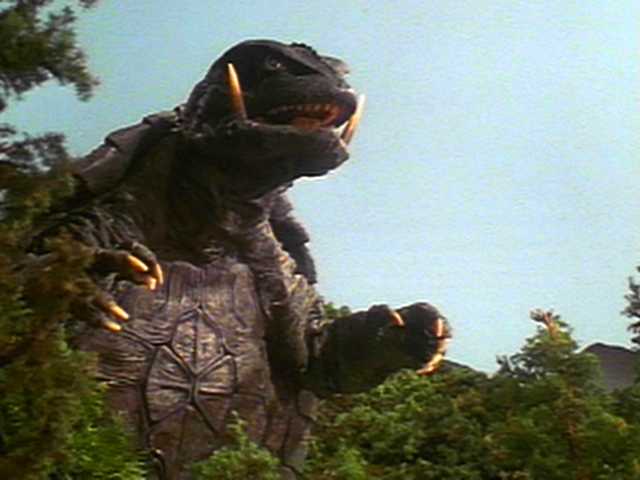
Of course, her most important co-star is the big man himself. For his return to theaters, Godzilla got a major redesign. The King of the Monsters resembles a dinosaur more then ever. His posture is slopping, head and hands forward, tail back. His scales are jagged and pointed. The more rounded head is topped off with snaggled teeth, always jutting out of his mouth. The most notable design change are his spines. Godzilla’s spines are bigger and sharper then ever before, sticking out like giant cartoon lightening bolts. It’s one of the most distinctive suits ever built for the character. While the movement is a bit stiff, the design is still impressive and memorable.

Disappointingly, Godzilla isn’t in that much of his own movie. There’s the fog-filled opening appearance, the kaiju attacking a light house and tearing through a tunnel. A lengthy march across the coastline includes the monster getting pelted with hi-tech bunker-busting missiles before being blown away by the rival kaiju. Both scenes work fairly well, however… After that, the focus shifts to the alien invader. The space ship looks cool enough, sleek and smooth, and is brought to life through a combination of fine model work and sometimes shaky CGI. Much attention is paid to the space ship touching down in Tokyo and the military’s various attempts to destroy it. Here, we learn more about the so-called Millennians' origin, where they come from and what they plan to do. There’s nothing intrinsically wrong with this section of the film but it drags a bit.

When Godzilla belatedly walks back into the film, “Godzilla 2000” picks up some steam. Using its CGI tentacles, the UFO drags Godzilla through the city, burying him beneath a building. This only slows him down for a minute, the Monster King bursting through the rubble. He explodes the invader’s ship with a single energy blast, an immensely satisfying moment. The model work during these sequences is excellent, the buildings having a real heft and weight to them.

The aliens realize quickly that Godzilla is the most powerful creature on the planet and sets out copying his genetic make-up. A moment that was heavily advertised in the trailers has the ship producing a giant monster, resembling H.G. Welles’ Martians and rendered in primitive CGI. That creature plays a tiny role in the finished film. Instead, the Millennian quickly degrades into an entirely different monster. Named Orga, the creature is a cross between Godzilla and the alien space ship. It’s an awkward design, with his giant snapping claws and bent posture limiting movement. Because of this, most of the fight between Godzilla and Orga involves the monsters trading energy blasts. A little more wrestling and grappling would have been nice. Rumors persist that Orga was inspired by the TriStar Godzilla, which might explain why the real Godzilla takes him down without too much effort. The absurd conclusion to the all-to-brief battle comes when Orga unhinges its jaw and attempts to swallow Godzilla whole. Turns out, sticking your fire-breathing enemy’s face right in your mouth isn’t a great plan. Godzilla blows Orga apart from the inside out. An ennoble ending to a less-then-impressive threat.

One interesting thing “Godzilla 2000” does is that it finally confirms why Godzilla is so hard to kill. His cells regenerate rapidly, producing a Wolverine-style healing factor. Super-missiles might blow chunks of his skin away but, within a day or two, he’ll be better. A theory like this was discussed by fans for years but its nice to have Toho finally confirm. The so-called G-Cells is actually what motivates the plot. Proving so un-killable, Orga attempts to adsorb the real Godzilla’s several times. Weirdly, it’s the enemy we actually see regenerate, his skin bubbling with weak computer graphics.

As of right now, “Godzilla 2000” is the last Godzilla film to receive a theatrical release in America. The dub recorded in this country is intentionally campy. It features such howlers as “Great Caesar’s ghost!,” “These missiles will go through Godzilla like crap through a goose,” and “There’s a little Godzilla inside of all of us.” The tongue-in-cheek, winking tone isn’t always appreciated and is frequently distracting. However, the American cut is also ten minutes shorter. Most of the edits are minor and successfully up punch the film’s sometimes maudlin pacing. The deliberately cheesy tone originally wrapped up with a big, stupid “The End… Question Mark!” appearing before the credits. This was so ridiculous that it was cut from all home video releases. Even if the tinkering wasn’t completely appreciated, it arguably makes the film smoother.

“Godzilla 2000” ends with the anti-heroic monster once again establishes as a neutral force of nature. The king burns down half of Tokyo in celebration of winning his fight, something that isn’t commented on. The human heroes acknowledge mankind’s role in his creation, accepting the great kaiju as a natural part of the world. It’s a surprisingly thoughtful conclusion to an overall uneven film. Several moments of diverting monster action, a great looking Godzilla, and a likable human cast is enough to make up for an unimposing enemy, uneven pacing, and some dodgy special effects. As the only real Godzilla movie I’ve ever seen theatrically, “Godzilla 2000” does hold a special place in my heart. Flawed though it is, the film still delivers.
[Grade: B-]

Friday, April 25, 2014

Series Report Card: Gamera (1999)


11. Gamera 3: Revenge of Iris
Gamera Surī: Jyashin Irisu Kakusei / 
Gamera 3: Awakening of Irys

After redefining the Gamera series, and some would say the entire kaiju genre, with the first two Heisei films, Shusuke Kaneko took a two year break from giant monsters. When the time came to produce a third and final Gamera film, Kaneko wrote a script that brought many of the plot points first raised in “Guardian of the Universe” full circle. The result was the darkest Gamera film ever made, one that attempts to weave a very personal human story in with the epic kaiju action while bringing the series to a satisfying conclusion.

Two years after Legion’s attack on Japan, the country is still recovering. A teenage girl named Ayana, whose parents died during Gamera’s battle with Gyaos in 1995, still holds a burning hatred for the kaiju. Now, a new race of even deadlier Gyaos has appeared, putting the entire world in peril, forcing Gamera back into action. Series protagonist Mayumi and Asagi attempt to aide Gamera in defending Earth and against a military that has dubbed him a threat. Meanwhile, Ayana discovers a strange new monster, a tentacled beast that feeds on human life force. Naming the creature Iris, she teaches it to hate Gamera as well. With some assist from a pair of anti-Gamera occultists, the two mighty monsters are put on a path of violence towards each other.

“Revenge of Iris” is widely regarded as the best Gamera film, if not the best kaiju film, ever made. While “Attack of the Legion” was most ambitious in its special effects, the third feature is more ambitious in story and character. Usually, in the daikaiju genre, the human story and the giant monster story co-exist, feeding into each other, while rarely fusing into one. “Gamera 3” builds upon the connection between humans and monsters the last two films featured. The young girls at the story’s center don’t just give the giants a last minute power boost. Instead, they are directly involved in the battle, motivating the creatures, driven by the same desires. Ayana’s desire for revenge powers Iris, the occultists project their own feelings on the monsters, while Asagi and Mayumi both believe Gamera will save the world.

All of that is well and good but the question has to be asked: Is “Revenge of Iris” truly a Gamera movie? The series’ investment in its own mythology has reached critical mass. Early on, we see a Gamera graveyard, the ocean floor littered with giant turtle bodies, failed prototypes made by the Atlantians. Much attention is paid to the concept of “mana,” the Earth’s life force. Gamera and Gyaos’ reemergence is directly tied to Earth’s “mana” levels being low. None of this has much to do with the classic conception of Gamera. While the last two films mostly went off on their own stories, they at least paid homage to the original series. “Revenge of Iris,” meanwhile, is more interested in its own ideas. Swap Gamera and Gyaos out for original monsters and the story would be completely unchanged.

Kaneko’s last two Gamera films explored the kaiju genre from a deconstructive angle. Yes, if two giant monsters fought in a packed city, people would get hurt, innocents would die. “Revenge of Iris” takes this further then ever before. The entire plot is motivated by collateral damage, human lives inadvertently lost during Gamera’s heroic battles. This comes into sharp focus during the first major battle. Gamera and a group of Gyaos touch down in Tokyo. The bird monster is bloodied, an eyeball dangling from its smashed socket. In the course of the fight, Gamera sets the entire city block on fire, visibly murdering people, claiming hundreds of lives. It’s a visceral, unsettling scene. The film is doing this intentionally, making you question if having the big turtle around is even worth it. Eventually, it does answer that question, proving that Gamera does care about humanity. However, the story can’t support a topic this heavy. It becomes difficult to root for Gamera when he has so much blood on his claws.

The script is uneven. Ayane’s storyline is interesting and loaded with potential. Ai Maeda gives a fine performance, showing a secret rage behind her calm eyes. At school, she meets a boy named Moribe. Moribe’s family has protected a near-by shrine for centuries. He knows something bad lurks inside but that doesn’t stop him from showing Ayane. The two youngsters have a romantic bound. Moribe is nervous about expressing his desire, realistically so. When Ayane is swept up by Iris, he saves her, running to her aide. When the monster attacks Kyoto, the girl caught in the crossfire, Moribe tries to help her. He is out of his element though. The magical knife the temple gave him to defeat monsters winds up being completely useless, in what is either sloppy writing or a hilariously subversive joke. Nozomi Ando is extremely good in the part.

However, the teens’ storyline has to compete for screen time with the film’s other concerns. Bringing Mayumi and Asagi back into the story was a sound idea. Neither character is given much to do though, mostly forced to discuss the plot with other people as the monsters rage off-screen. Mayumi’s plot is tied in with Inspector Osako, a minor character from the previous film. Osako has become homeless, Mayumi helping to reform the man. Osako’s story doesn’t go much of anywhere. The film’s human villains, Mito Asakura and Shin’ya Kurata, are also problematic. They mostly exist as plot devices, a way to get Ayane into Kyoto before the film’s last act. Both characters’ rant about the monsters’ purposes and their mystical origins. Tooru Teduka goes way over the top as Kurata, acting like a preening hipster. Senri Yamazaki as Asakura is mostly a non-entity. The film probably should have focused more on Ayane’s struggle instead of splitting time with these other plots.

Compared to the exciting, visceral kaiju action of the last two films, “Revenge of Iris” comes up short. Throughout the film, we hear about Gyaos attacking major cities around the world, Gamera fighting them off. Bafflingly, all of these battles are kept off-scene. CGI is heavily utilized during the fights. Gamera spins through the air, colliding with the flying Iris, missiles bursting around them. The computer graphics were, no doubt, cutting edge in 1999. However, they look incredibly dated by modern standards. The action direction is shaky, making it difficult to see what is going on at times. When Gamera and Iris finally reach the ground, their battle is disappointingly brief. Most of the fight takes place inside a cramped train station. The monsters impale and claw each other in close quarters. There’s little of the theatrical kaiju action fans crave. The fight concludes with a shrug, Gamera finishing Iris off with a mostly unexplained special move.

For all its faults, “Gamera 3: Revenge of Iris” works extremely well at times. Iris is a fantastically realized monster. The creature doesn’t look like any previous monster ever put to screen. The pointed head lacks a traditional mouth or eyes, producing a truly alien appearance. The natural armor, crystalline and jagged, is very memorable. The orange tentacles, topped off with clasping pinchers, are a highly dynamic weapon. Instead of flying with rockets or wings, Iris floats on the air using a clear membrane spread between his tentacles. The relationship between the monster and Ayane is interesting. As a cute baby-thing, she feeds it. When it starts to grow, Iris wraps Ayane with its tentacles, a moment dripping with Freudian implications. The kaiju also has a bad habit of sucking people’s life force, turning them into dried out mummies. When the corpses are discovered, it provides the movie with a horrific edge. Iris’ confrontation with the military, the giant monster easily finishing off the soldiers, is the movie’s sole moment of satisfying action.

“Gamera 3” works the best, not during its kaiju fights, but its quieter moments. The film’s emotional climax isn’t when Gamera banishes the evil monster. It is, instead, when Iris takes Ayane inside its skin. Falling through a psychedelic cascade of color, Ayane experiences Iris’ memories. She realizes her hatred has motivated the monster. She sees, firsthand, the creature decimating her village. For the first time, she questions her motivations. Despite doing nothing but hating him, Gamera rescues the girl, gorily pulling her free of Iris’ grasp. This moment makes it clear that the giant turtle fights for mankind, not just for the Earth. As Iris dies, Ayane is suddenly torn, the creature she’s devoted her life to hating being responsible for saving her. It’s a complex, fascinating moment, one the film needed more of.

In my review of “Gamera 2,” I suggested that the filmmakers had turned Gamera into a Christ figure. I was being sarcastic but “Revenge of Iris” continues in this vain. Gamera works in mysterious ways. Yeah, thousands of people wind up dead because of him but, ultimately, he wants to protect mankind. Even those that have abandoned him aren’t above his love. Ayane’s hatred might have unleashed a horrible new threat but Gamera doesn’t care. He forgives all. Just to make the subtext even more explicit, Gamera gets crucified. Iris stabs a huge hole through his chest, nearly killing the turtle. Not long after that, the giant turtle gets a massive spike hammered into the palm of his hand. Comparing a giant turtle that flies by farting fire to Jesus is pretty funny. The subtext might also be completely unintentional. Yet it’s hard to imagine Keneko didn’t know what he was doing. Framed in this context, “Revenge of Iris” becomes a story of faith tested and ultimately renewed.

“Gamera 3” ends on a deliberately ambiguous note. After defeating Iris, a swarm of Gyaos fly towards Tokyo. Gamera, despite being seriously wounded, with no guarantee he can win the fight, marches forward into battle. It’s tempting to say the film cuts off right before its most exciting moment. Yet that ending is film’s most definitively “Gamera”-like moment to me. The giant turtle’s primary characteristic over the years has been his undying tenacity. The suggestions that he might go down fighting, or even succeed against impossible odds, is in keeping with his character. The ending didn’t satisfy everyone, as enterprising fans later produced a fan-film called “Gamera 4: Truth,” wrapping up the storyline. I, personally, like the ambiguity.

I’m ultimately surprised a film as uneven as “Gamera 3: Revenge of Iris” is so beloved. The film’s script juggles more plot lines then it can handle. Its treatment of the monsters is uncertain and the movie holds back on the action. Yet there are some amazingly serene moments and an ultimately thoughtful heart behind the messy story and tone. If nothing else, the movie introduced an unforgettably odd monster to kaiju fans. “Gamera 3” wraps up the defiantly unique Heisei era in a defiantly unique way. [Grade: B]

Thursday, April 24, 2014

Series Report Card: Gamera (1996)


10. Gamera 2: Attack of the Legion
Gamera Tsū: Region Shūrai / 
Gamera 2: Advent of Legion

After the critical and financial success of “Gamera: Guardian of the Universe,” there was no way a sequel wasn’t going to happen. Director Shusuke Kaneko and writer Kazunori Ito wisely stuck around. The sequel, rolled out a year later, has more action and a bigger, badder threat. Unlike the previous film, “Gamera 2: Attack of the Legion” would have the giant turtle facing off against a brand-new foe, created specifically for the film. Considering Toho’s attempts to do something similar with their Godzilla series hadn’t worked out for them, could Gamera make it against a brand new baddie?

A year after Gamera and Gyaos’ battle through Tokyo, the city is still recovering. The military watches the ocean, preparing for another monster to appear. Another monster does appear but not out of the ocean but rather from the sky. While out with her students, science teacher Honami spots a star falling from the sky. Soon afterwards, strange creatures begin to appear in the city, attacking humans and consuming glass. The insect-like monsters quickly multiple, building a giant flower in Sapporo. Feeling the world is threatened, Gamera reemerges from the ocean. The new threat, quickly dubbed Legion by the Japanese military, proves a difficult challenge for Gamera, doubly so when the creature’s massive queen appears. If Gamera can’t defeat the Legion, all of Japan could be in peril.

The previous Gamera film went out of its way to distance itself from the silly shenanigans of the Showa era. “Attack of the Legion” is no different in that regard. However, the film introduces a stalwart element of the classic series: Aliens! Legion isn’t a devious invader like Viras or Zigra. It doesn’t even arrive in a flying saucer. Instead, the kaiju is a thoroughly modern alien. They arrive in a meteor as microscopic organisms. Like ants, the Legion function as a hive, with hundreds of soldiers and builders reporting to a massive queen. Their form of mass transportation, building a giant, explosive flower, is also something you’d see in nature. The alien monsters have no concise plan. They function as a mindless virus, arriving on a planet, stripping it raw, and leaving for the next. They intentionally recall the xenomorphs of the “Alien” franchise or any other parasite-style sci-fi monsters.

The comparison to “Aliens” is apt. “Gamera 2” is the first Gamera movie since the original to actually feel like a horror film. Near the beginning, security guards at a beer warehouse are spooked by an ominous shadow and a strange giant eye. Passengers in a subway are attacked by the Legion drones, human blood splattered on glass. We’ve seen plenty of kaiju blood over the course of the Gamera series but never red human blood. That’s somewhat startling. An entire tunnel fills with the crawling, snapping monsters, looking like a cross between stag beetles and spiders. Once the giant monster fights start in earnest, the film abandons any attempt at horror. Yet the sudden harsher elements still come as a surprise.

The focus is squarely on the alien threat for the first half-hour of the film. These sequences are successful but they do leave the viewer wondering when Gamera is going to show up. Luckily, “Attack of the Legion” is very good at establishing continuity with the first film. The battle between Gamera and Gyaos has left a lasting effect on Japan. The two monsters are mentioned frequently. The debate continues to rage about whether or not Gamera is truly an ally of humanity. A clever visual cue is when we spot the Tokyo Tower, still broken in two, under construction. The best nod to is when Asagi, the inadvertent priestess of Gamera from the first film, comes back. Though mostly kept on the sideline, Asagi continues to be an important character, her tear-drop medallion providing a serious plot point. When kaiju films frequently have non-existent continuity between them, “Gamera 2” being a true sequel is much appreciated.

Something that was surprising about “Guardian of the Universe” was how captivating its human story was. “Attack of the Legion,” on the other hand, can’t live up to that precedence. Honami, as played by Miki Mizuno, is fine in the role. She’s even charming, the actress rightfully playing up the character’s quiet tenacity. The problem comes when the movie creates a romantic storyline between Honami and the film’s military hero, Colonel Watarase. Toshiyuki Nagashima gives a slightly bland performance as the young colonel. Furthermore, you never get a romantic vibe between him and Mizuno. The two seem more like casual friends then star crossed lovers. When the movie attempts to play up their relationship, like the two separating at an airport, it doesn’t work. The final act separates the love birds, Honami forced to watch the kaiju battle from the streets while Watarase waits tensely in a secured bunker. The human plot is not smoothly integrated with the monster action and the characters aren’t that captivating on their own.

Despite these issues, “Gamera 2: Attack of the Legion” is successful. Watching the movie as a monster fan, it might be one of the most ambitious, effects-heavy kaiju films ever made. Gamera is given a slight redesign. The ridge on his head is more prominent, his forearms spinier. When flying, his arms extend into aerodynamic fins, like a sea turtle, a slightly silly if interesting visuals. The titanic turtle is more fearsome then ever before. The CGI, though still primitive, is integrated smoothly with the live-action suits.

Perhaps the filmmakers were hedging their bets. If the enemy monster was going to be brand new, it had to be impressive. And, boy, is it ever. The mother Legion is massive and ornate. The design pushes the art of suitamation as far as it can go. Legion has multiple thin legs extending from its head and body, constantly thrashing back and forth. An additional set of legs extends from the monster's back, reminding me of a weta’s sharpened spurs. Legion’s head is topped with a pointed crest, his vertical jaw snapping left and right. Inside its chest, it even carries a nest of immature Legion drones. The huge insect is even taller then Gamera, towering over the hero. Never does the monster look like a man in a suit. Instead, it’s a living, breathing, bizarre creature, that carefully balances looking plausible, alien, and awesome. Even the monster’s energy weapons, blue bolts shot from its mouth or red laser whips extending from its head, are creative and convincing.

Having created an intimidating adversary, effects director Shinji Higuchi orchestrates some impressive monster battles. Once Gamera appears, his body is quite literally covered with Legion drones. Spinning through the air, he attempts to shake the bugs off. Having been wounded, he instead splatters his green blood over half the city, an unforgettable image. The Showa series focused on Gamera’s bleeding simply for the cool factor. Kaneko and Ito seem to be intentionally playing up the turtle’s vulnerability. During his first fight with the queen Legion, he is impaled twice with the bug’s massive spikes. Green blood floods from wounds. A chunk of his shell is blown off, his head is cracked, and holes are burned through his skin. The giant tortoise takes a beating.

As in “Guardian,” a particular focus is given to the damage the monsters reek on the city. Upon arriving in Sapporo, Gamera crashes through a building. We see his huge foot smashes through the roof, making a rough landing. The camera is constantly placed at ground level, puny humans fleeing from the battling giants. The military is uncertain to trust Gamera and, considering how much property damage he creates, maybe they shouldn’t. The second act turn comes when Gamera attempts to bring down the Legion flower in Sendai. Upon pulling the huge plant apart, a massive fireball consumes the city, leaving the metropolis a steaming crater. (Considering Sendai was devastated during the 2011 Miyagi earthquake, this scene plays very differently now then it did in 1996.) The last act is motivated by whether Gamera survived the blast and, if he didn’t, can the military defend Tokyo from the encroaching Legion without him.

Gamera, of course, does survive the explosion. The titanic tortoise always pulls through from whatever damage is inflicted on him at the movie’s half-way point. Always has, right from the beginning. However, “Attack of the Legion” adds a different layer to the familiar plot point. The villainous monster is named Legion by one of the soldiers, quoting Mark 5:9, the infamous “For we are many” line. This adds a religious element that was previously lacking from the kaiju genre. Where do you think I’m going with this? Gamera died for your sins. The Friend to All Children suffers an injury, is seemingly deceased, only to be resurrected by the beliefs of his followers. Reading too much in to it? Oh yeah, definitely. Yet I have to wonder if some of this was at least intentional.

For the final battle, the action moves to the outskirts of Tokyo. Gamera confronts Legion, extra-pissed off. He tears the monster’s legs and jaws off, wounding it. The two kaiju wrestle, clawing and biting at one another. Even with an assist from the Japanese military, who finally comes around to the big turtle, it’s a rough fight. It honestly seems like Legion might win, whipping the terrapin into submission with his laser weapons. At the last minute, Gamera seems to draw energy from the life force of the Earth it self. With this boost, he charges a special attack, something powerful enough to finish off the enemy monster with one shot. That’s right, guys, Gamera just threw a Spirit Bomb. The script’s biggest flaw is this last-minute Hail Mary move. Underneath his chest armor this whole time, Gamera was packing a super weapon. Why didn’t he just use that in the first place? It’s a fairly lazy move, one that is introduced with zero foreshadowing.

Even if Japan was left in ruins, Gamera leaves victorious, a hard-fought victory finally won. “Gamera 2: Attack of the Legion” ends with an interesting message. Monami delivers her belief that Gamera wasn’t fighting for mankind but rather for the earth itself. And, should we continue to mistreat the Earth, the Guardian of the Universe might turn on us. Nothing else in the film supports this eco-friendly message yet I like it anyway. The idea of kaiju as gods above humanity, indifferent to us, is a potent one. It also, in an odd way, brings the Christ metaphor full circle. In other words, guys, get your shit together or else Jesus is going to come back pissed. And this Christ-figure just happens to be a giant turtle that spits fireballs…

While not as strong as its predecessor, “Gamera 2: Attack of the Legion” remains a fantastically entertaining monster brawl. Kaneko’s direction and Koh Otani’s music remain interesting while the special effects are out of this world. For that reason alone, it’s required viewing for monster movie fans. [Grade: B+]

Wednesday, April 23, 2014

Series Report Card: Gamera (1995)


9. Gamera: Guardian of the Universe
Gamera: Daikaiju Kuchu Kessen

I can’t say for certain what Japanese monster fans thought of Gamera by the late 1990s. Perhaps some fans appreciated those films for the campy wonders they are. Others probably dismissed them out right as ridiculous kid stuff. Either way, I bet the news of a “dark and gritty” Gamera reboot was met with eye-rolling and derisive signs. How do you grimdark up a fire-farting giant turtle? Somehow, director Shusuke Kaneko and screenwriter Kazunori Ito succeeded. Not only did “Gamera: Guardian of the Universe” fill the kaiju-sized void left by the end of Godzilla’s Heisei era, it has gone on to become one of the most beloved kaiju film of any age.

The film presents a Japan that has never been attacked by giant monsters before. Two strange events open the plot. First, a mysterious atoll, floating towards Japan, appears in the Philippines sea. Secondly, a giant winged creature is attacking and killing people on Goto Island. Expert Mayumi Nagamine investigates the latter, discovering a giant carnivorous bird species that grows very quickly and are born pregnant. Professor Kusangi, meanwhile, discovers a strange monolith atop the atoll. Just as the birds, named “Gyaos” by an ancient text, descends on Japan, the atoll reveals itself to be the giant, flying, fire-breathing turtle Gamera. Nagamine, Navy officer Yoshinari, and Kusanagi’s daughter, along with the rest of the Japan, are soon caught up in the battle between the two monsters, an ancient rivalry that goes back thousands of years.

As absurd as the idea sounds, “Gamera: Guardian of the Universe” is indeed a dark and gritty reboot of the silliest kaiju franchise. The film, at first glance, has little to do with the campy original series. Many of the defining characteristics of both Gamera and Gyaos are removed. Gamera no longer sucks fire into his mouth. Gyaos’ undoing isn’t a stiff, unmoving spine. Even the most serious of the Showa era had ridiculous things happening on-screen. “Guardian of the Universe,” meanwhile, plays its premise with dead seriousness. That sounds like a betray of the source material but, against all odds, the film works incredibly well. “Guardian of the Universe” is a complete reinvention of the Gamera series.

The sixties Gamera series never had any sort of unifying mythos. The ’95 film corrects this, building a surprisingly deep mythology around the monsters. Gamera and his enemy are linked with Atlantis. The original film briefly mentioned that the giant turtle came from Atlantis but none of the subsequent films brought it up. Both monsters are revealed as being genetically engineered by the ancient society. Gyaos was created to protect the world from pollution. When the flying monsters became impossible to control, Gamera was created to protect humanity. It was too late though, Atlantis already destroyed. Now, rising pollution has awoken the monsters again. Linking the creatures with both an established mythology and an ecological message gives them far more resonance then ever before.

Surprisingly, “Guardian of the Universe” almost plays like a deconstruction of the daikaiju genre. Gamera is Earth’s protector but surprisingly ambivalent to the man on the street. Upon appearing in Fukuoka, he knocks a Gyaos into an oil field, starting a huge fire that claims several lives. Throughout their battle, the two giant monsters wreck buildings, sending crowds of innocent people fleeing in terror. Kaneko’s direction is stationed on the ground, looking up at the massive monsters, emphasizing their huge size. Kaiju battles have always featured plenty of collateral damage but rarely has the human danger been this accentuated.

Even though the heroes quickly recognize Gamera as a good monster, the military still decides to attack him. Why wouldn’t they? It’s a giant monster that suddenly showed up and started smashing buildings. Gyaos is a deeply visceral threat, scooping up innocent people, devouring them whole. A growing monster of that size has to eat a lot, after all. The appearance of the beasts has an immediate effect on the country. Public transportation is choked with fleeing people. The stock market plunges. News broadcaster attempt to stay up to date on the story but are quickly outpaced. The Japanese senate votes on whether or not to attack the monsters, the decision made with great reluctance. The populace mostly responds to the creatures in fear. Yet one small child seems excited and a pair of partiers, on the way from a sporting event, want to place bets on the battle. The film had this experienced kaiju fan considering aspects of the genre he had never thought of before.

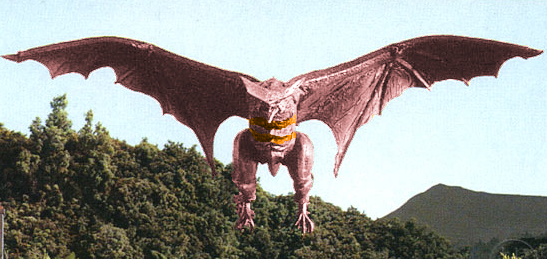
The film plays with the conventions of the genre while still delivering on the giant monster thrills. Both creatures are brought to life fantastically. Gamera’s design is updated with modern effects without deviating too much from his classic look. His face is more angular, the ridge on his head more pronounced. The turtle’s shell is more jagged, appearing harsher then before. Ridges, bumps, and extra armor are added to his body, giving Gamera an earthier, more intimidating appearance. I also like the touch of giving him big, green, expressive eyes, which roots the grittier design with personality. Gyaos, meanwhile, has been completely redesigned. The bat-like creature is given a more reptilian look, its skin red and scaly. The stiff posture is ditched for a more mobile body and neck, the monster now moving swiftly and believably through the skies. The changes make Gyaos more then just a Rodan rip-off. However, the designers were smart enough to keep the monster’s trademark element. Gyaos still has a sloping, triangular crest on his head and, notably, the monster still feasts on human flesh.

Initially, the film keeps coy about both monsters’ ability to shoot projectile weapons. Gyaos appears to be a big, hungry bird at first. However, the creature’s super-sonic cutting ray is maintained, fantastically revealed when two of the monsters cleave through the bars of their cage. Gamera’s fire breathing, now shown as condensed fireballs instead of long streams, gets a similarly dramatic reveal, flying out of nowhere. Both abilities play almost like in-jokes. Small references like that are sprinkled throughout, marking it as a true Gamera film. The giant tortoise takes the time to protect a child in the heat of battle. Destructive though he may be, Gamera doesn’t fight back when the military attacks him. He’s still a good monster. When severely injured, his green blood still running from open wounds, Gamera retreats to the ocean to heal himself. Though ditching the high-strung silliness of the classic series, “Guardian” maintains at least some of the spirit of the original films.

The kaiju fights are incredibly dynamic. Gyaos’ early attack on the island, a screaming man grabbed out of his car, is actually frightening, something you can’t say of most giant monster movies. Gamera’s grand entrance is exciting, headbutting a Gyaos into an explosion. The monsters encounter each other again in the forest. With a single fireball, Gamera explodes one of his enemies, monster guts flying everywhere. The film’s heroes, along with an innocent child, are caught on a bridge between the fighting beasts, raising the stakes of the fight considerably. The military attempts to shoot Gyaos down, the monster withstanding missiles strikes. He even redirects some rockets into Tokyo Tower, having the landmark. Memorably, the monster then nests on the wrecked structure. Gamera’s enters the final fight by exploding out of the ground, wrecking buildings and streets in the process.

That last battle is when the action truly shifts up. The digital effects of Gamera and Gyaos flying haven’t aged well, often looking fake. However, Kaneko’s direction is incredibly lively. The monsters race through the city, the camera flying with them. Gamera shoves his enemy into a building, the camera watching from inside as Gyaos’ head crashes through it. The creatures take to the air, flying up into the upper atmosphere. Gyaos’ wings pass before the moon before both monsters tumble back towards the Earth. Gamera crashing into another refinery, causing a massive explosion, seems to be the monster’s end. Until the film remembers the turtle’s rarely mentioned fire eating ability. He adsorbs the flames, supercharged, finishing his rival off with a giant blast to the face. That’s a satisfying moment. The final battle is incredibly exciting, one of the best in all of the subgenre.

The script is smoothly constructed. The opening minutes drag a bit, the two plot lines existing separately. The movie quickly brings them together, the characters realizing the connection between the two kaiju. A clever solution to stopping the Gyaos threat is introduced. The three bats are lured to a giant sports stadium, trapped under the dome. Actually, the plan probably would have worked if Gamera hadn’t come along, smashing the structure open. Early on, the story introduces Kusanagi’s daughter, Asagi. As a gift, she is given a strange pendent found on the atoll. This makes her a priestess of Gamera, developing a spiritual link with the monster. Now, when he is wounded, she is wounded too. When the turtle falls into a healing slumber, she does as well. At first, this subplot comes off like a clumsy device, a way to give the heroic tortoise a last minute energy boost. However, Asagi winds up being the story’s emotional heart. Gamera’s defeat would mean her death. Literally tying in the monster’s fate with one of the human cast members is a smart idea, getting the audience doubly invested in the fight. Though mostly a serious affair, Ito’s screenplay even sneaks in some humor. Comparing the flesh eating Gyaos with the Japanese ibis leads to a deadpan response. A taxi driver’s reaction to a military blockade provides a big laugh as well.

“Gamera: Guardian of the Universe” has a uniformly strong cast, something you couldn’t always say about the Showa films. Shinobu Nakayama is more then just a damsel in distress. Mayumi is motivated and courageous, devising ways to defeat the monstrous threats and putting her own life on the line to project an innocent child. Nakayama has solid chemistry with Tsuyoshi Ihara’s Yoshinari. While in most kaiju films, the military man Yoshinari would have been the hero. Ihara instead plays the love interest. The quiet moments between the two characters, such as a brief aside during Gyaos’ attack on Tokyo, really stand out. Another memorable quiet moment is when Professor Kusangi, played by Akria Onodera, pauses inside his sleeping daughter’s room to question how well he truly knows her. Onodera brings a surprising gravity to the part. As a man of science, he is reluctant at first to accept Gamera’s Atlantian origins. However, evidence piles up, forcing him to acknowledge the truth. Kusangi remains most concerned with his daughter though, which the film gets some great mileage out of in the final lap.

Aside from an ecological message that is introduced without much precedence and not commented on again, “Gamera: Guardian of the Universe” works incredibly well. It’s amazingly exciting, fantastically directed, well written, and features great special effects. It successfully re-birthed Gamera, exposing a new generation to the flying turtle and completely changing the character’s public perception. [Grade: A-]

Tuesday, April 22, 2014

Series Report Card: Godzilla (1998)


23. Godzilla

Godzilla’s status as an iconic pop culture figure has a long reach. He’s beloved all over the world, sometimes to the point that I wonder if Americans don’t love him more then the Japanese. So, because Hollywood is always looking for a recognizable brand name, an American “Godzilla” film had been considered for years. In the early eighties, horror-sequel-workhorse Steve Miner and Film Thoughts favorite Fred Dekker nearly made a 3-D movie with a stop-motion Godzilla. In 1993, after “Jurassic Park” made dinosaurs huge business again, TriStar immediately scooped up the rights to the character. “Speed” director Jan deBont was going to make a film where a Stan Winston-designed Godzilla would have battled a giant griffin. However, deBant’s proposed film cost too much money, loosing him the job. TriStar then handed Godzilla over to Roland Emmerich and Dean Devlin, right off mega-hit “Independence Day,” who got the job because they promised to make the film quickly and cheaply.

The film’s advertisement campaign is probably better remembered today then the actual movie. “Godzilla” was too big to fail. The studio carpet-bombed every city and TV screen with ads. The exhausting ad campaign, boasting “Size Does Matter” and featuring everyone from the Taco Bell dog to the big ball in Time’s Square, made the movie a huge hit. Even the soundtrack, with Puff Daddy warbling over a Led Zeppelin riff and a bloodless Bowie cover, was enormous. Despite making over 400 million worldwide, few people liked the movie, Godzilla fans least of all. Emmerich’s “Godzilla” has long been the whipping boy of the fandom, widely loathed for years. Separated a decade-and-a-half from the original release, now the question can be asked: Does the TriStar “Godzilla" succeed in any way?

Paying homage to the original, the film opens with a Japanese fishing boat being attacked by some huge, reptilian creature. When giant footprints are found in Jamaica, biologist and worm-specialist Nick Tatopoulos is recruited by the military to investigate. Tatopoulos quickly comes to the conclusion that a giant animal, mutated by nuclear testing in French Polynesia, is responsible. Turns out he’s right when the monster, dubbed “Gojira” by the only-surviving Japanese fisherman, rampages through New York City. However, that’s only the beginning as Nick, his estranged reporter girlfriend, and her cameraman sidekick soon discover that Godzilla is pregnant and has picked the Big Apple as the perfect nesting ground for its brood.

For all the things “Godzilla” has been criticized for over the years, nothing is more controversial then its titular monster. After getting one look at the creature, hardcore G-fans dubbed it “GINO:” “Godzilla in Name Only.” It’s not an unfair label. The film’s lean, spindly reptile barely resembles the classic monster. It’s greenish, sure, and has long spines on its back. That’s about it. Instead, the monster looks like an uninspired combination of various dinosaurs. This Godzilla doesn’t charge the military forces head on, instead spending most of the picture fleeing from helicopters. It gobbles piles of tuna, instead of raiding nuclear power plants. He doesn’t breathe atomic fire, a late-film super-burp being a poor substitute. Most damningly, this Godzilla isn’t a sleeping dinosaur mutated by the atom bomb into an unstoppable force of destruction. Instead, he’s a super-sized iguana and swiftly killed by missiles. Not experimental, super-strong missiles. Just regular, mundane missiles. It’s no wonder that fans rejected the monster. Even Toho, years later, would declare the creature unworthy of the title of “Godzilla,” officially dubbing the monster Zilla. As in, not a god, just a big lizard.

So “Godzilla” isn’t much of a Godzilla film. Can the picture be appreciated on its own merits, separate from the Japanese franchise that inspired it? That depends on your tolerance for brain-dead action movies. The defining characteristic of Emmerich and Devlin’s “Godzilla” is its overwhelming dumbness. The script has little respect for the ’54 original’s stark horrors. Instead, the film more-or-less regurgitates the clichés of the disaster movie genre, ignoring everything that made the original special.

American blockbusters are frequently criticized for their ferociously pro-military attitudes, some Hollywood movies playing like feature length recruitment videos. “Godzilla” features the military prominently but could never be mistaken for propaganda. The army in this movie is dumb. Astonishingly, staggeringly dumb. They successfully lure the monster out with a payload of tuna. Their missiles miss the creature, instead destroying the Flatiron Building. Helicopters chase after the fleeing Godzilla, their machine guns tearing through the walls of surrounding buildings. The air force can’t hit the giant monster, their missiles instead hitting the Chrysler building. The destruction of these New York landmarks are shrugged off, the military simply sighing in embarrassment. Yet the biggest indignity belongs to the Navy. Two submarines attempt to corner the monster in the Hudson Bay. Somehow, in a sequence that makes little sense, one sub aims its torpedoes at Godzilla but instead hit another submarine. A multimillion dollar submarine, not to mention countless lives, destroyed by friendly fire. The commanding officers only give it a passing mention.

Ultimately, it seems the military is responsible for more destruction then Godzilla is. For a giant monster, the creature rather skillfully navigates the city. It runs between the buildings, only occasionally scuffing the structures with its head or tail. The movie’s most infamous moment of stupidity comes when Godzilla leaps through the Pam Am building. Despite blowing a huge hole through the building, it continues to stand. Maybe in a pre-9/11 world, audiences were more willing to accept this, that skyscrapers could survive such damage. Seemingly no lives are lost in the destruction, nobody killed. After Godzilla’s first rampage, people are still gathering in diners and businesses. The news reports constantly. Everyone spends more time complaining about the traffic then the actual monster. Godzilla is less a force of nature then a minor inconvenience.

The script’s stupidity isn’t confined to its treatment of the military or the city destruction. Every character is either a thin stereotypes, deeply unlikable, or both. The man in control of the military, Kevin Dunn’s Colonel Hicks, is your typical clueless authority figure. When the heroes realizes Godzilla is pregnant and has already laid eggs somewhere in the city, he ignores them, willfully ignorant of the proof. The city’s mayor, patterned after Roger Ebert in the shallowest of jabs, isn’t concerned about the destruction the monster causes. Instead, he threats constantly about the effect this will have on his reelection campaign. Bafflingly, the film provides much time to Maria Pitillo’s Audrey. Audrey is a struggling reporter, held back by her sexiest, egomaniac boss, another pathetic cliché. When the story should be focusing on the monster’s rampage, it instead turns to Audrey’s struggle for journalistic recognition. In the course of the story, she betrays Nick’s trust, leaking crucial information to the public. Despite proving she can’t be trusted, the hero still falls in love with her, the two ending the film in each other arms. Audrey’s sidekick, Animal, is an incredibly broad New Yawk stereotype. He’s nearly killed by Godzilla but never seems worried, slinging pithy one-liners even when on the edge of death.

The movie’s weakest character work belongs to its treatment of the French. Aware that the French government is partially responsible for the monster’s creation, secret agents are sent to investigate. Though you’d think it would be easier for them to work with the U.S. government, the Frenchmen act in secret. The agents spend a lot of time hanging out in an apartment, watching television and complaining about American coffee. When they finally do something, they pretend to be Americans by chewing gum and talking like Elvis, a deeply stupid joke. Another weak joke is that each of the French soldier’s names is some variation on “Jean.” For an elite squadron of warriors, they are all easily dispatched by Godzilla’s offsprings.

“Godzilla” is also bankrupt on a sub-textually level. America’s nuclear experiments aren’t responsible for Godzilla’s creation. Instead, the blame is shifted to another country. The atomic bomb is repeatedly referenced in the film. Yet the monster’s radioactivity is never treated as problematic. The monster is never compared to the bomb’s massive destructive power. The film has nothing to say about the bomb, warfare, or anything of that nature. This “Godzilla” is simply a facile monster movie, as brainless as its characters.

That’s not even the worse part. “Godzilla” is also a rather poorly constructed screenplay. Audrey is an important character yet never interacts with the rest of the cast until an hour in. It’s only by coincident that she and her cameraman wind up in Madison Square Garden with Nick and the French commandos. That’s sloppy writing. Moreover, the film has an incredibly awkward structure. Godzilla attacks New York City and is downed in the water by the submarines. The focus then shifts to finding the eggs. Nick and the others discover hundreds of eggs inside Madison Square Garden. Despite the eggs hatching around them, none of the characters attempt to flee until much later. Suddenly, “Godzilla” becomes the shrillest “Jurassic Park” rip-off you’ve ever seen. The group is stalked by the newborn mutant iguanas. Their shadows are cast ominously on the walls behind them, blatantly mimicking the raptor attacks in “Park.” For newborns, the baby Zillas are spry, ignoring the piles of fish around them in order to chase the soldiers. After the babies are exploded, the original Godzilla reawakens without explanation, having borrowed under the Garden when no one was looking, I guess. Now “Godzilla” lurches into a belabored third act, the cast trying to escape the pissed-off monster. By constantly shifting its focus, the film leaves the audiences’ unsatisfied and confused.

The cast is problematic though it’s not like they were given much to work with. Matthew Broderick is an astonishingly bland leading man. Like everything else in the movie, he never seems concerned by what’s around him. Even after discovering that the monster is pregnant, making the situation much worse, he has time for banter with Pitillo. Broderick isn’t bad though, simply incredibly uninspired. He’s neither irritating nor exceptional. He’s just… There. Pitillo, who has few notable credits before this and even fewer after, is similarly uninspired. Her character is so unlikable that, even if the actress had an ounce of charisma, I don’t think she could salvage it. Veteran character actors like Jean Reno, Hank Azaria, Michael Lerner, and Harry Shearer each play their thin, stereotypical characters to the best of their abilities. It’s not their fault, Lerner and Shearer sometimes coming dangerously close to being entertaining. The script just gives them so little to work with.

The mood that truly defines this “Godzilla” is boredom. It’s amazing how uninteresting this movie is. With such an uninspired script, the special effects are the only thing keeping it going. Are those at least good? The CGI was, at the time, cutting edge. Even today, they hold up decently. Godzilla looks convincing enough when running through the city. There’s no weight or grit to the design but, by 1998’s standards, it’s not bad. Much worse are the Baby Godzillas. They have to interact directly with the human cast, bringing their fakeness into a harsher light. I’ll give credit where credit is due, however. When practical effects are used, they are perfectly serviceable. Effects supervisor Patrick Tatopulous might not be Stan Winston or Rick Baker but the guy knows his stuff. The designs are uninspired but the puppets and models move realistically.

Even if the destruction is incredibly soft and the script is full of lame jokes, “Godzilla” is still a monster movie. What distracts the most from this tone is David Arnold’s whimsical score. The film’s ambitions are obviously Spielberg-like, owning a massive amount to “Jurassic Park.” Arnold’s score is similarly indebted to John Williams. However, the sweeping, airy themes badly contrasts with scenes of the monster walking through the city. What exactly was the score’s goal? “Godzilla” never feels like an inspiring film full of awe nor was it intended to. The music appears to be written for a different movie.

“Godzilla” isn’t a film in need of a reprisal. It is truly not very good. The film is hackwork of the highest order and accomplishes something even the weakest of the Toho efforts didn’t: It bores me. The greatest legacy of 1998’s “Godzilla” wasn’t a stream of successful sequels, as originally planned. The film inspired a Saturday morning cartoon show that featured a fire-breathing Godzilla that fought other monsters and had better-then-average writing. Yet even that isn’t the best thing to come of this misbegotten blockbuster. Instead, the film inspired new interest in Godzilla. Many of the classic films were reissued on VHS, some available in the U.S. for the first time. As forgettable as this film is, it’s probably responsible for a whole generation of G-Fans. In a strange way, that almost validates the whole noisy, senseless, affair. Almost. [Grade: D+]

Monday, April 21, 2014

Series Report Card: Godzilla (1995)


22. Godzilla vs. Destoroyah
Gojira tai Desutoroia / Godzilla vs. Destroyah

By 1995, the Heisei Godzilla series was beginning to run out of steam. Simultaneously, TriStar Pictures was well into development on a cutting edge, American made Godzilla. Aware of the lesser quality of the last two films and fully expecting the American Godzilla movie to spawn a franchise of its own, Toho made a decision. Godzilla would die. The long running series was being brought to a seemingly permanent end. Fully aware that this was the end of an era, the death of an icon, the studio pulled out all the stops. The 22nd and intended final film, “Godzilla vs. Destoroyah,” had the King of the Monsters facing off against a terrible new enemy and facing an even greater struggle: His own mortality.

Birth Island, where Godzilla and his son have made their home for the last few years, goes up in a volcanic explosion. Absorbing massive energy from the blast, Godzilla’s heart, a natural nuclear reactor, begins to overheat. His eyes glow red, his skin burns like molten lava, and his power reaches unheard of new levels. With the help of the college-age grandson of the original film’s Dr. Yamane, G-Force realizes Godzilla is facing nuclear meltdown. When he reaches his maximum point, the King of the Monsters will explode, taking most of the planet with him. Meanwhile, the scientist Kensaku Ijuin has developed “micro-oxygen,” super-charged oxygen atoms. The doctor believes this is a miracle substance that could save the world but others worry it could be a dangerous new weapon. Those fears come true when microscopic organisms, surviving from the Precambrian period, interact with the micro-oxygen, birthing Destoroyah, a massive, extremely powerful new monster. Godzilla, on the brink of nuclear meltdown, along with the maturing Godzilla Junior, battle this new threat. The Japanese government hopes the monsters will destroy one another, preventing the end of the world.

Well aware of its status as the “final” Godzilla movie, “Godzilla vs. Destoroyah” treats its hero with a renewed mythic status. The film opens with a scenic pan of Hong Kong before the peaceful night is interrupted by the monster’s reappearance. A normal night flight halts when Godzilla attacks the plane at take-off. Godzilla’s smoldering skin is, at first, unexplained, adding to the shock. He tears through Hong Kong, exploding several buildings off the bay with his supercharged atomic breath. This opening scene establishes two very important factors. There’s something wrong with Godzilla, he’s incredibly pissed off about it, and that’s making him more powerful then ever before.

The film also goes out of its way to establish a connection with the very first film. Like that original, the opening credits are preceded by the Godzilla’s name, in bold Japanese kanji, filling up the scream, accompanied by the monster’s unforgettable roar. Momoko Kochi, in her final film role, returns as the now-elderly Emiko Yamane, still haunted by Godzilla’s original rampage and Dr. Serizawa’s sacrifice. Her father, Dr. Yamane, was such an important part of that film and is repeatedly referenced here. His grandchildren, Kenichi and Yukari, are several of the main characters. Kenichi, despite just being a college student, might be the most knowledgeable Godzilla expert in the world. His sister, Yukari, is a famous television reporter and motivates part of the plot.

The film very well could have been called “The Death of Godzilla.” Officially dubbed Burning Godzilla, the new design in this film is very effective. The red hot sores on his skin make it apparent how sick he is. His destruction is the most fierce it’s been in a long time. The movie makes it apparent very early on that if Godzilla meltdowns, the resulting explosion would devastate the planet. The movie doesn’t back down from showing what this would look like, all of Tokyo bursting into flames with the monster. When the Japanese military invest in some freezing technology, the film is given a brief hope spot. Godzilla is frozen before consuming a nuclear power planet. However, it doesn’t take him long to thaw out. His temperature continues to rise. Godzilla is going to melt down and there’s no way around it.

Instead of rehashing another old monster, Toho decided Godzilla’s final opponent would be an original creation. Destoroyah, always referred to as “Destroyer” in the film, is directly connected with the original as well. The monster has its origin in ancient soil mutated by Serizawa’s Oxygen Destroyer. Its evolution is further aided by the micro-oxygen, the modern day equivalent of the fifties’ super weapon. Having Godzilla fight the physical off-spring of the only weapon to kill him sounds gimmicky on paper. It almost makes Destoroyah sound heroic. The monster is anything but. His power is devastating, able to liquefy humans with a single burst. In his final form, he stands taller then Godzilla, his appearance demonic and grotesque. Since he’s made from an amalgam of microscopic organism, he’s very difficult to kill. There’s something symbolic about the monsters’ fight. Godzilla is the son of the atomic bomb while Destoroyah sprang from the next terrible super-weapon. That the two monsters are battling for the fate of the world is appropriate.

It’s a good thing that Destoroyah is a captivating threat. He takes up a lot of screen time. The Oxygen Destroyer’s effect is shown in graphic detail when an aquarium full of fish dissolves on-screen. Destroyah first appears as a ten-foot tall crab-like creature, with a rust-red armor, a crowned head and multiple spindly, crawling legs. Multiple versions of the monsters infest a power plant, forcing the military to go in. A solid amount of time is devoted to the soldiers fighting off the monsters. This portion of the film blatantly recalls “Aliens.” The military force is quickly overwhelmed by the monsters as they burst through the walls and drop through the ceilings. It’s hard to tell if the movie is intentionally referencing James Cameron’s classic or simply ripping it off. The men battle the monsters with flamethrowers. Most damningly, this first form of Destroyer has a second, snapping jaw that extends out of its mouth. Despite the derivative moments, this portion of the film remains effective. The military men have huge holes blown through their chest by the monster’s energy beams. A moment where Yukari is trapped in a car by one of the beast, it tearing at the metal, actually generates some decent suspense.

“Godzilla vs. Destoroyah” in addition to being the final film of the Heisei era, also finishes up a storyline that has been running through the last two films. Godzilla’s son comes of age. Last seen as the overly cute Little Godzilla, the juvenile monster has grown into Godzilla Junior. The teenage kaiju lumbers on-screen looking like a leaner, shorter version of his dad. While Godzilla Senior is on-ice, it’s up to Junior to battle the still evolving Destoroyah. How evil the enemy monster is established when he pins the smaller Godzilla and jabs its extending jaws into the kaiju’s flesh. Blood flies from the wound, a gory effect, and foam bubbles from Junior’s mouth. The younger monster comes out on top though, blasting off Destoroyah’s claws and dropping him, burning, into a building.

However, the film’s villain is far from done. Soon enough, he reemerges in his final form. The mature Destoroyah is a truly intimidating figure. He’s massive, taller and bulkier then Godzilla. His head is decorated with a massive horn, his jaws opening to reveal multiple rows of teeth. His whole body is covered with protruding spikes and horns. His wings are huge and bat-like, lending a truly demonic appearance. My favorite element of Destoroyah is his tail, which ends with a squeezing pincher. The monster can even generate light-saber-like energy slashes from his head horn. The Heisei era featured some fine creature designs but Destroyah is by far my favorite. The crew set out to create Godzilla’s most powerful enemy and I think they succeeded.

“Godzilla vs. Destroyah” generates genuine empathy for its monsters. Godzilla, still ablaze, bordering on meltdown, meets with his son near an airport. Destroyah swoops down, grabbing Junior, lifting him into the air. He drops the smaller monster onto a building, spraying with micro-oxygen blasts. The young monster blinks, his breathing labored. Miki Saegusa, who had watched the little monster grow up and formed a special bond with him, watches him die. The viewer has watched him grow up too. Godzilla approaches his foster son, attempting to breathe some atomic life into him, failing. For a series about giant monster stomping cities and beating the crap out of each other, moments like this resonate on a surprising emotional level.

For its final fight, the stakes have been raised. Now Godzilla’s fight with Destroyah is personal. Maybe it’s suit actors Kenpachiro Satsuma’s performance, maybe this viewer is projecting. Whatever the reason, Godzilla seems especially pissed-off during the final battle. Destroyah grabs him by the neck, dragging him across the city. He slices huge gashes into the Kaiju King’s skin with his horn. Godzilla blasts him with a massive energy wave, chunks blown off the villain’s chest, yellow blood pouring from his mouth. Two of the film’s most memorable moments come from this battle. Destoroyah is seemingly destroyed before a swarm of smaller monsters crawl over Godzilla, forcing the burning monster king to fight them off again. Godzilla burns so hotly, his back spines begin to melt. The fight is fearsome enough that the audience honestly isn’t disappointed that Godzilla doesn’t deliver the killing blow to Destoroyah. The military freezes the monsters with their experimental weapons, the villain shattering apart on the ground.

Originally, Godzilla was to defeat Destroyah when he reached melt-down, taking his enemy with him. However, Toho decided that would distract from Godzilla’s death scene. I believe this was the right decision. Inevitably, Godzilla’s core reaches its breaking point. Even in his dying moments, the King of the Monsters can’t get any rest. As he expires, the military pelts him with freezing rays, attempting to control the meltdown. It doesn’t work. Godzilla’s skin bubbles and flakes, melting off his bones. Akira Ifukube’s score plays out a mournful requiem as the greatest kaiju of all time dies. Humanity looks on bleakly, the end of their world imminent. One character rightfully blames mankind for their own destruction, bringing the series’ moral full-circle.

The final minutes of the film aren’t blankly explained. The radiation levels mysteriously drop, Armageddon held off at the last minute. Out of the smoke emerges a new Godzilla. Silhouetted against the burning ashes, he roars triumphantly. With repeated viewings, I’ve come to realize what’s happening. Godzilla Junior absorbs the radiation from his dying father, reborn as a mature Godzilla, inadvertently saving the world. However, on first viewing, I took this last scene as strictly metaphorical. Before the credits roll, scenes from Godzilla’s forty year history rolls, the immortal Ifukube theme playing over them. Godzilla may die but his legacy is immortal.

Long time fans will find a lot to love about the film. Yet I take issue with one aspect. The script is slightly muddled. The screen-time between the three monsters isn’t evenly distributed. The biggest problem is that there is no clear human protagonist. Yukari Yahame seems to be an important character early on but, after Destoroyah grows to giant size, mostly disappears from film. Her brother Kenichi gets more screen time but spends most of the film furrowing his brow at computer monitors. Takuro Tatsumi gets top billing as Dr. Ijuin. The character is important plot-wise as the inadvertent creator of Destoroyah. However, he too vanishes before the story’s end. The pilot of Super-X3, Major Sho Kuroki, is the most blatantly heroic of the cast, piloting the cool plane and saving the day. Yet he doesn’t have much development in the film’s quieter moment. Miki and less likable new telepath Meru get the most screen time but mostly spend the story panicking, nearly stepped on by the warring monsters. Maybe this was intentional and Godzilla himself is meant to be the main character. The lack of character focus is the sole major flaw in an otherwise effective, serious film.

“Godzilla vs. Destroyah” is one of the best of the Heisei era, shot dramatically by director Takao Okawara, featuring an excellent Akira Ifukube score, notably his last, with excellent special effects. Even back in 1995, I don’t know if fans seriously believed Godzilla was gone forever. However, the film acts as if he is, granting one of the greatest monsters of cinema a fittingly epic and surprisingly emotional send-off. [Grade: A-]


Sunday, April 20, 2014

Series Report Card: Godzilla (1994)


21. Godzilla vs. SpaceGodzilla
Gojira tai SupesuGojira

For the twenty-first film in the Godzilla series, Toho brought in a new creative team. Kensho Yamashita, who had previously done second-unit work on “Terror of MechaGodzilla,” was directing only his third film. It was screenwriter Hiroshi Kashiwabara’s first crack at a Godzilla movie while it was the first credit in general of co-writer Kanji Kashiwa. Tellingly, Yamashita and Kashiwa would never work on another film. “Godzilla vs. SpaceGodzilla” is widely considered the worst of the Heisei era and showed that the new wave of Godzilla films was already running out of steam.

On Earth, the UNGCC continues to pursue methods to stop Godzilla. After years of trying unsuccessfully to destroy Godzilla, the scientists hit on a new method. Using an implant shot into his skin and telepathic waves, they seek to control Godzilla. If this doesn’t work, the military has another huge-ass robot waiting in the wings: Moguera, a heavily-armed, drill-nosed machine that can split into two separate vehicles. Miki and the Lieutenants, Koji and Kiyoshi, attempt to hit the giant kaiju with the sub-dermal implant. Major Akira Yuki, on the other hand, wants to destroy the monster, to avenge the death of his friend. Most of these subplots are interrupted when Space Godzilla; a massive, crystal-covered, psychically-powered, clone of Godzilla; drops out of the sky. The evil double kidnaps the growing Little Godzilla, pissing of his adoptive dad, and sets about destroying the Earth.

“Godzilla vs. SpaceGodzilla” suffers from a seriously unfocused script. Compared to the effective A-to-B plot designs of the last few films, the movie feels like a collection of different ideas were tossed together. The central threat of SpaceGodzilla is completely unrelated to the rest of the film’s stories. His appearance has no connection to the other plot threads. You’d expect Project T, the plan to telepathically control Godzilla, to factor into the fight. It doesn’t. You’d expect Major Yuki’s personal grudge against Godzilla to affect the finale. Not really. Little Godzilla is imperiled early on, setting up the battle between the two Godzillas. Yet the immature monster doesn’t appear again until after the fight is over. There is a three-way battle between Moguera and the mutant dinosaurs but that’s the only storyline the movie resolves in a satisfying way.

Those are only the subplots that actually get developed. “Godzilla vs. SpaceGodzilla” has even more on its plate. Out of nowhere, after Project T is determined to be a failure, the Yakuza kidnaps Miki. The film’s heroes, Koji and Kiyoshi, rush in to save her, the movie making time for a gun fight. During the battle, Miki lifts a bed in the air with her mind, a power she has never mentioned before or since. The movie attempts to throw Miki and Koji together into a romance. Their romance takes up two whole scenes, one unceremoniously dropped into the middle of the movie without prior foreshadowing, and another stuck on at the very end. I’m glad the movie pushed Miki to the front of the plot but I’m disappointed that a previously strong heroine is mostly a damsel-in-distress here.

The movie probably should have focused on one of these plots instead of throwing all of them into one movie. For example, Major Yuki's revenge against Godzilla would have made a fine basis for a film. The dead friend is actually Lieutenant Gondo, the badass who shot a bazooka right into Godzilla’s face in “Godzilla vs. Biollante.” His personal vendetta is egged on by Gondo’s previously unmentioned sister, another underdeveloped character. He’s been living on Birth Island with the monsters, planning to shoot Godzilla with a blood coagulant. His first attempt, shooting the giant monster with tiny bullets from a small gun, fails. He doesn’t try again. Once in the pilot seat of Moguera, he goes off-course to fire at the good monster, the one currently defending the world from his evil clone. His co-pilots tie him up after this but untie him only a few minutes later. After the dust clears, Yuki completely changes his mind about Godzilla for no reason. Perhaps if the film didn’t have seven other storylines going, this change could have been paid more attention. In an already overstuffed film, it’s another subplot competing for screen time.

Then there’s the business of SpaceGodzilla. Godzilla’s fought some pretty ridiculous threats over the years, from upright cockroaches to giant flowers. It’s not the titular threats’ premise that makes him ridiculous. There’s already one evil Godzilla clone running around. Instead, it’s the monster’s origin. Godzilla cells carried into space by Biollante and Mothra pass through a black hole. Somehow, this trip causes the cells to mutate into a giant, evil Godzilla. For some other reason, the cells fused with a crystal organism, causing the finished monster to sprout huge crystals all over its body. For yet another reason, SpaceGodzilla feels compelled to head to Earth, planning to destroy his genetic father and the planet he’s on. Why? Because he’s evil, dude. To make things even more contrived, SpaceGodzilla also has psychic powers, levitating Godzilla into the air.

The real reason, I suspect, SpaceGodzilla was given telekinesis is because the creature’s design gave him tiny, neutered arms and massive, unmovable shoulders. There was no way that suit could believably wrestle with Godzilla, much less toss him through the air. The SpaceGodzilla suit represents the Heisei era’s worse tendencies. He’s freakishly muscled and over-designed. A list of his features: Huge crystals on his shoulders, a horn on his head, tusk at his mouth, a spiked tail, giant star-shaped spines down his back. To top it off, the monster is colored blueberry and burgundy. His superpowers include generating crystals from the ground, launching said crystals like missiles, flight, shooting beams from his mouth and spikes, and the infamous, rarely used telekinesis. SpaceGodzilla is to Godzilla as Venom is to Spider-Man, a beefed-up, overpowered, overrated, evil version of the hero.

The film’s second monster is another awkward design. Like MechaGodzilla, Moguera is an update of an older character. The alien-made giant mecha from “The Mysterians” has become a human-built robotic tank. Like 1993’s MechaGodzilla, Moguera seems designed as a toy first and a workable special effect second. The robot splits into two separate vehicles, a drill-tipped tank and a flying space craft. Moguera’s movement is awkward, the mech more frequently rolling around on treads. Despite being an update, Moguera seems less heavily armed then his predecessor. He’s got laser eyes, a laser cannon in his chest, and drill missiles in his arms. His only melee weapon is the giant drill on the tip of his nose. That isn’t especially useful, as the heroes find out when they try to attack with it. When separate, neither vehicle works very well. Both seem like smaller components of a larger machine which, of course, they are.

None of the film’s original kaiju are well regarded but a lot of scorn has been reserved for Little Godzilla, the evolution of the last film’s Baby. Here my opinion departs from the masses. I actually kind of like Little Godzilla. He’s designed for maximum cuteness, with big anime eyes, shrimp-y little arms, and a chubby belly. Yet I can’t help but like the little guy. He’s curious about everything around him, from the humans to the evil space monster, an instinct that gets him in trouble. When SpaceGodzilla snatched the smaller monster off the ground, I actually worry about him. When he’s returned to safety, he sneezes out a little nuclear breath, Minilla-style. Mostly, I wish the film paid more attention to Little Godzilla’s relationship to his foster dad. I think the two monsters have one scene together despite his disappearance being an important plot point.

The movie’s special effects are also inconsistent. The monster suits, over designed though they might be, work fairly well. SpaceGodzilla’s exposed jaw muscles are about the only thing I like about the design. There’s some fun effects during the final fight, Godzilla psychic-smashed through a building or Moguera exploding the villain’s shoulder crystals. Despite being in hero mode for most of the film, Godzilla still tears through a building upon arriving in Fukuoka City. It’s not very visually appealing but SpaceGodzilla reducing the city to a collection of giant crystal spires is certainly a memorable image.

Yet some of the film’s effects are unforgivable shoddy. When flying, SpaceGodzilla grows a giant cluster of crystals from his back, an odd, ungainly looking design. His crystal spires being fired like missiles is fairly cheesy looking. SpaceGodzilla attack on a NASA space station is unconvincing, actors clearly working in front of a green screen. Miki is visited by the Cosmos and Fairy Mothra, both of which are brought to life through unconvincing puppets and digital effects. Most infamously, Moguera and SpaceGodzilla fight in space. The two kaiju fly about an asteroid field. Giant plastic rocks float among a pitch black space. The cables holding both models up are visible while the asteroids are deeply fake looking. This scene also opens a plot hole. SpaceGodzilla is already established, by this point, as being in Earth’s orbit. Why is he suddenly in an asteroid belt? How can Moguera fly from Earth to the asteroid belt within a day, much less when damaged?

“Godzilla vs. SpaceGodzilla” is strangely maudlin in its pacing. The final battle seems to drag, the tinny, self-serious score drudging along. The fates of the various pilots are focused on, each one in mortal danger. While cutting between the human drama and the monster fight has been successful in the past, it only hinders the pacing this time. The scenes of city destruction lack any sense of fun, coming across as strangely depressing. The film generally makes me miss the days when an American distributor would have tightened the pacing up by shortening and shifting scenes.

For all these reasons and more, the film is not well regarded by G-fans today. “Godzilla vs. SpaceGodzilla” continued the Heisei era’s success at the box office but is not looked back upon fondly. Though not without its moments, the movie is a low point of the nineties series and brought the franchise’s current winning streak to a sudden end.  
[Grade: C]